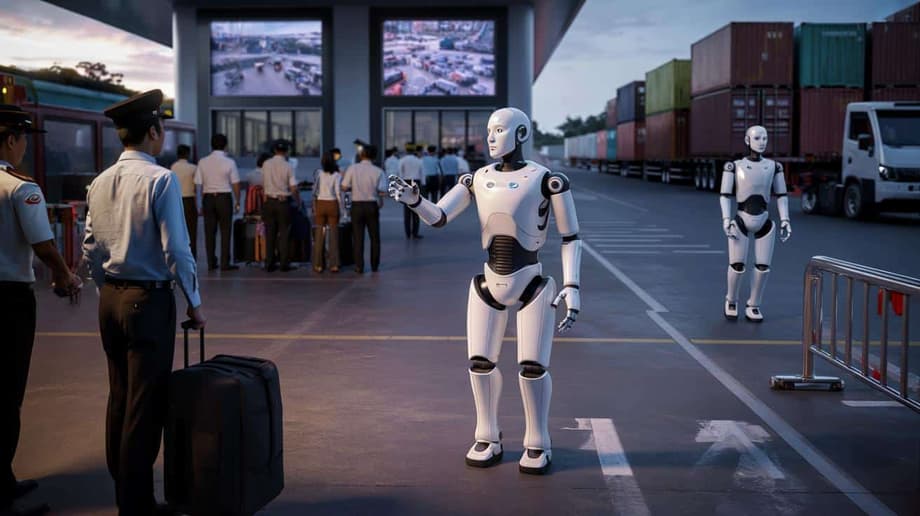
A New Guard on the Frontier
On a humid stretch of the China-Vietnam border, a new kind of border guard has reported for duty. The coastal city of Fangchenggang, typically known for long queues of trucks and impatient tourists, has quietly become a real-world laboratory for humanoid robotics. Beijing has approved a deployment worth approximately 264 million yuan (US$37 million) to place Ubtech’s Walker S2 machines at one of the country’s busiest land crossings. The goal is to unclog traffic and sharpen security simultaneously.
This initiative represents one of the largest real-world rollouts of humanoid systems in government operations to date. Instead of the fixed gates or kiosks found at most modern borders, authorities are introducing bipedal machines that can walk, talk, and interact directly with travellers. The project serves as a high-profile experiment for China’s broader strategy to integrate artificial intelligence and robotics into critical public infrastructure.
Why This Border Matters
Fangchenggang sits in the Guangxi region, directly adjacent to Vietnam, along a route buzzing with freight trucks, cross-border buses, and day-trippers. Customs officers at this location face a dual challenge: managing heavy trade flows while meeting rising expectations for faster, smoother crossings. The sheer volume of people and cargo creates congestion that can stifle trade and frustrate travellers.
Authorities deal with long queues, repetitive questions from travellers, and constant pressure to inspect both people and cargo without slowing down commerce. By turning this congested border gate into a live proving ground for AI-driven humanoid assistants, China aims to solve a logistical problem using advanced automation. If successful, the model could be replicated at other busy entry points across the nation.
The Walker S2: Anatomy of a Machine
The stars of this deployment are the Walker S2 robots, industrial-grade humanoids designed for continuous operation. Standing roughly 1.76 metres tall and weighing about 70 kilograms, these machines are roughly the size of an average adult. They possess a highly articulated body with 52 degrees of freedom, including dexterous hands capable of manipulating objects with precision. The robots can carry loads of up to 15 kilograms per arm and feature high-torque joints that allow for deep squatting and stooping.
One of the most critical technical features of the Walker S2 is its autonomous hot-swappable dual-battery system. The robot can replace its own depleted battery with a fully charged one in approximately three minutes. This capability allows for nearly 24-hour operation without manual intervention, a crucial requirement for border security where downtime is not an option. The system integrates Ubtech’s BrainNet 2.0 and Co-Agent AI frameworks, which combine multimodal reasoning and task planning to navigate complex environments.
For perception, the Walker S2 uses a pure RGB binocular stereo vision system that provides human-like depth perception. This allows the robot to adapt to dense and dynamic environments, such as a crowded border crossing, while advanced dynamic balancing algorithms help it maintain stability even when carrying heavy loads or moving at speeds up to 7.2 km/h.
Operational Duties and Human Collaboration
At the checkpoint, the robots are not replacing human border guards but are rather slotted into repetitive and highly visible tasks. Their duties include guiding passengers into the correct queues, answering simple questions about forms and procedures, and giving loudspeaker-style instructions in waiting halls. In the freight zones, the robots patrol between parked trucks and container stacks, scanning containers and relaying data to human command centres.
By handling these operational chores, the idea is that human agents can focus on higher-risk checks, complex paperwork, and intelligence work. At Fangchenggang, the humanoids act as traffic marshals, tour guides, and mobile CCTV towers rolled into one. Beyond immigration duties, some units will conduct inspections at manufacturing sites for steel, copper, and aluminium, walking predefined routes through high-temperature industrial sites.
The Power of Continuous Operation
The ability to function continuously shifts the operational model of border security. Traditional border posts require shifts of human staff, necessitating breaks, handovers, and rest periods. A robot that manages its own energy can remain in service for extended periods, which is vital in locations where constant vigilance is required.
This continuous operation is made possible by the self-charging mechanism. The robot simply needs access to a charging station to swap its battery pack, a process that takes mere minutes. This feature transitions the workload from constant supervision to planned maintenance. For the border authorities, this means coverage does not dip during shift changes or meal breaks, theoretically providing a more consistent security presence.
A National Strategy Unfolding
The deployment in Fangchenggang is not an isolated event but part of a much larger national strategy. China’s Ministry of Industry and Information Technology has called for a national innovation system around humanoid robots by 2025. The sector has received strong policy backing, and agencies across multiple provinces have begun incorporating robots into routine work.
Ubtech reports that cumulative orders for the Walker series have reached 1.1 billion yuan since shipments began. The company aims to deliver 500 industrial humanoid robots by the end of the year and increase production tenfold next year, with a long-term target of 10,000 units annually by 2027. Similar deployments have already appeared in airports, government offices, and at major events, such as the Shanghai Cooperation Organisation Summit where immigration authorities used multilingual robots.
Technical Realities and Global Skepticism
While the deployment has been hailed as a step forward by domestic proponents, experts outside China offer a more cautious perspective. Many researchers agree that while there has been a step change in humanoid capability over the past five years, the technology remains in an early stage. Esyin Chew, a roboticist at Cardiff Metropolitan University, notes that while robots can perform one or two things autonomously, they cannot yet react to real-world problems like human brains.
Technical limitations remain a significant obstacle. Reports from technology exhibitions highlight that bipedal robotics are nowhere near as capable as companies promise they will be. Robots often fail to perform autonomously, stumbling or requiring remote assistance to complete tasks. When a Walker S2 fails while working autonomously, a backup remote operator often takes over to complete the task, using the opportunity to gather data for future iterations.
There are also practical concerns regarding the maintenance of expensive hardware in humid and dusty environments. Battery life, charging logistics, and spare parts present non-trivial issues. A queue held up because the robot in charge needs maintenance or a recharge would defeat the purpose of the deployment. Furthermore, the integration of automation raises questions about privacy and data collection, as these machines act as mobile surveillance nodes.
Dismiss concerns over China’s reported deployment of humanoid robots along its borders, Lieutenant General Sukriti Singh Dahiya has stated, emphasizing that “the man behind the machine matters.” He explained that the effectiveness of any technology depends on the human operator guiding it, and the focus should remain on the human element rather than the machines themselves.
From a geopolitical standpoint, while the deployment showcases technological advancement, military observers from neighboring countries like India view it as a natural evolution of border management rather than a game-changer. The consensus is that technology is only as effective as the strategy and personnel supporting it.
The Future of Embodied AI
If the Fangchenggang test is judged a success, Chinese planners have a long list of candidate sites. Other Vietnam border crossings, the busy border with Laos, inland logistics hubs, and major city airports and metro stations are all potential locations. Humanoid robots could eventually manage passenger flows before security at Beijing or Shanghai airports, or roam platforms in megacity metro networks to answer questions and flag suspicious objects.
The Fangchenggang project serves as a template for how China might roll humanoids into everyday public infrastructure. It also illustrates how AI and robotics can shift public expectations. Once travellers get used to asking a robot for help at the border, they may come to expect a similar level of automated assistance in other parts of public life. The experiment on the Vietnam border is about more than just traffic flow; it is a test of how society interacts with and accepts embodied artificial intelligence.
Key Points
- China has deployed Ubtech’s Walker S2 humanoid robots at the Fangchenggang border crossing with Vietnam as part of a US$37 million contract.
- The robots are designed to handle tasks such as guiding travellers, managing queues, patrolling, and inspecting containers to improve efficiency and security.
- The Walker S2 features autonomous battery swapping, allowing it to operate continuously with just three minutes of downtime for power changes.
- This deployment is part of China’s broader national strategy to integrate robotics into critical infrastructure and public services.
- Experts remain cautious about the current capabilities of humanoid robots, citing technical limitations and the need for human oversight.
- Ubtech aims to scale production significantly, targeting 10,000 units annually by 2027.