A Paintbrush Against Time
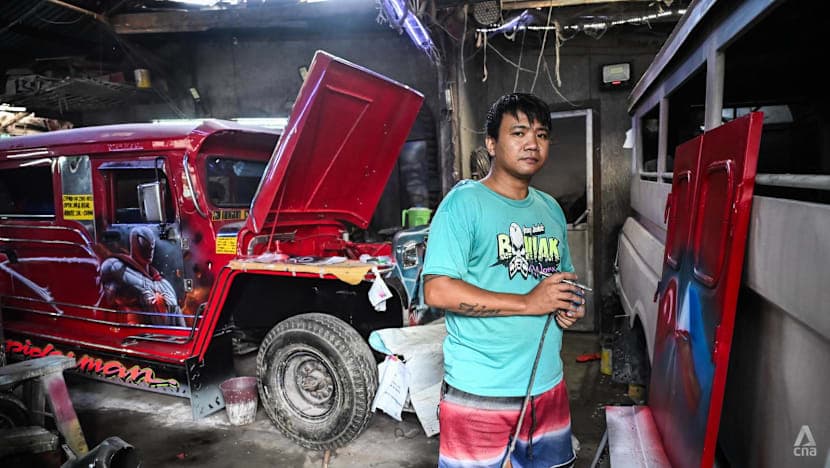
In the heart of Metro Manila, Kenneth Bon Salonga’s garage stands as a testament to a dying craft. Spare parts hang from the ceiling wrapped in cobwebs, creating an atmosphere that feels like part workshop, part laboratory. The 38-year-old artist squats between two deconstructed jeepneys, his hands lacquered in deep red paint as he applies detailed lines to a side window panel. This panel will soon become part of a frieze dedicated to Spiderman, joining countless other designs that have made Philippine jeepneys rolling works of art for decades.
Salonga has spent more than 20 years transforming ordinary metal vehicles into vibrant expressions of Filipino culture. His work is part of a tradition that has defined Philippine streets since the aftermath of World War II. But as the government pushes forward with its ambitious transport modernization agenda, this distinctive art form faces an uncertain future.
“When I first heard about jeepney modernisation, of course I felt sad. We would lose our jobs, because we would no longer be allowed to design modern units,” Salonga explained. “You are not allowed to touch them, whatever the design of the minibus is, that’s already fixed. It’s really sad because, imagine, I grew up with that. Every day you see the jeepneys pass by. When I was young I was really obsessed with jeepneys.”
“It was a symbol of resilience. It was something that was born out of necessity, out of materials that were totally discarded.” — Jose Victor Torres, historian and professor at De La Salle University-Manila
The story of the jeepney begins in the Philippines’ post-war period, when American military left behind thousands of Willys Jeeps. Resourceful Filipinos repurposed these vehicles, extending their bodies and adding rear benches to create a new form of public transport. These modified vehicles became known as jeepneys, a name derived from combining “jeep” with “knee,” reflecting the cramped seating where passengers’ knees often touched.
Jose Victor Torres, a historian and professor at De La Salle University-Manila, explained that jeepneys represent something deeper than mere transportation. He described them as “a Frankenstein’s monster of different parts and pieces” that demonstrates Filipino resourcefulness. Torres noted that these vehicles emerged from discarded materials that Filipinos transformed into something useful and distinctly their own.
The move toward personalized jeepney art accelerated significantly in the 1980s, when overseas Filipino workers began investing in jeepneys and decorating them as visible markers of their hard-earned success. What started as practical transport evolved into moving canvases that reflected social trends, political movements, and daily Filipino life.
Jeepney artists mostly work informally, so their numbers remain undocumented in official labor or business registries. However, community knowledge suggests that while hundreds once practiced this craft, only a handful remain today. These freelancers typically earn between US$250-340 per month, though a full custom job—increasingly rare—can pay approximately US$5,000 and take two months to complete. Many artists hold second jobs as auto mechanics or graphic designers to supplement their income.
The art itself often follows themes that reflect Filipino values and aspirations. Bru Sim, a graphic artist and author of “Jeepney Biyaheng Langit,” which documents religious imagery in jeepneys, described the eclectic nature of these designs.
“You see it from the jeepney imagery, where there’s a graduation photo of a child or a baby photo next to Papa Jesus, next to Pokemon, next to Lord of the Rings, next to gaming monsters. So it’s really a mixed bag.” — Bru Sim, graphic artist and author
Sim explained that these seemingly chaotic combinations actually reveal much about Filipino identity. “We’re not just tacky. We’re also religious. We’re serious, but we’re also funny. Family is very important to us. The Filipino identity is really in flux, based on the jeep.”
Academic research supports this view. A study published on ResearchGate analyzing the cultural significance of jeepney decorations found that these visual elements serve as powerful symbols that reflect and shape Filipino identities. Through semiotic analysis, researchers identified several recurring themes: love and sex, driving speed, economic success, religion, and family. These motifs are not merely decorative but communicate complex cultural messages as the vehicles traverse the country’s streets.
Religious imagery appears frequently on jeepneys, with figures such as the Sacred Heart of Jesus, the Virgin Mary, and various saints adorning both exteriors and interiors. Bible verses are commonly inscribed on different vehicle parts, serving as sources of inspiration and protection for drivers and passengers alike. These decorations reflect the deep religious faith that permeates Philippine society, a heritage from Spanish colonization that remains visible in daily public life.
Economic aspirations often manifest through images of money, popular brand logos, and representations of successful individuals or high-status objects. In a country where economic stability remains elusive for many, these symbols represent hopes for financial success and upward mobility. Similarly, speed motifs—including chrome miniature wings, missiles, birds, and airplanes—reflect both the jeepney drivers’ self-concept as competent navigators of city traffic and broader societal desires for efficiency and progress.
The cultural significance extends beyond visual symbols to the very structure of jeepney travel. The jeepney’s interior design, with seats facing each other, encourages conversation and socialization among passengers from all walks of life. Unlike generic public transportation elsewhere, personalized jeepneys showcase Filipino sensibilities through artwork and text, expressing humor, aspirations, gratitude, and faith.
Perhaps most importantly, jeepneys operate on an honor system for fares. There are no turnstiles or conductors; instead, passengers pass their fares to the driver, often with the help of fellow riders. This system fosters a sense of community and “bayanihan”—the Filipino tradition of communal unity and cooperation—that persists even in the crowded streets of Manila.
The Modernization Mandate
In 2017, the Philippine government launched the Public Utility Vehicle Modernization Program (PUVMP), aiming to replace traditional jeepneys with safer, more comfortable, and environmentally-friendly alternatives. The program represents the most extensive transportation reform initiative in the country’s history and addresses long-standing concerns about pollution, safety, and efficiency in public transport.
Under the modernization program, traditional jeepneys older than 15 years would no longer be eligible for registration. Modern replacements must meet strict standards including compliant engines, GPS systems, and automated fare collection systems. The program also requires operators to consolidate into cooperatives or corporations with at least 15 vehicles, fundamentally changing the ownership structure from individual operators to fleet-based systems.
The environmental arguments for modernization are substantial. A 2016 study by the Manila Observatory found that diesel-fed jeepneys were responsible for 15 percent of particulate matter emissions in Metro Manila. With air pollution remaining a serious health concern in Philippine cities, replacing older, more polluting vehicles with cleaner alternatives addresses a genuine public health need.
Safety considerations also drive the modernization effort. Jeepneys are frequently involved in traffic crashes in cities like Metro Manila, with reports showing thousands of incidents yearly. Their open design, lack of modern safety features, and sometimes reckless driving practices contribute to accident rates that concern transportation officials.
The government’s preferred modern replacements are typically electric minibuses or purpose-built vehicles that meet Euro 4 emissions standards. These vehicles offer standardized safety features, reduced emissions, and improved passenger comfort. However, they also come with a significantly higher price tag—modern jeepneys cost between PHP2.4 million to PHP2.8 million (approximately US$43,000-50,000), a prohibitive amount for most individual operators.
Despite these environmental and safety benefits, implementation has proven challenging. The program has encountered significant resistance from jeepney operators and drivers who argue that the changes would benefit large corporations while ensuring the death of small businesses. Protests and strikes have repeatedly delayed full implementation, with deadlines extending multiple times since the program’s inception.
George San Mateo, a driver for almost three decades who heads the transport rights group Piston (Pinagkaisang Samahan ng mga Tsuper at Operator Nationwide), has been at the forefront of resistance efforts. While he emphasizes that his group is not anti-development, he criticizes the modernization program as “anti-poor and profit-oriented.”
“Piston has no problem with modernization because we consider ourselves progressive. We are progressive, so we are not anti-development. But the problem with the modernization program… it is anti-poor and profit-oriented.” — George San Mateo, transport rights group Piston
The resistance stems from genuine economic concerns. The average jeepney driver earns around PHP500-600 (US$9-11) per day, barely enough to support a family. The high cost of modern units, even with government assistance programs, threatens to displace thousands of drivers who cannot afford the transition. This has created a stark divide between the government’s modernization goals and the economic realities facing transport workers.
The Human Cost of Transition
The modernization program’s impacts extend beyond vehicle aesthetics to affect livelihoods across the transportation ecosystem. For artists like Salonga, the transition means the end of a profession that has supported families for generations. The newer replacement models typically form parts of company fleets with uniform designs that leave no room for the splashy, personalized artistry that defined traditional jeepneys.
As jeepneys disappear from cities, many have resurfaced in the provinces, shifting pollution, safety risks, and aging infrastructure away from urban centers. This transition has made cities cleaner and more regulated while rural areas increasingly rely on older vehicles displaced from the capital. Critics argue that rather than eliminating the problems associated with jeepneys, modernization has often moved them out of sight.
The economic implications are equally concerning. A study examining the Jeepney Modernization Program in Cebu City found that implementation has encountered significant challenges, including the financial capacity of jeepney operators to purchase new vehicles, lack of adequate support from government agencies, and resistance from transport groups who fear job losses and reduced income.
Research focusing on jeepney drivers’ resilience highlights how these workers cope with income instability and the threat of job loss. The study emphasizes the need for practical solutions, better government support, and recognition of locally made jeepneys to ensure economic stability for drivers facing challenges from the modernization program.
Felomino Cruz Jr., a 75-year-old jeepney designer who has long wielded a paint gun, offers a different perspective. Unlike younger artists who mourn the passing of their craft, Cruz says he is ready for jeepneys to be replaced.
“I am in favour of modernisation. Because of the noise of the exhaust, the noise of the engine, the noise of the conductor, sometimes there are even drivers who are drug addicts. And their style is to turn the vehicles into racing cars. Jeeps have become extreme.” — Felomino Cruz Jr., 75-year-old jeepney designer
This division within the community reflects the complex trade-offs involved in modernization. While the art and cultural expression associated with jeepneys are undoubtedly valuable, so are reduced pollution, improved safety, and more efficient transportation for millions of Filipinos who rely on public transport daily.
The stakes extend beyond individual livelihoods. Jeepneys are estimated to ferry 40 million person trips per day across the country, with capacity to seat around 20 passengers on rear twin benches. They play a crucial role in solving the “last-mile” connectivity problem, connecting residential areas to major transport hubs. Disrupting this system without adequate alternatives could create significant mobility challenges for the urban poor.
New Horizons in Electric Mobility
As the modernization debate continues, technological developments offer potential middle ground solutions. In July 2025, South Luzon’s first electric vehicle assembly plant began operations in the LIMA Industrial Estate, located at the border of Lipa City and Malvar Town in Batangas. The LCS-EMON e-Jeepney Manufacturing Corp. facility represents both a milestone and a crucial development for the Philippines’ Public Utility Vehicle Modernization Program.
Luis “Chavit” Singson, chief executive of LCS-EMON, has positioned his venture as a way to revitalize the local transport industry while preserving the iconic jeepney aesthetic. His e-jeepneys are designed to maintain the traditional jeepney look while incorporating modern electric powertrain technology. Perhaps most importantly, the target price of PHP1.2 million (approximately US$21,300) per unit significantly undercuts other modern options, potentially making the transition more accessible to traditional operators.
“It must carry the iconic jeepney look, which is considered a cultural heritage.” — Luis “Chavit” Singson, CEO of LCS-EMON e-Jeepney Manufacturing
When the design was presented online, some critics deemed it “backward” with a “that’s good enough” mindset. However, many jeepney operators and cooperatives agreed with the approach of preserving cultural heritage while meeting modernization requirements. The e-J01 prototype electric jeepney boasts a range of 100 kilometers per full charge, can seat 22 passengers with six more standing, and is equipped with air-conditioning—a significant upgrade from the open-air traditional models.
Another local manufacturer, Francisco Motors, has also developed a fully electric modern jeepney dubbed the “Francisco Jeepney” that retains the traditional look while priced at PHP985,000 each for the first 1,000 units. The owner noted that replacing iconic jeepneys with mini-buses from other countries is “like removing a piece of our identity.”
These developments suggest that technological innovation and cultural preservation need not be mutually exclusive. Electric jeepneys that maintain traditional aesthetics while meeting modern environmental standards could offer a path forward that addresses both practical needs and cultural concerns.
Political and Social Responses
The cultural dimension of the jeepney phaseout has gained increasing attention from political leaders and cultural institutions. Senator Grace Poe, chair of the Senate committee on public services, has advocated for preserving traditional jeepney designs within the modernization framework.
“Let us allow our iconic jeepney designs to be used as long as they can keep up with the safety requirements… you can tweak the designs of these jeepneys to make it safer and more convenient for the public,” Poe said in a radio interview. She suggested involving artists as consultants to help maintain cultural character in modern vehicles, noting that other countries’ public transportation features their nations’ cultural trademarks.
Poe criticized the proposed design for modern jeepneys as “ugly and lacking character.” She asked, “Aren’t they ugly? They look like boxes, which I couldn’t understand. It lacks character. The designs do not have soul.” Her comments reflect broader concerns that standardization will strip Philippine public transport of its unique cultural identity.
An opinion piece in Rappler framed the jeepney phaseout not merely as a transportation issue but as one that encompasses livelihood, environment, safety, culture, and social justice. The author noted that the cultural significance of jeepneys is often overlooked due to limited understanding of culture as something dynamic rather than static tradition.
The article highlighted how jeepneys foster community through their honor system for fares and design that encourages socialization. It questioned whether the desire to banish jeepneys stems from powerful figures who may not embody such honor, suggesting deeper class tensions underlying the modernization debate.
In early 2025, the Department of Transportation signaled openness to modifying the modernization program to address concerns from transport groups. Transportation Secretary Vivencio B. Dizon stated, “We are open to changes… Clearly, there are some issues that need to be resolved. It is important for us to identify these problems first and then we will address these.” This flexibility could create opportunities for incorporating cultural preservation into modernization efforts.
BusinessMirror’s analysis of jeepney modernization pros and cons noted that while vehicle dealers, manufacturers, and financiers would benefit from the replacement market, the program poses significant challenges for drivers. The high cost of modern units remains the most significant barrier, with many drivers expressing that they have no objections to modernization in principle but cannot overlook the financial constraints.
Finding Balance Between Progress and Preservation
The debate over jeepney modernization ultimately raises questions about how societies balance development with cultural preservation. The Philippine experience offers insights relevant to other countries facing similar transitions in traditional transportation systems.
Academic research on jeepney art and symbolism emphasizes that these vehicles do more than transport people—they actively shape cultural narratives and social norms. The constant movement of decorated jeepneys through urban spaces allows them to encounter diverse sociocultural contexts, influencing perceptions and impacting social norms in different ways across various settings. This mobility amplifies the power of these symbols, making them a pervasive aspect of the Filipino visual landscape.
The potential loss of these symbols due to modernization may alter existing sociocultural dynamics and lead to the homogenization of public spaces. However, researchers suggest that progress need not inevitably lead to the erasure of cultural identity. Future modernization efforts in the Philippines could thoughtfully consider preserving cultural heritage by incorporating traditional jeepney art into the design of new vehicles.
Sim, the graphic artist and author, offers a nuanced perspective on the transition. “It’s just one aspect of Filipino art. There are other ways to express it,” she said. “Traditionally and culturally, everything is in flux. Filipino identity is in its people. And we’re always evolving.” She believes the art and creativity will live on in other forms, even if jeepneys disappear from city streets.
The experience of the COVID-19 pandemic, which temporarily halted the modernization program, demonstrated both the resilience of traditional jeepney operators and the importance of these vehicles in daily life. As the government resumed its push for modernization in 2023, the need for a balanced approach became increasingly apparent.
Potential solutions emerging from the debate include establishing systems that allow drivers or operators to personalize a portion of their vehicles, providing a canvas for individual expression similar to traditional jeepneys. Others have suggested developing national databases or museums dedicated to preserving and displaying jeepney art, ensuring that future generations can appreciate this cultural richness even as the country modernizes.
As the Philippines continues its journey toward sustainable public transportation, the jeepney remains a powerful symbol of the nation’s cultural dynamism, embodying its people’s complex narratives and values. The challenge lies in carrying these cultural narratives forward while embracing necessary improvements in safety, environmental performance, and efficiency.
The story of Kenneth Bon Salonga and other jeepney artists reflects a broader tension playing out across the developing world—how to modernize without losing the distinctive cultural expressions that make communities unique. As paintbrushes face off against policy mandates, the outcome will determine not just the future of Philippine public transport, but also how the nation balances progress with preservation.
The Essentials
- Jeepneys originated from surplus US military jeeps after World War II, becoming uniquely Filipino public transport vehicles decorated with vibrant art
- The Public Utility Vehicle Modernization Program (PUVMP), launched in 2017, aims to replace traditional jeepneys with safer, more environmentally-friendly alternatives
- Jeepney artists, who create distinctive designs reflecting Filipino culture, religion, family values, and aspirations, face unemployment as modern vehicles prohibit custom artwork
- Traditional jeepneys serve approximately 40 million passenger trips daily and provide crucial last-mile connectivity in Philippine cities
- Modern jeepneys cost between PHP2.4-2.8 million (US$43,000-50,000), putting them out of reach for most individual operators who earn roughly PHP500-600 (US$9-11) daily
- New electric jeepney models from local manufacturers like LCS-EMON and Francisco Motors aim to preserve traditional aesthetics while meeting modernization standards at lower costs
- The debate over modernization involves trade-offs between environmental and safety improvements versus cultural preservation and livelihood protection
- Senator Grace Poe and cultural advocates have called for preserving traditional jeepney designs within the modernization framework to maintain cultural identity