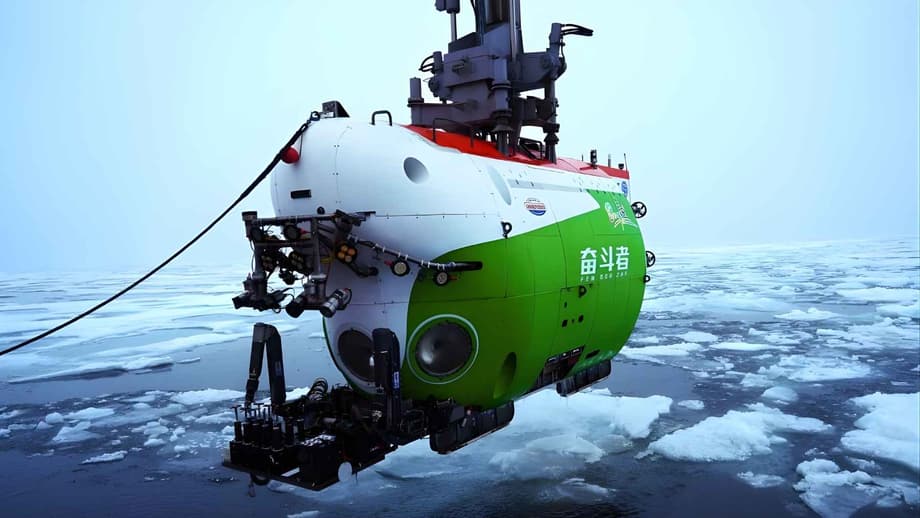
A Historic First in Polar Exploration
Scientists aboard the Chinese submersible Fendouzhe have accomplished what many considered impossible, diving more than five kilometers beneath thick Arctic pack ice to explore a previously untouched section of the Gakkel Ridge. This underwater volcanic mountain chain stretches between Greenland and Siberia, forming part of the global mid-ocean ridge system where tectonic plates slowly separate and new ocean crust forms. The expedition reached a maximum depth of 5,277 meters, marking the first time humans have directly observed this remote and geologically significant region.
- A Historic First in Polar Exploration
- Navigating the Challenges of Arctic Ice
- Advanced Technology for Extreme Environments
- The Geological Significance of Gakkel Ridge
- Hunting for Life in Extreme Environments
- Climate Connections in the Deep Arctic
- China’s Growing Polar Ambitions
- The Long Road of Scientific Discovery
- Key Points
The mission, conducted from the research vessel Tan Suo San Hao, completed 43 dives during a roughly three-month voyage that pushed the boundaries of polar exploration. The Gakkel Ridge has long fascinated scientists because it spreads at an exceptionally slow rate, creating unique geological and biological conditions that could reshape our understanding of how life survives in extreme environments. Xiaoxia Huang, a marine geophysicist at the Institute of Deep-sea Science and Engineering and the expedition’s chief scientist, described the eastern section of the ridge as the last piece of the puzzle in Arctic geological research.
“It’s really a privilege to have such an opportunity to study the deep sea in person,” said Huang, reflecting on the unprecedented nature of the mission.
While previous expeditions had surveyed parts of the ridge using sonar and uncrewed vehicles, no human-occupied submersible had ever reached the eastern Gakkel Ridge. A 2003 Nature study had revealed hydrothermal vents on the western side, but the eastern sector remained completely unexplored until now. The success of this mission opens a rare window on one of Earth’s last untouched seafloors, potentially revealing unusual deep-sea life and new insights into how the rapidly warming Arctic is changing.
Navigating the Challenges of Arctic Ice
Operating a manned submersible beneath Arctic pack ice presents extraordinary challenges that require innovative solutions. The expedition team developed a pioneering “ship-submersible coordination” method that enabled operations in waters where sea ice covered more than 80 percent of the surface. In such conditions, a submersible cannot simply surface anywhere. If it returns to the surface directly beneath thick ice, the occupants could become trapped with no way to exit or receive emergency support.
Before each dive, the icebreaking research vessel Tan Suo San Hao had to create a temporary opening in the pack ice, essentially carving a pool in the frozen ocean where the submersible could enter and exit safely. This process required careful coordination and timing, as the ice constantly shifts and moves with ocean currents and winds. The team spent 56 days operating in the Arctic Ocean, navigating nearly 2,000 nautical miles through ice-covered waters to reach their target areas.
The return journey from the depths proved particularly challenging. After completing their work on the seafloor, Fendouzhe would pause below the surface and use sonar and cameras to scan for open water or thinner ice that might allow safe surfacing. In some cases, the submersible had to wait while the support vessel cleared a path through the ice. This delicate dance between icebreaker and submersible represents a significant technical achievement in polar exploration.
Christopher German, a marine geochemist at the Woods Hole Oceanographic Institution who was not involved in the mission, emphasized the significance of reaching such a remote location.
“It’s so hard to get there that anything anybody does is almost guaranteed to be exciting and different and new,” German said.
Advanced Technology for Extreme Environments
The Fendouzhe submersible, whose name translates to “Striver,” is a remarkable piece of engineering designed specifically for extreme deep-sea exploration. Built in China, it can reach depths of at least 7,000 meters and has previously proven its capabilities by descending to 10,909 meters at the Challenger Deep in the Mariana Trench, the deepest known point in Earth’s oceans. For this Arctic mission, the submersible was adapted to operate in near-freezing temperatures and under the constant threat of shifting sea ice.
The research vessel Tan Suo San Hao represents another technological milestone. China describes it as the world’s first comprehensive scientific research ship designed specifically for global deep-sea exploration with ice-breaking capabilities. This combination of icebreaker and deep-sea support vessel allows for year-round operations in polar regions that were previously accessible only during brief summer windows when ice coverage was minimal.
Elmar Albers, a marine geoscientist at the Alfred Wegener Institute in Germany, noted that the technical achievements of the expedition extend beyond simple transportation.
“The Chinese mission is poised to yield significant new insights into Earth’s most extreme underwater habitats,” Albers said.
The expedition also featured China’s first joint underwater operation between two manned submersibles. The Fendouzhe worked alongside the Jiaolong submersible, with the two vehicles coordinating on positioning, marker exchanges, and underwater filming. This dual-submersible approach allows for more comprehensive surveys and provides redundancy for safety. Jiaolong also completed China’s first manned dive beneath Arctic ice during the mission, demonstrating the country’s growing capabilities in polar deep-sea operations.
The Geological Significance of Gakkel Ridge
The Gakkel Ridge holds special importance for geologists because it represents one of the most extreme examples of ultra-slow spreading mid-ocean ridges. While most mid-ocean ridges spread at rates of several centimeters per year, the Gakkel Ridge spreads so slowly that new crust forms at a pace slower than human fingernails grow. This exceptionally slow spreading rate creates unique geological formations and may influence the types of hydrothermal systems that develop along the ridge.
As part of the global mid-ocean ridge system, the Gakkel Ridge plays a crucial role in plate tectonics and the cycling of elements between Earth’s interior and surface. The ridge forms where the North American Plate and the Eurasian Plate pull apart, allowing magma to rise and create new oceanic crust. Understanding this process helps scientists model everything from volcanic activity to the evolution of ocean basins over geological time.
The expedition team targeted geologically interesting areas including seamounts, cliff faces, and undersea hills and canyons. They used cameras and sonar to replace the blurred outlines on earlier maps with detailed footage of the actual seafloor. These high-resolution images will help researchers understand the structure and formation of this unusual ridge system.
One of the primary scientific objectives was determining whether hydrothermal vents exist on the eastern Gakkel Ridge. These underwater hot springs form when seawater circulates through newly formed volcanic rock, becomes heated by underlying magma, and erupts back into the ocean carrying dissolved minerals. The vents on the western Gakkel Ridge, discovered in 2003, revealed communities of unusual organisms that thrive in complete darkness using chemical energy rather than sunlight.
Hunting for Life in Extreme Environments
The search for hydrothermal vents on the eastern Gakkel Ridge goes beyond simple scientific curiosity. These vent systems host unique ecosystems that could provide clues about how life might exist on other worlds. Organisms around hydrothermal vents derive energy from chemical reactions involving minerals like hydrogen sulfide, completely independent of sunlight. This type of metabolism mirrors what scientists suspect might exist beneath the icy shells of moons like Europa, which orbits Jupiter, and Enceladus, which orbits Saturn.
During nearly one hundred days at sea, the expedition team collected sediment cores, rocks, seawater samples, and biological specimens from along the ridge. These samples now await detailed analysis in laboratories, where scientists will search for chemical signatures of hydrothermal activity and evidence of unique organisms adapted to extreme conditions. Huang and her team remained tight-lipped about whether they found active vent systems, suggesting that definitive answers will require months of careful laboratory work.
The biological samples collected during the mission could reveal new species or unusual adaptations to life in deep, cold, and dark environments. The team observed various fish and deep-sea species living in what Huang described as the dark, the cold, the pressure and the rocks. These organisms have evolved remarkable strategies for survival in one of Earth’s most inhospitable environments, and understanding them could advance fields ranging from medicine to biotechnology.
The study of life in extreme environments, known as astrobiology, draws direct connections between deep-sea exploration and the search for extraterrestrial life. If organisms can thrive around hydrothermal vents in the Arctic Ocean, similar life forms might exist in subsurface oceans on icy moons throughout our solar system. The samples from the Gakkel Ridge could help refine models of what such alien ecosystems might look like.
Climate Connections in the Deep Arctic
While the mission took place thousands of meters beneath the surface and far from human civilization, its findings have direct relevance to climate change and its impacts on human societies. The Arctic is warming at a rate two to three times faster than the global average, with profound implications for weather patterns, sea levels, and ecosystems around the world. What happens along the Arctic seafloor feeds into the same climate system that shapes bitter cold snaps or unusually mild winters experienced in temperate regions.
Mid-ocean ridges like the Gakkel Ridge play a critical role in moving heat and chemicals through the deep ocean. As water circulates through the ocean crust near these ridges, it exchanges heat and minerals with the surrounding environment. This process affects ocean chemistry and circulation patterns that, in turn, influence global climate. Detailed data from the Gakkel Ridge can help scientists refine climate models that guide long-term planning for coastal communities, infrastructure development, and disaster preparedness.
The Arctic region also serves as a sentinel for global climate change. Changes in ocean temperature, chemistry, and ecosystems in the Arctic often signal broader shifts that will eventually affect other regions. By establishing baseline data on the deep Arctic environment now, scientists create a reference point against which future changes can be measured. This information is essential for understanding how the entire Earth system responds to continued warming.
The expedition team collected extensive observational data that will support research on rapid Arctic climate change. This includes information about water temperatures, salinity, chemical composition, and biological communities throughout the water column. Such data helps scientists understand how the Arctic Ocean is changing and how these changes might cascade through the global climate system.
China’s Growing Polar Ambitions
This mission represents more than just a scientific achievement. It also highlights China’s rapidly expanding capabilities in polar research and its growing presence in the Arctic region. China describes itself as a “near-Arctic state” and has steadily increased its polar activities over the past decade, sending icebreakers, research vessels, and unmanned submersibles to the region. Beijing frames its Arctic efforts as part of a “peaceful scientific development” strategy focused on climate research, marine biodiversity studies, and the mapping of undersea resources.
The technological capabilities demonstrated during this expedition, including deep-diving operations under thick ice and advanced icebreaking support vessels, have strategic implications. The Arctic is becoming increasingly accessible as climate change reduces ice coverage, opening new shipping routes and exposing potential resources. China’s growing technical proficiency in the region positions it to participate in future development opportunities and emerging Arctic trade lanes.
During this past summer, China dispatched five research ships, including an icebreaker, into the Arctic. This substantial presence underscores the country’s commitment to polar research and its desire to establish itself as a major player in Arctic affairs. The successful completion of 43 manned dives in ice-covered waters makes China the only country currently capable of conducting continuous manned deep-diving operations in the heavily ice-covered Arctic Ocean.
According to the Chinese Ministry of Natural Resources, the expedition validated the operational capabilities of both Fendouzhe and Tan Suo San Hao in polar ice zones. The mission established operational protocols for extreme polar conditions and pioneered a mobile ice-diving model that could expand future exploration possibilities. China’s leadership in this field could influence international discussions about Arctic governance, research collaboration, and environmental protection.
The Long Road of Scientific Discovery
While the expedition itself has concluded, the scientific work is just beginning. The raw samples and video footage collected during the mission will likely require years of detailed analysis before their full significance becomes clear. Rocks will be examined for their mineral composition and age, sediment cores will be analyzed for chemical and biological markers, and biological specimens will be studied to determine their relationships to other known species.
Scientists will pay particular attention to any evidence of hydrothermal vent activity on the eastern Gakkel Ridge. The presence of certain minerals, unusual water chemistry, or specific biological communities could indicate that active vents exist in the area. Such a discovery would not only complete the picture of the Gakkel Ridge but also provide new insights into how life spreads and evolves in deep-sea environments.
The geological data collected during the mission will help researchers understand how ultra-slow spreading ridges differ from their faster-spreading counterparts. This information could refine models of plate tectonics and improve our understanding of how Earth’s crust forms and evolves. The detailed mapping of undersea features will also provide a foundation for future research in the region.
As scientists analyze the data and samples from this historic mission, new questions will inevitably arise. Each discovery tends to reveal new mysteries, driving further exploration and research. The eastern Gakkel Ridge, once hidden beneath ice and unknown to science, has now become part of the scientific map. Its secrets may slowly change how we think about Earth’s deep ocean and the changing Arctic above it.
Key Points
- Chinese submersible Fendouzhe completed 43 dives during a 98-day Arctic expedition, reaching a maximum depth of 5,277 meters.
- Mission conducted first manned exploration of eastern Gakkel Ridge, an underwater volcanic chain between Greenland and Siberia.
- Expedition pioneered “ship-submersible coordination” method allowing operations in waters with 80 percent ice coverage.
- China became first country to conduct continuous manned deep-sea dives in heavily ice-covered Arctic Ocean.
- Team collected sediment cores, rocks, seawater, and biological samples from previously untouched depths.
- Mission included first joint underwater operation between two Chinese manned submersibles, Fendouzhe and Jiaolong.
- Research may reveal hydrothermal vents and unique ecosystems relevant to astrobiology and climate science.
- Expedition demonstrates China’s growing technical capabilities and presence in polar research.
- Samples and data will require years of analysis to fully understand their scientific significance.