A Historic Demand for Capital Punishment
In a somber courtroom in Seoul, South Korean prosecutors have requested the ultimate punishment for former President Yoon Suk Yeol. The special counsel team formally asked the court to impose the death penalty, arguing that Yoon was the ringleader of an insurrection stemming from his declaration of martial law in December 2024. This request marks a rare and dramatic moment in the nation’s modern political history, placing the former leader at the center of the country’s most serious legal crisis in decades.
The closing arguments at the Seoul Central District Court painted a stark picture of a head of state accused of attempting to subvert the very democracy he was sworn to protect. Prosecutors described Yoon’s actions not as a political misstep, but as a calculated bid to seize control of the judiciary and the legislature to maintain his grip on power. The court heard that Yoon had no legal grounds for his declaration and that his orders to mobilize the military constituted a direct attack on the constitutional order.
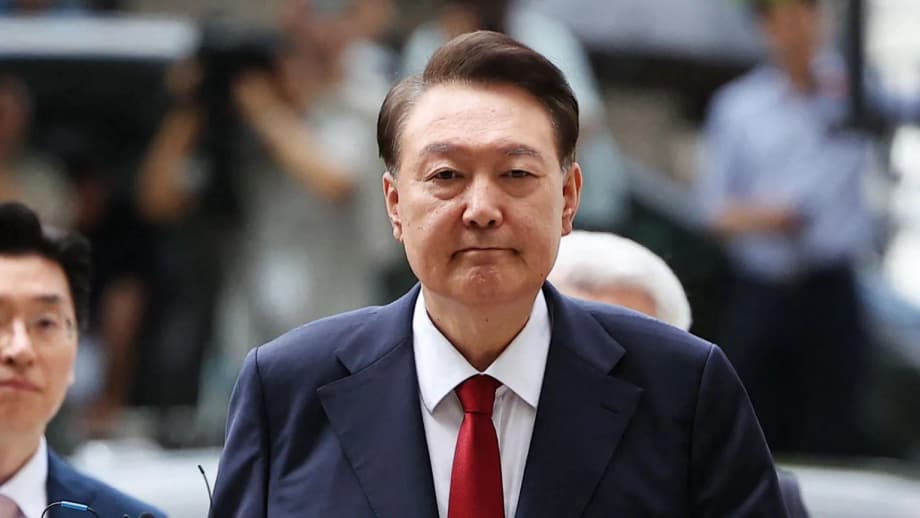
Yoon sat in the dock as the sentence request was read aloud, showing little visible reaction beyond a faint smile, while some of his supporters in the gallery reacted with angry outbursts. The former president has steadfastly denied the charges, insisting that his declaration of martial law was within his constitutional powers and was intended as a warning to his political opponents rather than a coup. Despite his denials, the prosecution argued that the gravity of the offense demands the severest penalty available under the law.
South Korea has not executed anyone since 1997, effectively making the country an abolitionist state in practice in the eyes of international human rights organizations. However, the charge of leading an insurrection carries only three possible sentences under South Korean law: death, life imprisonment with labor, or life imprisonment without labor. With prosecutors opting to seek capital punishment, they have signaled their view that the former president’s actions warrant the most severe condemnation possible.
The Night of Chaos and Confusion
The events that brought the country to this point began on the night of December 3, 2024. In a televised address that shocked the nation and the international community, Yoon abruptly declared emergency martial law. He claimed the drastic measure was necessary to protect the country from North Korean communist forces and to root out “anti state” elements that he claimed were paralyzing the government.
The declaration immediately plunged South Korea into political turmoil. Military units were mobilized and dispatched to key locations in Seoul, including the National Assembly. Soldiers surrounded the parliament building, attempting to block lawmakers from entering to vote on the decree. Outside the assembly, citizens gathered in protest, physically blocking military vehicles and clashing with special operations forces in scenes that evoked painful memories of the country’s authoritarian past.
Military Mobilization
Testimony during the trial revealed the extent of the military operation. Prosecutors presented evidence that Yoon had ordered the arrest of key political figures, including the speaker of the National Assembly and the leader of the opposition Democratic Party. Troops were also sent to raid the National Election Commission, an independent body, under orders to collect evidence of alleged voting fraud, a move prosecutors described as an attempt to undermine the country’s electoral integrity.
The crisis lasted only six hours. In a dramatic session, 190 lawmakers managed to break through military cordons to enter the parliamentary chamber. They unanimously voted to lift the martial law decree, forcing Yoon to back down. The swift rejection by parliament, coupled with massive public resistance, brought an end to the immediate crisis, but the legal and political fallout was just beginning.
Following the failed declaration, opposition lawmakers moved quickly to impeach Yoon. He was suspended from office and later formally removed by the Constitutional Court in April 2025. His downfall led to a snap election that brought his rival, Lee Jae Myung, to the presidency. Yet, even after his removal from office, Yoon continued to wield influence over a segment of the population, with right wing supporters viewing him as a martyr standing up to a liberal establishment.
The Prosecution’s Case for Insurrection
During the trial, prosecutors sought to establish that the martial law declaration was not a spontaneous reaction to a crisis but a premeditated plot to consolidate power. They told the court that evidence showed Yoon and his allies began planning the operation as early as October 2023. The goal, according to the prosecution, was to “monopolize power through long term rule” by strategically placing military personnel in key positions.
The prosecution highlighted the violence inherent in the plan, even if no one was killed during the implementation. They argued that Yoon’s intent was no less violent than past military coups because he authorized the use of force to achieve his political goals. A military commander testified that Yoon had explicitly ordered the arrest of lawmakers, directly contradicting Yoon’s claim that the deployment was merely to keep order.
Evidence of a Plan
Perhaps the most damning evidence presented was a memo attributed to one of the martial law planners. The document contained suggestions for “disposing” of hundreds of individuals, including journalists, labor activists, and lawmakers. Prosecutors also referenced plans to cut power and water to critical media outlets and to torture election officials into confessing to fabricated election fraud. This evidence was central to the argument that the declaration was a genuine attempt to dismantle the democratic system.
Assistant special counsel Park Eok-su addressed the court, emphasizing the severity of the betrayal. “Former President Yoon declared martial law with the purpose of remaining in power for a long time by seizing the judiciary and legislature,” Park stated. “The nature of the crime is serious as he mobilized physical resources that should have been used only in the interest of the national collective.”
Prosecutors also pointed to Yoon’s behavior since his arrest as an aggravating factor. They argued that he has shown no genuine remorse, failing to apologize to the public for the turmoil he caused. Instead, they noted, he has continued to blame the opposition and incite his supporters, some of whom engaged in violent protests outside the courthouse following his detention.
Yoon’s Defense and Claims of Innocence
Throughout the proceedings, Yoon Suk Yeol has maintained a defiant stance. He has pleaded not guilty to the charge of insurrection, arguing that a president’s declaration of martial law cannot legally constitute rebellion. His defense team has characterized the trial as a politically motivated “purge” and an abuse of prosecutorial power.
In his final statement to the court, which lasted 90 minutes, Yoon reiterated his core argument. He framed his actions not as a power grab but as an effort to “safeguard freedom and sovereignty” and to revive the constitutional order. He described the opposition controlled parliament as a “den of criminals” and “anti state forces” that were obstructing his administration’s ability to govern.
Yoon claimed that the martial law declaration was intended to be a peaceful, symbolic gesture, which he termed “message martial law.” He asserted that he knew the decree would be lifted within half a day and that he never intended to paralyze the country or arrest political leaders. Instead, he argued that he was trying to raise public awareness to what he saw as the dangerous actions of the Democratic Party.
Addressing the specific allegation that he ordered troops to drag lawmakers out of the assembly, Yoon shifted the blame to military subordinates. He suggested that the soldiers on the ground overstepped their orders because they were used to training for martial law under outdated, aggressive guidelines. This explanation was met with skepticism by prosecutors and legal observers, who noted the chain of command ultimately rests with the president.
“It was not a military dictatorship that suppresses citizens, but an effort to safeguard freedom and sovereignty,” Yoon told the court. “I had done so to fend off the wickedness that would ruin the nation.”
Co-Defendants and the Wider Web
Yoon is not standing alone in this trial. The insurrection case has been merged with the trials of several senior figures from his administration who are accused of carrying out his illegal orders. Prosecutors have sought significant prison terms for these codefendants, painting them as accomplices in the plot.
Former Defense Minister Kim Yong-hyun, described by prosecutors as having “moved as one body” with Yoon throughout the conspiracy, faces a request for life imprisonment. Prosecutors argued that Kim played a critical role in executing and coordinating the martial law operation. Former National Police Agency Chief Cho Ji-ho, who allegedly helped deploy police forces to block the assembly, faces a requested sentence of 20 years.
Other sentences sought include 30 years for retired Army Maj. Gen. Noh Sang-won, a former commander of the Defense Intelligence Command, and 15 years for former Seoul Metropolitan Police Agency chief Kim Bong-sik. The joint trial highlights the systemic nature of the alleged insurrection, suggesting it required the cooperation of the military and police leadership to function.
Aside from the insurrection charges, Yoon faces a mountain of other legal troubles. He is currently undergoing eight separate criminal trials covering charges ranging from abuse of power and obstruction of justice to election law violations. In one particularly startling case, prosecutors allege that Yoon ordered military drones to be flown over North Korea in 2024 in an attempt to provoke a crisis that could serve as a pretext for declaring martial law.
The Shadow of History and the Death Penalty
The request for the death penalty brings with it the weight of South Korean history. The last time a South Korean leader faced such a charge was in the 1990s. Former military dictators Chun Doo-hwan and Roh Tae-woo were tried for their roles in a 1979 coup and the subsequent violent suppression of the pro democracy uprising in Gwangju. At that time, prosecutors also sought the death penalty for Chun.
In a historical echo that may offer a grim preview for Yoon, Chun was initially sentenced to death. However, an appeals court later commuted the sentence to life imprisonment. Both Chun and Roh were eventually pardoned and released after serving about two years in prison. This precedent has led many legal experts to predict that even if Yoon is convicted, the death penalty is unlikely to be carried out, and his sentence may eventually be reduced.
South Korea’s last death sentence was handed down in 2016, but the country has not carried out an execution since December 1997. This longstanding moratorium means that while the prosecution’s request is symbolically powerful, the practical reality is that Yoon would likely spend the rest of his life in prison if convicted. Amnesty International classifies South Korea as “abolitionist in practice,” reflecting this status.
The political impact of the case is equally profound. Yoon is the first sitting president in South Korean history to be arrested and indicted. His fall from grace serves as a potent reminder of the country’s tumultuous relationship with its leaders. Many former South Korean presidents have ended their terms in scandal or prison, a phenomenon often referred to as the “curse of the Blue House.”
What Comes Next
The Seoul Central District Court has announced that it will deliver its verdict on February 19. The decision will mark a pivotal moment for the country, potentially closing a turbulent chapter or sparking a new wave of political unrest depending on the outcome. The current government, led by President Lee Jae Myung, has maintained a careful distance, stating simply that it believes the judiciary will rule in accordance with the law and public standards.
Public opinion remains deeply divided. While many citizens are horrified by the martial law declaration and support accountability, Yoon retains a loyal base of supporters who view the trial as a witch hunt. This polarization has led to frequent protests in Seoul, sometimes turning violent, as opposing factions clash over the future direction of the country.
For the legal system, the verdict will be a test of its independence and its ability to hold the highest office accountable. For the nation, it is a moment of reckoning with the fragility of democracy. The events of December 2024 exposed how quickly democratic norms can be challenged, even in a robust democracy like South Korea.
As the country awaits the judgment, the world watches closely. The outcome will likely influence South Korea’s international standing and its internal politics for years to come. Regardless of the sentence, the trial has irrevocably changed the landscape of South Korean politics, stripping away the aura of invincibility that once surrounded the presidency.
The Essentials
- South Korean prosecutors have requested the death penalty for former President Yoon Suk Yeol on charges of leading an insurrection.
- The charge stems from Yoon’s declaration of martial law on December 3, 2024, which lasted six hours before being overturned by parliament.
- Prosecutors argued Yoon planned the move to seize power and arrest political rivals, presenting evidence of lists naming people to be “disposed” of.
- Yoon denies the charges, claiming the martial law declaration was a symbolic “message” to fight “wickedness” in the opposition.
- The court is expected to deliver its verdict on February 19.
- Yoon faces life imprisonment or the death penalty under the law, though South Korea has not executed anyone since 1997.
- Former Defense Minister Kim Yong-hyun faces a requested life sentence, while other codefendants face lengthy prison terms.
- Yoon is the first sitting South Korean president to be arrested and indicted.
<