A 20-Year Term for Apple Daily's Founder
Jimmy Lai, the 78-year-old founder of Hong Kong's now defunct Apple Daily newspaper, has been sentenced to 20 years in prison, the harshest punishment handed down under the city's national security law. The media tycoon, a British citizen born in mainland China, received the sentence on Monday after his December conviction for conspiracies involving collusion with foreign forces and seditious publications.
Contents
- A 20-Year Term for Apple Daily's Founder
- What the Court Found
- A Trial Without a Jury
- From a Fishing Boat to a Newspaper Empire
- The Earlier Convictions and Key Dates
- Health and More Than 1,800 Days in Isolation
- Britain and the United States Press for Release
- Rights Groups Condemn the Sentence as Authorities Defend It
- Eight Other Defendants Receive Prison Terms
- Apple Daily's Closure and the Press Freedom Decline
- Information, Investment and Possible Diplomacy
- The Essentials
Lai has already spent more than five years in detention. Eighteen years of the new sentence will run consecutively with the five years and nine months he is serving for a separate fraud conviction. Consecutive sentences are served one after another; the remaining two years of the new punishment will run concurrently, meaning they overlap with the existing term.
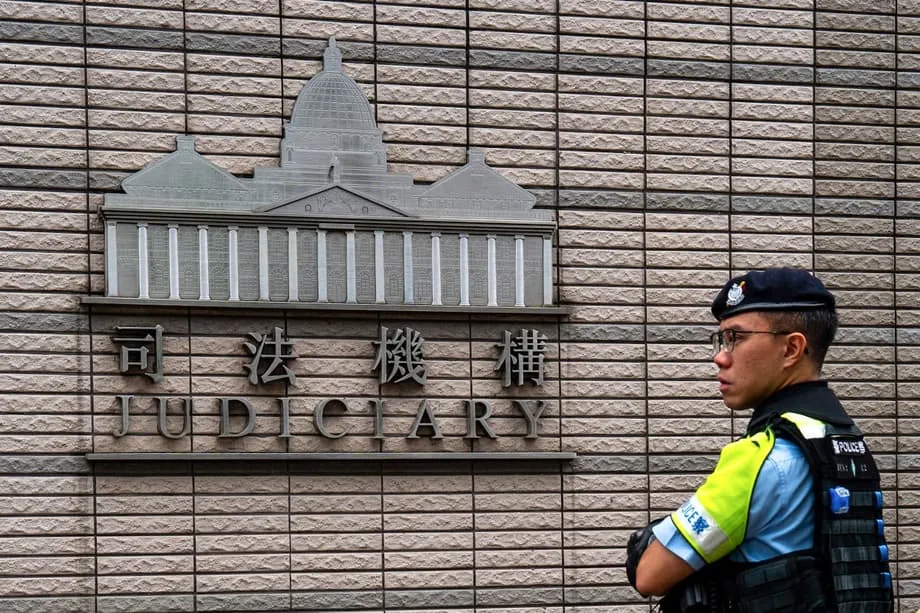
At the West Kowloon Law Courts Building, Lai smiled calmly, nodded and pressed his palms together toward supporters in the public gallery when the sentence was announced. Some people inside the courtroom wept. Outside, a heavy police presence watched small groups of supporters, some of whom had queued for days to attend.
Lai's family and rights organizations describe the punishment as effectively a life sentence because of his age and worsening health. His daughter, Claire Lai, warned that he would probably die a martyr behind bars. The sentence could keep him imprisoned into his nineties if he survives.
The case marks a defining moment in Hong Kong's change from a center of press freedom to a territory where criticism of Beijing can bring severe consequences. Beijing imposed the national security law in June 2020 after mass protests demanding democracy. Lai has since become an international symbol of the crackdown on dissent.
What the Court Found
Lai was convicted of three charges: two counts of conspiracy to commit collusion with foreign forces to endanger national security, and one count of conspiracy to distribute seditious publications. The offenses carry a maximum punishment of life imprisonment.
Three judges selected by Hong Kong's government to hear national security cases described Lai in their 855-page verdict as the unequivocal mastermind of the conspiracies. They found that he used Apple Daily to promote his political views in an attempt to undermine the Chinese Communist Party, both before and after the security law took effect.
Prosecutors cited 161 Apple Daily articles that they said incited hatred against the authorities and called for foreign sanctions. Sanctions are penalties imposed by governments to put pressure on another government or particular individuals. In this case, appeals for action by foreign governments were central to the prosecution's account of collusion.
The court also examined Lai's meetings with senior United States officials during Hong Kong's 2019 protests. Those officials included Vice President Mike Pence, Secretary of State Mike Pompeo and National Security Adviser John Bolton.
Lai's lawyers argued that he stopped calling for sanctions once the national security law came into force. The judges concluded that he continued his activities through less explicit means. Their decision placed both the newspaper's publications and Lai's contacts abroad at the center of the case.
A Trial Without a Jury
Lai's trial began in December 2023 and lasted 156 days before the December verdict. Unlike standard criminal trials in Hong Kong, national security cases are heard without juries, leaving the judges to decide guilt.
Authorities also prevented Lai's preferred lawyer, British barrister Timothy Owen, from representing him, citing national security concerns. The exclusion of foreign counsel, the selection of judges, the absence of a jury and restrictions on bail all represent departures from Hong Kong's common law traditions.
Lai has been denied bail since December 2020. A Court of Final Appeal ruling established that national security cases are an exception to the usual presumption in favor of bail, which generally allows an accused person to remain outside prison while awaiting trial under conditions set by a court.
Chief Justice Andrew Cheung defended the system last month. He said calls for Lai's premature release strike at the very heart of the rule of law. His position reflects the authorities' argument that the courts must determine criminal cases through legal proceedings despite pressure from foreign governments.
From a Fishing Boat to a Newspaper Empire
Jimmy Lai Chee-ying was born in Guangzhou in 1947 into a wealthy family that lost everything after the communists took power in 1949. At 12, he stowed away on a fishing boat bound for Hong Kong. He worked as a child laborer in garment factories and taught himself English.
Lai later built a fashion business, starting the international clothing brand Giordano in 1981. His commercial success preceded a political turning point: the 1989 Tiananmen Square massacre, when Chinese authorities violently suppressed protesters demanding democracy in Beijing.
The crackdown deeply affected Lai. He began writing columns criticizing the Chinese government and entered the media business to advocate democratic values. In 1995, two years before Hong Kong's handover to China, he founded Apple Daily.
Apple Daily became known for boisterous, frequently sensational journalism and an unapologetic stance in favor of democracy. As other Hong Kong media outlets increasingly censored themselves to avoid antagonizing Beijing, the newspaper remained a persistent critic of Chinese authorities.
Lai obtained British citizenship in 1994 and has never held a Chinese or Hong Kong passport. Hong Kong authorities nevertheless consider him a Chinese citizen. The disagreement over his nationality forms part of the setting for Britain's demands that he be released.
His outspoken criticism earned him the nickname Fatty Lai in earlier years. He survived firebomb attacks on his home and an assassination plot, yet continued attending demonstrations supporting democracy. Multiple arrests for unauthorized assembly followed from 2020.
Lai's life spans much of Hong Kong's modern transformation: a refuge for people fleeing communist China, a global financial center, and now a territory firmly under Beijing's control. The newspaper he founded became one of the most visible institutions caught in that change.
The Earlier Convictions and Key Dates
Lai had accumulated several prison sentences before the national security judgment. Those convictions involved demonstrations, a banned vigil and a fraud case connected to the lease at Apple Daily's headquarters.
The main events leading to the latest punishment unfolded over several years:
- June 2020: Beijing imposed Hong Kong's national security law following mass protests demanding democracy.
- December 2020: Lai began the period of detention during which he has been denied bail.
- April 2021: He received 14 months in prison for involvement in peaceful protests.
- May 2021: Another 14 months were added for organizing an unauthorized assembly.
- June 2021: Apple Daily published its final edition after police froze its assets and arrested senior staff.
- December 2021: Lai received 13 months for participating in a banned Tiananmen Square vigil.
- December 2022: He was sentenced to five years and nine months for fraud related to a lease violation at Apple Daily's headquarters.
- December 2023: His national security trial began.
- December, before Monday's sentencing: Judges convicted him after a trial lasting 156 days.
- Monday: The court imposed the 20-year national security sentence, with 18 years to follow the existing fraud term and two years to overlap with it.
The arrangement means the new punishment adds 18 years to the fraud sentence rather than allowing the entire 20-year term to be served alongside it. For a prisoner aged 78, that additional period is central to the family's warning that he may never leave prison alive.
Health and More Than 1,800 Days in Isolation
Lai's family and legal team have raised concerns about diabetes, hypertension, heart palpitations, progressive hearing loss and retinal vein occlusion affecting his vision. Hypertension means high blood pressure; retinal vein occlusion involves a blockage in a vein carrying blood away from the retina, the part of the eye that detects light.
At mitigation hearings last month, lawyer Robert Pang argued that every day in prison brings Lai closer to the end of his life. Mitigation is the stage at which a defense lawyer asks the court to consider circumstances that could justify a lighter sentence.
Pang said Lai had spent more than 1,800 days in solitary confinement since his detention began. The defense argued that this isolation makes imprisonment substantially more burdensome for him than for other inmates.
Prosecutor Anthony Chau said Lai's health remained stable. He told the court that Lai had lost only 0.8 kilograms over five years in detention and remained medically obese. Chau also said the solitary confinement was at Lai's request.
Claire Lai described her father's teeth as having rotted and said his weight had fluctuated dramatically during detention. She called those conditions heartbreaking. Hong Kong authorities maintain that he receives appropriate medical care and that concerns about his health are exaggerated.
Human Rights Watch and other organizations describe the 20-year term as effectively a death sentence given his age and health. His son, Sebastien Lai, said even five years would be practically equivalent to a death penalty for his father.
Sebastien Lai has framed his father's imprisonment as punishment for speaking the truth and defending freedom:
My father is in jail for the truth on his lips, courage in his heart, and freedom in his soul.
The family maintains that the prosecution punishes protected speech rather than genuine criminal conduct. The authorities defend the conviction and prison conditions, leaving a sharp disagreement over both the basis of the case and Lai's treatment.
Britain and the United States Press for Release
British Foreign Secretary Yvette Cooper called the prosecution politically motivated and described the 20-year sentence as tantamount to a life sentence for a man of Lai's age. She demanded his immediate release on humanitarian grounds so he could rejoin his family.
Prime Minister Keir Starmer raised Lai's case directly with Chinese President Xi Jinping during a January visit to Beijing. The British government said it would rapidly engage further with Chinese authorities after the sentencing.
Sebastien Lai has criticized Britain for failing to do enough. He said time was running out and that British values were being locked up alongside his father. His criticism puts pressure on London to turn its objections into a result that changes Lai's circumstances.
United States President Donald Trump said he felt deeply troubled by Lai's conviction and had asked Xi to consider releasing him. During his first term, Trump had also promised to secure Lai's release, telling the media tycoon in a letter that he was the only one who could save Hong Kong from China.
John Moolenaar, chairman of the US House Select Committee on China, said freeing Lai should be the starting point for improving relations between the United States and China. Both Washington and London have pressed for release on humanitarian grounds.
Whether that diplomatic pressure will secure Lai's freedom remains uncertain. No release date or agreement has been announced.
Rights Groups Condemn the Sentence as Authorities Defend It
Amnesty International described the punishment as a cold-blooded attack on freedom of expression and a grim milestone in Hong Kong's change from a city governed by the rule of law to one ruled by fear.
The Committee to Protect Journalists said the rule of law had been completely shattered in Hong Kong and called the decision the final nail in the coffin for press freedom. Reporters Without Borders said the curtain had fallen on press freedom in the territory.
Beijing and Hong Kong authorities rejected the criticism. Chinese Foreign Ministry spokesperson Lin Jian urged the countries concerned to respect the rule of law in Hong Kong and refrain from making irresponsible remarks.
Hong Kong Chief Executive John Lee welcomed the sentence. He said Lai had used Apple Daily to poison citizens' minds and that the heavy punishment brought great satisfaction to the people.
The opposing responses reflect the central conflict around the prosecution. Rights organizations view it as an attack on speech and journalism, while the authorities present it as enforcement of national security law and a demonstration of legal accountability.
Eight Other Defendants Receive Prison Terms
Eight other defendants were sentenced on Monday, receiving terms ranging from six years and three months to ten years. Six were former Apple Daily executives or editorial staff; two were activists associated with the international lobbying group Stand with Hong Kong.
The sentences were:
- Ryan Law, editor-in-chief: ten years.
- Lam Man-chung, executive editor-in-chief: ten years.
- Fung Wai-kong, editorial writer: ten years.
- Chan Pui-man, associate publisher: seven years.
- Yeung Ching-kee, editorial writer: seven years and three months.
- Cheung Kim-hung, publisher: six years and nine months.
- Andy Li, activist: seven years and three months.
- Chan Tsz-wah, activist: six years and three months.
All eight pleaded guilty, and several testified against Lai as prosecution witnesses. Guilty pleas and assistance to prosecutors typically allow sentence reductions under the security law. The judges said their evidence contributed substantially to Lai's conviction.
Apple Daily was also fined 6 million Hong Kong dollars, equivalent to $767,000, as a corporate entity. The financial penalty extended the judgment beyond individuals to the newspaper business itself.
Apple Daily's Closure and the Press Freedom Decline
Apple Daily printed its last edition in June 2021 after police froze its assets and arrested senior staff. Its closure followed a second major police raid that month, during which five executives were arrested and 18 million Hong Kong dollars in assets were frozen.
The newspaper's disappearance has become a symbol of lost civil liberties in Hong Kong. Many former journalists have since left the territory. Monday's sentences bring further punishment for people who held editorial and publishing roles at the paper.
Hong Kong ranked 18th in the World Press Freedom Index in 2002. It now stands at 140th among 180 territories, according to Reporters Without Borders. The change is a fall of 122 ranking places, placing the city much closer to the bottom of the index than it was in 2002.
Urania Chiu, a law lecturer at Oxford Brookes University, warned that legitimate criticism of the state, which often involves engagement with international platforms, may now readily be treated as criminal collusion. Her concern centers on how broadly sedition and collaboration with foreign forces can be interpreted.
For journalists and academics, that breadth creates a chilling effect: people may avoid publishing criticism or engaging abroad because they fear prosecution. Lai's conviction connects those concerns to specific activities, including newspaper articles, calls for sanctions and meetings with foreign officials.
Information, Investment and Possible Diplomacy
Eric Lai, a senior fellow at Georgetown University's Center for Asian Law, said critical media outlets and open exchanges with foreign officials about policy had been criminalized. He warned that this sharply jeopardized the free flow of information needed for transparent investment environments.
Hong Kong's standing as a credible financial hub depends in part on access to information that lets investors understand policies, risks and business conditions. Eric Lai's assessment connects the restrictions on journalism and international discussion to that practical concern.
Analysts suggest Beijing may regard Jimmy Lai as a bargaining chip in negotiations with Washington or London. Under that possibility, compassionate release on health grounds could be exchanged for concessions on trade or other issues.
Allowing him to die in prison could instead create a martyr who strengthens opposition to Chinese rule. These possible outcomes sit alongside the immediate reality: Lai remains imprisoned under a sentence his family says he is unlikely to survive.
The judgment has set a severe boundary around political expression in contemporary Hong Kong. Its consequences reach Lai, his former colleagues, the newspaper that closed in 2021 and the foreign governments seeking his release.
The Essentials
- Jimmy Lai, 78, received 20 years in prison, the longest sentence under Hong Kong's national security law imposed by Beijing in June 2020.
- He was convicted of two conspiracies involving collusion with foreign forces and one involving seditious publications.
- Eighteen years will run after his existing fraud sentence of five years and nine months; two years will overlap with it.
- Eight other defendants, including six former Apple Daily staff members and two activists, received between six years and three months and ten years.
- Apple Daily was fined 6 million Hong Kong dollars, or $767,000. The newspaper closed in June 2021.
- Lai has been detained since December 2020. His defense cited more than 1,800 days in solitary confinement and several medical conditions.
- Britain and the United States are pressing for his release. Starmer and Trump have raised his case with Xi Jinping.
- Hong Kong and Beijing defend the punishment as lawful; rights groups and Lai's family condemn it as an attack on freedom and effectively a life sentence.