Nine Launchers and a Deadline France Cannot Easily Close
France has just nine aging Lance Roquettes Unitaire (LRU) rocket launchers, while its planned national replacement will not enter service until 2030 at the earliest. As of February 20, 2026, a study by the French Institute of International Relations (IFRI) recommends South Korea's K239 Chunmoo as an interim answer to that gap, bringing a new supplier into a debate shaped by delivery delays, industrial capacity and doubts about traditional partners.
Contents
- Nine Launchers and a Deadline France Cannot Easily Close
- What France Needs Its Artillery to Reach
- Why HIMARS and PULS Face Political Resistance
- What Chunmoo Can Fire
- Norway and Estonia Show Two Procurement Models
- Poland Builds a European Production Base
- French Alternatives Still Need Time and Ammunition
- The Production Gap Behind the Launcher Debate
- How Different Launchers Could Work Together
- The Procurement Calendar Is Getting Crowded
- Key Points
The French Army's remaining launchers are derivatives of the American M270 Multiple Launch Rocket System. They require extensive maintenance, and Lockheed Martin, their original manufacturer, no longer provides maintenance support. French defense companies must undertake increasingly complex overhaul work to keep them operating beyond their intended service life.
Ukraine's war has demonstrated the value of accurate rocket strikes far behind the front. France's current reach is approximately 60 kilometers, enough for targets at brigade depth but short of the roughly 150 kilometers associated with division depth and 300 kilometers associated with corps depth. Those distances describe how far behind opposing forces an army may need to strike, including supply centers, air defenses and artillery positions.
Hanwha Aerospace's Chunmoo offers several ammunition options, relatively short delivery timelines and an expanding European customer base in Poland, Estonia and Norway. IFRI's recommendation places it at the center of the discussion, although France has not announced a purchase. Paris must weigh immediate military needs against its longstanding preference for weapons it can develop, manufacture and support at home.
The decision also concerns ammunition. A launcher can fire only as long as rockets remain available, making production capacity and dependable resupply as important as the vehicle itself.
What France Needs Its Artillery to Reach
France's artillery shortage reflects decades of declining capability and deferred modernization. Its nine remaining LRU systems trace their origins to platforms introduced during the Cold War, leaving the army dependent on an increasingly difficult maintenance effort at a time of renewed security tensions in Europe.
Long range precision artillery allows an army to attack positions beyond the immediate battlefield. Destroying a logistics node can interrupt fuel or ammunition deliveries. Striking an air defense position can help other forces operate more freely. Counter battery fire targets enemy artillery, ideally before it can move or fire again.
The French Army's current reach limits those choices. A weapon that reaches approximately 60 kilometers cannot perform the same missions as one capable of reaching 150 or 300 kilometers. France therefore faces both a shortage of launchers and a shortage of reach, with neither problem resolved simply by keeping the existing fleet running.
The 2024-2030 Military Programming Law, known as the LPM, commits France to a national replacement called Feux Longue Portee Terre (FLP-T). Safran and MBDA form one competing team, while Thales and ArianeGroup form the other. Selection of the winning team is expected in 2026.
FLP-T is intended to deliver an initial range exceeding 150 kilometers by 2030, followed by gradual expansion to 500 kilometers and eventually 1,000 kilometers. Those later stages promise much greater reach, but the immediate problem is the interval before the first systems arrive. An interim foreign purchase would aim to fill that interval while French development continues.
Why HIMARS and PULS Face Political Resistance
France's examination of foreign alternatives included the American M142 HIMARS and Israel's Precise and Universal Launching System (PULS). HIMARS has demonstrated its battlefield value in Ukraine and is standardized across NATO. PULS has been adopted by Germany, the Netherlands, Denmark and Spain.
French parliamentarians nevertheless identified major obstacles to choosing HIMARS. In a detailed report presented to the National Defence and Armed Forces Committee, they pointed to Lockheed Martin's production backlog extending to 2029-2030. Deliveries on that schedule would arrive close to the date France expects its own replacement, weakening the value of an interim purchase.
The parliamentarians also questioned reliance on Washington for a critical military capability, citing inconsistency in the American partnership and fluctuations in alliance politics. The authors of the report expressed their objection in direct terms:
In the face of the increasingly obvious inconsistency of the American partner, the choice of HIMARS would be geopolitically risky and politically incomprehensible.
French officials cited "growing geopolitical tensions with Israeli partners" as an obstacle to PULS, effectively removing EuroPULS from serious contention in the debate described. Its adoption by other European NATO members has not overcome those political concerns in France.
South Korea has gained an opening because the discussion reaches beyond weapon performance. French decision makers are also considering how reliably a supplier could deliver, how much influence France would have over ammunition production and whether political relations could complicate support during a crisis.
What Chunmoo Can Fire
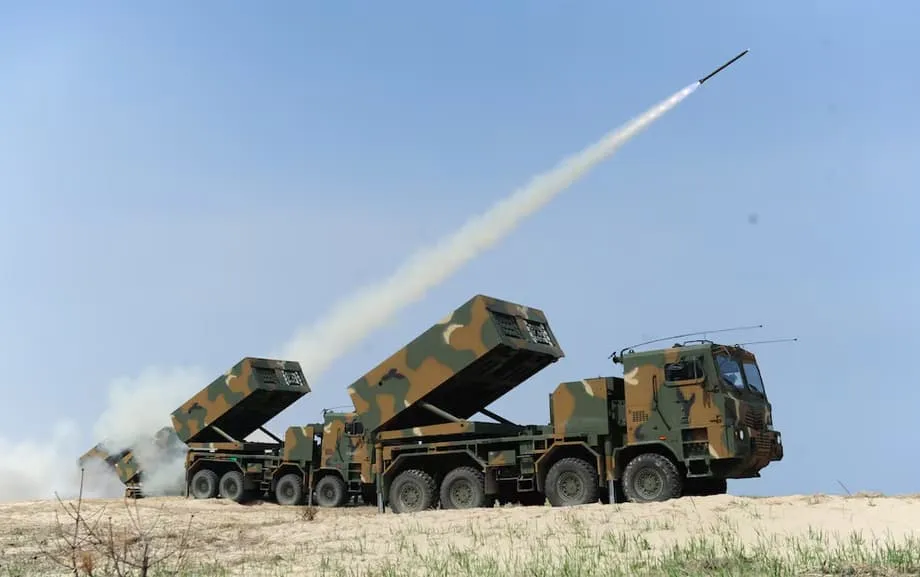
The K239 Chunmoo uses interchangeable launch pods that hold different types of ammunition. This modular arrangement lets commanders choose a load for a particular mission, from unguided rockets used against a wider area to guided weapons intended for precise strikes.
Its ammunition options include guided rockets measuring 239 millimeters in diameter with a range of 80 kilometers, extended range weapons reaching 160 kilometers, and the CTM-290 tactical ballistic missile with a range of 290 kilometers. The guided rockets use GPS and an inertial navigation system (INS), combining satellite positioning with onboard navigation to direct the weapon toward its target.
Norway's procurement includes an extended range variant capable of reaching 500 kilometers. That exceeds France's initial FLP-T requirement of more than 150 kilometers and gives the Chunmoo family room to cover missions at greater distances without an immediate replacement of the launcher.
Chunmoo's open architecture also permits customers to integrate national equipment. Poland's Homar-K version uses locally produced Jelcz trucks and the Polish Topaz combat management system. The truck carries the launcher, while the combat management system helps organize targeting and firing operations.
Hanwha says 95% of Chunmoo's manufacturing content is domestic to South Korea. The company presents that concentration as an advantage for supply reliability compared with systems dependent on more complex international production networks. France would still need to consider its own requirement for local ammunition production when negotiating any interim purchase.
Norway and Estonia Show Two Procurement Models
Norway recently finalized a $2 billion agreement for 16 K239 Chunmoo systems, becoming the first export customer for the variant reaching 500 kilometers. Deliveries are scheduled for 2028-2029, making the Norwegian order both a demonstration of demand and a claim on Hanwha's production schedule.
Norwegian Defence Minister Tore O. Sandvik said Hanwha was the only supplier that met all requirements for performance, delivery time and the cost framework. Oslo identified the 500 kilometer range as a decisive requirement that competitors could not match, with the capability intended to support Arctic deterrence against Russian forces.
Estonia has taken a different approach by ordering six Chunmoo systems to serve alongside its existing American HIMARS fleet. Its contract, worth 290 million euros, includes CGR-080 rockets reaching 80 kilometers, CTM-MR missiles reaching 160 kilometers and CTM-290 tactical ballistic missiles reaching 290 kilometers. Deliveries are due to begin in late 2027.
Estonian Defense Minister Hanno Pevkur described the purchase as a way to strengthen strikes deep inside an adversary's territory. Tallinn wants the ability to affect enemy forces before they approach Estonia's borders, extending the distance at which its military can respond.
Estonia's mixed fleet provides an example relevant to France: a country can acquire Chunmoo while retaining another rocket artillery system. For Paris, an interim purchase could similarly coexist with continued FLP-T development, providing usable equipment while the national program moves toward service.
Poland Builds a European Production Base
Poland is Chunmoo's largest European adopter, with contracts covering 290 Homar-K systems and deliveries running through 2029. Its program combines a large equipment purchase with national integration and plans to manufacture ammunition locally.
Hanwha Aerospace and Poland's WB Group have established a joint venture for missile production. The arrangement creates a European manufacturing hub that could support other NATO customers. Hanwha plans to supply European users, including Norway, with missiles produced in Poland.
Production closer to European customers could simplify transport and support ammunition availability during sustained operations. Poland's arrangement also shows the kind of industrial agreement France could seek, rather than buying launchers and depending entirely on imported ammunition afterward.
France's interest in a national supply base is central to the debate. An imported launcher might arrive faster than a new French design, but its usefulness during a prolonged conflict would depend on access to sufficient rockets and missiles. Licensed production would give French industry a role in supplying a foreign design while national development continues.
French Alternatives Still Need Time and Ammunition
Turgis Gaillard unveiled its Foudre system at the 2025 Le Bourget exhibition, presenting it as a "100% French-made" alternative positioned to compete directly with HIMARS. The system remains at an early prototype stage and lacks dedicated ammunition.
Foudre could potentially depend on Indian rockets, creating another foreign supply requirement despite the French origin of the launcher. The combination illustrates the practical challenge facing national projects: designing a vehicle and launcher is only part of the task; suitable ammunition must also be available.
MBDA and Safran have developed Thundart, a guided rocket measuring 227 millimeters in diameter that is compatible with existing LRU launchers. Its stated range of 150 kilometers matches the reach required for the first phase of FLP-T.
Thundart draws navigation and guidance technology from the AASM family of precision weapons launched from aircraft. That technology has been adapted to withstand the shocks associated with operations from carrier aircraft. Reusing technology from an existing weapons family is part of the French effort to develop a national rocket capability.
Foudre and Thundart therefore address different parts of the replacement problem, but development maturity and manufacturing capacity remain constraints. France must consider when complete systems can enter service and how quickly industry can replenish the ammunition they use.
The Production Gap Behind the Launcher Debate
France's procurement agency, the Direction generale de l'armement (DGA), expects national industry to produce only 50 to 100 missiles annually by 2030. French lawmakers have compared that projected output with consumption observed in Ukraine, where forces expend approximately 500 long range missiles each year during sustained combat.
The comparison puts the scale of the concern in simple terms. Producing 50 to 100 missiles would equal 10% to 20% of the cited annual consumption of 500. At those rates, the Ukrainian figure is five to ten times the projected French annual output.
French lawmakers acknowledge that prioritizing a purely national solution could be impractical under those production constraints. Licensed manufacture of a foreign system, including Chunmoo or India's Pinaka, is being discussed as a way to meet operational needs while French capacity grows.
Pinaka appears repeatedly in parliamentary reports. Its Mk2 variant reaches 75 kilometers, while the Mk3 version under development targets 120 kilometers. Those figures make it another option in the interim discussion, though its stated ranges are below the initial FLP-T ambition of more than 150 kilometers.
France's recent $7.41 billion agreement to export Rafale-M fighters to India provides a broader defense relationship that could support talks on licensed production. An arrangement could follow the industrial approach Hanwha has taken with Poland, giving France another possible route to equipment and ammunition production.
How Different Launchers Could Work Together
NATO's growing variety of rocket artillery creates practical demands for ammunition supply and coordination. European armies acquiring Chunmoo alongside American HIMARS and M270 systems, or Israeli PULS variants, must organize stocks, maintenance and targeting across different weapons families.
Germany has stated that it wants to integrate American Guided Multiple Launch Rocket System (GMLRS) rockets with its PULS launchers. Technical and industrial barriers remain, and Lockheed Martin has expressed skepticism about compatibility. Such integration requires work on the relationship between the launcher and the ammunition, alongside the systems that control firing.
General Christopher T. Donahue, commander of US Army Europe, has advocated common autonomous missile launchers able to fire different national ammunition types through unified command systems. The goal is to make weapons from several countries easier to coordinate while preserving national industrial roles.
For France, that approach could support Chunmoo batteries using rockets manufactured in Poland or coordinating strikes with German EuroPULS units. Local ammunition production would remain part of France's conditions for an interim solution.
A larger variety of suppliers also creates redundancy: an army has more than one route to equipment and ammunition. Ukraine's war has demonstrated the importance of magazine depth, meaning enough stored ammunition and replacement production to sustain repeated firing over time.
A dispersed Chunmoo battery can fire twelve guided rockets per launcher against troop assembly areas or air defense positions, then move before enemy artillery responds. HIMARS sections could operate alongside it against valuable individual targets. Coordinating such forces would allow different systems to contribute to the same campaign while retaining their own ammunition requirements.
The Procurement Calendar Is Getting Crowded
France faces pressure to decide while Hanwha's production schedule fills with confirmed orders. Estonia expects its first deliveries in late 2027, Norway expects deliveries in 2028-2029, and Poland's contracted program runs through 2029. New customers must seek space alongside those commitments.
The alternative is to rely on nine aging LRUs until FLP-T becomes available, leaving the army dependent on extensive maintenance through much of the remaining decade. IFRI's recommendation argues that Chunmoo could provide an operational capability within four years while France continues developing its sovereign replacement.
The principal dates in the debate are:
- 2024-2030: France's Military Programming Law provides for the national FLP-T replacement program.
- 2025: Turgis Gaillard presents Foudre at the Le Bourget exhibition.
- 2026: France expects to select between the Safran-MBDA and Thales-ArianeGroup teams for FLP-T.
- Late 2027: Estonia expects Chunmoo deliveries to begin.
- 2028-2029: Norway is scheduled to receive its Chunmoo systems.
- 2029: Poland's contracted Homar-K delivery program runs through this year.
- 2030 at the earliest: France expects FLP-T to enter service, initially reaching more than 150 kilometers.
France's choice brings two goals into the same procurement decision: having enough firepower soon and preserving a national capability over the longer term. Buying an interim system while continuing FLP-T would pursue both, following the broader European move toward South Korean equipment when delivery schedules and ammunition needs demand faster action.
Chunmoo's appeal rests on a combination of reach, modular ammunition, European orders and opportunities for industrial cooperation. France must weigh those features against foreign dependence, integration requirements and the time needed to obtain production slots. The urgency comes from the same concrete starting point: nine old launchers, limited reach and a national replacement still several years away.
Key Points
- As of February 20, 2026, IFRI recommends K239 Chunmoo as an interim option for France, which has nine aging LRU launchers.
- France's FLP-T replacement is expected no earlier than 2030, with selection of its industrial team expected in 2026.
- French parliamentarians oppose HIMARS on political grounds and cite a production backlog extending to 2029-2030. Officials also cite political tensions affecting PULS.
- Chunmoo ammunition options reach 80, 160 and 290 kilometers; Norway has ordered a variant reaching 500 kilometers.
- Norway's $2 billion purchase covers 16 systems, Estonia's 290 million euro contract covers six, and Poland has contracts for 290 Homar-K systems.
- Poland's Hanwha-WB Group joint venture provides a model for European missile production and supply.
- French production projected at 50 to 100 missiles annually by 2030 compares with approximately 500 consumed annually in Ukraine.
- France continues work on Foudre and Thundart while also examining licensed production possibilities involving Chunmoo or India's Pinaka.