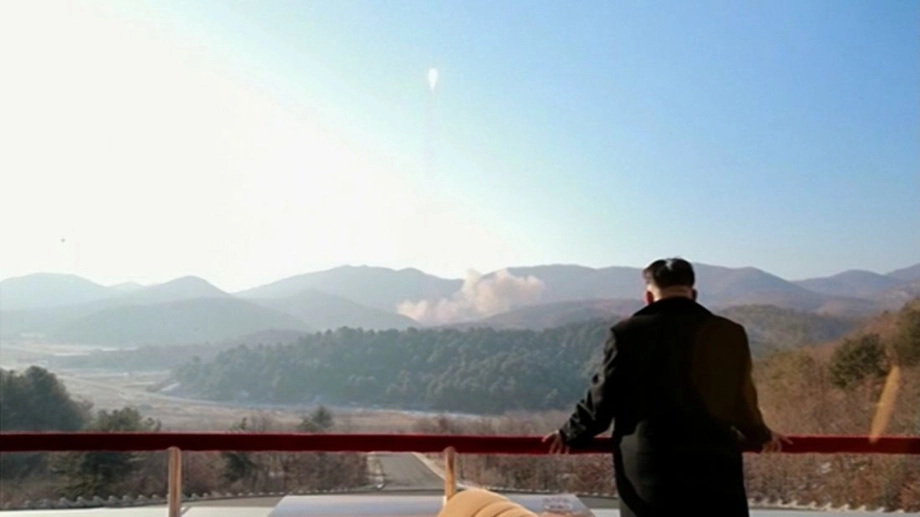
Projectiles fly as pressure rises
North Korea fired several projectiles into the sea from its east coast at about 10 a.m. local time on Thursday, March 3, 2016, just hours after the United Nations Security Council unanimously approved a new round of sanctions. South Korea placed its military on heightened alert as tensions rose following North Korea's January nuclear test and February rocket launch.
Contents
The launch came a day after the Security Council vote and a forceful statement by South Korean President Park Geun-hye, who said the world should help make North Korea abandon its nuclear programme. Seoul was also trying to determine whether the projectiles were short range missiles or artillery fire. The Defence Ministry had not identified them when it announced the investigation.
The episode brought together two kinds of pressure on Pyongyang: international measures aimed at restricting trade and South Korea's increasingly confrontational response. It also showed how quickly military activity and political statements could intensify the dispute on the divided peninsula.
What South Korea knew about the firing
South Korea's Defence Ministry said the projectiles were launched from North Korea's east coast at around 10 a.m. local time, or 0100 GMT. The ministry was examining whether they were missiles or artillery, a distinction that matters because the two types of weapons differ in range and how they are used.
North Korea fired the projectiles into the sea, but the available details did not specify how many were launched, where they landed, or what type of weapon they were. South Korea's heightened alert reflected the uncertainty and the tense military climate after the North's recent nuclear and rocket tests.
The firing followed the Security Council's vote by only hours. Its timing made the launch an immediate test of how North Korea would respond to the new penalties, although the information released that day did not explain the North's purpose.
What the new UN sanctions changed
The Security Council adopted Resolution 2270 on March 2, 2016. The UN's Security Council resolutions records list it under non-proliferation and the Democratic People's Republic of Korea, alongside earlier measures including resolutions 1718, adopted in 2006, and 1874, adopted in 2009.
Resolution 2270 strengthened sanctions after North Korea's fourth nuclear test. Among its trade measures, it banned exports of coal and iron, as well as gold, vanadium, titanium and rare earth metals. A limited exception allowed some coal and iron transactions when they were solely for people's livelihood. The resolution also expanded restrictions already in place rather than starting a new sanctions system from scratch.
The resolution expanded the arms embargo and non-proliferation measures, including restrictions on small arms and light weapons, dual-use nuclear and missile items, and items that could contribute to prohibited programmes. It also provided for a ban on any item if it was related to those programmes, and addressed the operational capabilities of North Korea's and other Member States' armed forces.
It required mandatory inspection of cargo destined for or originating from North Korea. It also banned North Korea from chartering vessels and aircraft, prohibited operating North Korean vessels or using North Korean flags, and barred flights by any plane or port calls by any vessel when connected to prohibited items, prohibited activities, or designated persons or entities.
The financial measures included an asset freeze on the North Korean government and Workers' Party entities associated with prohibited programmes and activities; the freeze also applied to vessels, including OMM vessels. North Korean banks were prohibited from opening new branches, and states were required to close existing North Korean bank branches in their territories. Member States were prohibited from opening branches in North Korea, and states were required to close existing offices there if they were related to prohibited programmes or sanctions violations.
The resolution imposed sectoral sanctions banning coal, minerals and fuel, and prohibited Member States from procuring or transferring them. It added items to the luxury goods ban. It clarified the ban on hosting North Korean trainers, advisers or other officials for police, paramilitary or military training, and prohibited specialized training or teaching for North Korean nationals in specific fields that could contribute to the country's proliferation-sensitive activities. Member States were also required to expel North Korean diplomats and foreign nationals involved in illicit activities.
Resolution 2270 designated an additional 16 individuals and 12 entities. Of the 31 vessels listed in its Annex III, four were removed on March 21, 2016, and another five were removed on December 17, 2016.
The vote was unanimous. The United States drafted the resolution, and China, North Korea's main ally, backed it. China's support mattered because it is a major trading partner of North Korea, giving it a central role in whether restrictions on trade could bite.
Sanctions are measures that restrict trade, money transfers or other dealings with a country. In this case, the Security Council sought to make it harder for North Korea to obtain resources connected to its nuclear and missile programmes. The measures followed earlier UN resolutions directed at the same programmes.
Two tests set the stage for the vote
The immediate sequence began with North Korea's nuclear test on January 6, 2016. It was the country's fourth such test. On February 7, North Korea launched a rocket it said was part of a programme to put a satellite into orbit.
The United States and South Korea said the rocket launch violated existing Security Council resolutions. North Korea argued that launching rockets for a space programme was its sovereign right. The disagreement reflects a central difficulty in the dispute: a rocket designed to carry a satellite uses technology that can also be relevant to developing ballistic missiles.
The Security Council's March 2 vote followed those two events. North Korea fired the projectiles the next morning, while South Korea's government was also taking domestic steps on security and human rights.
- January 6: North Korea conducted its fourth nuclear test.
- February 7: North Korea launched a rocket carrying a satellite, according to its stated purpose.
- March 2: The Security Council unanimously adopted Resolution 2270.
- March 3: North Korea fired several projectiles into the sea from its east coast.
Park's language marks a tougher approach
Park welcomed the Security Council action and renewed her call for North Korea to change its behaviour. Her remarks showed a marked shift from the engagement policy she had earlier described as "trustpolitik," which had sought to build trust between the two Koreas.
Speaking at a Christian prayer meeting on Thursday, Park said South Korea would work with other countries to oppose North Korea's nuclear development and its treatment of people in the North. Park referred to North Koreans as her "brethren" and tied the security dispute to freedom and human rights.
"We will cooperate with the world to make the North Korean regime abandon its reckless nuclear development and end tyranny that oppresses freedom and human rights of our brethren in the North," Park said.
North Korea's official media had also escalated its verbal attacks. In a commentary published on Wednesday, it compared Park to an "ugly female bat" and said she was fated to "die in the dreary cave, its body hanging down." The insult came as the South Korean president publicly supported stronger international pressure.
Seoul adds security and human rights measures
South Korea's parliament passed a long-delayed security law late on Wednesday, creating an anti-espionage unit. The country also adopted a law aimed at improving human rights in North Korea. Those steps formed part of Seoul's broader response to the North's nuclear test and rocket launch.
The changes came alongside the suspension, the previous month, of operations at a jointly run factory project in North Korea. The complex had been the two rivals' last remaining place for regular interaction. Its closure removed an established channel for economic cooperation at the same time that military and political tensions were rising.
For people and businesses connected to the factory, the suspension meant the end of that regular cross border work. For the governments, it signalled that the period's security crisis was affecting cooperation as well as diplomacy.
What the launch did, and did not, establish
The projectiles added to an already tense week, but South Korea had not yet determined whether they were missiles or artillery. That identification was the key immediate question left open by the Defence Ministry's statement. No further launch details, including the number of projectiles, were given in the account of the incident.
The larger dispute involved more than one launch. The Security Council's action targeted North Korea's nuclear and missile activities through trade restrictions, while Pyongyang maintained that its satellite rocket was a lawful space programme. South Korea and the United States viewed the launch as a violation of UN resolutions.
The next steps described at the time were the investigation into the projectiles and the implementation of the newly adopted sanctions. No later hearing, vote or deadline was specified. The immediate situation remained unsettled: the sanctions had been approved, the North had fired into the sea, and Seoul was maintaining a heightened military alert.
Key Points
- North Korea fired several projectiles into the sea from its east coast at about 10 a.m. on March 3, 2016.
- South Korea was still determining whether they were short range missiles or artillery fire.
- The Security Council unanimously adopted Resolution 2270 on March 2 after North Korea's January nuclear test and February rocket launch.
- The resolution banned exports of coal, iron and several minerals, with a limited livelihood purpose exception for some coal and iron transactions.
- President Park called for North Korea to abandon its nuclear programme as Seoul adopted new security and human rights measures and suspended the jointly run factory project.