Ambitious Green Strategy for Vietnam’s Economic Hub
Ho Chi Minh City is preparing to implement a radical shift in urban transportation policy. The city plans to prohibit petrol-powered vehicles in its central districts to promote the adoption of electric vehicles, mirroring similar measures underway in the capital, Hanoi. This initiative represents a significant effort by Vietnam’s largest metropolis to address severe air quality issues and modernize its transportation infrastructure.
Authorities have outlined a roadmap that targets specific milestones for electric vehicle adoption. The city aims for electric vehicles to comprise 50% of motorbikes used by government officials and ride-hailing drivers by 2027, reaching 100% by 2030. Starting in January 2027, gasoline-powered vehicles would face restrictions during peak hours in designated low-emission zones. A city-backed research institute proposed these measures in July, suggesting further tightening of limits in 2028.
The city intends to pilot these zones in the Can Gio district, located in the southern part of the city. This area was chosen due to the high volume of truck traffic there. Following the pilot, the restrictions will expand to the downtown area in 2027. To enforce these new rules, the megacity plans to utilize street cameras to identify and fine drivers who enter the restricted zones illegally.
Supporting this transition requires substantial infrastructure development. The city plans to build 1,338 charging stations at strategic locations such as shopping malls. Additionally, regulations aim to ensure that 100% of offices, hospitals, parking lots, and bus stations are equipped with charging capabilities. This infrastructure build-out is essential to alleviate range anxiety and encourage residents to switch from traditional internal combustion engines to electric alternatives.
The Challenge of Replacing Gas Motorbikes
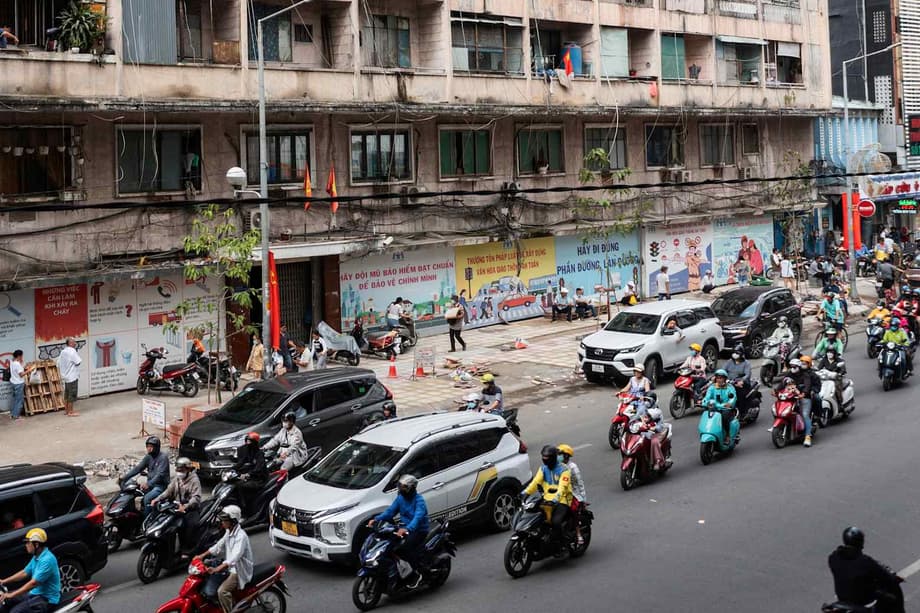
Implementing a ban on petrol vehicles poses a unique challenge in Vietnam. The country has one of the highest rates of motorbike ownership in the world, with nearly 80% of the population owning one. The vast majority of these two-wheelers are gasoline-powered. In Ho Chi Minh City and Hanoi, millions of people rely on motorbikes for daily commuting, making any restriction on their use a highly sensitive social and economic issue.
One of the primary reasons for the strict new regulations is the worsening air pollution in Vietnam’s major cities. The situation has become critical enough to demand immediate intervention. According to IQAir, a Swiss air quality monitoring company, Hanoi ranked as the 10th most polluted city out of 126 surveyed in early January, holding the undesirable title of the worst in Southeast Asia. Ho Chi Minh City did not fare much better, ranking 33rd on the same list.
The health impacts of this pollution are substantial and costly. Academics estimate that between 2020 and 2025, asthma cases caused by air pollution cost Vietnam approximately 422 billion dong, or roughly 16 million dollars. This financial burden, coupled with the human cost of respiratory illnesses, has motivated the government to pursue aggressive measures to reduce vehicle emissions.
However, the transition is not without significant hurdles. A paradoxical situation has emerged where some residential buildings in Ho Chi Minh City have actually begun banning electric vehicles due to fears of battery fires. This contradicts the overarching government policy designed to encourage EV adoption. A 2024 report for the European Commission indicated that evidence suggests electric vehicles are actually less prone to fires than gasoline vehicles. Despite this data, fear and misinformation persist, creating confusion for residents who wish to comply with green initiatives.
Tech specialist Hoang Thanh Tuyen highlighted this conflict in a Vnexpress opinion piece that garnered hundreds of comments. He pointed out that many people are caught between conflicting prohibitions. While the government encourages electric vehicles on the roads, building managers prohibit them in parking areas. Tuyen argued that to boost uptake, authorities need comprehensive policies that cover not just roads, but also buildings. He suggested mandatory standards for charging infrastructure in apartments and plans to upgrade older structures. Without these changes, he warned, a ban becomes the easiest solution for building managers, making life difficult for drivers who “want to do what’s right but can’t.”
Connecting to National Policies and Hanoi’s Lead
The plans in Ho Chi Minh City do not exist in a vacuum. They are part of a broader national strategy driven by Prime Minister Pham Minh Chinh. In July, the Prime Minister issued Directive 20, which sets a precedent for the rest of the country. This directive orders that all fossil fuel motorbikes be banned from driving within Hanoi’s Ring Road 1 starting July 1, 2026. Ring Road 1 is a 30-kilometer loop that encircles the central districts of the capital, including Hoan Kiem and Ba Dinh.
The ban in Hanoi is expected to affect approximately 2 million daily riders initially, with no exemptions planned for internal combustion engine bikes regardless of their age. Electric bikes, buses, and other public transport options will be allowed to operate freely. To soften the blow for consumers, the government plans to offer subsidies ranging from 120 to 200 dollars for electric vehicles priced over 590 dollars. The timeline for Hanoi is aggressive, with plans to expand the ban to Ring Road 2 by January 2028, and to Ring Road 3 by 2030, coinciding with the full completion of the city’s metro system.
This push for electrification is a key component of Vietnam’s commitment to reach net-zero carbon emissions by 2050. The government has positioned the shift as both an environmental necessity and an economic opportunity to support domestic industries. A survey conducted in September indicated that 60% of riders in Hanoi said they would switch to EVs if prices dropped and charging infrastructure became more prevalent.
Prime Minister Chinh has emphasized the need for a balanced approach. In discussions with Japanese executives, he stated that reducing emissions is a global issue requiring joint efforts to find the most optimal solution with a suitable roadmap. The policy draws some inspiration from Guangzhou, China, which implemented a similar ban in 2006, though Vietnamese officials maintain that their strategy is an independent decision aimed at cleaning their own streets.
The directive has sparked intense debate regarding feasibility and timing. Observers have questioned whether the city can enforce such a sweeping ban within the tight timeframe set by the government. Critics point to limited public transport options, a patchy electricity grid, and a lack of sufficient charging infrastructure. Furthermore, the logistical challenge of blocking millions of drivers from entering the city center presents a massive enforcement hurdle.
Nguyen Khac Giang, a visiting fellow at the ISEAS-Yusof Ishak Institute in Singapore, described the situation bluntly. “It’s just a mess if you look at the overall picture,” he told reporters. “In a very short span of time, it’s really difficult to make it happen.” He referenced the summer of 2023, when blackouts hit Hanoi and surrounding northern provinces, forcing factories to shut down and causing widespread turbulence. Giang warned that such a rapid green transformation, without proper preparation, could cause severe problems for the electricity system in Vietnam.
Economic Implications for Industry Giants
The transition away from gasoline-powered vehicles is sending shockwaves through the automotive industry, particularly for manufacturers who have long dominated the Vietnamese market. Honda, the Japanese giant, currently controls about 80% of Vietnam’s 4.6 billion dollar motorbike market. In 2024, the company sold 2.6 million units in the country. However, following the announcement of the government’s ban, Honda’s sales in Vietnam fell by nearly 22% in August compared to the previous month, representing a 13% drop year-on-year.
The rapid shift in policy has caught traditional manufacturers off guard. Honda and other motorbike makers, including Yamaha and Suzuki, have written letters to authorities criticizing the changes as being too fast. The Vietnam Association of Motorcycle Manufacturers, an industry body comprised largely of foreign manufacturers, argued that residents, businesses, and regulators need at least two to three years to prepare. They recommended a phased approach, starting with restrictions on older, high-emission vehicles before implementing a full ban. The association warned that moving too quickly could result in massive job losses and a cliff-like drop in sales for foreign businesses.
Honda supports approximately 200,000 jobs through its factories, dealers, and suppliers in Vietnam. While the company has launched its own electric models, such as the ICON e:, 99% of its sales in the country remain gas-powered. The company is scrambling to electrify its lineup, pledging no factory closures but clearly facing a fight to maintain its dominance. Japan’s embassy has also weighed in, warning in October that a staged plan is necessary to avoid shutdowns and bankruptcies.
Conversely, domestic manufacturers are positioned to benefit significantly from these policies. VinFast, the automotive arm of Vietnam’s largest conglomerate Vingroup, has seen its sales surge. In the second quarter of 2025, VinFast sales jumped by 55% to 70,000 units. The company offers a wide range of electric products, from affordable scooters to high-end models, and also supplies vehicles to Xanh SM, a ride-hailing platform that exclusively uses VinFast cars and motorbikes.
Other Vietnamese companies like Dat Bike, Pega, and Selex Motors are also gaining ground. Dat Bike, founded in 2018, initially targeted young customers with roadster-style designs but has recently moved toward the mainstream scooter market. Selex Motors specializes in two-wheelers designed specifically for delivery and ride-hailing services. These domestic firms started producing EVs early on as a strategy to compete with foreign giants in a segment where they could find a foothold.
Infrastructure and Grid Reliability Concerns
While the government’s ambition is clear, the physical infrastructure required to support millions of electric vehicles remains a work in progress. The success of the ban relies heavily on the availability of charging stations and the stability of the power grid. Experts have raised serious concerns about whether the current infrastructure can handle the surge in electricity demand that would result from a mass conversion to electric vehicles.
Hanh Nguyen, a PhD candidate at the Australian National University specializing in Southeast Asia, highlighted the strain on the grid. “It is quite concerning to think about six million vehicles charging every day,” she said. “It can put a big pressure on the electricity supply in Vietnam, and our supplies are not really consistent, especially during hot summer months.” The instability of the power supply in northern Vietnam is a well-documented issue, making the prospect of simultaneous charging for millions of vehicles a daunting technical challenge.
Beyond the grid, the sheer number of charging stations needed is immense. The Ho Chi Minh City Institute for Development Studies has proposed a plan to build 3,000 public charging and battery swap stations by 2028. This is part of a broader vision where new residential and commercial projects are required to include charging infrastructure. However, reaching these targets requires massive investment and coordination between the public and private sectors.
Building this infrastructure also faces regulatory and practical hurdles. Securing land and permits for installation is a complex process. Managing grid capacity and establishing standardized charging protocols are crucial technical challenges that must be resolved. Investors in charging station businesses will also need to ensure profitability, which depends on utilization rates, electricity costs, and pricing strategies. Without a reliable and convenient charging network, consumer adoption of electric vehicles will likely stall.
The cost of switching to electric vehicles is another major barrier for the average citizen. While the government has proposed financial support packages, such as covering registration fees and offering subsidies of roughly 3 to 5 million Vietnamese dong, the upfront cost remains high. An electric bike typically costs around 1,000 dollars, a significant sum in a country where the average monthly income is approximately 250 dollars. For low-income earners, including the tens of thousands of people working for ride-hailing and delivery services, this cost represents a prohibitive barrier without more substantial aid.
These financial pressures have led to fears that the ban will disproportionately affect the poor. A Grab driver in Hanoi expressed the sentiment of many workers in the gig economy, stating that it is already difficult to make ends meet. Some drivers, the driver noted, cannot even earn enough to cover basic meals or support their families. The prospect of having to purchase a new vehicle adds a layer of anxiety to an already precarious financial situation.
The Path Forward for Urban Mobility
As the 2026 deadline for Hanoi approaches and 2027 looms for Ho Chi Minh City, the government faces a difficult balancing act. Officials must weigh the urgent need to reduce pollution against the economic and social realities of a population deeply dependent on affordable, flexible transportation. The success of this initiative will depend on the government’s ability to address the multifaceted challenges of infrastructure, cost, and public acceptance.
Legal experts have already begun to address the regulatory gaps exposed by the conflicting policies of city mandates and building rules. Dang Thi Thuy Huyen, director of HPL & Partners law firm, noted that under current legislation, there is no provision allowing apartment building management to prohibit electric vehicles. She argued that such practices undermine national efforts to support the clean energy transition. Lawyers and residents are urging the government to clarify regulations to balance fire safety concerns with the rights of electric vehicle owners.
The automotive market is already shifting in anticipation of the new rules. Analysts predict a surge in second-hand petrol motorcycle sales as owners in restricted zones look to sell their vehicles before they lose value or become illegal to use. At the same time, interest in electric motorcycles is growing, though adoption remains limited by cost and infrastructure.
The Dat, an automotive analyst and head of Cartimes at the Industry and Trade Magazine, believes the market will evolve in phases. In the short term, manufacturers like VinFast are poised to benefit, while traditional petrol makers must adapt quickly to manage surplus inventory. In the long term, as bans expand to outer ring roads, the transition to electric mobility will accelerate. Distributors unable to pivot toward electric vehicles risk being forced to close, while urban consumers will increasingly view electric vehicles as the norm.
Ultimately, the transition to electric vehicles in Vietnam is about more than just swapping engines. It is a profound restructuring of the urban environment and the economy. While the goals of cleaner air and reduced carbon emissions are universally shared, the path to achieving them is fraught with complexity. The coming months and years will test the resilience of Vietnam’s infrastructure, the adaptability of its industries, and the patience of its citizens.
Key Points
- Ho Chi Minh City plans to ban petrol vehicles downtown by 2027 to promote electric vehicles.
- The city targets 50% of official and ride-hailing motorbikes to be electric by 2027, reaching 100% by 2030.
- Low-emission zones will be piloted in Can Gio district before expanding to the city center.
Authorities plan to use street cameras to fine violators who enter restricted zones illegally.
Air pollution is a primary driver, with Hanoi recently ranked the most polluted city in Southeast Asia.
Honda dominates the current market but faces declining sales due to the shift toward electric models.
Domestic brands like VinFast are experiencing rapid growth in response to government policies.
Concerns persist regarding charging infrastructure, electricity grid stability, and the high cost of electric vehicles.
Some apartment buildings have banned electric vehicles due to fire safety fears, conflicting with government policy.
The initiative is part of Vietnam’s broader goal to reach net-zero carbon emissions by 2050.