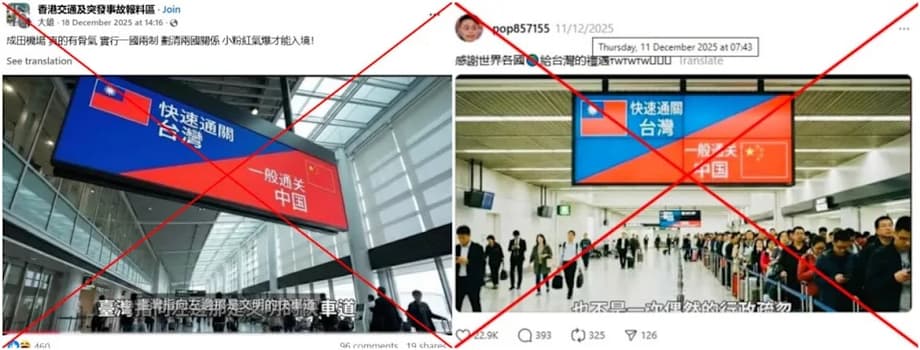
Digital Deception at Narita Airport
fabricated images purportedly showing special immigration lanes for Taiwanese travelers at Japan’s Narita International Airport spread rapidly across social media platforms in December 2025. The images featured large signboards with Chinese and Taiwanese flags, displaying labels reading “quick clearance, Taiwan” and “ordinary clearance, China.” These visuals were shared alongside claims that Japan had implemented preferential treatment for Taiwanese visitors while subjecting Chinese travelers to slower processing times. The posts gained particular traction as Japan and China engaged in their most significant diplomatic standoff in years, following provocative statements from Japanese Prime Minister Sanae Takaichi about Taiwan.
“Narita Airport has shown remarkable backbone by implementing the approach of one country, two systems, clearly delineating relations between the two nations. Those Chinese patriots must be furious upon entry,” read part of a Facebook post shared on December 18, 2025, accompanying one of the fabricated images.
The visual content circulated widely on multiple platforms including Threads, X (formerly Twitter), Instagram, and Facebook. Some users celebrated the supposed policy change, with comments in traditional Chinese reading, “That’s how you treat friends and enemies,” and “Thank you Japan. Now we don’t have to queue up with the Chinese.” Others questioned the authenticity of the images, noting that such a dramatic policy shift would have been covered by mainstream news outlets.
Despite the skepticism from some users, the posts reached hundreds of thousands of viewers, illustrating how rapidly AI-generated content can spread during periods of heightened geopolitical tension. The incident represents a growing challenge for platforms and governments alike as artificial intelligence tools become increasingly sophisticated and accessible to anyone with internet access.
Japan’s Immigration Services Agency swiftly responded to inquiries about the images, confirming what aviation experts and frequent travelers already suspected. “There are no priority lanes based on nationality or region,” the agency’s Press Relations Section told AFP in an email on December 25, 2025. The statement definitively established that no such discriminatory immigration policy existed at Narita or any other Japanese international airport.
A reverse image search on Google revealed metadata identifying the images as “Made with Google AI” in the platform’s “About this image” feature. This built-in transparency tool, introduced by Google to combat misinformation, provided crucial evidence of the images’ artificial origins. Upon closer examination, visual inconsistencies characteristic of AI-generated content became apparent to trained observers. These included misaligned ceiling lines, missing structural beams connecting glass panels, anatomically distorted hands on travelers depicted in the images, and blurred or inconsistent facial features.
This incident at Narita Airport was not an isolated case of AI-generated misinformation during the Japan-China diplomatic crisis. It formed part of a broader pattern of fabricated content designed to exploit and amplify tensions between the two nations. In late November 2025, as diplomatic relations deteriorated, a TikTok video appeared to show a Chinese foreign ministry spokesperson announcing that all Japanese citizens in China must complete departure procedures by the end of the month. The video, which included scenes of people working on laptops, travelers at airports, and airplanes taking off, was shared with cropped text overlays reading “announced limit on all Japanese people in China.”
Closer inspection of that video revealed telltale signs of AI generation, including a watermark from Sora (OpenAI’s text-to-video AI model), faces that appeared artificially merged, and incorrect background Chinese characters reading “Chinese Communist” rather than the standard “Chinese” seen at authentic foreign ministry briefings. The video also identified the spokesperson as “Zhao Jianming,” a name that does not appear among official spokespersons listed on China’s Ministry of Foreign Affairs website. Neither the official ministry website nor the Embassy of Japan in China contained any such announcement.
Another sophisticated disinformation campaign targeted John Mearsheimer, the renowned international relations scholar and professor at the University of Chicago. A video circulating on TikTok, X, Facebook, and YouTube featured a man resembling Mearsheimer delivering commentary about Japan’s confrontation with China. The simplified Chinese caption claimed that “Japan thought it could provoke China without facing economic retaliation is a fundamental misunderstanding of modern geoeconomics.” The video included a text overlay repeating this sentiment and presented fabricated quotes suggesting Mearsheimer criticized Japan’s assertive posture toward China.
“It definitely is not an accurate representation of my views on the relationship between China and Japan,” Mearsheimer told AFP in an email on December 10, 2025. “I am deeply disappointed in YouTube’s unwillingness to shut this problem down, especially since it not only damages me but YouTube as well. Moreover, it undermines the notion of an open and honest discourse which we need so much and which YouTube is supposed to facilitate.”
The fabricated Mearsheimer video showed subtle but detectable signs of manipulation, including unnatural lip movements and a complete lack of shoulder movement typical of AI-generated avatars. Voice-cloning detection tools indicated the audio was likely AI-generated. AFP traced the video to a YouTube channel called “Mearsheimer Fans Channel,” which included a disclaimer stating it was not affiliated with Professor Mearsheimer, the University of Chicago, or any other institution. After AFP flagged three offending channels to YouTube, the platform removed them for violating policies on spam, deceptive practices, and scams.
The timing of these disinformation campaigns coincided directly with escalating diplomatic tensions following Prime Minister Sanae Takaichi’s controversial remarks about Taiwan in November 2025. During her first month in office, Takaichi departed from Japan’s traditional strategic ambiguity regarding Taiwan, stating in the Diet on November 7 that military action against Taiwan could trigger Japan’s right to collective self-defense. This particular phrasing invoked Japan’s 2015 security legislation, which permits military action alongside allies even when Japan itself is not directly attacked.
Takaichi specified that if China’s use of warships or exercise of force against Taiwan created a “survival-threatening situation” for Japan, it could constitutionally justify a military response. This marked the first time a sitting Japanese prime minister had made such an explicit statement about potential military intervention in a Taiwan scenario. Previous Japanese leaders, including Deputy Prime Minister Taro Aso in 2021, had made similar suggestions, but never with such directness from the nation’s highest office.
China’s response was immediate and multifaceted. Beijing filed formal protests with the United Nations, launched economic retaliation measures, and initiated a diplomatic campaign to isolate Japan internationally. The Chinese Foreign Ministry branded Takaichi’s comments as a revival of Japan’s militarist past, while state media outlets published cartoons depicting her in imperial military uniform and burning Japan’s pacifist constitution. Some social media posts labeled her a “witch,” playing on the phonetic similarity between her surname and a word meaning “troublemaker” in Mandarin.
Economic measures included reimposing a ban on Japanese seafood imports, just days after lifting a previous ban tied to Fukushima water release concerns. Scallop exporters in Hokkaido and Aomori prefectures were particularly affected. China also warned its citizens against traveling to Japan, leading to mass cancellations of group tours. Analysts estimated this tourism freeze could cost Japan approximately 2.2 trillion yen ($14.2 billion). Cultural exchanges suffered as well, with new Japanese movies pulled from Chinese theaters and comedy shows and book deals cancelled.
The diplomatic fallout extended to United Nations proceedings, where China’s ambassador to the UN, Fu Cong, accused Takaichi of violating international law. China invoked World War II-era “enemy state” clauses to suggest military retaliation could occur without UN Security Council approval. On social media, China’s consul-general in Osaka posted a threatening message that was later deleted: “If you stick that filthy neck where it doesn’t belong, it’s going to get sliced off.” China also reminded Japan of its 2010 embargo on rare earth exports during a previous territorial dispute, with Tsinghua University scholar Liu Jiangyong warning, “Everything is possible.”
Takaichi, a 64-year-old conservative representing Japan’s nationalist vanguard, refused to retract her statements. Known for visiting the controversial Yasukuni Shrine and opposing wartime apologies, she had vowed to “work like a horse” to restore Japan’s global prestige. Despite international pressure, her approval ratings at home soared to approximately 70%, more than double those of her predecessor. The domestic support underscored a significant shift in Japanese public opinion toward a more assertive stance on regional security.
While Japan navigated this diplomatic crisis, China escalated military pressure on Taiwan with exercises dubbed “Justice Mission-2025.” In late December 2025, China’s Eastern Theater Command mobilized army, navy, air force, and rocket units for two days of drills around Taiwan. The exercises included live-fire activities and rocket launches, with some projectiles landing in waters closer to Taiwan than in previous drills. Taiwan’s Defense Ministry reported that China deployed 130 warplanes and 22 ships around the island, with 90 aircraft crossing the median line of the Taiwan Strait.
Taiwanese President Lai Ching-te condemned the drills as “military intimidation” and accused China of disregarding international expectations for peace. “This is a blatant provocation to regional security and the international order,” he said in a Facebook statement. Meanwhile, Chinese Foreign Minister Wang Yi framed the exercises as a response to what Beijing termed “collusive actions” between Taiwan and the United States, specifically referencing a landmark $11.1 billion US arms deal that included HIMARS rocket systems, anti-tank missiles, loitering drones, and military software.
The military aspect of the crisis also encompassed Japan’s defensive preparations. Tokyo moved forward with plans to station surface-to-air missiles on Yonaguni Island, just 110 kilometers from Taiwan. Defense Minister Koizumi described this deployment as lowering “the chance of an attack,” while Beijing characterized it as a provocation. Chinese military aircraft had previously locked radar onto Japanese fighter jets near Okinawa’s main island, prompting Tokyo to summon Beijing’s ambassador on December 7, 2025.
The information warfare dimension of this crisis reflects broader trends in modern geopolitical conflict. AI-generated content allows state and non-state actors to manufacture compelling narratives that exploit existing tensions. The Narita Airport images, for instance, appealed to Taiwanese national pride and anti-Chinese sentiment, simultaneously provoking Chinese nationalist anger. Such content creates emotional reactions that transcend rational verification processes, making it highly effective for spreading through social networks where engagement algorithms favor emotionally charged material.
Expert analysts note that AI-generated misinformation serves multiple strategic purposes during diplomatic crises. It can confuse adversaries about genuine policy changes, create domestic pressure on governments by manufacturing public outrage, and test response capabilities. The targeting of respected figures like John Mearsheimer demonstrates attempts to lend false credibility to manufactured positions, potentially influencing expert discourse and policy debates. As these tools become more sophisticated, distinguishing authentic from artificial content becomes increasingly challenging for ordinary citizens and even trained analysts.
Tech platforms face growing pressure to implement more effective detection and labeling systems for AI-generated content. Google’s “About this image” feature, which helped identify the Narita Airport images as artificial, represents one approach to this challenge. TikTok’s labeling of the fake expulsion video as AI-generated content shows another platform’s response. However, the rapid evolution of generation technology continues to outpace detection capabilities, creating an asymmetric advantage for purveyors of disinformation.
The Japan-China crisis over Taiwan illustrates how traditional diplomatic, economic, and military dimensions of international conflict now overlap with sophisticated information operations. As tensions persist in the Taiwan Strait and across the broader Indo-Pacific region, observers expect AI-generated misinformation to feature increasingly prominently in geopolitical maneuvering. The ability to fabricate convincing evidence of non-existent policies or events adds a dangerous layer of complexity to already volatile situations.
For governments and citizens alike, the episode underscores the critical importance of media literacy and source verification in the digital age. Official channels like Japan’s Immigration Services Agency provided rapid, authoritative responses that helped debunk the false claims. However, the initial spread of the misinformation revealed vulnerabilities in how information circulates during heightened international tensions. As one expert noted, the goal of such campaigns is often less about making people believe specific falsehoods and more about creating general confusion and distrust that makes consensus impossible.
The Bottom Line
- AI-generated images falsely claimed Japan created separate immigration lanes for Taiwanese and Chinese travelers at Narita Airport
- Japan’s Immigration Services Agency confirmed no such priority lanes exist based on nationality or region
- The misinformation spread during heightened tensions following PM Sanae Takaichi’s November 2025 comments about defending Taiwan
- Multiple AI-generated videos circulated during the same period, including fake content featuring scholar John Mearsheimer
- China responded to Takaichi’s remarks with economic retaliation, diplomatic protests, and military drills near Taiwan
- The incident highlights growing challenges in detecting and countering AI-generated misinformation during geopolitical crises