Lab test exposes gaps in Hong Kong scaffold net safety
A laboratory test on a debris net taken from a large Hong Kong housing estate has intensified scrutiny of how the city regulates renovation safety. The sample, which held documentation showing it met official standards, ignited and shed flaming droplets under controlled conditions. The result has accelerated calls to rewrite testing rules and tighten enforcement after a catastrophic blaze at Wang Fuk Court in Tai Po on November 26 killed at least 159 people and displaced thousands.
- Lab test exposes gaps in Hong Kong scaffold net safety
- How a compliant net still caught fire
- Investigators say unsafe materials and deception played a role
- Why current standards fell short
- Bamboo scaffolding in the spotlight
- Citywide removal order and new rules
- Human cost and community fallout
- What builders and residents should look for
- Key Points
Debris netting is widely used during external repair work to catch falling materials and protect pedestrians. In Hong Kong, it often covers bamboo scaffolding that stretches up towers for months at a time. When the mesh is not flame resistant, it can behave like a continuous fuel source on the facade. If molten plastic forms and drops as it burns, it can ignite other materials below, jump across gaps, and start fresh fires inside flats through open windows.
The lab finding that a net with a passing safety certificate still ignited has triggered a hard look at whether existing standards capture real world dangers. It has also exposed weaknesses in the inspection regime and supply chain, from forged paperwork to the ease with which non compliant materials can be installed out of sight. The government has moved quickly with a citywide removal order for renovation netting, mass sampling and new rules that will change how materials are tested and approved before installation.
How a compliant net still caught fire
The test that set off the alarm was simple in concept. A sample of green plastic scaffold mesh was exposed to flame. The net ignited and produced flaming droplets, a serious hazard in vertical fires. These droplets are globs of burning polymer that can fall, stick to surfaces, and spread the blaze to fresh fuel. The material had a safety report indicating it met official acceptance criteria. The outcome, fire with active dripping, showed how a net can pass a tick box yet still behave dangerously when it matters most.
What the lab likely tested
Fire tests for thin plastics typically assess how quickly flames spread and whether droplets form and persist. Some standards penalize dripping, others focus on surface flame spread. A pass in one dimension does not guarantee safe performance in the complex environment of a high rise exterior. On a tower, netting wraps large vertical areas and can act like a sail, exposing more surface to heat and wind. Once hot, the net may soften and pull away from ties, sagging toward the fire and contributing additional fuel. If droplets ignite items below, flames can leap from floor to floor far faster than a simple lab test suggests.
Investigators say unsafe materials and deception played a role
Officials examining the Wang Fuk Court disaster say multiple hazards lined up. After a summer typhoon damaged renovation materials, some contractors allegedly replaced compliant netting with cheaper mesh that did not meet fire safety requirements. To mislead inspectors, who often take samples near ground level, compliant netting was reportedly installed at the base while inferior material was installed above. Of twenty samples later taken from the estate, seven failed fire safety checks. Police have arrested 21 people, including 15 from construction firms on suspicion of manslaughter and six from a fire service installation contractor on suspicion of fraud.
The inquiry has also widened into suspected forged documentation for scaffold netting used at other housing estates. Investigators traced certificates to a manufacturer based in Shandong and found that one testing lab denied issuing a report while another could not be reached. City departments have seized documents and samples from several sites, and more than a thousand samples from over 300 buildings are now being tested. The scope of the alleged fraud has strengthened the case for strict chain of custody, random on site sampling, and accredited testing before any netting goes up.
How sampling was gamed
Past practice often relied on a piece of netting or a supplier certificate presented at site. If inspectors sampled only at accessible locations such as the base, it allowed contractors to stage compliant material where checks were likely. The overhaul now under way aims to eliminate that vulnerability. New rules will require samples taken randomly at various elevations, testing at designated laboratories, and batch identification that ties every piece of installed mesh to a verified report.
Why current standards fell short
The fire at Wang Fuk Court exposed weaknesses in both paper standards and real world oversight. Many tests address flame spread under controlled settings that do not include strong wind, stack effect up tall facades, or the presence of other fuels nearby. A net that earns an acceptable flame spread rating can still drip molten plastic. In a real event, those droplets can ignite balcony items, protective foam around windows, or curtains inside flats. Standards also do not reflect aging in the field. Ultraviolet light and weather can degrade flame retardant additives in plastics. If the netting at Wang Fuk Court had been on the facade since mid July, months of sun and rain may have reduced its fire performance by the time the blaze broke out.
The science of flaming droplets and vertical fire spread
When polymer mesh burns, it can melt and form beads of fuel that drop while still ignited. Each droplet is a small torch that can start spot fires on lower floors or ignite items on scaffolding platforms. The vertical layout of netting creates a chimney effect. Hot gases rise and preheat the plastic above, which then ignites more readily. If wind pushes flames along the facade, fire can wrap around corners and jump between towers when distances are small. At Wang Fuk Court, officials also pointed to foam boards around windows. Many such boards are made from polystyrene, which ignites easily and produces intense heat. Once both netting and foam are burning, the energy release accelerates. That helps explain how seven of eight towers at the complex were affected and why the blaze lasted for an estimated 40 hours.
Bamboo scaffolding in the spotlight
Bamboo scaffolding is a signature of Hong Kong construction. It is light, fast to assemble, and cheaper than steel, and specialist crews have honed the craft over generations. The fire has brought a contentious debate over bamboo safety. Some engineers argue bamboo is hard to ignite and that netting and foam were the main accelerants. Others counter that dry bamboo is combustible and, once alight, contributes fuel to a running facade fire. Online experiments show fresh bamboo tends to char before flaming, yet that does not mirror the conditions on a tall, mesh wrapped building with wind and multiple ignition points.
What experts recommend
The emerging consensus is that temporary works around occupied tall buildings should be non combustible whenever possible. Where bamboo remains in use, it should be treated, netting must be flame resistant, and connections to the building should limit the gap that can act as a chimney. Regular inspections, proper ties, and plans for high wind days are basic controls. Authorities have already pushed more metal scaffolding into public projects, and several specialists say metal systems or other non combustible approaches should be preferred on tall occupied estates where a facade fire can have catastrophic consequences.
Citywide removal order and new rules
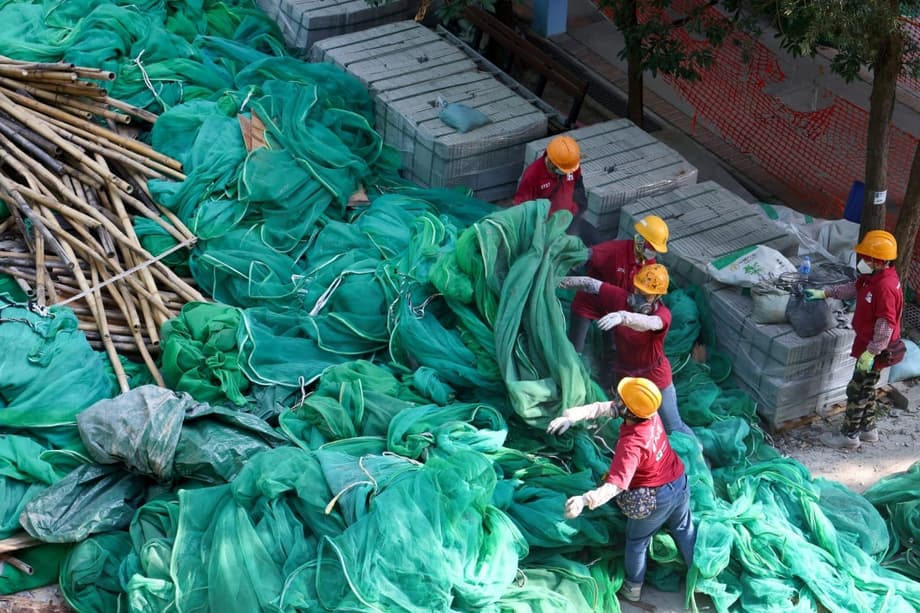
In the days after the fire, the government ordered the immediate removal of exterior scaffolding nets on all buildings undergoing major repair work. The order covered more than 200 private buildings and about a dozen public housing or government projects. Contractors must bear the cost. Renovation work has paused across large parts of the city as inspectors verify whether any remaining netting meets safety standards. At one large estate in Sha Tin, workers were seen dismantling the mesh within hours of the directive. Some residents welcomed the step, saying it reduced the risk of another disaster.
What the new code will require
Officials say a new Buildings Department code will require every batch of scaffold net to be sampled on site and tested at designated facilities before installation. The change addresses both performance and process. Samples will be tied to specific lots with traceable documentation. Inspectors will not accept certificates from unknown or unverifiable labs. City leader John Lee has also asked a judge led committee to investigate the fire and review oversight of building renovation. In parallel, officials plan to review building management systems amid allegations of tender rigging and poor maintenance practices that left residents exposed.
Human cost and community fallout
Wang Fuk Court, home to roughly 4,600 people, suffered the deadliest fire Hong Kong has seen in decades. Authorities report at least 159 deaths, and dozens remain missing. Police say 140 bodies have been identified so far. More than 2,900 residents are now in temporary accommodation, with many staying in hostels, camps or hotels and others in transitional housing units. Foreign domestic workers from Indonesia and the Philippines are among those still unaccounted for. Donations for survivors have topped the equivalent of 115 million dollars, with public and private funds helping families secure new housing and basic supplies.
Residents had complained about hazards around the renovation works for months. Fire alarms reportedly did not operate properly. Foam boards over windows fed the flames. Mesh netting wrapped the towers. Many asked why stronger action did not come sooner. The police have widened arrests beyond construction firms and consultants to include those accused of falsifying safety records. Officials have also warned the public against spreading rumors, and at least one person who called for an independent inquiry has been detained. The combination of deep grief, a large scale investigation and heightened sensitivity around public criticism has created a tense atmosphere as the city waits for answers.
What builders and residents should look for
Safety on a live facade starts with materials that actually match their paperwork. Labels alone are not enough. Project managers should demand reports from recognized laboratories with traceable batch numbers and sample photographs that match the installed mesh. Random site sampling and independent testing before installation help prevent substitution. Where budget allows, prefer non combustible systems such as metal scaffolding. If plastic mesh is used, it should meet a credible flame test that addresses both flame spread and flaming droplets. Inspections should verify that foam boards or other cladding around windows are not easily ignited.
Questions regulators still need to answer
Several issues now sit squarely in front of regulators. Which fire test methods will Hong Kong adopt for scaffold mesh, and how will they treat flaming droplets and aging in the field. How will the city ensure labs are accredited and reports are genuine. What chain of custody will tie every roll of net to a verified batch. How will inspection teams maintain coverage across hundreds of sites. Will restrictions on bamboo be expanded for tall, occupied buildings. The coming code and the judge led review will be measured by how clearly they answer these questions and how quickly they reduce risk on active sites.
Key Points
- A lab test found a scaffold net sample ignited and shed flaming droplets despite documentation showing it met safety standards.
- The deadly fire at Wang Fuk Court in Tai Po killed at least 159 people and affected seven of eight towers at the complex.
- Investigators say some contractors swapped in cheaper, not compliant netting and staged compliant mesh at ground level to mislead inspectors.
- Seven of twenty net samples from Wang Fuk Court failed fire tests taken after the blaze.
- Police have arrested 21 people, including 15 on suspicion of manslaughter and six on suspicion of fraud linked to safety paperwork.
- Authorities ordered the removal of scaffold nets from more than 200 private buildings and about a dozen public projects.
- New rules will require on site sampling, testing at designated labs, and traceable documentation before any netting is installed.
- Officials are probing suspected forged certificates tied to a manufacturer based in Shandong and unverifiable lab reports.
- Bamboo scaffolding is under renewed scrutiny, with experts urging non combustible systems or treated materials and stricter inspections on tall occupied blocks.
- More than 2,900 residents are in temporary accommodation, donations exceed 115 million dollars, and a judge led inquiry is being set up to review oversight.