A fragile winter wonder at the edge of change
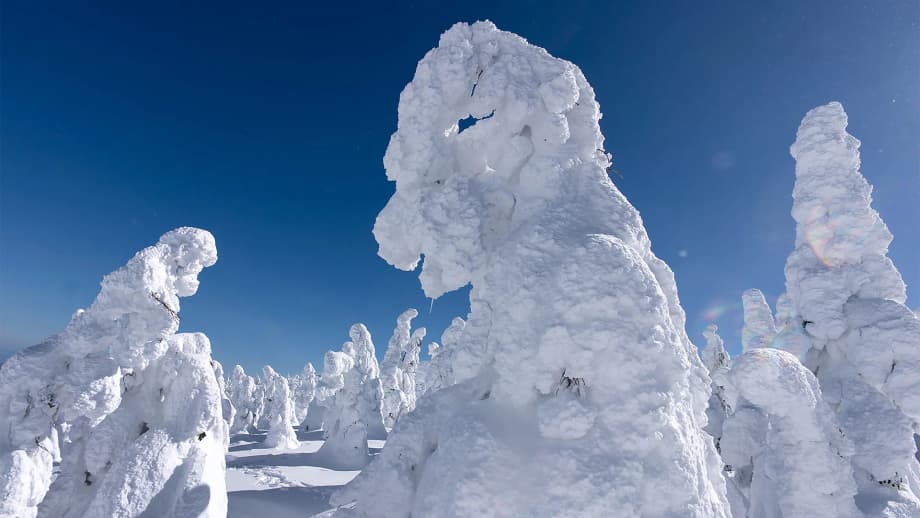
Each winter on the upper slopes of Mount Zao, evergreen firs swell into ghostly white figures. Locals call them juhyo, snow monsters shaped by wind, cloud and cold. In good years the formations rise in packed ranks across the ridge, a silent army that draws visitors from across Japan and far beyond. The spectacle is rare, and it is getting rarer. Recent scientific work finds the monsters are thinning fast, a warning sign for a landscape that has long depended on a delicate balance of weather and forest health.
Juhyo are not sculptures made by hand. They are rime ice, built when supercooled cloud droplets freeze the instant they strike the windward sides of trees. At Zao the process needs a tight set of ingredients. Persistent westerly winds can blow up to 26 meters per second. Surface air must sit near the freezing point, roughly minus 6.3 to minus 0.1 degrees Celsius at the summit. Clouds must carry an unusually high load of liquid water. When those elements align, the ice grows in layered ridges called shrimp tails, and neighboring trees merge into towering white forms that look alive in winter light.
That combination of meteorology, topography and vegetation converges in very few places. Northern Japan provides it more often than anywhere else on Earth. Which is why the news from Zao matters beyond a single mountain. Longtime observers and new arrival tourists now encounter sparser figures, thinner outlines and, in many places, bare trunks where monsters once stood. The change is measurable. It is also tied to both warming winters and forests under attack.
For Yamagata communities that rely on winter tourism, the stakes are practical as well as emotional. Hotels, restaurants and ski businesses plan every season around the weeks when the juhyo are at their peak.
How snow monsters form on Mount Zao
The raw material for a snow monster is the Aomori todomatsu, also known as Maries’ fir (Abies mariesii), a subalpine evergreen that grows in tight stands across Zao’s high slopes. Supercooled droplets inside low cloud banks ride in on strong westerlies from the Sea of Japan. Those droplets remain liquid below 0 C until they strike a surface, then freeze instantly. Repeated gusts paste new layers on the windward face of each branch, producing the shrimp tail ridges that give juhyo their sculpted look. When storms cycle through for weeks, the shapes thicken and neighboring trees fuse into statues several meters across.
Two elements make Zao special. First, the mountain’s position and shape concentrate winter winds so they arrive aligned from the west for long stretches, rather than shifting direction. Second, the evergreen foliage of Maries’ fir provides endless surfaces for droplets to freeze on. Deciduous trees drop their leaves, so they do not build the same mass of rime. The result is not just ice on a tree. It is an otherworldly landscape built by physics, a kind of natural 3D printing that relies on consistent cold, a steady wind corridor and moisture-rich clouds.
Why do these figures appear in so few places?
Rime ice can form on mountain ridges around the world, but true juhyo, with thick, merged figures that stand in dense ranks, need a narrow set of conditions. Japan’s Tohoku region, facing the Sea of Japan, is one of the few places where the right tree, wind and cloud conditions repeat for weeks at a time. Historically, juhyo were seen from Hokkaido in the north to Ishikawa Prefecture on the Sea of Japan coast. In recent decades the range has contracted, and reliable displays are now concentrated on peaks such as Zao, the Hakkoda range in Aomori, Mount Hachimantai in Iwate, Mount Moriyoshizan in Akita and Mount Azumayama spanning Fukushima and Yamagata. As winters warm, the altitude at which conditions are cold enough has moved upward. In some northern areas there are no longer conifer stands at heights that meet the necessary thresholds.
A century of photos shows shrinking giants
For locals, the thinning figures have been obvious for years. In August 2025 a research team led by Fumitaka Yanagisawa, professor emeritus at Yamagata University and head of a long-running juhyo research group, put numbers to those observations. By analyzing photographs taken from identical vantage points around Zao’s summit dating back to 1933, the group graded each winter’s figures on a six-point thickness scale and measured the width of individual formations.
The results trace a long slide. In the 1930s, many figures measured five to six meters across, with ranks of monsters filling the skyline. By the postwar decades they were often two to three meters. Since 2019, many have been half a meter or less, in some places reduced to narrow columns with little rime on the windward side. The team ties that change to two drivers acting together. Winters on the mountain are trending warmer. At the same time, the host trees have been weakened by insects, leaving less foliage for ice to cling to and fewer healthy stands at the elevations where conditions are right.
The insect story is stark. Around 2013, tortrix moth caterpillars stripped needles from Maries’ firs across the Zao range. Starting around 2015, bark beetles moved into those stressed trees. Beetles favor weakened hosts and can kill them outright by tunneling beneath the bark. Yamagata officials estimate that about 23,000 firs, roughly one fifth of the prefectural side’s stands, have died. Without needles and fine branches, rime has little to grab. Even in winters with strong storms, bare trunks cannot build the layered ice that produces bulky juhyo.
Recent winters show how uneven the damage can be across elevations. In one particularly cold, snowy season, large figures reappeared around 1,500 to 1,600 meters where trees remain healthy. Higher up, above 1,600 meters, whole swaths of forest were dead or broken, and the landscape was dotted with skeletal trunks. The pattern points to a forest stress problem layered on top of a climate signal, rather than a single cause.
Yanagisawa describes the change as measurable and hard to ignore. Introducing his team’s findings, he said the photographic record now backs up what regular visitors have been seeing for years.
There is now quantitative proof of just how much the ice monsters have shrunk.
Climate stress, pests and the new winter math
Winters in northern Japan are still cold, and major storms still arrive. The long-term averages are shifting all the same. In nearby Yamagata City, average temperatures from December through March have risen by about 2 degrees Celsius over the past 120 years. Across Japan’s alpine zones, temperature trends have outpaced the global average since the 1980s. Nationally, the Japan Meteorological Agency reports an average warming of about 1.3 C over the past century. In Hokkaido the increase is about 1.6 C over 100 years. If effective countermeasures do not slow the trend, projections for Japan point to a rise of around 4.5 C by late in this century relative to the late 20th century baseline.
For juhyo, small changes in winter temperature and cloud structure can have outsized effects. The rime-building process relies on supercooled liquid water inside clouds. Warmer air changes the vertical structure of winter storms and can reduce the time windows when droplets exist in the right temperature range. A shift of a degree or two can decide whether droplets freeze onto a tree or fall as wet snow that slides off branches. Warmer spells also shorten the season. When springlike thaws arrive earlier, the monsters melt out faster and the total number of display days shrinks.
Forest health interacts with those weather windows. Defoliated firs capture less ice and do not grow broad shrimp tails. Bark beetle populations can climb after warm summers and mild winters, which improves survival rates and allows multiple generations in a season. Storms still create impressive figures at times, and some winters bring ideal runs of cold and wind. The long-term trend, measured in the Zao photo record, points to thinner figures, fewer days of peak viewing, and a steady rise in the lower limit where conditions are cold enough.
Tourism on a knife edge
The snow monsters are a pillar of the Zao winter economy. Tens of thousands of visitors line up for ropeway rides to the crest every season. Hotels and inns plan events around peak viewing weeks. Skiers and snowboarders slow their runs to weave among the figures, and guided night tours spotlight the brightest monsters on clear evenings. Social media spreads images worldwide and sends new guests to Yamagata each year.
This success depends on predictability. The best viewing days are rare in an average January or February, often just a handful per month when clouds break and winds drop. Warmer winters and insect damage have made outcomes more variable. Visitors who arrive after a week of thaw or in a bad pest year can find a ridge of spindly trees with patchy coatings rather than hulking figures. That gap between expectation and reality matters to small businesses that rely on repeat guests and word of mouth.
Local agencies have stepped up messaging to help visitors set realistic plans. The ropeway posts updates on visibility and figure growth. Tourism bureaus encourage flexible itineraries that include hot springs, local food and museums. The goal is not to eclipse the juhyo, which remain the marquee draw, but to make sure travelers leave with a good trip even in lean years.
Can a forest be rebuilt in time?
Community groups, researchers and public agencies are working to keep the conditions for juhyo alive. In March 2023, Yamagata Prefecture launched the Juhyo Revival Conference, a permanent council that links scientists, local officials, businesses and residents. The aim is to restore fir stands where possible, protect healthy pockets and build up the knowledge needed to nurse a high mountain forest through a century of strain.
Since 2019, the local forest office has transplanted more than 190 naturally regenerated Maries’ fir saplings from lower slopes to the summit zone near the ropeway station. The growth curve is slow. These trees take 50 to 70 years to reach maturity, so today’s work is a gift to future generations. Staff monitor survival, try different planting densities and test protections against rodents after field mice damaged some plots. Sanitation cutting in dead stands, removal of heavily infested material, and targeted monitoring for tortrix moths and bark beetles are part of the toolkit in many conifer forests, and lessons from those efforts are being applied to Zao’s unique setting.
Young residents are part of the story. Students in a forestry and environmental science course at Murayama Technical High School, about 20 kilometers northwest of Zao, have been planting Maries’ fir seedlings and studying how to propagate them efficiently since 2022. With support from the Yamagata Forest Office, they collect saplings on the mountain, experiment with cuttings and test nursery methods to grow healthy stock. Their work does not change the weather, but it strengthens the resource juhyo depend on, a living stand of hardy firs at the right elevation.
Local leaders are realistic about the scale of the challenge. Replanting cannot reverse a warm winter. It can rebuild structure in damaged stands and give the mountain a better chance when cold, windy periods return. Paired with broader climate action that lowers long-run warming, the measures underway help keep the door open for future generations to see the phenomenon in person.
How visitors can help now
Travelers cannot control the weather, yet they can support the places that steward the snow monsters. Choosing local operators, staying on marked routes among the figures and avoiding any contact with trunks or branches protects the living trees beneath the rime. Checking ropeway and weather updates before heading up reduces crowding on poor-visibility days. Visitors who want to do more can support community forestry groups and volunteer events that plant and protect Maries’ firs.
Thoughtful choices help sustain a landscape under pressure. The snow monsters exist only for weeks each year, but their hosts are alive year-round and will need decades of care.
Key Points
- Juhyo, or snow monsters, form on Maries’ firs at Mount Zao when strong westerly winds drive supercooled droplets that freeze on contact, building rime ice into thick shapes.
- New analysis led by Yamagata University compared identical photo angles back to 1933 and found a long decline in figure thickness, from five to six meters across in the 1930s to around half a meter in many places since 2019.
- Insects have devastated host trees. Tortrix moth outbreaks began around 2013, followed by bark beetles from about 2015, killing an estimated 23,000 firs on the Yamagata side.
- Warmer winters reduce the windows when rime can grow. Yamagata’s December to March average has warmed about 2 C over 120 years, and the lower altitude limit for juhyo formation has shifted upward.
- Some healthy stands at 1,500 to 1,600 meters still produce large figures in cold, stormy winters, while higher elevations show extensive die-off and bare trunks.
- The snow monsters anchor winter tourism in Zao, drawing tens of thousands of visitors, but more variable conditions increase the risk of disappointing seasons for businesses.
- Yamagata’s Juhyo Revival Conference, launched in March 2023, coordinates restoration. Since 2019, more than 190 fir saplings have been transplanted to summit zones, with a multi-decade horizon for recovery.
- Students at Murayama Technical High School are propagating Maries’ firs and testing planting methods, a community effort to rebuild forest health across generations.
- Japan’s long-term warming trend is expected to continue without strong countermeasures. In warmer-than-usual winters later this century, snow monsters may not form at all.
- Visitors can help by following marked routes, checking conditions, and supporting local conservation, small steps that protect the living trees beneath the ice.