A Wall of Hulls Appears in Disputed Waters
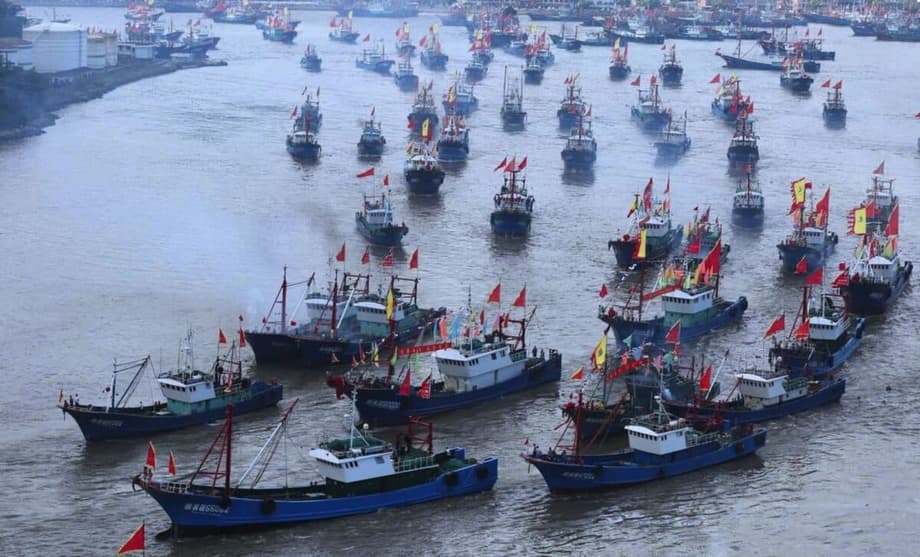
Satellite imagery captured on February 12, 2026, revealed an unprecedented maritime deployment across the East China Sea. Thousands of vessels flying Chinese flags appeared in concentrated grid formations near waters administered by Japan, arranged in dense patterns that maritime analysts describe as inconsistent with commercial fishing operations. The formations, documented through commercial satellite passes conducted in late January and early February, showed tightly packed clusters of hulls maintaining stationary positions over multiple days rather than dispersing according to currents, depth, or marine stock locations.
The visual confirmation triggered immediate enforcement action. Within 24 hours of the imagery publication, Japanese authorities seized a Chinese fishing vessel suspected of violating domestic fisheries law after it entered the territorial waters off Nagasaki prefecture. The Japan Coast Guard arrested the vessels captain around 12:23 p.m. on February 12, marking the first such detention of a Chinese fishing boat since 2022. The Fisheries Agency reported that the vessel had attempted to flee to avoid inspection before being boarded.
Decades of Maritime Friction
The waters involved encompass areas surrounding the Senkaku Islands, a chain of uninhabited islets administered by Tokyo but claimed by Beijing, which refers to them as the Diaoyu Islands. These rocky outcrops, located approximately 105 miles east of Taiwan and 254 miles west of Okinawa, have served as a persistent flashpoint between Asias two largest economies for more than a decade. The islands sit near potential oil and gas reserves, adding economic stakes to the sovereignty dispute.
According to the Japan Coast Guard, Chinese government vessels entered the contiguous zone near the Senkakus 357 times in 2025, setting a record for the fourth consecutive year. Seishiro Sakamoto, commander of Japans 11th Regional Coast Guard, assessed the operational tempo in a statement issued in early 2026.
The situation surrounding the Senkaku Islands is becoming increasingly severe, and the situation remains unpredictable. We will continue to conduct surveillance and vigilance activities with a high sense of urgency so as not to miss even the slightest change and will take all possible measures to protect our territorial waters.
The contiguous zone extends 24 miles beyond the 12-mile territorial limit, where countries may exercise limited control under international law. Chinese ships also sailed into the territorial waters themselves 27 times last year, with eight instances involving the chasing of Japanese fishing vessels past the territorial limit. Historical patterns show that tensions over the Senkakus tend to escalate in cycles, with each crisis establishing new operational baselines that never fully return to pre-crisis norms. In September 2010, a Chinese fishing trawler collided with Japanese Coast Guard patrol vessels near the islands, triggering a diplomatic freeze and rare earth export restrictions from Beijing. Two years later, Tokyos decision to nationalize three of the islands from private ownership prompted China to establish regular coast guard patrols in surrounding waters, fundamentally altering the maritime status quo.
From Parliamentary Remarks to Open Confrontation
The current crisis follows remarks made by Japanese Prime Minister Sanae Takaichi during a parliamentary session on November 7, 2025. When questioned about regional security scenarios, Takaichi suggested that a hypothetical Chinese military attack on Taiwan could constitute a situation threatening Japans survival, potentially triggering collective self-defense measures under Tokyos security framework. Beijing views self-governed Taiwan as part of its territory and has not excluded the use of force to achieve reunification.
Chinese Foreign Minister Wang Yi labeled Takaichis statement as shocking and accused Japan of having crossed a red line. Beijing launched a global diplomatic campaign against Tokyo, including letters to the United Nations criticizing Japanese policy and coordinated statements from multiple government ministries. Chinese authorities also reinstated a de facto ban on Japanese seafood imports and urged citizens to reconsider travel to Japan, though they stopped short of imposing rare earth export restrictions used during the 2010 crisis.
The rhetorical escalation translated into maritime action on December 2, 2025, when coast guard vessels from both nations engaged in a confrontation near the Senkakus. China claimed it expelled a Japanese fishing boat from Chinese territorial waters, while Japan asserted it intercepted and drove away two Chinese coast guard ships that had approached a Japanese fishing vessel. Both sides issued contradictory accounts of the same encounter, with Chinese spokesperson Liu Dejun stating that Chinese vessels took necessary control measures and the Japan Coast Guard declaring that the Chinese ships had violated international law by asserting claims in Japanese territory.
Patterns That Defy Commercial Logic
The scale and configuration of the February 2026 formations distinguish this episode from seasonal fishing surges. According to analysis published by regional outlets, flotillas consisting of up to 2,000 vessels positioned themselves in coordinated groupings rather than forming the loose, mobile arcs typically associated with trawling operations. Commercial satellite imagery allowed analysts to compare sequential passes, determining that the fleets remained clustered over multiple days rather than drifting, fishing, or dispersing according to weather conditions.
Maritime tracking data indicate that many vessels broadcast civilian Automatic Identification System signals, which vessels use to prevent collisions and identify themselves to maritime authorities. However, AIS compliance does not clarify coordination or intent. Fishing fleets in the East China Sea typically disperse to locate marine stocks, forming operational patterns that differ significantly from the stationary grids documented in recent satellite passes.
Precedent for such coordinated maritime demonstrations exists in the regions recent history. In August 2016, more than 200 Chinese fishing vessels and seven China Coast Guard ships gathered near the Senkaku Islands, repeatedly entering the contiguous zone and territorial waters despite warnings from Japanese authorities. That incident marked a serious departure from previous norms, with more Chinese government ships entering the area in five days than in any full month in the preceding three years.
Tokyo Draws a Line
The February 12 seizure represented a shift from passive monitoring to active enforcement. Japanese law permits the detention of foreign vessels operating without authorization inside territorial waters, though such actions have occurred intermittently over the past decade and usually involve smaller numbers of boats. The captain remains in custody pending investigation, with Japanese authorities determining whether to refer the case to prosecutors based on evidence collected during inspection and questioning.
The Japan Coast Guard increased patrols in the area following the satellite confirmations, deploying vessels and aircraft to monitor the clusters and issue radio warnings when ships approached territorial waters. Japanese officials have described the activity as large-scale but have not publicly attributed the deployments to a formal state directive from Beijing. Chinese foreign ministry briefings reiterated longstanding sovereignty claims over the islands and surrounding waters without directly addressing the specific satellite imagery.
Diplomatic channels between the capitals remain technically open, with Japans foreign ministry lodging protests following reported incursions. However, the relationship has deteriorated to its lowest point in over a decade. Prime Minister Takaichi has maintained approval ratings around 75 percent despite Chinese pressure, and polls indicate majority support among Japanese citizens for the governments firm stance on regional security matters.
Calculating the Next Move
Security analysts suggest the current escalation may result in permanent changes to Japan-China relations and the operational environment in the East China Sea. Historical patterns indicate that following each major crisis in 2010 and 2012, Beijing normalized new behaviors in the disputed waters, establishing regular presences that never returned to pre-crisis levels. After the 2012 nationalization, China began deploying assets inside the territorial waters on a routine basis, and in November 2013 established an air defense identification zone over portions of the sea.
Tokyo has responded to increasing pressure by diversifying economic ties and reducing dependence on Chinese supply chains. Japanese dependence on Chinese rare earths dropped from approximately 90 percent in 2010 to about 60 percent in 2023, with further diversification likely following the current tensions. Japan has also strengthened security relationships with the United States, Australia, and other regional partners, while increasing defense spending and developing capabilities to monitor and respond to maritime incursions.
The risk of further escalation remains significant as both nations link regional security concerns regarding Taiwan to their territorial claims in the East China Sea. Chinese officials have characterized Takaichis government as promoting militarism and have referenced World War II-era United Nations Charter clauses in ambiguous threats regarding potential military action. Japan continues to assert that the Senkaku Islands constitute indisputable Japanese territory under international law and historical fact.
Key Points
- Satellite imagery confirmed thousands of Chinese fishing vessels in grid formations near Japanese waters in February 2026
- Japanese authorities seized one vessel and arrested its captain on February 12, 2026, the first such detention since 2022
- The formations appeared near the Senkaku Islands, administered by Japan but claimed by China as Diaoyu
- Tensions escalated following Prime Minister Sanae Takaichis November 2025 comments regarding potential Japanese military response to a Taiwan contingency
- Chinese coast guard vessels entered the contiguous zone near the islands a record 357 times in 2025
- Analysts note the vessel formations remained stationary in patterns inconsistent with commercial fishing operations