Bridging the Digital Divide from Orbit
Vietnam has officially authorized Elon Musk’s SpaceX to deploy its Starlink satellite internet service nationwide, granting licenses for up to 600,000 user terminals in an initial phase that promises to reshape digital connectivity across the Southeast Asian nation. The Ministry of Science and Technology issued telecommunications licenses to Starlink Services Vietnam Co., Ltd. in mid February, marking the culmination of a nearly year long pilot program and positioning Vietnam as the fifth Southeast Asian country to host the controversial billionaire’s satellite network.
The approval represents more than a routine regulatory decision. It signals Vietnam’s calculated opening to next generation space technology, explicitly designed to reach the mountainous terrain, offshore islands, and remote border regions where fiber optic cables and cellular towers have never reached. With nearly 80% of Vietnam’s 100 million citizens already online, the government is targeting the final connectivity frontier: the 20% living beyond the reach of traditional infrastructure, plus creating resilient backup networks for when typhoons and floods sever undersea cables and terrestrial lines.
Unlike traditional geostationary satellites that orbit at 36,000 kilometers, causing noticeable delays in signal transmission, Starlink operates a constellation of low Earth orbit satellites at approximately 550 kilometers altitude. This proximity enables high speed, low latency internet comparable to fiber optic broadband, capable of supporting video conferencing, online gaming, and remote work applications. By the end of 2025, SpaceX had launched more than 10,000 such satellites, though only about 6,750 remained operational, serving approximately 5 million users across 125 countries and territories.
A Controlled Five Year Experiment
The licensing structure reveals a cautious but deliberate approach by Vietnamese regulators. Rather than immediate unlimited commercial deployment, Starlink enters under a controlled five year pilot framework mandated to conclude before January 1, 2031. This timeline, established under a directive from Deputy Prime Minister Ho Duc Phoc first issued in April 2025, makes Starlink the first foreign entity permitted to test and now commercially operate satellite internet services in Vietnam’s tightly regulated telecommunications sector.
The Ministry of Science and Technology granted two distinct licenses: one covering fixed and mobile satellite telecommunications services, and a separate authorization from the Radio Frequency Department permitting the use of specific radio frequencies and related equipment. This dual licensing ensures Starlink can legally construct transmission and reception infrastructure without interfering with existing wireless networks operated by domestic giants Viettel, VNPT, and MobiFone.
Local science and technology departments nationwide have received instructions to coordinate oversight, ensuring compliance with national defense and security requirements. The regulatory architecture reflects Vietnam’s balancing act: embracing technological innovation while maintaining strict control over information infrastructure in a one party state. The Radio Frequency Management authority specifically mandated that Starlink’s system must ensure “no interference with existing radio communication networks,” a critical technical requirement for approval.
Ground Infrastructure and Gateway Strategy
Technical specifications reveal a methodical rollout plan. The initial phase includes construction of four gateway stations, also known as ground stations, strategically positioned to manage traffic and ensure regulatory oversight. According to regulatory filings and industry sources, one such station is planned for Da Nang, with the potential network eventually expanding to between ten and fifteen facilities nationwide, representing an estimated investment of around $3 million per station.
These gateway stations serve a critical function beyond mere signal routing. All Starlink traffic must pass through these facilities, enabling Vietnamese authorities to monitor and control data flows, store information locally as required by cybersecurity laws, and identify users when necessary. The stations also allow authorities to suspend service on security grounds, addressing established government concerns about uncontrolled internet access.
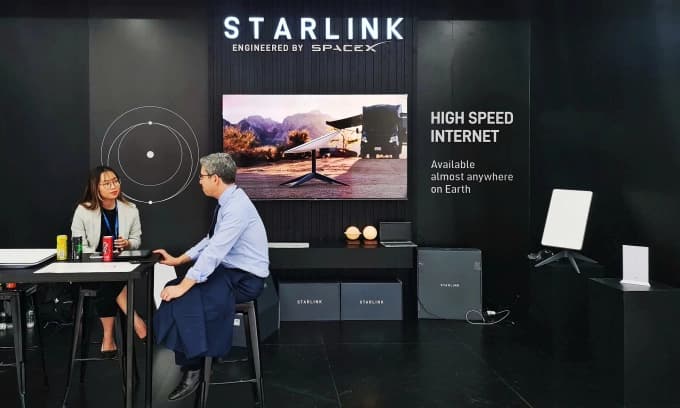
The 600,000-terminal cap represents approximately 0.6% of Vietnam’s population, a deliberately conservative figure that allows regulators to assess network impact and spectrum management before potential expansion. Each terminal, typically a compact dish antenna weighing a few kilograms, connects to the satellite constellation to deliver broadband speeds. Starlink first demonstrated this capability in Vietnam at the Vietnam International Innovation Expo in October 2023, held in Hanoi’s Hoa Lac area, where it achieved speeds of approximately 200 Mbps during testing.
Local Leadership and Corporate Structure
Behind the technical deployment lies a carefully structured corporate entity designed to satisfy Vietnam’s local presence requirements. Starlink Services Vietnam Co., Ltd., headquartered in Hanoi’s Cua Nam Ward, operates with a charter capital of approximately $1.15 million and is wholly owned by Starlink Holdings Netherlands B.V., a SpaceX affiliate based in Amsterdam. This Dutch holding company structure is common for multinational tech firms seeking to manage international tax and liability concerns while operating in specific national markets.
In a notable concession to local regulations, SpaceX appointed Do Ba Thich, a 36-year-old Vietnamese national from Hanoi, as Chief Executive Officer. Lauren Ashley Dreyer, an American citizen born in 1983, serves as chairwoman and legal representative. This hybrid leadership structure, common for foreign tech entrants in Vietnam, ensures local accountability and government relations while maintaining ultimate corporate control with the parent company.
The establishment of this legal entity in late 2025 followed the pilot license approval, allowing SpaceX to proceed with full commercial licensing applications. Industry analysts suggest this corporate architecture supports potential future investments, with earlier reports indicating SpaceX may invest up to $1.5 billion in Vietnamese operations depending on pilot program success. However, Starlink has not yet announced an official commercial rollout date, with its website currently listing Vietnam as “coming soon.”
Geopolitical Calculations and Trade Tensions
The approval’s timing carries significant geopolitical weight. The announcement came just days before Communist Party General Secretary To Lam’s scheduled travel to Washington to attend the inaugural meeting of President Donald Trump’s Board of Peace initiative on February 19, and amid tense bilateral trade negotiations. The United States imposed 20% tariffs on Vietnamese exports last year, prompting six rounds of talks toward a new trade agreement that remains unresolved.
Analysts view the Starlink licensing as a strategic olive branch to the Trump administration, particularly given Elon Musk’s role as a close presidential advisor and head of the Department of Government Efficiency. Vietnam’s manufacturing dependent economy, which recorded 8% growth last year despite tariff pressures, aims for double digit expansion this year, making improved US trade relations economically vital.
However, the timing also reflects Vietnam’s independent digital transformation agenda. By approving Starlink before concrete trade breakthroughs, Hanoi demonstrates sovereignty over its telecommunications policy while still signaling goodwill toward American investment. The dual use nature of satellite internet, offering both civilian connectivity and potential military communications applications, adds another layer of strategic calculation to the licensing decision. Vietnam maintains strict cybersecurity laws requiring data localization and government access to networks, conditions Starlink must satisfy despite its historical resistance to such requirements in other markets.
Complementing Rather Than Competing
Despite the fanfare surrounding Starlink’s entry, telecommunications experts predict limited disruption to Vietnam’s established market. Doan Quang Hoan, vice chairman of the Radio-Electronics Association of Vietnam and former head of the Radio Frequency Department, notes that coverage gaps in Vietnam are relatively small and geographically concentrated in areas often lacking national power grid access.
Satellite internet could quickly eliminate remaining coverage gaps in Vietnam. However, its impact on the domestic telecom market is likely to be limited because current coverage gaps are relatively small and largely confined to areas without access to the national power grid.
Vietnam has built Southeast Asia’s most dynamic internet ecosystem, with three major state linked operators dominating: Viettel (military owned), VNPT (former monopoly carrier), and MobiFone. These companies have invested billions in fiber to the home networks and 4G/5G mobile coverage, reaching most populated areas with competitive speeds and pricing. Urban centers enjoy widespread gigabit fiber broadband, while mobile penetration exceeds 100% nationally.
Where Starlink offers unique value is resilience. During a December 2025 press briefing, Telecommunications Authority representatives stressed satellite internet’s role as a crucial reserve channel during natural disasters. Unlike fiber optic cables, occasionally disrupted by anchor strikes, earthquakes, or maintenance accidents in the seabed, satellite connections bypass terrestrial infrastructure entirely.
Satellite internet is a crucial reserve channel during natural disasters, because it does not rely on terrestrial transmission lines.
For remote islands in the South China Sea or mountainous border regions near Laos and China, Starlink eliminates the economic impracticality of laying fiber through difficult terrain. The service complements rather than competes with ground networks, filling the final gaps in universal service obligation goals while providing redundancy during emergencies when traditional networks fail.
The Essentials
- Vietnam granted SpaceX licenses to operate up to 600,000 Starlink terminals and four gateway stations during a five year pilot ending before January 1, 2031
- The Ministry of Science and Technology issued telecommunications and radio frequency licenses to Starlink Services Vietnam Co., Ltd., a local entity with Vietnamese CEO Do Ba Thich
- Service targets remote mountainous regions, border areas, and islands where traditional fiber optic infrastructure is unavailable or unreliable
- Approval comes amid US Vietnam trade negotiations and ahead of Communist Party leader To Lam’s visit to Washington for President Trump’s Board of Peace meeting
- Experts predict limited market disruption to dominant domestic carriers Viettel, VNPT, and MobiFone, viewing Starlink primarily as a complement for coverage gaps and disaster resilience
- All traffic must route through government controlled gateway stations, ensuring compliance with Vietnam’s cybersecurity and data localization requirements