Small Gains Leave Two Export Economies Under Pressure
Japan grew just 0.1% in the final quarter of 2025, while Switzerland expanded 0.2%, allowing both economies to avoid a technical recession after shrinking in the previous quarter. The figures, announced within hours of each other on February 16, 2026, showed how little momentum two major manufacturing economies had regained amid trade disputes and weaker consumer demand across the Northern Hemisphere.
Contents
- Small Gains Leave Two Export Economies Under Pressure
- Japanese Households Provide Limited Support
- Trade Disputes Weigh on Japan's Recovery
- Switzerland Recovers as Industry Stalls
- The Yen and Franc Move in Opposite Directions
- Takaichi's Election Mandate Meets a Weak Economy
- Green Investment Offers Another Route for Japan
- How the Figures Compare Across Major Economies
- British Defense Shares Rise on Spending Prospects
- Corporate Setbacks Contrast With Housing Stability
- Key Points
Japan's quarterly increase translated into an annualized growth rate of 0.2%. Economists had expected growth of 0.4% from the previous quarter, or about 1.6% annualized. The actual quarterly gain was less than a third of the forecast, putting immediate pressure on the yen and presenting a growth challenge for Prime Minister Sanae Takaichi after her sweeping election victory.
Switzerland's 0.2% increase was measured against the previous quarter. Although it matched Japan's annualized headline figure, the two numbers describe different periods. Quarterly growth measures the change over three months; an annualized rate expresses the pace that would result if that quarterly performance continued for a year.
Japan had contracted by a downwardly revised 0.7% in the third quarter, equivalent to an annualized decline of 2.6%. Switzerland had shrunk by 0.5% over the same period. A technical recession commonly means two consecutive quarters of falling economic output, so their small gains broke that sequence.
Both countries nevertheless entered 2026 with weak growth. Japan relied heavily on a small rise in household spending, while Switzerland's services sector provided modest support as industry stagnated. Their results showed the strain that trade barriers and uncertain demand were placing on economies with substantial business abroad.
Japanese Households Provide Limited Support
Private consumption, which accounts for more than half of Japan's economic output, rose 0.1% in the fourth quarter. Household spending provided the main support for the recovery, although its increase was much smaller than the 0.4% recorded between July and September.
Japanese consumers continued spending despite pressure on their budgets, but the figures left the durability of that spending uncertain. Government measures intended to ease prices could help households, while wages would need to rise faster than prices to increase their purchasing power.
Shinichiro Kobayashi, chief economist at Mitsubishi UFJ Research and Consulting, described the strength of consumption and the conditions needed to sustain it:
Personal consumption showed resilience, but whether this resilience can be sustained will depend on whether price relief measures will make an impact and whether real wages will turn positive.
Real wages measure what earnings can buy after accounting for inflation. A worker can receive a higher salary and still afford less if prices rise faster. Kobayashi's assessment placed household purchasing power at the center of Japan's growth outlook.
Business investment offered only limited help. Capital expenditure, the money companies spend on assets such as equipment and buildings, increased 0.2%, against expectations of 0.8%. That shortfall showed the uncertainty facing manufacturers and weakened another traditional source of growth driven by private demand.
Net external demand contributed nothing to the quarter's growth. This measure combines the effect of exports and imports on economic output. Exports fell less sharply than before, but trade failed to provide a positive contribution to Japan's modest rebound.
Trade Disputes Weigh on Japan's Recovery
Japan's exporters faced a formalized baseline U.S. tariff of 15% on Japanese imports. The rate was lower than the initial 27.5% tariff on automobiles and the threatened 25% rate on other goods, but it continued to disrupt supply chains across the Pacific.
Tariffs are taxes on imported goods. They can raise the cost of selling into a foreign market and force companies to reconsider prices, production and investment. Japan's weak capital spending and falling exports came against that uncertain trading environment.
Tokyo's diplomatic dispute with Beijing over Taiwan security issues added another source of pressure. Chinese tourism to Japan nearly halved, while Chinese consumers boycotted Japanese goods. The deterioration affected both demand for products and spending by visitors.
Japan therefore faced difficulties in two important areas of international business: access to the U.S. market and commercial relations with China. The milder decline in exports offered some relief, but household spending remained crucial while those pressures persisted.
Switzerland Recovers as Industry Stalls
Switzerland's State Secretariat for Economic Affairs attributed the country's 0.2% quarterly expansion to muted growth in services. Industry stagnated under international pressure, leaving the recovery from the third quarter's 0.5% contraction modest.
Switzerland grew 1.4% across the full calendar year of 2025, compared with 1.2% in 2024. That improvement of 0.2 percentage points still left annual growth below the country's historical average of 1.8% since 1981.
President Donald Trump's trade war had imposed a particularly steep barrier on Swiss exports. U.S. tariffs were initially set at 39%, before an agreement in November reduced them to 15%. The reduction eased the burden, although exporters continued to face the remaining tariff.
Swiss services exports grew at rates above their historical average even as industries dependent on overseas sales struggled. Financial stability also continued to attract investors seeking a safer place for their money during uncertain conditions.
Manufacturing purchasing managers' index data suggested sustained expansion in the industrial sector, providing an underlying source of support. Such surveys track business conditions reported by purchasing managers, while the quarterly economic figures showed that industry's contribution to output had stagnated.
The Swiss recovery consequently combined stronger services exports with weak industrial output. Its annual growth improved, but the final quarter showed how difficult it remained to build momentum under trade restrictions.
The Yen and Franc Move in Opposite Directions
The yen weakened beyond 153 to the dollar after Japan's disappointing growth figures. Traders adjusted their expectations for Bank of Japan interest rate policy, anticipating that the central bank might delay further steps toward more normal monetary conditions.
Lee Hardman, a currency expert at MUFG bank, explained the depreciation as a repricing of policy expectations. Weak growth reduced market confidence that the Bank of Japan would raise interest rates aggressively. The dollar moved from levels just above 152 yen to more than 153 yen.
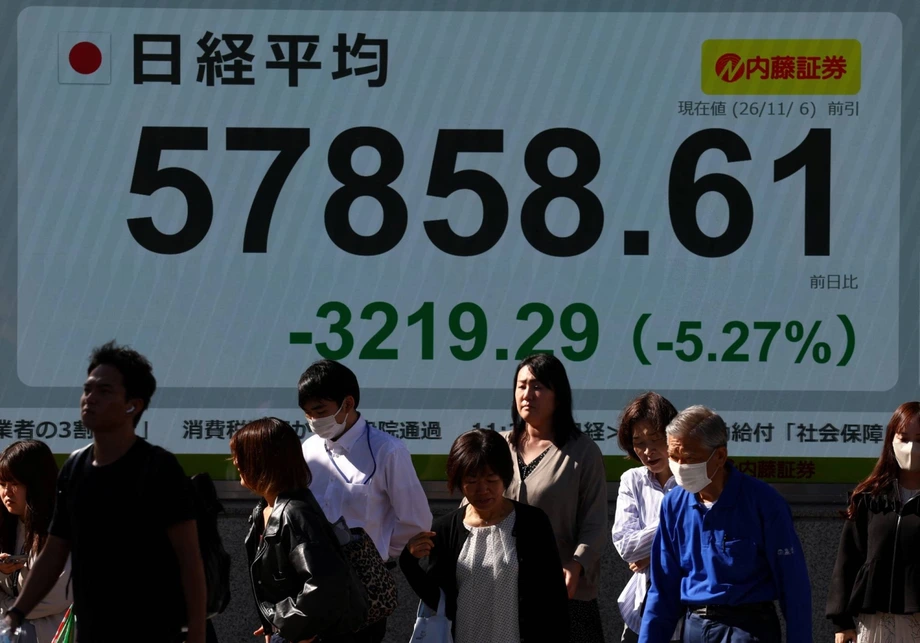
Tokyo's stock market also struggled with the figures. Masahiro Ichikawa, chief market strategist at Sumitomo Mitsui DS Asset Management, observed that investors found it difficult to interpret the release as anything other than concerning news. The Nikkei 225 fell 0.24%, while the broader Topix lost 0.8%.
The Swiss franc strengthened against the dollar as government bond yields rose. The USD/CHF currency pair declined about 0.8% during recent trading sessions, reaching levels last seen in early February. A falling dollar to franc exchange rate means fewer francs are needed to buy a dollar.
Swiss government bonds maturing in 10 years saw their yields rise by 12 basis points to 1.42%. A basis point is one hundredth of a percentage point, so that increase was 0.12 percentage points. Swiss economic resilience encouraged speculation about tighter monetary policy as inflation approached 1.8%.
The Swiss National Bank and Bank of Japan both faced a balancing task: supporting growth while managing inflation and exchange rates. Currency weakness can make imported goods more expensive, adding pressure to household budgets. Their currencies' opposing movements reflected different market expectations about how each central bank would respond.
Takaichi's Election Mandate Meets a Weak Economy
Prime Minister Sanae Takaichi's Liberal Democratic Party won 316 of the lower house's 465 seats in the recent election, its largest majority since the party's establishment in 1955. The historic victory gave her a supermajority and substantial political room to pursue her agenda.
The result theoretically strengthens her ability to advance controversial constitutional revisions and expansive fiscal stimulus. Japan's weak growth, however, makes the economic side of that agenda more urgent and complicates decisions about spending and borrowing.
Takaichi campaigned on a modified version of Abenomics, with aggressive government spending financed partly through debt issuance. She has already unveiled a stimulus package worth ¥21.3 trillion, described as approximately $100 billion, to support growth and protect households from inflation.
A suspension of the food sales tax for two years is also under consideration. Takaichi insists that savings and subsidy reforms would pay for that measure, rather than new borrowing. The tax proposal remains under consideration.
Her first bilateral meeting with Bank of Japan Governor Kazuo Ueda since the election took on greater importance after the GDP release. Markets were seeking clarity on whether the central bank would continue normalizing monetary policy despite the disappointing growth figures.
Fiscal hawks warned that Japan's public debt, already exceeding 240% of GDP, restricts its capacity for further stimulus without unsettling the bond market. GDP measures the value of goods and services produced by an economy; debt above 240% of GDP means the accumulated public debt exceeds twice that annual output.
Government spending can support demand, but financing it requires attention to borrowing costs and investor confidence. Takaichi's large parliamentary majority gives her political strength, while the debt burden and weak recovery shape the financial choices available to her.
Green Investment Offers Another Route for Japan
Japan's GX League, a voluntary coalition of 750 companies with high emissions, provides another avenue for structural reform and business investment. The group is piloting mechanisms that put a price on emissions ahead of mandatory implementation in 2026.
Emissions pricing attaches a financial cost to pollution, giving companies a reason to consider equipment and production methods that release less carbon. The program could encourage capital spending on decarbonization at a time when Japan's broader investment growth remains weak.
Japan's Green Transformation Plan aims to mobilize nearly €1 trillion in public and private investment over the next decade. Its targets include renewable energy penetration of 36% to 38% and electric vehicles accounting for 20% of new car sales by 2030.
Those goals place longer term investment alongside the government's immediate effort to support household spending. The weak fourth quarter figures make both priorities relevant: relief for consumers now and investment that can support production in the years ahead.
How the Figures Compare Across Major Economies
Japan's quarterly growth of 0.1% matched the United Kingdom's result, placing both near the lower end of the available Group of Seven figures. Switzerland's 0.2% expansion also sat among the weaker results when compared with those major economies.
Germany and Italy each grew 0.3% in the fourth quarter, while France expanded 0.2%. These figures showed modest gains across several European economies, rather than a strong recovery shared by all.
The United States and Canada had not yet reported their final quarter figures as of February 16. U.S. growth was expected to moderate toward an annualized rate of 3.5%, following 4.4% in the third quarter. Those annualized figures use a different time basis from the quarterly European comparisons.
The U.S. outlook reflected support from resilient consumer spending and a strong technology sector. Economies in Asia and Europe with greater dependence on manufacturing exports continued to absorb the disruption caused by trade fragmentation, as tariffs and disputes complicated international commerce.
The sequence of recent developments helps explain the pressure entering 2026:
- July to September 2025: Japan contracted 0.7%, while Switzerland's economy shrank 0.5%.
- November 2025: An agreement reduced U.S. tariffs on Switzerland from 39% to 15%.
- October to December 2025: Japan returned to growth of 0.1%, while Switzerland expanded 0.2%.
- February 16, 2026: The growth releases focused market attention on central bank decisions and government spending.
British Defense Shares Rise on Spending Prospects
London's defense stocks rose as Asian markets absorbed the weak growth news. Reports suggested that the British government could bring forward its target of spending 3% of economic output on defense to the end of the current parliament, instead of waiting until the next legislative session.
Babcock gained 2.5%. The engineering company supports naval, land, air and nuclear operations, including the United Kingdom's fleet of submarines powered by nuclear reactors. Aerospace parts supplier Melrose rose 2.2%, while BAE Systems advanced 1.3%.
The prospect of faster spending followed Prime Minister Keir Starmer's weekend address to the Munich Security Conference. He urged European nations to increase their NATO commitments and avoid excessive dependence on American defense guarantees.
The United Kingdom had already pledged to reach defense spending of 2.5% of GDP by 2027. Moving toward 3% sooner would represent a larger fiscal commitment while the government also faced competing demands for domestic spending. The accelerated timetable was a reported possibility, rather than an announced decision.
Corporate Setbacks Contrast With Housing Stability
SkinBioTherapeutics shares fell more than 40%, following a 50% decline on Friday, after the company disclosed accounting irregularities connected to its former chief executive, Stuart Ashman. The successive falls deepened the damage to its market value.
The board said £770,000 in accrued royalty income included in the previous year's results would likely be removed from the accounts following an investigation into Ashman's conduct. Accrued income is revenue recorded before the related payment has been received.
The company said material information had been misrepresented to its board, auditors and advisers. The expected accounting change placed the reliability of the previously recorded royalty income at the center of the corporate controversy.
Pinewood.AI fell nearly 30% after investment group Apax Partners abandoned takeover discussions, citing challenging market conditions. Pinewood supplies software management systems to car dealers and maintained that its prospects over the longer term remained strong, pointing to recurring revenue and established partnerships with original equipment manufacturers.
Britain's housing market provided a more stable picture. Rightmove reported that competition among sellers had reached its highest level in 11 years, giving buyers considerable negotiating power. The average asking price for a newly listed home was £368,019, down just £12 during the month and unchanged from a year earlier.
The virtually flat prices followed a record seasonal increase in January. Rightmove property expert Colleen Babcock attributed the stability to a record number of sellers entering the market early since Boxing Day. The supply of homes met pent up demand without pushing asking prices higher.
Net confidence among buyers and sellers recovered to September 2025 levels after uncertainty surrounding November's budget passed. A possible Bank of England interest rate cut in March could provide further support as the spring selling season approaches.
Key Points
- Japan grew 0.1% in the fourth quarter of 2025, equivalent to 0.2% annualized, well below expectations.
- Switzerland expanded 0.2% after a 0.5% contraction, with services supporting growth while industry stagnated.
- Japanese consumption rose 0.1%, capital expenditure increased 0.2%, and net external demand contributed nothing to growth.
- U.S. tariffs and Japan's dispute with China continued to pressure trade and business confidence.
- Takaichi's 316 seats give her a powerful mandate, but weak growth and public debt above 240% of GDP complicate spending choices.
- The yen weakened beyond 153 to the dollar, while the Swiss franc strengthened and Swiss bond yields rose.
- British defense shares gained on the prospect of faster spending, while SkinBioTherapeutics and Pinewood.AI suffered steep falls.
- British asking prices remained near £368,019 as competition among home sellers reached an 11 year high.