Tokyo Reopens After a Historic Friday Rout
Financial markets in Japan face a decisive four days of trading starting Tuesday, November 24, 2026, after a steep global retreat from artificial intelligence stocks triggered one of the largest single session drops in Tokyo market history. Investors spent Monday, November 23, absorbing overseas market swings while the Tokyo Stock Exchange remained closed for Labor Thanksgiving Day.
Contents
- Tokyo Reopens After a Historic Friday Rout
- How Three Companies Drove Almost Half the Drop
- Why Wall Street Lost Faith in the Artificial Intelligence Boom
- Mixed Trading Across Asia Gives Tokyo Clues Before the Open
- Why a Weak Yen Squeezes Japanese Families and Businesses
- The Bank of Japan Faces a Tough Rate Decision and Bond Test
- Key Events Shaping Markets From November 24 to 27
- Can Tokyo Find Stability Beyond Chip Giants
- The Bottom Line
Before the holiday, Friday, November 20 brought heavy selling across Japanese equities. The benchmark Nikkei 225 plunged 3,007.56 points, or 5.06 percent, to finish at 56,436.65, marking its fifth largest point decline ever recorded and its lowest closing level since April 9. The broader TOPIX index dropped 148.25 points, or 3.88 percent, to end at 3,674.22.
Selling pressure swept across nearly the entire Tokyo market rather than staying confined to one corner. Out of more than 1,500 companies traded on the top tier Prime Market on Friday, roughly 90 percent fell, 8 percent rose, and 1 percent finished unchanged, with nonferrous metals, electric appliances, and glass and ceramics leading the decline.
For the full week ending November 20, the Nikkei fell more than 7 percent. Since hitting an all time record high of 72,366.34 on June 25, 2026, the index has shed 15,929.69 points, a drop of roughly 22 percent. In market terms, a fall of 10 percent from a peak is known as a correction, while a drop of 20 percent or more is labeled a technical bear market, signaling prolonged pessimism among buyers. Even after that slide, the Nikkei remains up 17 percent over the past 12 months.
How Three Companies Drove Almost Half the Drop
Understanding why the Nikkei 225 dropped much more sharply than the TOPIX comes down to how each index calculates its score. Most major global indexes weigh companies by total market value, while the Nikkei weighs companies by the price of a single share, giving stocks with high share prices outsized power to pull the average up or down.
Just three technology and semiconductor names accounted for roughly 1,335 yen, or about 44 percent, of the Nikkei index drop on November 20. Chip testing equipment maker Advantest pulled the index down by about 602 yen as its shares tumbled 10.3 percent. Technology investor SoftBank Group shaved off about 414 yen after plunging 14.5 percent, leaving the stock more than 60 percent below its highest level over the past 52 weeks. Semiconductor toolmaker Tokyo Electron subtracted roughly 319 yen as its shares fell 7.1 percent.
Losses spread rapidly across companies supplying chips, memory, and materials for data centers. Cable and optical supplier Fujikura sank 12.2 percent, memory chip maker Kioxia Holdings dropped 11.7 percent to stand nearly 80 percent below its recent peak, Lasertec fell 9.2 percent, and chip equipment maker Disco declined 8.3 percent. Infrastructure and material suppliers Mitsui Mining and Smelting and Furukawa Electric each dropped more than 10 percent.
Defensive shares outside technology offered rare shelter during Friday's turmoil. Insurance companies led gains on the Nikkei, with Tokio Marine Holdings climbing 3 percent as the top performer, MS&AD Insurance advancing 2.83 percent, and Sompo Holdings rising 1.71 percent. Pharmaceutical makers Takeda Pharmaceutical and Shionogi & Co posted modest gains of 0.63 percent and 0.4 percent.
Why Wall Street Lost Faith in the Artificial Intelligence Boom
Behind Tokyo's slump sits a growing debate on Wall Street over whether massive corporate spending on artificial intelligence will generate enough profit to justify high stock valuations. Technology research firm Gartner projects global spending tied to artificial intelligence will hit $2.7 trillion in 2026 and $3.6 trillion in 2027, prompting comparisons to the internet stock bubble that burst in 2000.
Market hopes briefly centered on artificial intelligence startup Anthropic, which completed a record $81 billion initial public offering in New York on November 19. Priced at $83 a share on November 18, Anthropic became the first major frontier artificial intelligence developer to trade publicly. Chief Executive Officer Dario Amodei rang the opening bell Thursday morning after a listing filing that highlighted potential breakthroughs in biology, medicine, economic growth, and public services.
Anthropic shares opened 34 percent above their offering price at $111.50 and climbed as high as $115.10 before losing momentum to close Thursday at $97.17, up 17 percent. On Friday, November 20, the stock fell 9 percent to close at $88.91 after briefly dipping near $83, draining cash from competing technology shares rather than sparking a rebound.
Confidence in semiconductor demand also took a hit earlier in the week from chip giant Nvidia, long viewed as the financial engine of artificial intelligence because it both builds advanced processors and invests heavily in cloud computing startups. On November 17, Nvidia reported August to October 2026 revenue and net income roughly double the level of a year earlier, projecting $130 billion in revenue for the November 2026 to January 2027 quarter.
Investors largely looked past those record sales to focus on leadership and regulatory troubles following the resignation of longtime Chief Executive Officer Jensen Huang amid an alleged espionage scandal and calls for tighter curbs on chip sales to China. Reports of an accounting inquiry by the United States Securities and Exchange Commission added further pressure. At the earnings briefing, Chief Financial Officer and acting Chief Executive Officer Colette Cress stated that Huang would not return as chief executive and signaled greater caution when picking future investments. Nvidia shares slid more than 3 percent on November 18 and fell 14 percent on November 20.
Broader Wall Street benchmarks suffered heavy losses on Friday as short seller Hunterbrook Capital released a critical report on chipmaker AMD regarding its dependence on Chinese markets and supply chains. The Philadelphia Semiconductor Index plunged 11 percent, while the technology heavy Nasdaq Composite sank 5.3 percent to wipe out all its gains for 2026. The S&P 500 dropped 3.7 percent into a 10 percent correction, and the Dow Jones Industrial Average fell more than 900 points for a fifth straight losing day, weighed down further by soft sales guidance from retailer Walmart and renewed tensions in the Middle East.
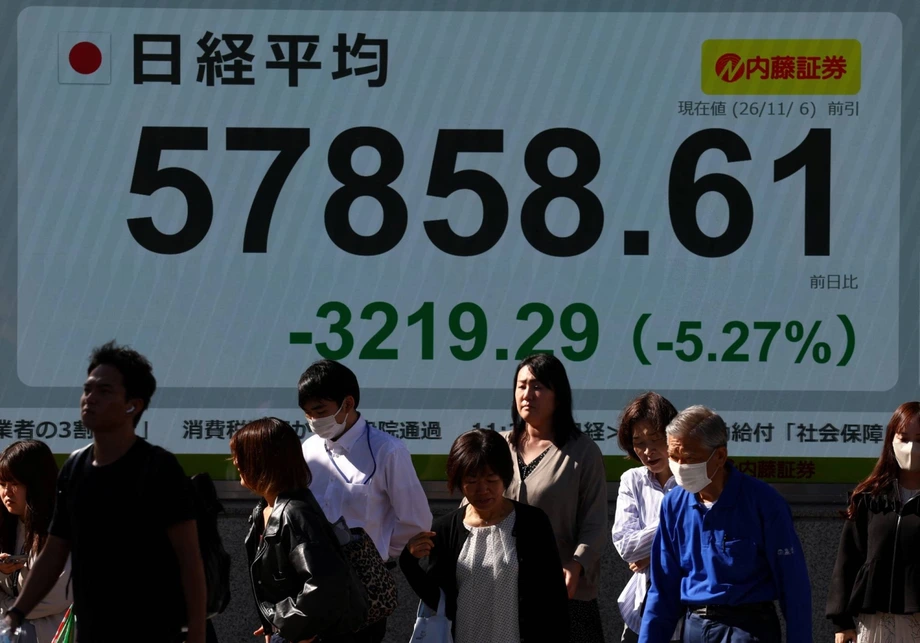
Political shifts in Washington have compounded these concerns. A landslide victory by the Democratic Party in United States midterm elections earlier in November raised expectations that stricter rules could slow construction of energy hungry data centers, a worry that had already pushed the Nikkei down 6 percent to 57,434.77 on November 6.
Mixed Trading Across Asia Gives Tokyo Clues Before the Open
Trading across neighboring Asian markets on Monday, November 23, offered Tokyo investors a mixed picture ahead of Tuesday's reopening. In Seoul, the Korea Composite Stock Price Index fell as much as 5.8 percent before closing down 3.3 percent, weighed down by memory chip leaders Samsung Electronics, down 3.1 percent, and SK Hynix, down 2.5 percent. Hong Kong's Hang Seng Index edged down 0.1 percent after sliding nearly 2 percent earlier in the session, while Shanghai's CSI 300 Index reversed a 1 percent drop to gain 0.1 percent and Taiwan's Taiex rallied 2.2 percent.
Early signals from United States equity futures pointed toward stabilization, with S&P 500 futures rising 2.2 percent and Nasdaq futures advancing 2.9 percent on Monday. Investors are trying to gauge whether last week's selling pushed valuations too low. Rajat Agarwal, an Asia equity strategist with Societe Generale, described the sudden drop in American technology benchmarks as extreme.
I think markets are trying to find some ground after a massive sell-off in [the] US on Friday, a more than a three-standard-deviation event in tech indices.
Trade figures from South Korea offered a counterweight to fears of collapsing chip demand, showing total exports jumped in the first 20 days of November as semiconductor shipments surged 294.4 percent from a year earlier. Khoon Goh, head of Asia research at ANZ, said that underlying trade strength could steady nerves even as artificial intelligence valuations remain the main worry.
AI-related concerns will continue to dominate this week, as investors try to determine if the bottom is near. A bright spot is that US equity futures are up and South Korea reported very strong exports for the first 20 days of November, driven by semiconductor exports, which are up 294.4 percent year-on-year.
Several Japanese market strategists expect a lengthy period of ups and downs before the Nikkei threatens its June peak again. Eiji Sato, senior analyst at Mitsui Sumitomo Insurance, noted that the midterm elections cooled excessive optimism and said factors including Huang's departure, Anthropic's listing, and American interest rate policy could keep volatility high for roughly six months.
AI is a long-lasting theme, so I believe occasional corrections like this are a sign of a healthy market.
Masahiro Ichikawa, chief market strategist at Sumitomo Mitsui DS Asset Management, noted that Friday's buyers lacked a clear catalyst to step back in after excessive spending had run ahead of proven profits. Citing past recoveries, including the roughly four months required for Tokyo shares to rebound after United States tariff shocks in April 2025, Ichikawa argued that reclaiming the 72,000 level takes time.
Based on the past cases, if this turns out to be just a temporary market correction, the Nikkei could test its recent high again within several months or a year.
Brokerage Nomura Securities took an even more cautious stance following the midterm elections, lowering its Nikkei target to 62,000 for December 2026, 66,000 for December 2027, and 72,000 for December 2028, down from earlier projections of 73,000 next year and 76,000 in 2028. Nomura noted added downward pressure from the Bank of Japan's October decision to raise its annual sales of exchange traded funds, often called ETFs, from 330 billion yen in January to 860 billion yen ($5.3 billion).
Why a Weak Yen Squeezes Japanese Families and Businesses
Alongside stock swings, currency traders remain focused on the yen, which recently hovered near 159 per dollar after approaching 160 earlier in November. When investors sought safer assets during Friday's stock tumble, the dollar slipped slightly to 159.19 to 159.20 yen at 5 p.m. in Tokyo, down from 159.69 to 159.71 yen a day earlier, before the yen strengthened further toward the middle of the 158 yen range in New York trading. The euro traded at $1.0983 to $1.0984 and 174.85 to 174.89 yen late Friday in Tokyo.
Currency pressure persists largely because interest rates in the United States remain far above rates in Japan, drawing global funds toward the dollar. On November 20, United States Treasury notes maturing in 10 years yielded 4.94 percent even after falling 0.10 percentage point on safety buying, compared with 2.785 percent on Japanese government bonds of the same maturity.
For everyday households and businesses in Japan, a weak yen brings mixed consequences. Major exporters such as Toyota, Honda, Nissan, and industrial machinery makers earn higher yen profits when converting overseas sales back home, though tariffs, electric vehicle rivalry, and costly imported components can eat into those gains. At the same time, a weak currency pushes up domestic bills for imported oil, liquefied natural gas, groceries, and raw materials, straining household budgets as well as airlines, trucking firms, and energy heavy manufacturers.
Japanese authorities have repeatedly warned against sudden currency swings, keeping traders alert for potential government intervention to buy yen if the currency slides back toward 160. Selling dollars to support the yen can slow rapid declines, yet such steps often struggle to turn the tide if strong American economic data keeps United States interest rates high.
The Bank of Japan Faces a Tough Rate Decision and Bond Test
Monetary policy adds another layer of tension ahead of the Bank of Japan's final policy meeting of 2026 in December. After raising its benchmark interest rate in June and lifting it to 1.25 percent in September, Governor Kazuo Ueda indicated on November 19 that the central bank intends to continue tightening policy because underlying inflation stays firm. A November 20 survey of economists showed a majority expect a rate increase to 1.5 percent in December, with additional moves possible before March 2027.
Traders will examine remarks from Bank of Japan policy board member Naoki Tamura on Thursday, November 26, for clues on how quickly rates might climb. The central bank faces a narrow path because Japan's economy unexpectedly shrank during the July to September quarter as elevated food and energy costs held back consumer spending. Even though major employers have raised pay, inflation has eroded real purchasing power, while small and medium businesses often lack the pricing muscle to pass rising labor, material, and loan expenses on to customers. Holding rates too low risks weakening the yen further, whereas raising rates too fast could stall domestic demand.
Japan's government bond market will test investor confidence on Tuesday, November 25, when the government auctions roughly 300 billion yen in bonds maturing in 40 years. Yields on benchmark Japanese government bonds maturing in 10 years closed Friday at 2.785 percent, down 0.035 percentage point as anxious equity investors sought safety, yet still elevated near 2.8 percent compared with Japan's long era of near zero interest rates.
Rising yields matter deeply for Japan because of its enormous public debt. Prime Minister Sanae Takaichi plans to bolster economic security, back strategic industries, and spur domestic investment, partly by using proceeds from the Bank of Japan's ETF sales. Weak demand at Tuesday's bond auction could drive borrowing costs higher and spark fresh debate over long run fiscal sustainability. Higher yields also present shifting trade offs for financial firms, improving lending margins for banks while threatening valuation losses on older bond holdings at banks and insurers.
Key Events Shaping Markets From November 24 to 27
Events spanning early November through this week highlight how tightly Japanese stocks, bonds, and currency moves remain linked to economic releases in both Tokyo and Washington:
- November 6: Nikkei 225 drops 6 percent to 57,434.77 after Democratic Party gains in United States midterm elections spark data center regulation fears.
- November 17: Nvidia posts record quarterly earnings and a $130 billion sales forecast, overshadowed by Jensen Huang's resignation and cautious investment guidance.
- November 19: Anthropic debuts on Wall Street at $83, rises to $115.10, and closes at $97.17; Bank of Japan Governor Kazuo Ueda signals further rate increases.
- November 20: Anthropic falls 9 percent to $88.91; Nasdaq drops 5.3 percent; Nikkei 225 plunges 3,007.56 points to 56,436.65.
- November 23: Tokyo markets close for Labor Thanksgiving Day; South Korea's Kospi falls 3.3 percent while Taiwan's Taiex gains 2.2 percent.
- November 24: Tokyo trading resumes, reacting to Wall Street futures and regional chip trade data.
- November 25: Japan auctions 300 billion yen in bonds maturing in 40 years and releases October corporate services prices; the United States publishes Personal Consumption Expenditure inflation data.
- November 26: Bank of Japan board member Naoki Tamura speaks and Japan issues revised leading economic indicators; United States markets close for Thanksgiving.
- November 27: Preliminary November Tokyo consumer inflation data arrives ahead of a shortened post holiday trading session on Wall Street.
Friday's preliminary November consumer price report for Tokyo stands out as the week's main domestic gauge. Core consumer prices in the capital, which exclude fresh food, rose 2.6 percent in October from a year earlier, staying above the Bank of Japan's 2 percent goal. Faster inflation in services and everyday goods would strengthen the case for a December rate hike, just as hotter United States Personal Consumption Expenditure price figures on Wednesday could keep the dollar strong. Thinner trading volumes around Thursday's Thanksgiving holiday in the United States could make currency, bond, and futures swings sharper than usual.
External pressures stretch beyond Washington as well. Japanese automakers, electronics producers, chemical makers, and tourism operators continue tracking sluggish consumer demand, industrial competition, and diplomatic friction with China. Global energy market instability also keeps fuel import costs in focus, pushing investor attention toward companies working on renewable power, nuclear technology, and energy efficiency as Japan tries to cut its reliance on imported fossil fuels.
Can Tokyo Find Stability Beyond Chip Giants
Over the coming four sessions, investors in Tokyo must determine whether any early bounce signals genuine stabilization or a brief pause before further selling. Sharp declines often tempt bargain hunters and prompt traders who bet against stocks to buy back shares, creating quick rallies that can fade if core concerns over artificial intelligence returns, inflation, and borrowing costs remain unresolved.
Friday's drop exposed the danger of relying too heavily on a narrow group of semiconductor and artificial intelligence leaders to carry the wider market. Steadying Japanese equities over the final weeks of 2026 will depend on whether investor money broadens beyond high priced technology shares into banks, domestic retailers, energy security, and industrial manufacturers.
The Bottom Line
- The Nikkei 225 plunged 3,007.56 points, or 5.06 percent, to 56,436.65 on November 20, putting the index 22 percent below its June 25 peak of 72,366.34 as Tokyo resumes trading November 24.
- Advantest, SoftBank Group, and Tokyo Electron accounted for roughly 44 percent of the Nikkei's drop after Anthropic's $81 billion listing faded and leadership turmoil hit Nvidia.
- The yen hovered near 159 per dollar while benchmark Japanese bond yields stood near 2.785 percent ahead of Tuesday's 300 billion yen auction of bonds maturing in 40 years.
- Investors face key inflation tests this week, including United States Personal Consumption Expenditure data on November 25 and Tokyo's November consumer price report on November 27, before the Bank of Japan meets in December.