A Landmark Punishment in Hong Kong’s Security Crackdown
Hong Kong pro-democracy media tycoon Jimmy Lai has been sentenced to 20 years in prison, marking the harshest penalty handed down under the city’s controversial national security law. The 78-year-old founder of the defunct Apple Daily newspaper, who has spent more than five years in detention, received the sentence on Monday after being convicted in December of conspiring to collude with foreign forces and publishing seditious material.
- A Landmark Punishment in Hong Kong’s Security Crackdown
- The Charges and the Mastermind Designation
- From Refugee to Media Mogul
- Health Concerns and Solitary Confinement
- International Condemnation and Diplomatic Pressure
- The Co-Defendants and the Fate of Apple Daily
- What This Means for Hong Kong’s Future
- The Essentials
The case represents a defining moment in Hong Kong’s transformation from a bastion of press freedom to a territory where criticism of Beijing carries severe consequences. Lai, a British citizen born in mainland China, has become an international symbol of the crackdown on dissent that has unfolded since Beijing imposed the security law in June 2020 following mass pro-democracy protests.
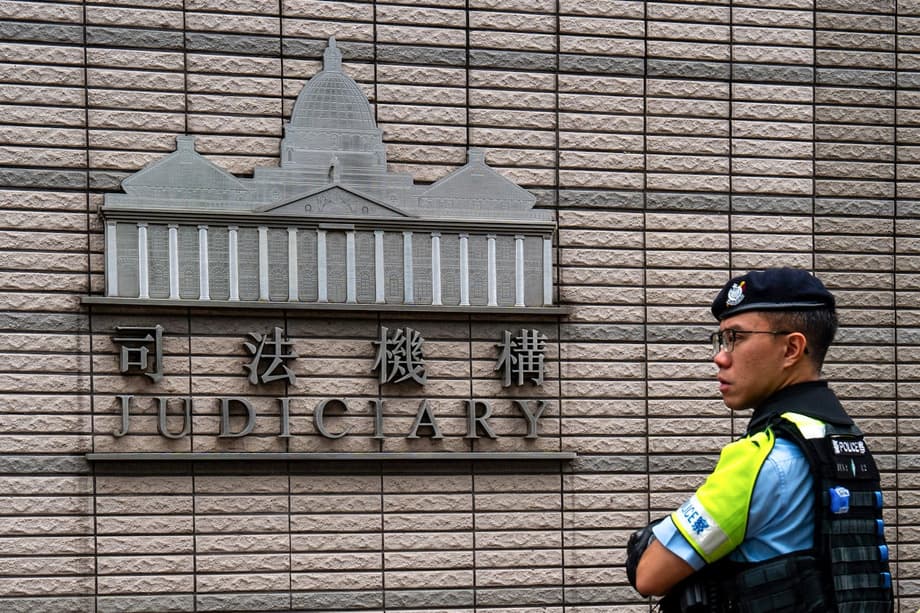
When the sentence was read out at the West Kowloon Law Courts Building, Lai smiled calmly and nodded, pressing his palms together in a gesture of gratitude toward supporters in the public gallery. Some in the courtroom wept as the 20-year term was announced, while outside, heavy police presence monitored small groups of supporters who had queued for days to witness the proceedings.
Eighteen years of the new sentence will be served consecutively with a five-year, nine-month term Lai is already serving for a separate fraud conviction. Given his age and deteriorating health, rights groups and family members have described the punishment as effectively a life sentence, with his daughter Claire warning that he will likely die a martyr behind bars.
The Charges and the Mastermind Designation
Lai was convicted on three specific charges: two counts of conspiracy to commit collusion with foreign forces to endanger national security, and one count of conspiracy to distribute seditious publications. The maximum penalty for these offenses under the Beijing-imposed law is life imprisonment.
In their 855-page verdict, three judges handpicked by Hong Kong’s government to oversee national security cases described Lai as the unequivocal mastermind of the conspiracies. The court found that Lai used Apple Daily to promote his political views in an attempt to undermine the Chinese Communist Party, both before and after the security law took effect.
The prosecution cited 161 articles published in Apple Daily that allegedly incited hatred against authorities and called for foreign sanctions. The court also examined Lai’s meetings with senior United States officials during the 2019 protests, including encounters with Vice President Mike Pence, Secretary of State Mike Pompeo, and National Security Adviser John Bolton. Lai’s lawyers argued that any calls for sanctions ceased once the national security law came into force, but the judges concluded he continued his activities through less explicit means.
Unlike standard criminal trials in Hong Kong, national security cases are heard without juries. Lai was also denied his first choice of legal representation when authorities blocked British barrister Timothy Owen from participating, citing national security concerns. The trial began in December 2023 and lasted 156 days before the verdict was delivered.
From Refugee to Media Mogul
Jimmy Lai Chee-ying’s life trajectory mirrors Hong Kong’s own evolution from a refuge for those fleeing communist China to a global financial center now firmly under Beijing’s control. Born in Guangzhou in 1947 to a wealthy family that lost everything when the communists took power in 1949, Lai stowed away on a fishing boat to Hong Kong at age 12, working as a child laborer in garment factories while teaching himself English.
He built a fashion empire starting with the international clothing brand Giordano in 1981, achieving significant commercial success. However, the 1989 Tiananmen Square massacre marked a turning point. Deeply affected by the violent crackdown on pro-democracy protesters in Beijing, Lai began writing columns criticizing the Chinese government and entered the media industry to advocate for democratic values.
In 1995, two years before Hong Kong’s handover to China, Lai founded Apple Daily. The tabloid became known for its rambunctious, often sensational journalism and its unapologetic pro-democracy stance. At a time when other Hong Kong media outlets increasingly self-censored to avoid antagonizing Beijing, Apple Daily remained a persistent critic of Chinese authorities.
Lai obtained British citizenship in 1994 and has never held a Chinese or Hong Kong passport, though Hong Kong authorities consider him a Chinese citizen. His outspoken criticism earned him the nickname Fatty Lai in earlier years, and he survived firebomb attacks on his home and an assassination plot. Despite the threats, he continued to participate in pro-democracy demonstrations, leading to multiple arrests for unauthorized assembly beginning in 2020.
Previous Convictions and Cumulative Sentences
Before the national security trial, Lai had already accumulated significant prison time for his activism. In April 2021, he received 14 months for involvement in peaceful protests. In May 2021, another 14 months were added for organizing an unauthorized assembly. In December 2021, he received 13 months for participating in a banned Tiananmen Square vigil.
In December 2022, Lai was sentenced to five years and nine months for fraud related to a lease violation at Apple Daily’s headquarters. His national security sentence will see 18 years run consecutively to this existing term, while two years will run concurrently. He has been denied bail since December 2020, following a Court of Final Appeal ruling that national security cases constitute an exception to the presumption in favor of bail.
Health Concerns and Solitary Confinement
Lai’s family and legal team have raised alarm about his medical conditions and treatment in custody. The 78-year-old suffers from diabetes, hypertension, heart palpitations, progressive hearing loss, and retinal vein occlusion that affects his vision. During mitigation hearings last month, his lawyer Robert Pang argued that every day in prison brings Lai closer to the end of his life.
Pang also highlighted that Lai has spent more than 1,800 days in solitary confinement since his detention began. The defense argued this isolation makes his prison life significantly more burdensome than that of other inmates. However, prosecutor Anthony Chau maintained that Lai’s health remains stable, noting he has lost only 0.8 kilograms over five years of detention and remains medically obese. Chau also stated that the solitary confinement was at Lai’s request.
Human Rights Watch and other organizations have described the 20-year sentence as effectively a death sentence given Lai’s age and health trajectory. His son Sebastien told the BBC that even a five-year term would be practically equivalent to a death penalty for his father. Daughter Claire Lai stated that her father’s teeth have rotted and his weight has fluctuated dramatically during detention, conditions she described as heartbreaking.
My father is in jail for the truth on his lips, courage in his heart, and freedom in his soul.
The above statement from Sebastien Lai encapsulates the family’s position that the prosecution represents punishment for protected speech rather than genuine criminal conduct. Hong Kong authorities counter that Lai received appropriate medical care and that concerns about his health are exaggerated.
International Condemnation and Diplomatic Pressure
The sentencing has drawn sharp criticism from Western governments and international rights organizations. British Foreign Secretary Yvette Cooper called the prosecution politically motivated and described the 20-year term as tantamount to a life sentence for a man of Lai’s age. She called for his immediate release on humanitarian grounds so he could be reunited with his family.
Prime Minister Keir Starmer raised Lai’s case directly with Chinese President Xi Jinping during a visit to Beijing in January. The UK government has indicated it will rapidly engage further with Chinese authorities following the sentencing. However, Lai’s son Sebastien has criticized the British government for not doing enough, stating that time is running out and that UK values are being locked up along with his father.
United States President Donald Trump has also intervened, stating he felt deeply troubled by the conviction and had asked Xi Jinping to consider releasing Lai. During his first term, Trump had promised to secure Lai’s release, telling the media mogul in a letter that he was the only one who could save Hong Kong from China. The chairman of the US House Select Committee on China, John Moolenaar, said freeing Lai should be the starting point for improving US-China relations.
Human rights organizations have been equally forceful in their condemnation. Amnesty International described the sentence as a cold-blooded attack on freedom of expression and a grim milestone in Hong Kong’s transformation from a city governed by rule of law to one ruled by fear. The Committee to Protect Journalists declared that the rule of law has been completely shattered in Hong Kong, calling the decision the final nail in the coffin for press freedom. Reporters Without Borders said the curtain has fallen on press freedom in the territory.
Beijing and Hong Kong authorities have rejected all criticism. Foreign Ministry spokesperson Lin Jian urged relevant countries to respect the rule of law in Hong Kong and refrain from making irresponsible remarks. Hong Kong Chief Executive John Lee welcomed the sentence, stating that Lai used Apple Daily to poison the minds of citizens and that the heavy punishment brings great satisfaction to the people.
The Co-Defendants and the Fate of Apple Daily
Lai was not the only defendant sentenced on Monday. Eight co-defendants received prison terms ranging from six years and three months to ten years. Six were former executives and editorial staff of Apple Daily, while two were activists associated with the international lobby group Stand with Hong Kong.
Among the journalists, editor-in-chief Ryan Law received the harshest sentence of ten years, as did executive editor-in-chief Lam Man-chung and editorial writer Fung Wai-kong. Associate publisher Chan Pui-man was sentenced to seven years, editorial writer Yeung Ching-kee to seven years and three months, and publisher Cheung Kim-hung to six years and nine months. The two activists, Andy Li and Chan Tsz-wah, received seven years and three months, and six years and three months respectively.
All eight co-defendants had pleaded guilty and several testified against Lai as prosecution witnesses, which typically allows for sentence reduction under the security law. The judges noted that their evidence significantly contributed to Lai’s conviction. Apple Daily itself was fined 6 million Hong Kong dollars ($767,000) as a corporate entity.
The newspaper, which printed its final edition in June 2021 after police froze its assets and arrested senior staff, has become a symbol of the civil liberties lost in Hong Kong. Its closure followed a second major police raid in June 2021 that saw five executives arrested and 18 million Hong Kong dollars in assets frozen. Many former journalists have since left the territory.
What This Means for Hong Kong’s Future
The sentencing of Jimmy Lai and his colleagues sends a clear signal about the boundaries of acceptable discourse in contemporary Hong Kong. Where the territory once ranked 18th in the World Press Freedom Index in 2002, it now sits at 140th out of 180 territories, according to Reporters Without Borders.
Legal experts note that the broad interpretation of sedition and collusion with foreign forces creates a chilling effect for journalists and academics. Urania Chiu, a law lecturer at Oxford Brookes University, warned that offering legitimate critiques of the state, which often involves engagement with international platforms, may now easily be construed as criminal collusion.
The case also demonstrates the extent of Beijing’s control over Hong Kong’s legal system. The use of handpicked judges, the exclusion of juries, the denial of bail, and the prohibition of foreign counsel all represent departures from Hong Kong’s common law traditions. Chief Justice Andrew Cheung defended the system last month, stating that calls for Lai’s premature release strike at the very heart of the rule of law.
For the international community, Lai’s imprisonment raises questions about the viability of Hong Kong as a credible financial hub. Eric Lai, a senior fellow at Georgetown University’s Center for Asian Law, noted that critical media outlets and open exchange with foreign officials on policy matters have been criminalized, sharply jeopardizing the free flow of information necessary for transparent investment environments.
Whether international diplomatic pressure can secure Lai’s release remains uncertain. Analysts suggest that Beijing may view Lai as a useful bargaining chip in negotiations with Washington or London, potentially granting compassionate release based on health grounds in exchange for concessions on trade or other issues. Alternatively, allowing him to die in prison could create a martyr that galvanizes further opposition to Chinese rule.
The Essentials
- Jimmy Lai, 78, received a 20-year prison sentence for national security offenses, the longest term under Hong Kong’s security law imposed by Beijing in 2020.
- The British citizen was convicted of conspiring to collude with foreign forces and publishing seditious articles in his now-defunct newspaper Apple Daily.
- Eight co-defendants, including six former Apple Daily executives and two activists, received sentences ranging from six years and three months to ten years.
- Eighteen years of Lai’s sentence will run consecutively with an existing five-year, nine-month fraud sentence, effectively ensuring he remains imprisoned into his nineties if he survives.
- Lai has been in detention since December 2020, primarily in solitary confinement, and suffers from diabetes, hypertension, and vision problems.
- The UK and US governments have called for his release on humanitarian grounds, with President Trump and Prime Minister Starmer both raising the case with Chinese leadership.
- Hong Kong authorities defend the sentence as upholding the rule of law, while human rights groups describe it as effectively a death sentence and a grave attack on press freedom.