A Ghost Returns to the Forest
For nearly three decades, the flat-headed cat existed in a state of uncertainty within Thailand’s borders. Scientific records showed the species had last been documented in the country in 1995, leading conservation authorities to classify it as possibly extinct within the nation. The small, wetland-dwelling feline had become something of a phantom, absent from all surveys despite persistent anecdotal reports from local fishers who occasionally trapped the unusual cats. Now, thanks to a determined camera-trapping project in the remote southern reaches of Thailand, this ghost has materialized once more.
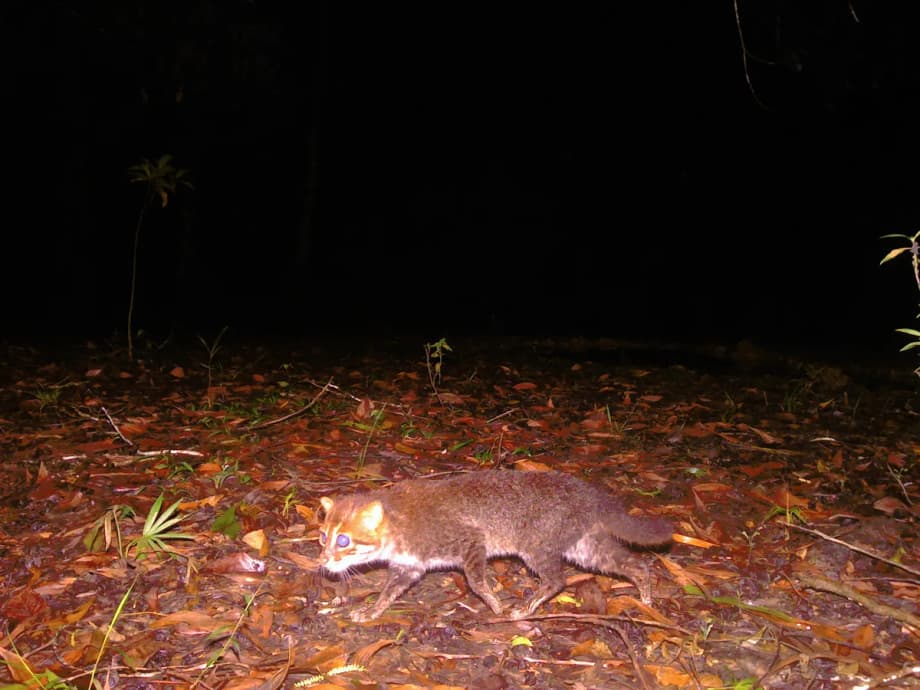
Scientists from Panthera, the global wild cat conservation organization, in partnership with Thailand’s Department of National Parks, Wildlife and Plant Conservation, have confirmed 29 detections of flat-headed cats in Princess Sirindhorn Wildlife Sanctuary. Thirteen of these records came from 2024, followed by 16 more in 2025. Perhaps most significantly among these sightings was the capture of a female flat-headed cat accompanied by her cub, proof that not only does the species persist in Thailand, but it is successfully reproducing.
The announcement came on Thailand’s annual Wildlife Protection Day, adding symbolic weight to the discovery. Suchart Chomklin, Thailand’s Minister of Natural Resources and Environment, celebrated the finding in an official statement.
“For decades, the flat-headed cat has been classified as ‘likely extinct,’ but after years of sustained protection, strong scientific partnerships, and community stewardship, we can now celebrate its return to Thailand this National Wildlife Day.”
This rediscovery represents more than just the reappearance of a rare animal. It validates years of conservation efforts in one of Southeast Asia’s most threatened ecosystems and offers hope for other species presumed lost. The flat-headed cat, one of the rarest wild cats in the world, had been thought extinct in Thailand since the previous confirmed sighting in 1995. By 2014, officials feared the rare species had gone extinct within their borders, discouraged by the lack of evidence. The recent confirmation brings an end to that long period of doubt and uncertainty.
Anatomy of a Wetland Specialist
The flat-headed cat earns its name from its distinctive cranial structure, featuring an unusually flattened skull and small, rounded ears set far apart. Weighing an average of just 1.5 to 2 kilograms, this diminutive feline weighs less than half of a typical domestic house cat. Its size makes it not only the smallest cat in Southeast Asia but one of the smallest feline species anywhere on Earth. This tiny stature allows it to move easily through the dense underbrush of its preferred habitat.
Beyond its flattened head, the flat-headed cat possesses several remarkable adaptations for its aquatic lifestyle. The species has webbed feet, an uncommon trait among wild cats, which helps it navigate waterlogged peat-swamp forests with ease. Its eyes are unusually large and positioned forward, providing excellent depth perception for hunting underwater prey. These specialized features have evolved for a life spent largely in and around water. They live almost exclusively in Southeast Asia’s wetlands among the peat swamps and freshwater mangroves that are rapidly disappearing under agricultural expansion and land conversion.
Scientists classify the flat-headed cat in the genus Prionailurus, making it a close relative of the better-known fishing cat and leopard cat. Unlike these relatives, however, the flat-headed cat has an extremely restricted geographic range. The species exists naturally only on the islands of Borneo and Sumatra, along the Malaysian peninsula, and in the extreme southern tip of Thailand where it has now been rediscovered. Despite its taxonomic placement, remarkably little is known about the species’ biology and behavior. No systematic study has ever been conducted on its diet, though researchers believe flat-headed cats subsist primarily on fish, frogs, and shrimp.
The animals appear to be largely solitary, like most other small cats, with females rearing cubs with no male involvement. The species typically gives birth to just one offspring at a time, a reproductive strategy that makes population recovery slow and difficult. The International Union for Conservation of Nature (IUCN) currently lists the flat-headed cat as endangered, with an estimated global population of approximately 2,500 adult individuals. This precarious status makes the rediscovery in Thailand particularly meaningful for the species’ overall survival prospects.
Battling the Swamp to Find a Cat
The rediscovery emerged from an ecological survey launched last year by Panthera and Thailand’s Department of National Parks, Wildlife and Plant Conservation. The research team targeted Princess Sirindhorn Wildlife Sanctuary, a protected area in Thailand’s far southern region where suitable habitat remained. This sanctuary contains peat swamp forests and wetland ecosystems that could theoretically support flat-headed cats. To reach the cats’ habitat, researchers had to tackle treacherous terrain in peat swamp forests, confronting chest-high waters and tangled mangroves.
Reaching the potential habitat proved extraordinarily difficult. The sanctuary’s swamp forest terrain presents a challenging mosaic of open water and patches of land. Rangers and researchers could advance only 1 to 2 kilometers per day while navigating chest-high waters and tangled mangroves. Previous surveys had been limited to forest edges because accessing the interior required battling through these formidable natural obstacles. The nature of the swamp forest terrain, with its complex mosaic habitat of open water and patches of land, makes traditional survey methods nearly impossible to execute effectively.
Rattapan Pattanarangsan, Panthera’s conservation program manager for Thailand, explained the difficulties involved in this work.
“There are two problems with gathering more information about how flat-headed cats are faring in the sanctuary – the first is the nature of the swamp forest terrain, with its complex mosaic habitat of open water and patches of land where rangers can move only 1-2km a day.”
Despite these challenges, the research team successfully deployed camera traps throughout the sanctuary’s remote areas. These motion-activated cameras would operate continuously, capturing images of any wildlife that passed by. The team waited months before reviewing the footage, uncertain what they might find. When they finally examined the camera trap images, the discovery exceeded expectations. Not only had the cameras recorded flat-headed cats, but they had documented them repeatedly. The cats appeared to be returning to the same areas again and again, suggesting a relatively concentrated local population.
The Unique Challenges of Study
While the discovery of the cats is cause for celebration, researchers face significant hurdles in learning more about Thailand’s flat-headed cat population. Two primary complications hinder scientific study: the challenging habitat and the cats’ physical characteristics. At this stage, scientists cannot estimate the population size because the methods used so far do not allow for individual identification or abundance estimation.
The second major challenge stems from the flat-headed cat’s appearance itself. Unlike many wild cat species, such as tigers, leopards, or clouded leopards, individual flat-headed cats cannot be identified by coat patterns. They lack distinctive markings or unique spot patterns that would allow researchers to distinguish one individual from another in photographs.
Rattapan Pattanarangsan highlighted this specific limitation in the research process.
“The second is the nature of the beasts themselves. Individual flat-headed cats cannot be identified by coat patterns, which prevents us from using photographic capture-recapture methods.”
This inability to identify individuals prevents the use of photographic capture-recapture methods, a standard technique for estimating animal populations. Without knowing whether repeated camera trap images show the same cat multiple times or different cats entirely, scientists cannot calculate population density or abundance with confidence. These research constraints mean that despite 29 documented detections, the actual number of individual flat-headed cats in Princess Sirindhorn Wildlife Sanctuary remains unknown. The population could be as few as a handful of cats or potentially several dozen. Without this basic information, conservationists struggle to assess the population’s viability or design targeted protection strategies.
One thing that excites the Panthera team in Thailand is that this newly-discovered population appears to be more concentrated than other ones in Malaysia and Indonesia. This higher concentration makes this site more suitable for intensive research, and this area therefore offers strong potential for future ecological and behavioral studies. Because the flat-headed cat population in Thailand appears concentrated, this site could become an important research destination for experts worldwide.
A Breeding Population and Future Hope
While every sighting of a flat-headed cat carries scientific value, the image of a female with her cub holds particular importance. This single photograph tells researchers several critical things about the population’s status. First, it confirms that the rediscovered flat-headed cats in Thailand are not merely transient individuals wandering from neighboring populations in Malaysia. The presence of a cub indicates that adults are not only surviving but successfully reproducing within the sanctuary. This establishes the existence of a resident breeding population rather than occasional visitors.
Wai Ming Wong, Panthera’s small cat conservation science director, described the moment via email to Mongabay news.
“Rediscovering flat-headed cats in southern Thailand is an extraordinary moment for conservation. It shows that, where wetlands and river systems remain intact, even the most elusive and threatened carnivores can persist.”
The rediscovery has immediately shifted focus from finding the cats to protecting them. Conservationists recognize that this population’s survival depends on swift and decisive action. The announcement of the cats’ presence brings both opportunities and risks, requiring careful management. One immediate concern is the potential threat from wildlife traffickers. Publicizing the rediscovery inevitably reveals the location of this rare and valuable species to those who might seek to capture it illegally. As soon as the news is released, protection work must be strengthened.
Urs Breitenmoser, co-chair of the IUCN’s Cat Specialist Group and one of the reviewers of the 2014 assessment that declared the species possibly extinct in Thailand, described the significance of the finding.
“Rediscovering flat-headed cats in southern Thailand is a remarkable find. It’s good news for the end of the year!”
Authorities believe this group may represent the last remaining population in Thailand. The species had previously been categorized as possibly extinct, with a total global population estimated at just 2,500. Stringent conservation efforts must be instituted immediately to protect the forest habitat. Experts emphasize that the plan needs to be executed now, rather than later. With the release of this news, wildlife traffickers will also be alerted to the cats’ location. Consequently, scientists are currently conducting a threat assessment for this newly discovered population.
The Bottom Line
- Flat-headed cats have been rediscovered in Thailand after nearly 30 years without confirmed sightings.
- Camera traps recorded 29 detections in Princess Sirindhorn Wildlife Sanctuary between 2024 and 2025.
- A female flat-headed cat was photographed with her cub, confirming successful breeding.
- The species weighs only 1.5 to 2 kilograms, making it one of the smallest cats in the world.
- Global population is estimated at approximately 2,500 adult individuals.
- Flat-headed cats are specialized wetland hunters with webbed feet and a flattened skull.
- Research is complicated by difficult terrain and the cats’ lack of distinctive coat patterns.
- This population may be the last remaining flat-headed cats in Thailand.
- Conservationists are conducting threat assessments and planning enhanced protection measures.
- The discovery validates the importance of protected areas for conserving endangered species.