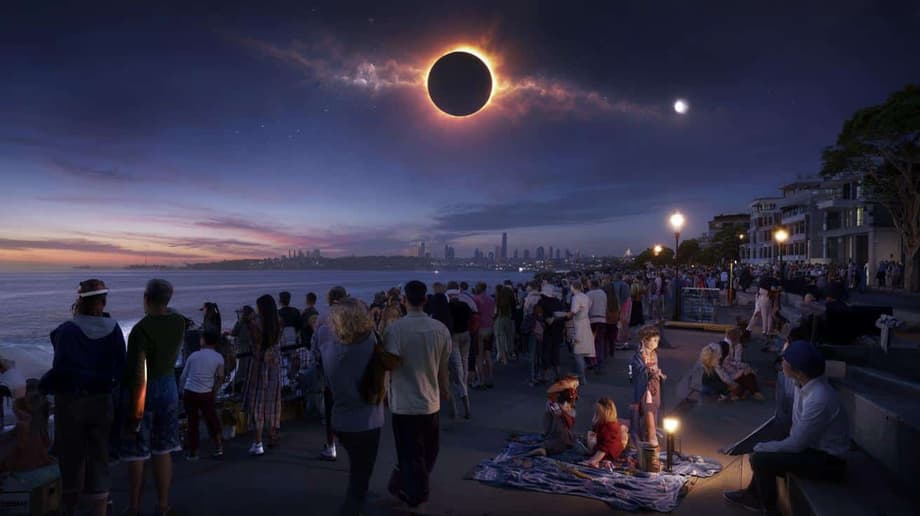
The Day the Sky Will Pause
Birds will stop mid-song, dogs will fall strangely quiet, and the bright afternoon light will begin to feel wrong. People will step outside holding cardboard glasses, half-laughing, half-whispering, as the sun takes on a bitten edge. Shadows will sharpen, then twist. Streetlights will flicker on in broad daylight. For a few minutes, the world will look like a movie that someone dimmed with a giant cosmic dimmer switch. This isn’t just a scene from science fiction or a distant memory. Astronomers have now officially confirmed the date of what they’re calling the longest total solar eclipse of the century, a rare event where day will almost literally turn to night.
- The Day the Sky Will Pause
- A Cosmic Choreography: Understanding the Eclipse
- The Path of Totality: From Kimberley to the Tasman Sea
- A Golden Age of Eclipses
- Weather, Logistics, and the Eclipse Chaser’s Dilemma
- Science in the Shadow: Research Opportunities
- Safety First: Protecting Your Eyes During the Eclipse
- The Human Experience of Totality
- The Essentials
On 22 July 2028, in the middle of an ordinary Saturday afternoon, the sun will vanish for up to 6 minutes and 23 seconds along a narrow path, giving Earth its longest total solar eclipse of the 21st century. Astronomers had this date pencilled in for years, but they’ve now locked in the official timing, path, and visibility zones with far greater precision. The path of totality will sweep across parts of Australia, the Pacific, and New Zealand, with partial phases visible over a much wider area of the Southern Hemisphere. For millions, lunch break that day will look like midnight.
The moon’s shadow will race across oceans and cities at more than 2,000 km/h, turning beaches, farms, highways, and rooftops into front-row seats for a celestial blackout. In Sydney, astronomers expect totality to last more than 3 minutes, enough time for the temperature to drop noticeably and the city to plunge into a deep twilight. Small coastal towns along the path are already in early talks about crowd control, temporary campsites, and sky-watch parties on school sports fields. One tourism official in Western Australia quietly predicts their “busiest week of the decade” as eclipse chasers start booking years in advance.
A Cosmic Choreography: Understanding the Eclipse
A total solar eclipse happens only when the moon passes directly between Earth and the sun, at just the right distance to cover the solar disk almost perfectly. The 2028 alignment gives the moon a slightly larger apparent size in our sky, which explains the extraordinary duration of totality. Earth’s curved surface means only a slim track gets the full blackout; outside that corridor, people see a partial bite out of the sun.
Astronomers have now refined the path to within a few hundred meters using updated lunar topography data from recent missions. It’s the sort of mathematical obsession that sounds dry on paper, yet it decides who will see a life-changing sky and who will see “just” a weirdly dim sun from their office window.
This particular eclipse belongs to Saros 146, a series of eclipses that occur approximately every 18 years, 11 days, and 8 hours. The Saros cycle is one of the most predictable patterns in celestial mechanics. Each eclipse in a Saros series follows a similar path across Earth, with the locations shifting gradually northward or southward with each repetition. The 2028 eclipse is part of a sequence that has been producing total solar eclipses since 1938 and will continue until 2154.
What makes this particular event special is the combination of factors. The moon will be near its apogee (farthest point from Earth) on July 23, giving it a slightly smaller apparent size in the sky. However, its alignment with the sun will still be precise enough to create a total eclipse. The geometry of this eclipse results in an exceptionally long period of totality, making it one of the most anticipated celestial events of the 21st century.
The Path of Totality: From Kimberley to the Tasman Sea
The moon’s shadow will begin its journey over the Indian Ocean before making landfall at the isolated Christmas and Cocos (Keeling) Islands. These Australian territories will be the first to experience totality, with Christmas Island seeing 4 minutes and 5 seconds of darkness and the Cocos Islands experiencing 3 minutes and 26 seconds.
From there, the umbra will strike the Australian continent in the Kimberley region of Western Australia. This remote area, known for its rugged landscapes and ancient rock formations, will experience some of the longest durations of totality. Near the Drysdale River, observers will be bathed in darkness for approximately 5 minutes and 10 seconds, making it one of the longest durations of totality for any eclipse in the coming decades.
The shadow then sweeps in a south-easterly direction across the Australian continent. It will cross the Northern Territory, briefly graze South Australia, move through southwest Queensland, and cut directly through New South Wales. This trajectory places major population centers directly in the line of the celestial event. The path will pass near or through towns including Wyndham, Kununurra, Tennant Creek, Birdsville, Bourke, and Dubbo before continuing through the centre of Sydney.
Sydney, Australia’s largest city, finds itself in a privileged position. The city will experience totality for approximately 3 minutes and 44 seconds starting at 1:59 PM local time. This is a historic event for the metropolis, which has not seen a total solar eclipse since 26 March 1857. The next opportunity for Sydney residents will not arrive until 3 June 2858, making this a genuine once-in-a-lifetime event for the city’s 5 million residents.
Leaving the Australian coast, the shadow traverses the Tasman Sea before making landfall again on the South Island of New Zealand. The path crosses the southern Alps, affecting major tourist destinations like Queenstown and Dunedin. In New Zealand, the last total solar eclipse occurred in 1965, visible only in a small part of Northland. For the South Island, this 2028 event represents a significant return of totality.
Sydney’s Historic Moment
The impact of this eclipse on Sydney cannot be overstated. The city’s iconic landmarks, including the Opera House, Harbour Bridge, Anzac Bridge, Darling Harbour, and the Bondi to Coogee coastline, will be enveloped in complete darkness during totality. The visual spectacle of a total eclipse over a major urban setting is rare, and photographers worldwide are already planning to capture the juxtaposition of the eclipsed sun against Sydney’s famous skyline.
Dr. Ian Griffin, an astronomer and director of the Otago Museum in New Zealand, has emphasized the emotional weight of these events. He bought a house in Dunedin specifically to be on the centerline for the 2028 eclipse, demonstrating the dedication this phenomenon inspires. He believes the event will be a major tourism drawcard, offering a “money shot” if the weather cooperates.
“Anyone who is on a line basically going through Queenstown and Alexandra – all those places in Central from Milford to Dunedin will be able to see what those folks in America saw today,” Griffin explained. “Of course it’s the middle of winter and the sun will be low in the sky but that makes for some amazing pictures if we do get clear skies.”
A Golden Age of Eclipses
The 2028 eclipse doesn’t exist in a vacuum. It is the final act in a rare “golden age” of eclipses occurring between 2026 and 2028. During this short window, Earth will experience three total solar eclipses and three annular “ring of fire” eclipses. This clustering is a result of the Saros cycle, creating a brief period of unusually frequent celestial events.
The sequence began with a total solar eclipse in August 2026, visible from Greenland, Iceland, and Spain. This will be followed by the highly anticipated “Eclipse of the Century” on 2 August 2027. That event will boast a maximum totality of 6 minutes and 22 seconds as it passes over Egypt and the Middle East. Just under a year later, the baton passes to the Southern Hemisphere for the 2028 event.
While the 2027 eclipse holds the record for the longest duration of the 21st century, the 2028 eclipse offers a unique combination of duration, accessibility, and scenic backdrops. The path of the July 2028 solar eclipse will intersect with that of the November 2030 eclipse at a point between Thargomindah and Bourke in Eastern Australia, that of the July 2037 eclipse near Bedourie in southwestern Queensland, and that of the December 2038 eclipse at a point in the Tasman Sea.
This intersection pattern is considered unusual, since the average interval for any given spot on Earth to observe a total solar eclipse is about once every 375 years. For regions like New South Wales, experiencing totality in 2028 and then having another opportunity just two years later in 2030 is a statistical anomaly that offers locals a concentrated period of celestial activity.
This eclipse is particularly special because it is the second of five total solar eclipses visible from Australia over a 16-year period spanning from 2023 to 2038. Astronomers and enthusiasts often refer to this sequence as the “Eclipse Quintet.” However, the 2028 event is frequently described as the “king” of this series due to its long duration of totality and the accessibility of the path.
The path width is approximately 230 kilometers (143 miles), which is exceptionally wide for a total solar eclipse. This breadth offers a greater margin of error for weather and logistics, allowing more people to experience the full spectacle without needing to be on a precise central line.
Weather, Logistics, and the Eclipse Chaser’s Dilemma
For the dedicated eclipse chaser, planning starts years in advance. The primary concern is often weather. While the path of totality is fixed by the laws of physics, cloud cover is determined by local meteorology. July is winter in the Southern Hemisphere, which generally offers clearer skies in the interior of Australia compared to the coast.
Western Australia and the Northern Territory boast the best probabilities for clear skies. Towns like Kununurra and regions around the Bungle Bungles have a historical cloud cover probability of around 10-11% in late July. This makes them prime targets for international travelers willing to venture into the outback. Karlu Karlu (Devils Marbles) in the Northern Territory has similar favorable odds at 20% cloud cover probability.
In contrast, coastal locations and major cities face higher risks. Sydney has a historical cloud cover probability of about 47% in late July. Similarly, New Zealand’s South Island, while stunning, faces winter weather volatility with cloud cover probabilities potentially exceeding 70% in some areas. Christmas Island has a 65% chance of cloud cover, while the Cocos Islands face a 57% probability.
Despite the weather risks, Sydney is expected to draw the largest crowds. The logistics of moving millions of people within a city to viewing spots are complex. Authorities are already discussing crowd control for vantage points like the Harbour Bridge and Opera House. For those willing to travel, the Australian outback offers a solitude and reliability that urban settings cannot match.
Tourism officials in Western Australia predict this could be their busiest week of the decade. People still talk about the 2017 eclipse over the United States, when tiny American towns were overrun by caravans, telescopes, and last-minute campers parked in supermarket lots. This one is longer, rarer, and over regions that don’t usually see the global spotlight for astronomy events.
For those looking to experience the eclipse with expert guidance, specialized tours are already being organized. New Scientist is offering a tour through the Australian Outback, starting at Uluru and traveling through the Red Centre before arriving at a private viewing site near Alice Springs. Another tour focuses on New Zealand’s South Island, taking visitors through Queenstown, Christchurch, and the Aoraki Mount Cook region before viewing the eclipse from a carefully selected location.
Science in the Shadow: Research Opportunities
While the visual spectacle is the main draw for most observers, the scientific community treats these events as rare laboratory windows. The extended period of totality in the 2028 eclipse—over 5 minutes in some locations—provides researchers with an unprecedented opportunity to study the sun’s atmosphere.
The brief period of totality allows astronomers to study the sun’s corona, the outermost layer of the sun’s atmosphere, which is usually obscured by the bright photosphere. By blocking the main light source, scientists can measure the temperature and density of the corona and track solar wind dynamics. These observations are crucial for understanding space weather and its potential impact on satellites, power grids, and communication systems on Earth.
For climate scientists, the eclipse represents a natural experiment that no laboratory could recreate—a temporary “off switch” for solar energy over a huge area. Researchers will study how the atmosphere responds when daylight is abruptly cut, measuring temperature changes, wind patterns, and the behavior of various atmospheric layers. This data helps improve climate models and our understanding of Earth’s energy balance.
Extended totality means more time to study the sun’s corona, track sudden changes in solar wind, and measure how the atmosphere responds when daylight is abruptly cut. Some research teams will use spectrometers to analyze the composition of the corona, while others will deploy high-altitude balloons to capture images from above most of Earth’s atmosphere.
Amateur astronomers will also contribute valuable observations. Citizen science projects often collect data from thousands of observers along the path, helping to create detailed maps of the corona’s structure and timing of contact points. This collaborative effort between professional and amateur astronomers is a hallmark of modern eclipse research.
Safety First: Protecting Your Eyes During the Eclipse
Watching a solar eclipse is one of those rare cases where safety equipment really matters. Looking directly at the sun, even when it’s mostly covered, can permanently damage your eyes. You need eclipse glasses that meet the ISO 12312-2 standard, or a properly filtered telescope or camera. The flimsy-looking cardboard viewers from reputable suppliers are fine; your old sunglasses are not.
A simple method that works for almost everyone is to combine safe viewing with short breaks where you just feel the ambient change. Use glasses to check the bite out of the sun, then slip them down to your chest and notice the way the light on the ground turns metallic and strange.
During totality itself—those rare minutes when the sun is completely covered—you can briefly remove your glasses and look directly at the ghostly corona. The instant a sliver of sunlight reappears, the glasses go back on.
This is also where small mistakes can spoil a big day. People forget that kids will copy whatever adults do, including unsafe habits. They tape glasses to phone cameras and think that’s protection. They drive while staring up through the windshield at a darkened sky. None of that ends well.
An easy fix is to treat eclipse day like a beach day with a toddler: set a few simple, non-negotiable rules and repeat them often. For many, the bigger regret isn’t eye safety, it’s distraction. They spent the whole event fiddling with camera settings or livestreaming for friends who will barely watch the replay.
An eclipse is one of the few modern spectacles that’s actually better with your phone down for a while. The photos from professionals will be incredible. Yours will be slightly blurry and crooked, and yet absolutely perfect if they remind you how it felt to stand there, mouth open, as the daylight drained away.
The Human Experience of Totality
Some people who’ve seen totality say the emotional punch caught them off guard. “You think you’re going for the science,” one eclipse chaser said, “and then the sky goes dark and your brain suddenly remembers that this is the star that keeps you alive… and it’s gone. Everyone around you makes the same tiny sound.” That blend of fear, awe, and relief lingers long after the sun returns.
It’s why veteran observers plan their days around the human side, not just the optics. They pack blankets, not just lenses. They bring a thermos and snacks so nobody has to leave to find food at the critical moment. They pick a spot where they can lie down and just stare up without a neck cramp.
Arrive early, test your viewing gear, and pick a backup spot in case of clouds. Talk through the timeline with kids or friends so no one panics when the light drops. Agree on a “no talking for 60 seconds” rule during totality, just to feel the silence. Write down the exact local time totality begins and ends; those minutes are slippery. Plan one photo, not fifty. Then put the camera away and just be there.
What makes this eclipse different isn’t only its length on paper. It’s the way it will wash over such a variety of landscapes and lives in a single sweeping shadow: surfers on a darkened beach, farmers watching the light drain from their fields, office workers crowding onto balconies, pilots steering through a twilight sky at noon.
In a world that spends so much time fractured by feeds and algorithms, a slow-moving line of darkness might be the strangest kind of common ground. By the time 22 July 2028 arrives, most of us will have lived through dozens of other news cycles, trends, and minor catastrophes. Many of them will feel urgent; few will be as inevitable as this.
The moon doesn’t check our calendars. It doesn’t move its orbit for our deadlines or weddings or football finals. It just passes in front of the sun on schedule, throwing a shadow that doesn’t care who you voted for or what phone you use. Maybe that’s why eclipses stay in people’s stories long after the live streams have disappeared.
They mark a specific, shared moment when our daily routines literally went dark and then came back. When the temperature dropped and the birds lost their script for a few minutes. When you turned to whoever was standing next to you—partner, colleague, stranger in a park—and said something small like, “Wow,” because there wasn’t really anything else to say.
The date is set. The numbers are locked in. The only thing still unwritten is where you’ll be standing when the day turns to night and the sky reminds you that, for all our technology and noise, we still live on a rock orbiting a star that can disappear in a heartbeat—and return just as quietly.
The Essentials
- Date and Timing: The total solar eclipse occurs on Saturday, 22 July 2028. The maximum duration of totality is 6 minutes and 23 seconds near the central Pacific around 02:09 UTC. Local times vary significantly by location.
- Primary Viewing Regions: Totality will cross parts of Western and Eastern Australia, skim over the Pacific, and reach sections of New Zealand. Large nearby cities outside the exact path will still see a deep partial eclipse.
- Sydney’s Historic Moment: Sydney will experience totality for approximately 3 minutes and 44 seconds starting at 1:59 PM local time. This is the first total solar eclipse visible from Sydney since 1857 and the last until 2858.
- Maximum Duration: The longest period of totality, approximately 5 minutes and 10 seconds, will occur near the Drysdale River in Western Australia’s Kimberley region.
- Safety Requirements: Viewing the sun requires ISO 12312-2 certified eclipse glasses at all times except during the brief period of total totality. Regular sunglasses are not sufficient protection.
- Weather Considerations: Western Australia and the Northern Territory offer the best chances for clear skies (10-20% cloud probability), while Sydney faces a 47% chance of cloud cover and New Zealand’s South Island faces even higher probabilities.
- Part of a Rare Sequence: This eclipse is the second of five total solar eclipses visible from Australia between 2023 and 2038, and the final major total eclipse in a “golden age” of three total eclipses occurring between 2026 and 2028.