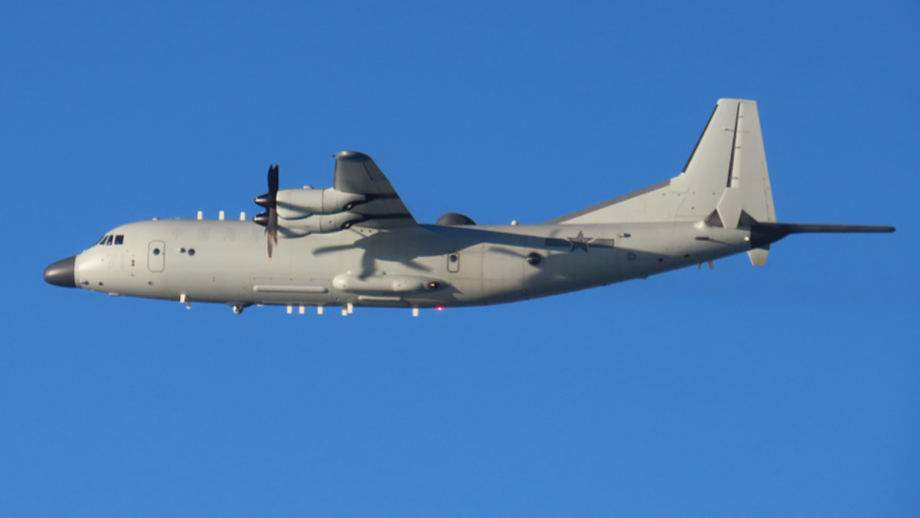
A New Submarine Hunter Appears
On March 28, 2026, the Japan Air Self-Defense Force (JASDF) scrambled fighter jets to intercept a Chinese military aircraft over the East China Sea, marking the first confirmed encounter with one of Beijing’s most advanced maritime patrol platforms. The aircraft, identified as a Y-9FQ ‘High New 15’ anti-submarine warfare (ASW) plane operated by the Chinese People’s Liberation Army Naval Air Force (PLANAF), represents the next generation of Chinese submarine hunting capabilities. This intercept comes just seven months after the aircraft made its public debut during the Victory Day parade in Beijing on September 3, 2025, offering Japanese defense officials and military observers their first operational look at this sophisticated surveillance platform.
The Japanese Ministry of Defense’s Joint Staff released images of the encounter on March 30, describing the aircraft configuration in their official statement. Officials explained that the interception revealed capabilities not previously observed in the region.
Regarding the Chinese military patrol aircraft (Y-9), flights have been confirmed in the airspace around the East China Sea and other areas in the past, but the aircraft confirmed this time has a different shape in the nose (frontmost part) compared to previous aircraft, and this is the first time the Self-Defense Forces have confirmed and announced such an aircraft.
This acknowledgment underscores the significance of the encounter in tracking the evolution of Chinese maritime surveillance capabilities.
Technical Capabilities and Sensor Suite
The Y-9FQ, developed by Shaanxi Aircraft Corporation since 2020, represents a substantial leap forward from its predecessor, the Y-8Q, also designated KQ-200, which was China’s first modern dedicated maritime patrol aircraft. While both aircraft share the distinctive elongated tail mounted Magnetic Anomaly Detector (MAD) sting used to detect submarines by sensing distortions in the Earth’s magnetic field, the Y-9FQ incorporates several advanced technologies that transform its surveillance effectiveness.
Most notably, the Y-9FQ features an elongated nose housing an Active Electronically Scanned Array (AESA) radar. Unlike traditional mechanically scanned radars that physically move an antenna to track targets, AESA systems use thousands of tiny transmit and receive modules to steer radar beams electronically. This technology allows the Y-9FQ to simultaneously track multiple surface and air targets while conducting ground mapping through synthetic aperture radar (SAR) modes. Air intakes positioned behind the nose provide cooling for this high power radar system, a design feature visible in imagery released by Japanese defense authorities.
Beneath the windshield, the aircraft carries an Electro-Visual System (EVS) that enables high resolution optical and infrared surveillance, allowing operators to visually identify vessels even in low visibility conditions. Additional sensors include Electronic Support Measures (ESM) antennas on the wingtips for detecting and classifying enemy radar emissions, a SATCOM antenna on the mid-fuselage for real time data transmission to command centers, and new Missile Approach Warning Sensors (MAWS) distributed across the fuselage and tail to alert crew to incoming threats. A ventral electro optical ball turret, similar to that found on the American P-8A Poseidon, provides 360 degree surveillance coverage below the aircraft.
Operational Details of the Intercept
The JASDF’s Southwest Air Defense Force coordinated the scramble response, dispatching F-15J fighters from Nyutabaru Air Base in Miyazaki Prefecture, the installation closest to the intercept region in the East China Sea. The 305th Tactical Fighter Squadron, which operates the F-15J from this base, maintains a constant state of readiness to respond to airspace incursions in the strategically sensitive waters between Japan’s southwestern islands and the Asian continent.
According to the operational track map released by Japan’s Ministry of Defense, the Y-9FQ flew circuitous patterns in the middle of the East China Sea, operating near the boundary of Japan’s Exclusive Economic Zone (EEZ). Aviation observers noted that the flight path suggested the aircraft may have been actively tracking a Japan Maritime Self-Defense Force (JMSDF) submarine conducting operations in the area. The presence of an older Y-8 aircraft, appearing to be a KQ-200 ASW variant distinguished by a dome under its nose, operating alongside the Y-9FQ suggests a coordinated mission possibly involving training or capability demonstration.
Anti-submarine warfare aircraft like the Y-9FQ employ a combination of sensors to hunt submarines. The MAD sting at the tail detects metallic submarines by measuring changes in the Earth’s magnetic field, while sonobuoys, which are acoustic sensors dropped into the water, listen for propeller noise and machinery vibrations. The AESA radar can detect snorkels or periscopes breaking the surface, and the electro optical systems provide visual confirmation. This multi-sensor approach allows the aircraft to cover vast swaths of ocean, making them critical assets for monitoring underwater traffic in contested waters.
Regional Military Activity and Strategic Context
The Y-9FQ intercept did not occur in isolation. During the preceding week, Japanese forces tracked an unusual surge in Russian military activity in the same general maritime region. On March 27, JASDF fighters intercepted two Russian Tu-142 long range maritime patrol aircraft as they transited from the Sea of Okhotsk to the Sea of Japan, reaching as far as the coast of Akita Prefecture. Simultaneously, the Japan Maritime Self-Defense Force monitored a Balzam class intelligence collection ship navigating through the Tsugaru Strait connecting waters.
Perhaps most provocatively, on March 17, two Russian MiG-31 fighter jets armed with Kh-47M2 Kinzhal hypersonic missiles flew over the Sea of Japan as part of a five aircraft package that included an Il-78M tanker and two Su-30 fighters. The Japan Self-Defense Forces were simultaneously tracking a Russian Navy Udaloy-III class destroyer in the area. The Kinzhal missile, capable of speeds exceeding Mach 5 and carrying nuclear or conventional warheads, represents a significant escalation in aerial threats when deployed near Japanese territory.
These incidents fit a broader pattern of coordinated Chinese and Russian military activities in the region. Since 2019, the two nations have conducted nine joint strategic air patrols over the Sea of Japan and surrounding areas, with the most recent occurring in December 2025. These patrols typically involve Russian Tu-95 Bear bombers and A-50 airborne early warning aircraft flying alongside Chinese H-6 bombers and J-16 fighters. While neither Beijing nor Moscow claims these exercises target third countries, the operations demonstrate their growing military interoperability and shared interest in challenging regional air defense networks.
Escalating Aerial Tensions and Radar Technology
The March intercept follows a disturbing incident in December 2025, when Chinese J-15 fighter jets operating from the aircraft carrier Liaoning conducted radar lock-ons against JASDF F-15s near Okinawa on two separate occasions within a three hour window. Radar lock-on occurs when a fighter’s radar transitions from surveillance mode to fire control mode, preparing to guide missiles to a target. This action, which triggers immediate warnings in the targeted aircraft’s cockpit, represents hostile intent that falls just short of actual weapons fire.
Modern AESA radars, like those carried by the Y-9FQ and increasingly deployed on Chinese fighter aircraft, complicate the detection of such hostile intentions. Unlike older mechanically scanned radars that must shift into a distinct Single Target Track mode, AESA systems can electronically steer multiple narrow beams while maintaining broad surveillance. They employ Low Probability of Intercept (LPI) techniques, including rapid frequency hopping and reduced sidelobe emissions, designed to blend into background noise and evade detection by older Radar Warning Receivers. This technological evolution means that targeted pilots may receive little or no warning before a missile launch, increasing the risk of miscalculation during tense aerial encounters.
Japanese defense officials lodged formal protests with Beijing following the December incidents, demanding measures to prevent recurrence. Chinese naval spokesperson Wang Xuemeng disputed Japan’s account regarding the December 2025 events, claiming Japanese aircraft had harassed Chinese training operations.
Recently, the Chinese Navy’s Liaoning aircraft carrier formation conducted normal carrier-based fighter flight training in the sea and airspace east of the Miyako Strait, with the training areas announced in advance. During this period, Japanese Self-Defense Force aircraft repeatedly approached and harassed the Chinese Navy’s training sea and airspace, seriously disrupting the normal training on the Chinese side and posing a grave threat to flight safety.
Regardless of which narrative holds more truth, the increasing frequency of such encounters highlights the dangerous potential for escalation in the crowded airspace above the East China Sea.
China’s Network of Special Mission Aircraft
The Y-9FQ represents just one component of an expansive ecosystem of special mission aircraft built on the Shaanxi Y-9 transport platform. This versatile airframe serves as the foundation for the KJ-500 and KJ-700 Airborne Early Warning and Control (AEW&C) aircraft, as well as at least five variants dedicated to electronic warfare, electronic intelligence, and signals intelligence collection. Both the KJ-500 and the KJ-700 share the Y-9FQ’s elongated nose configuration, suggesting common radar architecture and sensor integration.
This standardization offers China two distinct strategic advantages. First, it creates operational redundancy; losses of individual aircraft can be replaced from a deep inventory of platforms sharing common parts and maintenance procedures. Second, and more significantly, the standardized data linking and intelligence, surveillance, and reconnaissance (ISR) capabilities across these aircraft provide Beijing with persistent, theater-wide situational awareness. When the Y-9FQ detects a submarine or surface vessel, that data can instantly flow to KJ-series airborne early warning planes coordinating fighter operations, or to electronic warfare variants analyzing adversary communications.
The American equivalent, the P-8A Poseidon, operates in a similar multi-mission capacity, conducting long range maritime patrol, anti-submarine warfare, and secondary electromagnetic sensing roles for the United States Navy and its allies. The appearance of the Y-9FQ suggests China seeks comparable capabilities to monitor the first island chain and protect its growing submarine fleet, which includes both nuclear ballistic missile submarines and advanced attack submarines capable of operating far from Chinese shores.
Diplomatic Relations Under Increasing Strain
The military encounters occur against a backdrop of deteriorating diplomatic relations between China and Japan. Just two days after the Y-9FQ intercept, on March 30, Beijing imposed sanctions on an aide to Japanese Prime Minister Sanae Takaichi following visits to Taiwan, which China considers sovereign territory. The sanctions represent another flashpoint in the ongoing tensions over the self-governing island, which Japan and the United States have pledged to help defend against potential Chinese aggression.
China’s maritime patrol flights frequently probe the boundaries of Japan’s Air Defense Identification Zone (ADIZ), a buffer airspace extending beyond territorial waters where unidentified aircraft must be tracked and identified. While ADIZs are not defined by international law and military aircraft operating in international airspace are not legally required to identify themselves, entering these zones without notice triggers mandatory scramble responses from air defense forces. The Y-9FQ’s appearance in the East China Sea, operating in the same general area where Japanese submarines regularly train, signals Beijing’s intent to monitor and potentially challenge Japanese underwater capabilities.
The Japanese Ministry of Defense has pledged to maintain continuous monitoring of regional airspace. Officials emphasized their commitment to regional security in their statement regarding the March 28 intercept.
The Ministry of Defense and the Self-Defense Forces will continue to collect information and conduct vigilance and surveillance 24 hours a day on military movements around our country, while taking all possible measures against airspace violations.
As China continues deploying advanced platforms like the Y-9FQ, and as Russia maintains its provocative flights with Kinzhal-armed fighters and intelligence ships, the airspace above the East China Sea remains one of the world’s most militarized and potentially volatile regions.
Key Points
- The Japan Air Self-Defense Force intercepted a Chinese Y-9FQ ‘High New 15’ anti-submarine warfare aircraft over the East China Sea on March 28, 2026, marking the first confirmed encounter with this advanced platform.
- The Y-9FQ, which debuted publicly at Beijing’s September 2025 Victory Day parade, features an Active Electronically Scanned Array (AESA) radar, Electro-Visual System, and Magnetic Anomaly Detector for submarine hunting.
- An older Y-8/KQ-200 ASW aircraft accompanied the Y-9FQ during the flight, which operated near Japan’s Exclusive Economic Zone and possibly tracked a Japanese submarine.
- The intercept occurred during a week of heightened regional military activity, including Russian Tu-142 patrols, a Balzam-class spy ship transit, and earlier flights of MiG-31s armed with Kinzhal hypersonic missiles.
- China and Russia have conducted nine joint strategic air patrols since 2019, demonstrating growing military interoperability in the region.
- Beijing imposed sanctions on a Japanese prime ministerial aide on March 30, 2026, following Taiwan visits, further straining diplomatic relations amid the military tensions.