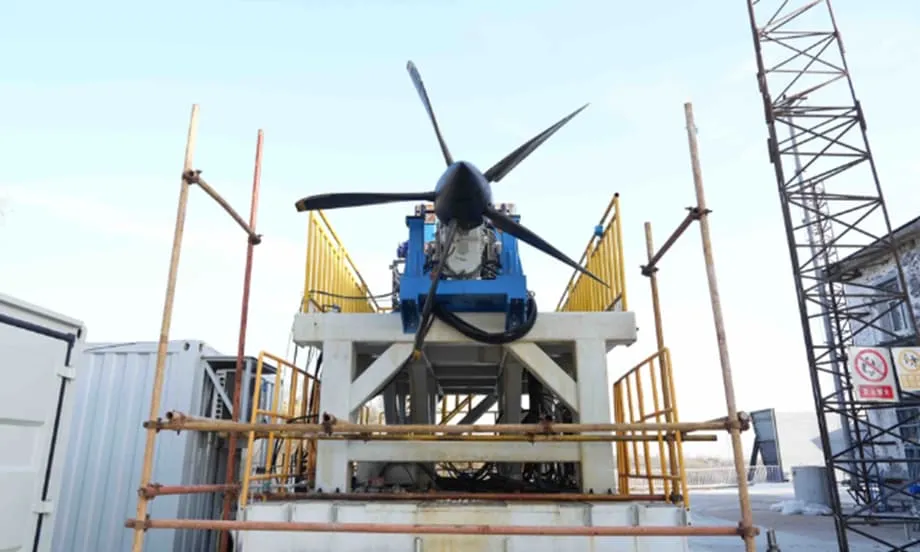
AEP100 reaches a new stage in Zhuzhou
China has completed full ground tests of its first megawatt class liquid hydrogen aviation engine, bringing a new propulsion system closer to possible use in regional aircraft. The AEP100 turboprop, developed independently by the Aero Engine Corporation of China (AECC), met full performance standards during testing at the AECC Hunan Aviation Powerplant Research Institute in Zhuzhou, in Central China's Hunan province.
Contents
- AEP100 reaches a new stage in Zhuzhou
- What engineers tested
- Why the fuel must stay extremely cold
- Hydrogen changes combustion and aircraft design
- A possible industrial chain worth one trillion yuan
- China joins competing approaches to hydrogen flight
- Why passenger aircraft are still some distance away
- Unmanned logistics and regional routes come first
- Two routes toward lower aviation emissions
- Key Points
The achievement, described on March 30, 2026, marks the first time a Chinese liquid hydrogen engine has reached that performance standard at the megawatt level. Engineers demonstrated stable operation across different power settings and operating conditions, while indicators for both the engine and its liquid hydrogen transport system stayed within normal limits.
A turboprop uses a turbine engine to drive a propeller. The AEP100 platform is intended for regional aviation, making it relevant to shorter routes between secondary cities and remote communities. Its development opens the possibility of aircraft that use hydrogen instead of conventional aviation fuel, reducing reliance on fossil fuels and potentially eliminating carbon emissions from short flights.
AECC's work also establishes domestic capability in an advanced form of propulsion being explored by aerospace companies elsewhere. The ground tests move China's hydrogen aviation effort beyond a theoretical proposal and into an operating engine with an integrated fuel system.
Passenger service remains a longer term prospect. The immediate achievement is the engine's demonstrated performance on the ground, with further work needed on durability, aircraft integration, infrastructure, safety and commercial economics before travelers could board an aircraft powered by this technology.
What engineers tested
The AEP100 campaign included ignition trials and performance adjustment runs under controlled ground conditions. Engineers watched turbine temperatures, vibration levels and pressure stability while an integrated feed and control system supplied liquid hydrogen to the engine.
The engine maintained stable combustion through multiple power settings, including extended operation at higher power levels. The liquid hydrogen transport system also remained within normal operating parameters throughout the test sequence.
Rapid throttle movements were another part of the work. These changes ask an engine to increase or reduce power quickly, rather than remain at a steady output. For an aircraft approaching a short runway or flying in mountainous terrain, a prompt response to changing power demands is an essential part of operation.
The tests examined how the engine and its fuel delivery system worked together during those changes. Hydrogen must arrive at the combustion hardware at the right pressure and temperature as demand rises or falls. A mismatch could cause unstable burning or a flameout, meaning the flame inside the engine goes out.
Successful operation across this performance range provides a technical foundation for moving liquid hydrogen turbine propulsion into practical engineering applications. It also addresses a gap in China's aviation propulsion capabilities, creating options for future aircraft development programs.
Why the fuel must stay extremely cold
Liquid hydrogen requires storage at around minus 253 degrees Celsius. Keeping fuel at that temperature demands equipment very different from the tanks and fuel lines used for conventional kerosene.
The hydrogen version of the AEP100 incorporates a specialized cryogenic storage and feed system. Cryogenic means operating at extremely low temperatures. This system delivers fuel under tightly controlled pressure and temperature conditions, using advanced insulation, modified fuel lines and safety equipment intended to prevent leaks.
Engineers must also manage boil off gas. Even an insulated tank can absorb heat, allowing some liquid hydrogen to warm and become gas. The storage and delivery equipment therefore has to handle changes in the fuel's condition while maintaining a dependable supply to the engine.
These demands become more difficult when an aircraft needs a quick change in power. The engine's controls and the liquid hydrogen system must respond together during critical phases of flight, maintaining stable combustion as fuel demand changes. The Zhuzhou tests demonstrated that coordination under the ground conditions examined.
Hydrogen changes combustion and aircraft design
Hydrogen carries a high amount of energy for its mass, but its low volumetric density creates a separate challenge. Put simply, fuel weight and fuel space are different problems: hydrogen can offer substantial energy by weight while requiring much larger tanks than conventional jet fuel for an equivalent flying range.
Future aircraft using this engine would therefore need new approaches to tank placement. Fuselage or wing layouts could have to change to accommodate the storage volume and cryogenic equipment. Integrating the powerplant is consequently an aircraft design task as well as an engine development task.
Hydrogen also burns differently from kerosene. Its fast flame speed and wide flammability range require combustion hardware to be tuned specifically for it. The engineering goal is to keep burning stable across operating conditions while controlling nitrogen oxide emissions, which can increase when hydrogen burns at high temperatures.
The proposed environmental benefit centers on avoiding carbon emissions from the fuel used in flight. Nitrogen oxides remain a concern for hydrogen combustion, and the wider industrial plan includes green hydrogen production. The engine, fuel supply and supporting infrastructure all form part of the effort to reduce aviation's carbon footprint.
These characteristics explain why adapting an existing turboprop to liquid hydrogen requires substantial changes. The fuel cannot simply be substituted for kerosene without redesigning storage, delivery, controls and combustion equipment, followed by work to fit those systems into an aircraft.
A possible industrial chain worth one trillion yuan
The aviation program is expected to encourage a broader industrial chain potentially valued at one trillion yuan. That prospect reaches far beyond the manufacture of engines, covering green hydrogen production, hydrogen liquefaction plants, cryogenic storage and transport, and specialized airport refueling systems.
Each part has a distinct role. Production facilities would supply hydrogen, liquefaction plants would turn it into the extremely cold liquid needed by the engine, and storage and transport equipment would keep it in usable condition. Airports would need facilities capable of transferring that fuel into aircraft routinely.
China classifies hydrogen as a key industry for reducing national carbon emissions. Its intended uses extend into heavy industry, trucking over long distances and power generation, where businesses are seeking alternatives to fossil fuels. Aviation offers a visible application that connects this energy strategy with advanced manufacturing.
China is also the world's leading producer of electrolyzers used to make green hydrogen. The aircraft engine program could strengthen its position in the global clean energy market while encouraging work on advanced equipment and new materials. The potential trillion yuan industrial chain is an economic expectation linked to future development and deployment.
China joins competing approaches to hydrogen flight
Airbus is advancing its ZEROe hydrogen fuel cell aircraft concept, while American and European companies are testing turbofan and turboprop engines using gaseous or liquid hydrogen blends. The programs explore different ways of supplying power and different configurations for aircraft of various sizes.
A fuel cell approach and a hydrogen combustion engine represent different routes to propulsion. The AEP100 program focuses on a turbine engine burning hydrogen, with the Zhuzhou work examining the engine and its liquid fuel delivery system together.
Regional aircraft and flights over shorter distances are considered the most likely early candidates for hydrogen adoption. They need less power and smaller fuel loads than aircraft making long journeys across continents. A megawatt class turboprop fits that regional category and could become a competitor in an emerging market for aircraft connecting secondary cities.
China's program adds another major participant to the international effort. Parallel experiments with propulsion and fuel system designs could help the technology develop, while commercial competition may increase as companies seek workable aircraft concepts.
Trade policies and tensions over technology transfer could affect how quickly those developments reach global markets. They may also shape whether companies form partnerships or countries protect domestic industries. China's progress in clean energy and aviation technology could attract greater scrutiny from international competitors seeking to retain their own market positions.
Why passenger aircraft are still some distance away
Wang Yanan, editor in chief of the Beijing based Aerospace Knowledge magazine, cautioned that liquid hydrogen aviation engines remain at an exploratory stage around the world. He identified equipment lifespan, energy density, storage costs and safety as constraints on commercial use.
Liquid hydrogen aviation engines are currently still in the exploratory stage worldwide. Due to limitations in equipment lifespan, energy density, storage costs and safety, they are unlikely to be applied to commercial passenger aircraft in the short term.
Wang said a new technology must meet two conditions together before replacing existing aviation engine systems. It must achieve genuine decarbonization, and its cost, performance, safety and reliability must be at least equal to those of conventional jet fuel systems.
For airlines, those requirements are closely connected. An engine must operate dependably through repeated service, its fuel must be practical to store and supply, and operating costs must support commercial routes. Passenger aviation leaves very little room for failure, so successful ground operation is one stage in a much longer development process.
Research programs and specialized aviation uses are more likely to come first. Urban air mobility and unmanned cargo systems are possible areas of interest, but their safety and economic feasibility require further demonstration. The combined demands of cost, performance, safety and reliability mean liquid hydrogen engines are not yet ready to replace conventional fuels in mainstream commercial service.
Unmanned logistics and regional routes come first
The AEP100 hydrogen development roadmap envisages a phased introduction, starting with unmanned aerial logistics platforms and regional aviation services. Later development could extend into mainline commercial routes over longer distances.
That sequence would allow time to build the infrastructure required for routine use. Airports would need cryogenic storage tanks, new fuel handling procedures and updated safety protocols. The engine's progress therefore depends partly on work outside the aircraft itself.
The next development stages focus on extended endurance runs, detailed reliability assessments and refinements to engine control software. These would examine a wider range of operating situations before a transition to flight testing or airworthiness certification, the process of assessing whether an aircraft and its systems meet requirements for safe operation.
No date was given for flight testing, certification or the start of commercial passenger service. The intended progression sets out the order of work, while the timing depends on further engineering and the readiness of the supporting fuel network.
Regional routes of several hundred to one thousand kilometers are among the potential future applications described for the technology. Such aircraft could connect medium sized cities and remote locations, potentially offering quieter flights and reducing the carbon footprint of journeys now made with conventional aviation fuel.
Two routes toward lower aviation emissions
Sustainable aviation fuels offer a more immediate route to reducing emissions from existing fleets because they can serve as drop in replacements for conventional fuel. That approach works with aircraft already in use, while hydrogen requires more extensive changes to engines, tanks, aircraft layouts and airport facilities.
The AEP100 hydrogen variant represents a possible second wave of change. Its development could influence aircraft design and route planning during the 2030s and 2040s, provided continuing engineering work and substantial infrastructure investment resolve the remaining technical and economic challenges.
The Zhuzhou achievement gives that longer term effort a concrete starting point: an independently developed Chinese engine operating stably with an integrated liquid hydrogen system at the megawatt level. Turning the test result into routine flights will require dependable equipment, affordable fuel handling and a complete system that meets commercial aviation standards.
China's industrial ambitions and its aviation research are closely connected in this project. A successful aircraft application would create demand for hydrogen production, liquefaction, transport and airport refueling, while progress in those industries would help make aircraft operation more practical. The immediate milestone belongs to engine testing; the wider opportunity depends on all those parts developing together.
Key Points
- AECC's independently developed AEP100 turboprop completed China's first full ground tests of a megawatt class liquid hydrogen aviation engine meeting full performance standards in Zhuzhou, Hunan.
- Ignition trials, power adjustments and rapid throttle movements demonstrated stable engine operation, with normal indicators for the liquid hydrogen transport system.
- Liquid hydrogen requires storage at around minus 253 degrees Celsius, specialized delivery equipment and larger aircraft tanks than conventional jet fuel for equivalent range.
- Hydrogen propulsion offers the potential to eliminate carbon emissions from fuel used in flight, while combustion design must also control nitrogen oxide emissions.
- A potential industrial chain worth one trillion yuan would cover green hydrogen production, liquefaction, storage, transport and airport refueling.
- Unmanned logistics and regional aviation are the intended early applications, with endurance testing, reliability assessments and control software work preceding flight testing and certification.
- Wang Yanan cautioned that equipment lifespan, energy density, storage costs and safety make commercial passenger applications unlikely in the short term.
- Airbus and American and European companies are pursuing other hydrogen aviation programs, while passenger deployment dates for the AEP100 hydrogen variant have not been given.