Computing Beneath the Oimachi Line
Four Tokyu Group companies plan to install a modular data center beneath an elevated section of Tokyo's Oimachi Line starting in June 2026, testing whether servers can run reliably beneath passing trains. Announced on March 23, the project would turn unused railway space into a site for computing equipment at a time when land and electricity connections are restricting data center expansion in Japan's capital.
Contents
- Computing Beneath the Oimachi Line
- Four Companies Divide the Work
- What Passing Trains Could Do to Servers
- Existing Fiber Gives the Site an Advantage
- Tokyo's Land and Electricity Pressures
- How a Modular Data Center Fits Together
- Maintenance Adds Another Test
- From the June Trial to Possible Expansion
- What Other Dense Cities Could Learn
- The Essentials
The trial will measure sound insulation, thermal insulation, vibration isolation and cooling efficiency. Together, those tests will show whether a compact facility can keep equipment stable and at the right temperature while trains travel overhead.
Tokyo already has 132 operational data centers and at least 18 more under construction, yet demand continues to outpace supply. The proposed installation tackles one part of that pressure: finding somewhere to put the equipment without developing a conventional building on an expensive urban site.
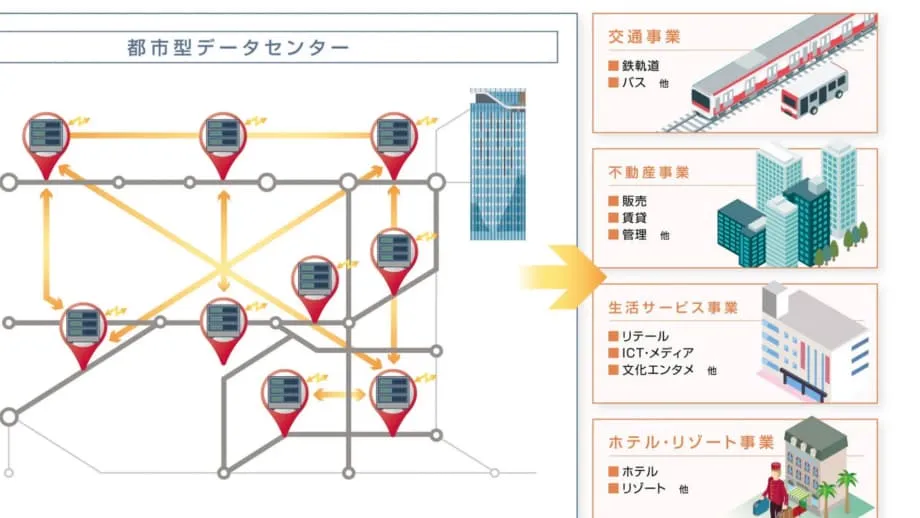
Tokyu's approach combines three assets already available within the group: unused land beneath railway tracks, a modular unit being developed by its construction business, and optical fiber cables running along its railway corridors. Successful testing could support further installations across the Tokyu network, with Shibuya specifically identified as a possible location.
As of March 30, the installation remains a planned experiment. Its commercial prospects depend on whether the equipment can withstand the railway environment, how much energy cooling requires, and whether maintenance costs allow the facilities to operate profitably. The June deployment is intended to test that approach before any broader rollout.
Four Companies Divide the Work
Tokyu Construction is developing the modular data center, a container sized enclosure that packages servers, cooling systems and power supply equipment together. The format is designed for deployment without the traditional construction process needed for a dedicated data center building.
Tokyu Electric Railway is providing the site beneath the elevated track. The space currently generates no revenue, giving the group an opportunity to put an otherwise unused property asset to work.
It's Communications Corporation, the group's telecommunications arm, will provide connectivity through optical cables already installed along the railway corridor. Tokyu Corporation, the parent company, is coordinating the initiative.
The division of responsibilities brings the physical site, equipment design and network connection into one group project. A data center needs all three: a place for its machines, systems that keep them operating, and communication links that let those machines exchange information with users and other facilities.
The railway corridor supplies both land and an existing route for data traffic. Tokyu is testing whether those assets can support another use alongside their transport function, potentially creating income from locations that currently contribute no revenue.
What Passing Trains Could Do to Servers
Every train passing above the proposed installation will introduce vibration into its surroundings. For sensitive electronic equipment, repeated movement can loosen connections, damage hard drives and place stress on solder joints, the small connections that hold components onto circuit boards.
Data center equipment also needs stable temperatures. Repeated warming and cooling cause materials to expand and contract, which can shorten the life of components. Beneath an elevated railway, steel structures can heat in direct sunlight and cool quickly in evening shadows, creating changing conditions around the enclosure.
Noise from passing trains adds another operating concern. The trial will examine sound insulation alongside thermal insulation and vibration isolation, with noise also relevant to personnel who must maintain equipment at the site.
Vibration is often measured in gravitational units, a way of expressing the force of movement relative to gravity. It must remain below specified thresholds for spinning disk drives and even systems using solid state storage. The trial will examine whether industrial isolation systems can filter out the repeated pounding of urban rail traffic.
Cooling efficiency completes the four main measurements. The unit must remove the heat its servers produce while coping with conditions outside. Reliable operation beneath moving trains will depend on the enclosure and its supporting systems maintaining the temperature and stability that the hardware requires.
Existing Fiber Gives the Site an Advantage
It's Communications has already built a network of optical fiber cables with substantial capacity along Tokyu's railway lines. Those cables provide a ready route for carrying data, giving the proposed installation an advantage over an urban site that needs new communication infrastructure.
Installing fiber in a dense city can require street excavation, municipal permits and permission to use land or routes controlled by others. Negotiations may involve property owners, local governments and utility companies. That work can make connecting a new data center both expensive and slow.
The Oimachi Line project can instead connect to cables already following the railway. Using that existing network removes the need to establish an entirely new fiber route and allows the modular unit to be integrated with telecommunications infrastructure already in place.
Tokyu's wider ambition would treat railway corridors as routes for both passengers and digital traffic. Small computing facilities distributed along those routes could support edge computing, which places processing equipment closer to where data is used instead of concentrating everything in larger, more distant facilities.
Shibuya's inclusion as a possible future location gives that approach a concrete urban target. It is one of Tokyo's busiest commercial and transport hubs, where the cost and practical difficulty of constructing a conventional data center would be especially high.
Tokyo's Land and Electricity Pressures
Tokyo's data center expansion faces two constraints that a compact enclosure addresses in different ways: expensive land and limited access to power. Research firm Mordor Intelligence put the rise in the capital's land prices at 69% in 2024, increasing the cost of traditional facility construction and placing it beyond the reach of many operators.
The city's 132 operating data centers and at least 18 facilities under construction show that development is continuing. Demand nevertheless remains ahead of supply, adding pressure to find locations and designs that can enter service more quickly.
Electricity connections can take much longer than equipment installation. Yasuo Suzuki, executive vice president and managing director for Japan and APAC at NTT Global Data Centers, described the waiting period in a recent industry interview:
Power grid connection wait times in inner Tokyo can stretch five to 10 years.
For a company that needs computing capacity immediately, a wait of that length can block a project regardless of whether a suitable plot is available. The Tokyu plan focuses on making better use of land and existing communication links, while access to electricity remains part of Tokyo's broader capacity problem.
Smaller facilities are gaining ground in this constrained market. Medium sized data centers in Japan are growing at a compound annual rate of 12% through 2031, outpacing larger builds because they can be deployed more quickly. Compound growth means each year's increase builds on the previous year's expanded total.
Tokyu's proposed units take that preference for faster deployment into an unusual setting. They prioritize speed and the use of overlooked urban space over the scale of a conventional facility.
How a Modular Data Center Fits Together
Modular data centers package the main parts of a computing facility into an enclosure engineered in advance. Servers perform the computing work, cooling equipment removes their heat, and power supply systems deliver the electricity needed to keep them running.
A conventional facility can require years of architectural planning, foundation work and building construction. Modular units can be manufactured away from the installation site while permits are processed, then lifted into position by crane and connected to existing utilities. That approach has gained traction globally where space and construction schedules constrain development.
Tokyu Construction's unit applies the container format to the more demanding surroundings beneath an active railway. Its design is likely to need advanced vibration damping, potentially using spring isolators, rubber mounting platforms or active technologies that counter movement. These are possible engineering approaches, rather than a specified equipment list for the trial.
Cooling will also have to work efficiently despite temperature changes associated with sunlight heating the overhead steel. Weather protection will be needed against rain splashing back toward the enclosure and the urban pollution common around railway infrastructure.
The modular format brings the equipment together in one deployable package. The trial will test whether that package can provide the controlled conditions of a data center in a location exposed to railway movement, outdoor temperature changes and weather.
Maintenance Adds Another Test
Technicians working beneath an elevated railway will face a different setting from those at a conventional facility on the ground. Access can be restricted by limited clearance, and proximity to electrified railway infrastructure can create hazards.
Maintenance procedures will need to protect staff while allowing railway services to continue. Possible arrangements include work during periods with fewer trains or the use of access platforms designed for the location.
Equipment layout and access matter because a data center must remain serviceable after installation. A compact unit may be quick to place beneath the tracks, but technicians still need practical ways to inspect equipment, carry out repairs and maintain the systems that keep servers cool and powered.
Costs will be part of the commercial test. Frequent hardware failures caused by vibration could make the installation uneconomic. Excessive cooling demand could increase electricity use, while difficult maintenance could consume the income earned from operating the facility.
Tokyu's experiment therefore extends beyond checking whether a server can run while a train passes overhead. The proposed business depends on acceptable equipment failure rates, stable temperatures and a maintenance arrangement that can work alongside an active railway.
From the June Trial to Possible Expansion
The Oimachi Line installation is intended as a proof of concept, a practical trial used to check whether an idea can work before it is deployed more widely. Success could allow Tokyu to place similar units across its railway network and convert thousands of meters of unused space beneath tracks into infrastructure that earns revenue.
The sequence announced so far is short:
- March 23, 2026: Four Tokyu Group companies announced the modular data center initiative.
- March 30, 2026: The project remained at the planning stage ahead of installation.
- June 2026: Installation beneath an elevated section of the Oimachi Line is scheduled to begin.
- After successful testing: Broader deployment across the Tokyu network, including a possible Shibuya location, could follow.
Shibuya would test the concept in an especially dense and valuable location. A workable installation there would strengthen the case for using small parcels of railway land where conventional data center development faces substantial financial and logistical barriers.
The immediate task is narrower: establish whether the Oimachi Line unit can maintain reliable operation under actual railway conditions. Wider expansion depends on the results of that first installation.
What Other Dense Cities Could Learn
Tokyu's proposal sits alongside other attempts by railway operators to find additional uses for their property. Solar panels and compact retail spaces already form part of that search globally; computing facilities would add a use that draws on both real estate and telecommunications infrastructure.
The combination is central to this project. Unused land beneath the tracks provides a location, while the railway's existing fiber network supplies a connection. Bringing the two together could create a business linking transport assets with demand for digital services.
Other dense cities, including Hong Kong and Manhattan, face similar difficulty finding space for new infrastructure. A successful Tokyu installation could provide a practical example for places where land is scarce and building a dedicated facility is costly.
The results will depend on the balance between the advantages of the site and the demands of operating beneath trains. Cheap or unused space can carry additional engineering and maintenance costs. Tokyu's trial will examine whether those costs leave room for a reliable, commercially viable data center.
Tokyo's pressure for more computing capacity is already visible in expensive land, long electricity connection waits and the growth of smaller facilities. The June experiment will test whether railway space can become another part of the city's response.
The Essentials
- Four Tokyu Group companies announced the project on March 23, with installation beneath the Oimachi Line planned from June 2026.
- The trial will measure sound insulation, thermal insulation, vibration isolation and cooling efficiency.
- Tokyu Construction is developing the unit, Tokyu Electric Railway is providing the site, It's Communications is supplying fiber connectivity, and Tokyu Corporation is coordinating the initiative.
- Tokyo has 132 operational data centers and at least 18 under construction, while demand continues to outpace supply.
- Mordor Intelligence put Tokyo's land price increase at 69% in 2024. NTT Global Data Centers executive Yasuo Suzuki said electricity connection waits in inner Tokyo can reach five to 10 years.
- Medium sized data centers in Japan are growing at a compound annual rate of 12% through 2031.
- Successful testing could support expansion across the Tokyu network, including Shibuya, subject to equipment reliability, cooling requirements and maintenance costs.