Adult birthdays will no longer bypass teen protections
Instagram began introducing AI age estimation in Japan on November 10, 2026, extending a system that places suspected teenage users under protective settings even when their accounts list an adult birthday. Meta announced the global expansion on November 9, saying millions more teenagers would receive its Teen Account protections.
Contents
- Adult birthdays will no longer bypass teen protections
- What changes when an account is classified as a teen
- How the expansion reached Japan
- Estimating age without asking everyone for identification
- Why errors near an age boundary matter
- Apple's age signal adds another route
- A legal agreement puts age detection under scrutiny
- Parents will receive explanations inside Instagram
- Japan weighs rules as platforms try different methods
- Key Points
The change targets a weakness in age registration: a child can enter a birth date that makes them appear to be 18 or older. Instagram will now use its own assessment to identify accounts likely belonging to people aged 13 to 17 and apply restrictions on contact, content and time spent using the app.
Meta's global expansion announcement ties the move to commitments made in an agreement with 52 US attorneys general representing states, territories and the District of Columbia. Similar detection technology is being introduced on Facebook, with a worldwide rollout on Threads planned to begin before the end of 2026.
Japan has had Instagram Teen Accounts since January 2025. The new development concerns how Instagram finds teenagers who have registered as adults, rather than the introduction of the protective settings themselves.
For a teenager using an account with an adult birthday, the practical result could be immediate changes to who can send messages, which posts appear and whether a parent must approve weaker settings. Meta has not disclosed the accuracy of its age estimates, the number of Japanese accounts affected or a detailed correction process for Japan.
What changes when an account is classified as a teen
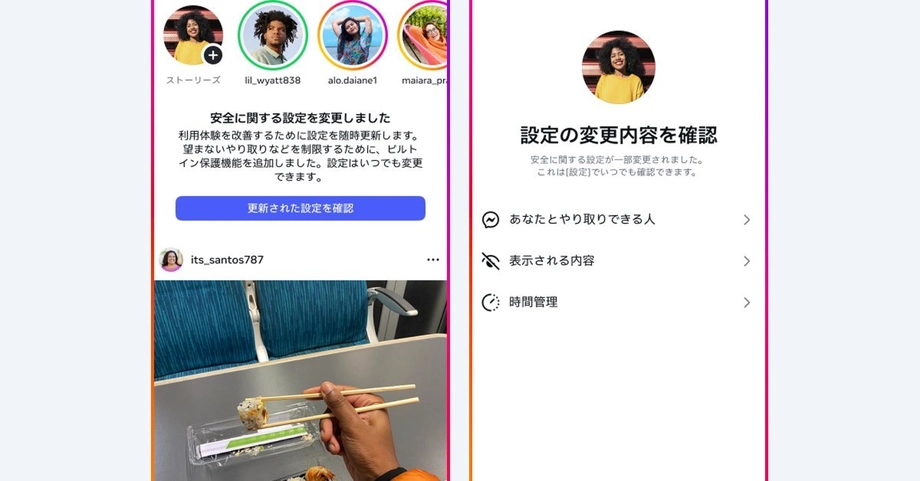
Teen Accounts combine several restrictions rather than relying on a single filter. Accounts are private by default, direct messages are limited to people the teenager follows or already has a connection with, and protections restrict sensitive content and hide harmful comments.
Instagram also issues a reminder when daily use reaches 60 minutes. Sleep mode suppresses notifications between 10 p.m. and 7 a.m. A reminder encourages someone to stop scrolling; a time limit set through parental supervision can place a firmer boundary on access.
Parents using supervision tools can monitor usage and set limits on time spent in the app. Users younger than 16 need parental permission to make protections less restrictive. The controls therefore affect both what happens on the screen and how much independence younger teenagers have over their settings.
Japan began receiving another layer of content restrictions in May 2026, drawing on standards used for films intended for audiences aged 13 and older. Posts involving strong language or dangerous stunts can be hidden even when shared by an account a teenager follows. Accounts that repeatedly publish unsuitable material can face restrictions on following or exchanging messages with teenagers.
How the expansion reached Japan
Meta's age estimation effort developed separately from the rollout of Teen Accounts. The protective account settings came first in Japan; technology for identifying teenagers using adult birthdays followed later.
The principal milestones are:
- January 2025: Instagram introduced Teen Accounts in Japan.
- April 2025: Meta began testing AI identification of teenagers using adult birthdays in the United States.
- During 2025: The technology reached Australia, Canada and the United Kingdom.
- May 2026: The expansion reached EU countries and Brazil.
- August 2026: Meta reached an agreement with 52 US attorneys general that included stronger identification of children and teenagers.
- November 9 and 10, 2026: Meta announced the global expansion and began introducing it in Japan.
- By the end of 2026: Meta plans to begin a similar worldwide rollout on Threads.
Descriptions of the early rollout place Australia, Canada and the United Kingdom in either the April 2025 introduction or a September 2025 expansion. The Japanese launch and the November 2026 global announcement are the latest steps in that sequence.
Estimating age without asking everyone for identification
AI age estimation uses patterns in account information and activity to judge the age group a person probably belongs to. It is different from checking a birth date against an official document: the system makes an assessment rather than confirming a precise birthday.
Information described in connection with Instagram's teenage age estimates includes profile details, the kinds of content an account interacts with and when the account was created. Such information can help a system identify likely teenagers while avoiding a request for identification from every user.
Meta also uses technology to identify children younger than 13, who fall below its minimum age requirement. The company clarified that photo analysis involving bone structure, along with references to school grades and birthday celebrations, is used in that effort to detect and remove younger children.
Instagram therefore has two tasks with different outcomes. A user assessed as 13 to 17 is placed in an experience designed for teenagers. An account believed to belong to a child younger than 13 is subject to action aimed at keeping children below the minimum age off the service.
Why errors near an age boundary matter
A person who has just turned 18 may use Instagram much like a friend who is still 17. That makes the boundary between adult and teenage accounts difficult to determine from behaviour alone. Similar problems arise whenever access depends on crossing a particular birthday.
Australia's Age Assurance Technology Trial offers one measure of this difficulty. In testing with a boundary of 16, 8.5% of participants who were actually 16 were classified as younger than 16. The trial examined age assurance technologies, while Meta has not published a comparable performance figure for this Instagram expansion.
For a user assigned to the wrong age group, correction matters because the classification changes access to settings and content. Meta has described ways for users mistakenly identified as teenagers to change their settings, while services using age checks may request a facial image or identification to resolve uncertainty.
Privacy becomes part of that decision. An identity document can contain a name, address, photograph and document number as well as a birthday. Collecting fewer copies reduces the number of organisations holding that sensitive information. Behavioural estimation, meanwhile, depends on drawing conclusions from information about how an account is used.
Apple's age signal adds another route
Australia is the first location named in this announcement where Meta has begun using Apple's age range signal as an additional way to understand a user's age. The process starts when a parent sets up a smartphone for a teenager.
A parent can choose to have the app store confirm the device user's age and assign an age range. When the teenager downloads an app, Apple passes that range to the developer, allowing the developer to check whether the user meets the app's age requirement.
Meta says receiving a verified age signal through the device would work better and protect privacy more effectively than requiring each app to conduct its own verification. The company supports legislation requiring app stores to verify age and obtain parental consent.
Meta explained its preferred approach in its announcement:
One verified signal from people's devices, shared consistently with all apps, is far more effective and privacy-preserving than asking every platform to verify age individually.
Participation currently remains voluntary at several points: parents can choose the option, app stores can collect and share the information, and developers can decide whether to use it. Meta argues that these choices leave teenagers with different levels of protection across apps. It proposes using AI estimates as a backup to catch mistakes and help correct age information across services.
A legal agreement puts age detection under scrutiny
Meta's agreement with 52 attorneys general followed lawsuits alleging that its services contributed to social media addiction and harmed the mental health of young users. The August settlement included commitments to improve how the company identifies teenagers and children younger than 13.
The settlement has been described as potentially worth up to $18 billion; another published figure puts it at $17.1 billion. Meta's announcement of the age estimation expansion confirms the agreement and its age assurance commitments without setting out the financial terms.
Meta says it is investing in stronger technology for both age groups. For teenagers, the goal is to apply restrictions even when the registered birthday says adult. For younger children, the goal is to detect accounts that should not be using the service.
Age detection is consequently becoming part of the company's legal commitments as well as a product feature. The worldwide expansion applies the same basic approach across more markets, while Meta continues introducing it on Facebook and prepares to begin on Threads.
Parents will receive explanations inside Instagram
Parents in the United States are due to begin receiving Instagram notifications and a video in their feeds during November 2026. Meta says these will explain how teenagers are placed under age appropriate protections and how parents can help ensure the registered age is accurate.
The video will lead to an article by Larry Magid, an internet safety advocate and president and chief executive of ConnectSafely. The article explains Meta's approach to excluding children younger than 13, protecting teenagers and involving parents. It is available to parents worldwide.
A correct birthday matters because several safeguards depend on recognising the account as belonging to a teenager. In Japan, for example, Instagram began providing alerts in August 2026 to parents using supervision tools when their children repeatedly searched for terms associated with serious personal distress over a short period.
Meta is also calling on TikTok and YouTube to adopt similar practices for identifying children and teenagers. Its argument is practical: teenagers use several services, so restrictions in one app leave gaps when another service accepts an inaccurate adult birthday.
Japan weighs rules as platforms try different methods
Japan's policy debate has focused on how services should establish age and protect young users. A June 2026 draft from a Ministry of Internal Affairs and Communications expert group opposed a blanket age restriction, citing the role of social media in communication and differences in risk between services.
A Children and Families Agency expert group recommended in an interim report in July that social media operators be required to check age, while continuing discussion about age restrictions. A final report is expected before the end of 2026.
Other platforms are pursuing different approaches. Discord began applying teenage settings by default to all users in March 2026, then identifying adults through an internal model. When it cannot reach a decision, users may be asked for a facial age estimate or identification. Roblox began requiring facial age estimation for chat access in January 2026, while ChatGPT began introducing age prediction based on usage that month.
Instagram's expansion follows a different route: identify likely teenagers among accounts registered as adults and apply protections automatically. For Japanese families, the immediate change is that an adult birthday becomes less likely to leave a teenage account outside the protective system. The next scheduled developments are the planned Threads launch and Japan's final policy report before the end of the year.
Key Points
- Instagram began introducing AI age estimation in Japan on November 10, 2026, following Meta's global announcement a day earlier.
- Accounts assessed as belonging to users aged 13 to 17 can receive Teen Account protections despite listing an adult birthday.
- Protections include private accounts, messaging restrictions, content controls, a daily usage reminder and overnight notification limits.
- Meta expects millions more teenagers worldwide to receive the settings.
- Meta is using Apple's age range signal in Australia and supports mandatory age checks through app stores.
- The expansion follows commitments in an agreement with 52 US attorneys general.
- A similar global rollout on Threads is planned to begin before the end of 2026.