Calls, Data and Texts Restored After Overnight Repairs
NTT Docomo said it restored its 5G Standalone service across Japan at about 1:20 a.m. on November 6, 2026, ending roughly 14 hours of disruption to voice calls, mobile data and SMS. The company identified congestion in switching equipment serving 5G SA subscribers as the cause.
Contents
- Calls, Data and Texts Restored After Overnight Repairs
- Which Customers Had Trouble Connecting?
- What Went Wrong Inside the Network?
- Why 5G SA Was a Separate Group
- How the Incident Unfolded
- What Customers Should Do After Restoration
- Website Intrusions Added to the Disruption
- Why Docomo Kept Updating Customers
- An Outage Just After an Investment Announcement
- Key Points
Docomo placed the start of the disruption at about 11:18 a.m. on November 5. Those times put the incident at approximately 14 hours and two minutes, spanning the afternoon, evening and early hours of the following day.
The start was also reported as 10:55 p.m. on November 4, a materially earlier time than the November 5 onset given in Docomo's detailed incident updates. The company's November 5 timeline is the basis for the roughly 14 hours stated in its restoration announcement.
The disruption affected customers subscribed to the optional 5G SA service. Other Docomo 5G customers, users of its 4G service and customers of mobile virtual network operators using Docomo's network were unaffected. Docomo also said emergency calls were unaffected.
Customers who still have trouble connecting should restart their phones or turn airplane mode on and then off, the company advised. Anyone who temporarily changed their network setting to 4G during the outage should return it to the previous setting.
Which Customers Had Trouble Connecting?
Docomo's affected customers experienced difficulty making voice calls, loading data and using SMS. Reported symptoms included calls that could not be placed, calls that disconnected and slow data loading. The disruption was nationwide in geographical reach, but limited to the 5G SA subscriber group.
A mobile virtual network operator, or MVNO, sells mobile service using capacity rented from another carrier. Docomo confirmed that these providers were outside the affected group, narrowing the scope from its initial notices.
Docomo's first announcements had referred broadly to its own lines and MVNOs using its network while checks continued. Its third update, issued at 2 p.m. on November 5, identified 5G SA subscribers as the affected customers and confirmed that emergency calls, including Japan's 110 police and 119 fire and ambulance numbers, were unaffected.
The number of affected subscribers and the number of failed calls or messages were not given. The confirmed scope therefore describes the service and geographical area involved, rather than a measured total of customers who experienced problems.
What Went Wrong Inside the Network?
Docomo identified congestion in the switching equipment that accommodates 5G SA subscribers. Such equipment handles signals needed to connect customers through the network. Congestion occurs when the work arriving at equipment exceeds what it can process smoothly, creating a bottleneck.
Accounts of the incident also described a failure in switching equipment that processes signals from base stations, the radio sites that connect mobile phones to the network. Docomo's restoration explanation specifically identified congestion in the equipment serving its 5G SA customers.
For a customer, that kind of bottleneck can interrupt several services at once. A phone needs more than a radio connection to a nearby base station: the network behind it must also process the information required to establish calls and carry data or messages.
Docomo said it completed the necessary measures and checked that service was operating normally before announcing restoration. Its announcement did not detail what triggered the congestion or the specific technical changes used to resolve it.
Why 5G SA Was a Separate Group
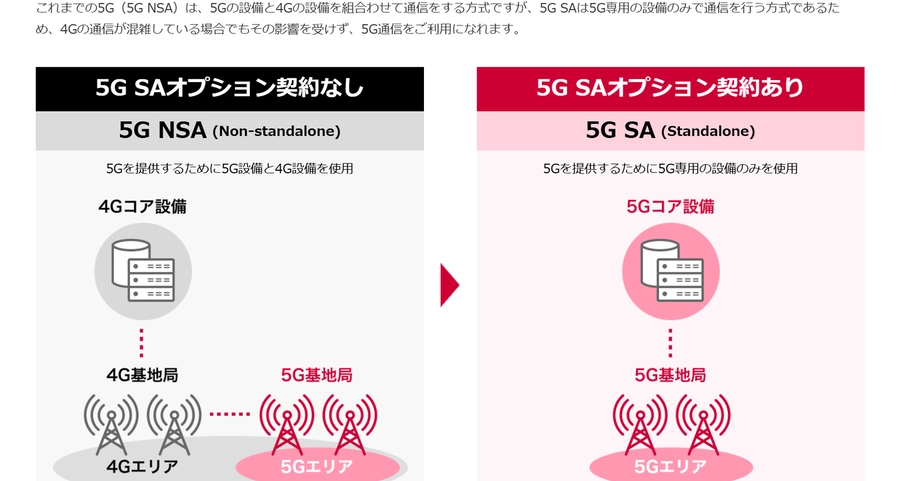
Docomo began offering 5G SA in August 2022. The optional service has no additional usage fee. SA stands for Standalone, meaning the service uses a dedicated 5G network rather than relying on 4G equipment in the network's core.
Docomo's initial 5G service, launched in 2020, used a different arrangement. A customer's phone could connect to a base station using 5G radio signals while the core network behind that connection still used 4G equipment. The core is the part of the network that manages connections and directs communications.
Standalone service changes that arrangement by using 5G equipment through the core as well. This helps explain why Docomo could identify a particular group of 5G customers as affected while other 5G and 4G customers continued using their services.
The difference also made the temporary 4G workaround relevant. Selecting 4G changed the connection the phone was attempting to use, giving affected subscribers a possible way to resume calls, data and texts while repairs continued.
How the Incident Unfolded
Docomo gradually narrowed its description of the disruption as engineers checked the affected services. Its earliest notice left the starting time and the effect on emergency calls under investigation.
The key developments stretched from late morning on November 5 into the following day. All times below are local to Japan.
- November 5, about 11:18 a.m.: The disruption began, according to Docomo's detailed incident timeline.
- 1 p.m.: The second update identified the starting time, while checks on the affected services and emergency calls continued.
- 2 p.m.: The third update limited the affected group to 5G SA subscribers, confirmed emergency calls were unaffected and introduced the 4G workaround.
- 3 p.m.: The fourth update reported no new information and said restoration work was continuing.
- 4 p.m.: The fifth update said investigators had found no signs of unauthorized access or a cyberattack around the network incident.
- 5 p.m. to 11 p.m.: Further notices continued at roughly hourly intervals as the disruption persisted.
- November 6, about 1:20 a.m.: Docomo said service had been restored after measures to address congestion and checks of normal operation.
The 2 p.m. update came about two hours and 42 minutes after the stated onset. It gave customers a more precise explanation of who was affected, as well as a practical step that could help before full restoration.
What Customers Should Do After Restoration
Docomo's advice after restoration was to restart the handset or switch airplane mode on and off if service remained difficult to use. These steps make the phone attempt a fresh connection to the mobile network.
Customers who selected 4G as a temporary measure were asked to restore their previous network setting. Leaving the phone set to 4G would keep it from selecting 5G even after the affected service had returned.
During the outage, Docomo said choosing 4G and then restarting the phone or toggling airplane mode could allow voice, data and SMS to work. The wording was conditional: the company presented this as a possible workaround while engineers continued repairs.
The restoration announcement said the network measures were complete. Its remaining handset advice addressed customers whose phones had not yet reconnected successfully.
Website Intrusions Added to the Disruption
Docomo was also dealing with unauthorized access involving its Online Shop and My Docomo websites. Both sites had been stopped from the early hours of November 5, and no restoration estimate had been given for them in the account describing their closure.
The Online Shop allows customers to purchase smartphones and other products. My Docomo lets users check or change contract details. Their suspension affected a different set of activities from the difficulty making calls, sending texts or using mobile data.
Up to approximately 300,000 personal information records were reported to have leaked from the two websites. That figure refers to records; a total number of distinct people affected was not specified.
For the 5G SA network incident, Docomo said its investigation, covering the period before and after the disruption, had found no traces of unauthorized access or events indicating a cyberattack. The company maintained that position in the information accompanying restoration at 1:20 a.m.
Customers therefore faced two concurrent problems with different recovery updates: the mobile network was restored overnight, while the website closures still had no stated recovery timetable in the account of the intrusions.
Why Docomo Kept Updating Customers
Docomo issued updates at roughly hourly intervals, including notices that contained no new technical findings. Its second through twelfth updates ran from 1 p.m. to 11 p.m. on November 5.
Japan's Ministry of Internal Affairs and Communications published guidelines on public notices during telecommunications outages in March 2023, with application generally beginning on April 1 that year. The guidelines call for an initial notice within 30 minutes in principle.
For designated public institutions such as Docomo, the guidance calls for website updates at least about once an hour, excluding late night and early morning, even when there is no change to report. Docomo's afternoon and evening notices followed that approximate frequency.
The timing of its first notice was not specified in the detailed chronology, so the interval between the start of the disruption and that notice cannot be calculated. The later notices show when customers received narrower information about the affected services and the temporary workaround.
An Outage Just After an Investment Announcement
Docomo had announced plans to invest in accelerating its shift to 5G SA at its fiscal 2026 second quarter results briefing on November 4, the day before the network disruption began according to its incident timeline.
The outage put the reliability of that service in immediate focus. Customers subscribed to the newer network arrangement were directed temporarily toward 4G while the company worked on the switching equipment serving them.
Docomo's restoration announcement closed the immediate network incident after about 14 hours. The practical next steps were to reconnect any phones still experiencing difficulty and reverse temporary 4G settings, while the website intrusions remained a separate customer concern.
Key Points
- Docomo said nationwide disruption to its 5G SA service ended at about 1:20 a.m. on November 6, 2026.
- Its detailed timeline placed the start at 11:18 a.m. on November 5, giving a duration of about 14 hours.
- Voice calls, mobile data and SMS were affected; other Docomo 5G and 4G customers, MVNO customers and emergency calls were unaffected.
- Docomo identified congestion in switching equipment serving 5G SA subscribers and said it found no signs of a cyberattack on that network incident.
- Customers still having trouble should restart their phones or toggle airplane mode, and undo temporary changes to 4G settings.
- Separate website intrusions stopped the Online Shop and My Docomo, with up to about 300,000 personal information records reported leaked.