Four Legs, a Hydrogen Engine and a 2035 Target
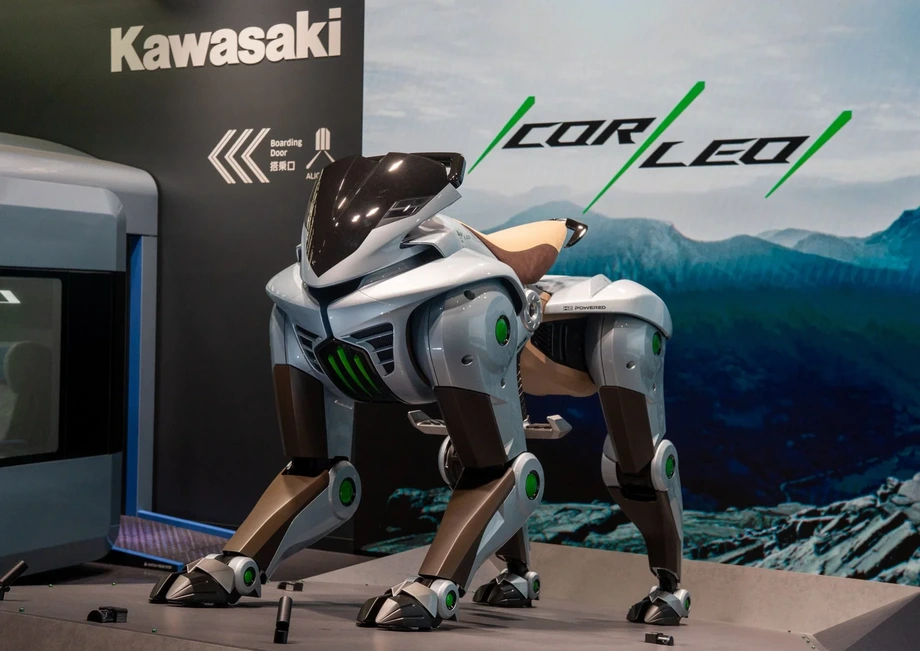
Kawasaki Heavy Industries is developing CORLEO, a vehicle with four robotic legs and a hydrogen engine, with two major targets: use at Expo 2030 Riyadh in Saudi Arabia and commercialization in 2035. Before then, a full size model is scheduled to appear at the EICMA motorcycle show in Milan from November 5 to 8, 2026, where visitors will be able to see it but not ride it.
Contents
- Four Legs, a Hydrogen Engine and a 2035 Target
- What Visitors Will See in Milan
- How the Legs Borrow From Motorcycles
- Steering Through Body Weight
- Why a Hydrogen Engine Produces Electricity
- SAFE ADVENTURE Extends Beyond the Vehicle
- The Milestones From Osaka to Riyadh
- A Simulator First, With Other Uses Under Discussion
- Key Points
The project combines two parts of the Japanese industrial group that usually serve different purposes: robotics and motorcycles. CORLEO replaces wheels with independently controlled legs, while drawing on motorcycle technology to manage movement, balance and shocks from uneven ground. Riders would steer by shifting their weight, in a manner Kawasaki compares with horseback riding.
In its CORLEO development announcement, dated December 3, 2025, Kawasaki said it had established the SAFE ADVENTURE Business Development Team, reporting directly to its president. The dedicated organization gives the concept a place within the company's development plans, alongside a riding simulator targeted for completion by 2027.
The schedule puts the Milan display nine years before the intended commercial launch. Kawasaki has not announced a price, sales markets, range, maximum speed, hydrogen capacity or customer delivery date. For prospective riders, the nearest milestones are therefore an exhibition model and a simulator, followed by the intended use in Riyadh.
What Visitors Will See in Milan
CORLEO is scheduled to join Kawasaki's motorcycle display at the Fiera Milano Rho exhibition centre, in Hall 11 at booth N46. The public dates are November 5 to 8, 2026, following two days reserved for the press and trade visitors.
The full size model will let visitors judge the proportions of a machine that sits between a motorcycle and a rideable robot. There will be no opportunity to ride CORLEO at the booth. Kawasaki describes the project as a new form of personal mobility, with legs intended to carry a rider through places that are difficult for conventional vehicles to reach.
CORLEO first appeared as a concept at the Future Life Expo: Future City showcase during Expo 2025 Osaka, Kansai. Kawasaki says that appearance generated approximately 1.2 billion social media impressions. Impressions count appearances of content on screens, so a person viewing several posts can contribute more than once.
The move from Osaka to a major motorcycle exhibition also reflects the project's origins. Kawasaki is presenting CORLEO as something a person actively rides, using body movement and balance, rather than simply as a robot that transports a passive passenger.
How the Legs Borrow From Motorcycles
CORLEO's four legs are designed to adjust their placement as the ground changes. The control system coordinates the legs to support the machine and rider, while the parts touching the ground are shaped to provide grip. The intended advantage is flexibility: a leg can lift and choose a new contact point when a wheel would have to roll across an obstacle.
Kawasaki identifies the rear legs as a direct connection to its motorcycle engineering. They use an arrangement based on a swingarm, the moving structure that supports a motorcycle's rear wheel and allows it to rise and fall over bumps.
On CORLEO, the rear legs can move independently up and down to absorb shocks. Kawasaki says this should help the rider maintain a posture that makes it easier to look at the terrain ahead. A rider who can keep watching the route has more opportunity to respond to the next obstacle.
Kawasaki describes the intended combination as the ability of robotics to handle rough terrain with the maneuverability and stability developed through motorcycles. The company's stated ambitions include mountains and areas with water, making coordination between grip, leg movement and rider position central to the design.
Steering Through Body Weight
CORLEO's proposed controls replace the familiar combination of handlebars and throttle with changes in posture and weight distribution. Sensors detect the rider's movements, and the control system translates them into instructions for the legs.
The rider provides a direction through body movement while the machine manages the detailed work of placing its feet and maintaining balance. That division of tasks is essential to the concept: a person cannot individually direct four robotic legs while also watching a difficult route.
Kawasaki says support functions are intended to help people cross challenging terrain easily and safely. That is a development goal involving the rider as well as the machine. The controls must interpret deliberate movements while dealing with the motion caused by bumps, slopes and changes in footing.
The planned simulator offers a way to develop and experience this unusual riding method before commercial sales. It is also a separate product opportunity, since Kawasaki intends to use work from CORLEO beyond the physical vehicle.
Why a Hydrogen Engine Produces Electricity
CORLEO's proposed power system uses a 150 cc hydrogen engine to generate electricity for the mechanisms that move its legs. Hydrogen is stored at the rear of the vehicle, described in the Milan exhibition plans as cartridges.
The number 150 cc describes engine displacement, the volume swept by the engine's pistons. It is a measure of engine size rather than a statement of the electrical power available to the legs. The energy follows a simple sequence: hydrogen fuels the engine, the engine drives a generator, and electricity powers the leg mechanisms.
A hydrogen combustion engine burns fuel to produce mechanical movement. A fuel cell uses a different process, converting hydrogen's chemical energy directly into electricity. Kawasaki's official description specifies an engine generating electricity for CORLEO.
Shigemi Tanaka, head of Kawasaki Motors Europe, has described the project as an example of technical expertise across the group and progress toward a carbon neutral future. Assessing that environmental ambition will require information about the finished machine's fuel consumption and how its hydrogen is produced and delivered. Those practical details will also affect where owners can use and refuel it.
Kawasaki already has a commercial hydrogen project in a different field. Its commercial hydrogen blend engine generates electricity using natural gas mixed with 30 percent hydrogen by volume. That industrial machine belongs to the eight megawatt class, while CORLEO is being developed as personal transport. Together, the projects show Kawasaki pursuing hydrogen combustion at very different scales.
SAFE ADVENTURE Extends Beyond the Vehicle
Kawasaki is developing CORLEO within SAFE ADVENTURE, a broader effort to make mountain travel safer. The company describes an ambition to reduce mountain accidents while making mountainous areas enjoyable and accessible.
A planned navigation system would detect weather, temperature, surface conditions and wildlife appearances, then use that information to guide people toward safer routes. Kawasaki says guidance could reach users through devices such as smartphones. Plans also describe information appearing on the vehicle's display.
The navigation work addresses a different problem from keeping the robot upright. CORLEO's leg controls would manage each step, while route guidance would help a rider decide where to go. A machine may be able to cross a difficult patch of ground even when changing weather or conditions farther ahead make another route preferable.
Kawasaki places SAFE ADVENTURE within three priorities in its Group Vision 2030: a safe and secure remotely connected society, future mobility, and energy and environmental solutions. CORLEO brings those priorities together through a vehicle, an information service and a hydrogen power system.
The Milestones From Osaka to Riyadh
Kawasaki's development plan stretches across a decade, with exhibitions, simulation and intended practical use marking different stages. The company's official targets put completion of the simulator before the proposed Riyadh deployment and commercial sales after it.
- 2025: CORLEO's concept model appears at Expo 2025 Osaka, Kansai.
- December 3, 2025: Kawasaki announces development toward commercialization and a dedicated SAFE ADVENTURE team reporting directly to its president.
- November 5 to 8, 2026: A full size model is scheduled for public display at EICMA in Milan, without visitor rides.
- 2027: Kawasaki targets completion of a CORLEO riding simulator.
- 2030: Kawasaki targets use as a mobility vehicle within Expo 2030 Riyadh.
- 2035: Kawasaki targets commercialization.
Development plans have also been described as including intensive field testing through 2027, covering joint durability, hydrogen consumption and the stability of leg control. Kawasaki's official announcement assigns the 2027 completion target specifically to the simulator and describes Riyadh as a target for use within the exhibition grounds.
Those stages involve different engineering tasks. A simulator must reproduce the feeling of riding convincingly, while a vehicle carrying people needs reliable physical movement, fuel handling and controls. The five years between the intended Riyadh use and commercialization leave a further development period in the published schedule.
A Simulator First, With Other Uses Under Discussion
Kawasaki plans to make CORLEO's simulator technology available to the gaming and esports industries. The company identifies motion data and three dimensional models developed during the project as parts of the system it intends to deploy.
That creates an earlier route for people to experience CORLEO's riding concept. A simulator could reproduce movement and responses without requiring users to travel to a mountain or have access to hydrogen fuel. Its 2027 target comes eight years before the intended commercial vehicle launch.
Potential physical uses discussed around CORLEO include adventure tourism, infrastructure inspection and environmental monitoring. Each involves reaching locations where access can be difficult. Kawasaki's official near term focus is the vehicle's development, the simulator, navigation and intended use at Expo 2030 Riyadh.
The central challenge now is turning an attention grabbing concept into a repeatable riding experience. Independent leg movement, weight based controls, hydrogen electricity generation and route guidance all need to work together. Kawasaki has set dates for that effort; the Milan display will give the public a closer look at the machine it intends to build.
Key Points
- CORLEO combines four robotic legs with a hydrogen engine that generates electricity.
- A full size model is scheduled for EICMA in Milan from November 5 to 8, 2026. Visitors will not be able to ride it.
- Riders would control movement by shifting their weight, while motorcycle derived rear leg mechanisms help absorb shocks.
- Kawasaki targets a riding simulator in 2027, use at Expo 2030 Riyadh and commercialization in 2035.
- SAFE ADVENTURE also includes navigation using weather, temperature, terrain and wildlife information.
- Price, range, maximum speed and customer delivery dates have not been announced.