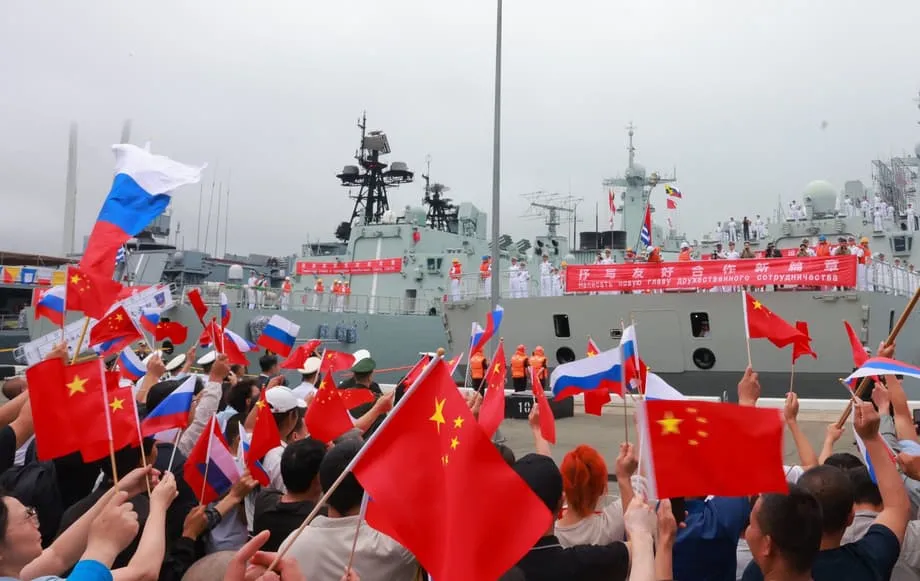
A partnership stretching from Ukraine to the Indo-Pacific
China and Russia held 14 joint military exercises in 2024, while their bilateral trade had reached a record $240 billion in 2023. For Australian defence planners preparing the next National Defence Strategy as of March 31, 2026, those figures describe two connected challenges: military cooperation across the Indo-Pacific and economic support that helps Moscow sustain its war in Ukraine.
Contents
- A partnership stretching from Ukraine to the Indo-Pacific
- How the alignment took shape
- Military exercises become more demanding
- What China gains from Russian technology
- Trade helps sustain Russia's war economy
- National currencies reduce exposure to Western pressure
- Canberra weighs funding and partnerships
- India and Indonesia retain room to manoeuvre
- Maritime disputes and pressure on Japan
- Information operations widen the contest
- North Korea connects the regional pressures
- The Bottom Line
Presidents Vladimir Putin and Xi Jinping declared their no-limits partnership in February 2022, weeks before Russian forces crossed into Ukraine. Their declaration described a friendship without boundaries and cooperation without forbidden areas. It formalised a relationship that had developed over three decades after the Cold War.
The alignment challenges the international order led by Western countries, which has supported Australian prosperity and sovereignty since 1945. Australian strategic planners increasingly see a coordinated threat stretching across Europe and Asia, on a scale not encountered for at least half a century.
Beijing supplies an economic lifeline that helps Russia withstand Western sanctions. Moscow provides defence technology and experience from combat that can support China's military modernisation. Joint propaganda, coordinated positions at the United Nations and increasingly complex exercises extend their cooperation beyond trade and weapons.
Australia therefore faces a planning problem that crosses geographic boundaries. Pressure in Europe and pressure in the Indo-Pacific can draw on the same economic, diplomatic and military relationships. Canberra must assess that connection while maintaining an essential economic relationship with China and a central security alliance with the United States.
How the alignment took shape
Moscow and Beijing moved gradually beyond historical differences after the Cold War. While Western governments concentrated on economic prosperity and anticipated a peace dividend, the two governments developed cooperation around a shared concern: protecting their authoritarian political systems from the perceived threat of liberal democratic values.
February 2022 marked a public declaration of that convergence rather than its beginning. Subsequent trade growth and military activity have made the relationship more practical and more consequential for countries outside Europe.
The main developments span several years:
- During the three decades after the Cold War, China and Russia progressively set aside historical differences and expanded cooperation.
- In February 2022, Putin and Xi declared their no-limits partnership shortly before Russia invaded Ukraine.
- In 2023, bilateral trade reached $240 billion, an increase of 26.3 percent from the previous year.
- In April 2024, Russian Foreign Minister Sergei Lavrov said national currencies had almost completely replaced the US dollar in bilateral trade.
- During 2024, the two militaries conducted 14 joint exercises.
- In August 2025, they held naval drills involving artillery, operations against submarines and air defence.
- By March 31, 2026, the relationship was a central consideration for Australian planners preparing the next National Defence Strategy.
China and Russia have different capabilities and interests, yet each supplies something the other needs. Their cooperation also provides an anchor for a broader grouping involving Iran and North Korea.
Military exercises become more demanding
Joint military exercises increased from one or two annually in the early 2000s to 14 in 2024. That represents between seven and 14 times the earlier annual frequency. Russia maintained this activity while continuing its war in Ukraine, demonstrating an ability to sustain several military efforts simultaneously that Western allies, until recently, struggled to match.
Chinese and Russian forces have conducted joint missile defence exercises and coordinated naval patrols extending from the Sea of Japan to the South China Sea. The August 2025 naval drills included artillery, submarine hunting and air defence, bringing together skills needed to protect ships and conduct coordinated operations.
Such exercises give the forces practical opportunities to test equipment, procedures and cooperation. Interoperability means that different militaries can communicate and work together effectively, including when they use different equipment or command structures.
Analysis by the Australian Strategic Policy Institute, or ASPI, describes this military convergence as a foundation for a real alternative to Western military alliances. China and Russia are gradually standardising command and control procedures, models for sharing data and systems that track missiles in real time.
Command and control covers how military leaders receive information, make decisions and direct forces. More compatible procedures could make combined operations easier, especially when decisions must be made quickly.
What China gains from Russian technology
China's defence budget grew from $7.7 billion in 1995 to approximately $250 billion in 2025. Using those figures, the later budget was more than 32 times the earlier amount. Spending has expanded enormously, while China's last major military engagement remained its 1979 war against Vietnam, which produced poor results for Beijing.
Russia brings experience from sustained combat operations and modern warfare. That experience offers lessons about military performance under pressure that exercises and simulations cannot reproduce. Access to those lessons matters to a Chinese military undergoing extensive modernisation.
Moscow has supplied Beijing with advanced S-400 missile defence systems, Su-35 fighter technology and important components, including high performance turbofan engines. These engines remain difficult for Chinese manufacturers to produce domestically.
Technology transfers and operational experience work alongside joint training. Together, they can help China improve equipment and the procedures used to operate it, while giving Russia a powerful partner even as its forces remain committed in Ukraine.
Former US Secretary of Defense Robert Gates has warned that the United States has never before faced four allied antagonists simultaneously: Russia, China, North Korea and Iran. He also warned that their collective nuclear arsenal could soon be twice the size of America's own. That wider grouping complicates planning for Australia and its allies across several regions.
Trade helps sustain Russia's war economy
China-Russia trade reached $240 billion in 2023, up 26.3 percent from 2022. The relationship has developed beyond a straightforward exchange of commodities into a network that supports Russia's economy despite extensive Western sanctions.
Chinese exports replace goods previously available from Europe and the United States. Beijing has also become a platform through which Russia obtains Western technologies with both civilian and military applications.
Customs data estimates put Chinese exports of products identified by Western governments as priorities for weapons production at more than $300 million a month. These are often called dual-use products because the same item can serve an ordinary commercial purpose or become part of military production.
The goods include machine tools used to manufacture ballistic missiles, semiconductors used in military optics and engines for Russian drones. Machine tools shape and manufacture parts; semiconductors are electronic components that help equipment process information and operate.
Up to 90 percent of Russia's microelectronics imports now originate from China, including components used in tanks, armoured vehicles and aircraft. Those supplies connect the trade relationship directly to Russia's ability to maintain and produce military equipment.
European policy analysts argue that this assistance has moved China beyond the role of economic competitor and into that of a security threat requiring containment. Their assessment centres on Beijing's contribution to the economic and technological base sustaining Russia's aggression against Ukraine.
National currencies reduce exposure to Western pressure
Sergei Lavrov, Russia's foreign minister, announced in April 2024 that Russia and China had almost completely replaced the US dollar in their bilateral trade with their own national currencies. That change gives their commercial relationship greater separation from American financial infrastructure.
The renminbi became the leading foreign currency in Russian deposits. Russian cash holdings of the Chinese currency doubled in 2023 to the equivalent of $68.7 billion.
Financial integration helps Moscow circumvent Western sanctions while supporting Beijing's ambition to develop alternative payment systems and reduce global dependence on American financial infrastructure. Trade in goods and access to ways of paying for them therefore reinforce each other.
European Commission President Ursula von der Leyen and US Secretary of State Antony Blinken have repeatedly warned that Chinese assistance to Russia affects fundamental relationships with Western countries. Beijing has continued that support despite those warnings.
For Australia, the connection between finance, industrial goods and military production widens the security challenge beyond ships, aircraft and troops. Economic relationships can sustain military activity far from the country supplying the goods or processing the payments.
Canberra weighs funding and partnerships
Australia's next National Defence Strategy must address a more contested environment shaped by economic coercion, defence cooperation and joint information operations. The timing of the strategy's release was not specified. The planning argument calls for funding commitments extending beyond the traditional budget estimates covering four years.
Canberra is expanding its network of security partnerships alongside the US alliance. The recent Australia-European Union Security and Defence Partnership connects countries confronting related pressures in Europe and the Indo-Pacific.
These additional relationships broaden Australia's options. Analysts nevertheless regard the United States as Australia's most important security ally, even amid concerns about Washington's capacity to manage competing strategic demands and the reliability of its commitments.
China occupies two roles in Australian calculations: an important economic power and a strategic adversary. Defence planning must accommodate both, while recognising that Beijing's support helps keep Moscow's war effort viable.
China and Russia also use diplomatic pressure and information operations to promote authoritarian values internationally. Their cooperation spans defence, trade and ideology, making it relevant to Australian policy beyond conventional military preparedness.
The partnership currently stops short of a mutual defence treaty, a commitment under which one country promises to help defend the other. Future formal coordination during a conflict remains a possibility for planners to consider, with combined operations, shared logistics and coordinated strategic signals among the potential developments.
Iran and North Korea add another dimension. The broader grouping contains several nuclear powers, with China its strongest element and Russia its most disruptive. Australian planning must account for how activity by one member could affect the resources and attention available to respond elsewhere.
India and Indonesia retain room to manoeuvre
India's strategic autonomy limits the scope for cooperation among New Delhi, Beijing and Moscow despite India's longstanding defence ties with Russia. Strategic autonomy means retaining freedom to make decisions rather than accepting the obligations of a single political or military bloc.
New Delhi's participation in the Quadrilateral Security Dialogue, or Quad, and its resistance to bloc politics place constraints on Chinese and Russian regional coordination. India's choices show how established relationships with Moscow can coexist with resistance to a wider alignment involving Beijing.
Indonesia follows its bebas dan aktif doctrine, meaning a free and active foreign policy. Jakarta engages both powers while seeking to avoid entanglement and preserve regional balance.
Indonesia recently rejected a Russian request to establish a base for aircraft capable of flying long distances in Papua. That decision reflected Jakarta's preference for maintaining room to manoeuvre rather than hosting a Russian military presence of that kind.
These policies make regional countries active participants in shaping security arrangements. Their decisions can raise the cost of Chinese and Russian cooperation or limit where it can operate effectively.
Maritime disputes and pressure on Japan
Vietnam and the Philippines assert their sovereignty in the South China Sea through legal mechanisms and diversified defence partnerships. Their actions complicate efforts by major powers to maintain a coherent position across contested waters.
Japan faces pressure from both the north and west. Russian military aircraft have intruded into its airspace, and the Kuril Islands dispute remains unresolved. Chinese maritime expansion adds another source of strain.
Closer China-Russia cooperation removes an advantage Japan previously gained from historical mistrust between the two powers. Tokyo must consider the possibility of pressure from both directions as it reassesses its pacifist constitutional constraints and substantially increases defence spending.
Japan's response has three parts: strengthening the US alliance, deepening cooperation with Australia and India through the Quad, and pursuing proactive engagement with Beijing and Moscow. These approaches combine security partnerships with continued diplomatic contact.
Regional resistance gives Australian diplomacy practical openings. Support for legal capacity, programmes that improve awareness of activity at sea and diversified defence partnerships can strengthen countries seeking alternatives to dependence on a single major power.
China and Russia therefore operate in a region where local governments continue to shape access, partnerships and diplomatic outcomes. The strength of the partnership at the global level meets more fragmented conditions on the ground and at sea.
Information operations widen the contest
China and Russia coordinate narratives that blame NATO expansion for Russian aggression, describe Western conduct as imperialism and draw on grievances about colonialism across the Global South. That messaging has helped encourage many countries outside the West to withhold condemnation of Russia's invasion, complicating efforts to isolate Moscow.
Cyber and intelligence cooperation has also intensified. Both countries conduct industrial espionage, political influence operations and cyberattacks against Western targets, including Australian networks.
Chinese and Russian intelligence operations intersect in Europe, including through penetration of political parties on the far right and far left. These activities spread doubts about democracy and deepen social divisions. Finnish security services have warned that the two countries share goals they promote together when doing so serves their interests.
Stephen Kotkin of the Hoover Institution describes a central feature of the relationship: Russia and China may disagree about what they support, while agreeing about what they oppose. Their shared opposition targets the Western liberal international order, universal human rights and institutions intended to provide collective security.
For both authoritarian governments, liberal democratic ideas are perceived as a threat alongside military power. Cooperation therefore extends to information control, internet governance and propaganda techniques that restrict civic participation and free expression.
North Korea connects the regional pressures
Moscow and Beijing have supported North Korea's nuclear diplomacy while openly violating international sanctions they previously supported in the UN Security Council. Their actions have weakened efforts to contain a security problem close to several American allies.
Russia provides Pyongyang with hydrocarbons and potentially technology usable for both civilian purposes and missiles. China supplies economic support and diplomatic cover.
This cooperation has reduced the chances of a peaceful resolution of the Korean crisis and added to the threats surrounding US allies in Northeast Asia. It also connects the China-Russia partnership to a country whose nuclear activities already require sustained regional attention.
Australia's challenge is to account for these connections without losing sight of regional differences. Moscow gains economic support, Beijing gains military technology and experience, and both gain diplomatic partners. India, Indonesia, Japan and countries bordering the South China Sea continue to shape how far that cooperation can translate into coordinated action.
The next National Defence Strategy must weigh those pressures together: the resources needed for deterrence, the continuing importance of the United States and the value of partnerships that give Australia and its neighbours more choices.
The Bottom Line
- Putin and Xi declared their no-limits partnership in February 2022, shortly before Russia invaded Ukraine.
- Joint military exercises rose from one or two annually in the early 2000s to 14 in 2024.
- China-Russia trade reached $240 billion in 2023, an increase of 26.3 percent.
- Customs data estimates put Chinese exports of priority goods with civilian and military uses at more than $300 million a month.
- Russia supplies China with defence technology and combat lessons, while China helps sustain Russia's economy and military production.
- Iran and North Korea broaden the security challenge, while regional governments constrain how China and Russia can act together.
- Australia is expanding security partnerships while retaining the United States as its central ally and preparing its next National Defence Strategy.