Tokyo Enters Its Peak Cherry Blossom Weekend
Tokyo's cherry blossoms reached full bloom on March 28, 2026, three days earlier than the historical average and two days earlier than in 2025. The Japan Meteorological Agency confirmed the milestone after observers found that at least 80 percent of the blossoms on its designated Somei Yoshino sample tree at Yasukuni Shrine in Chiyoda Ward had opened.
Contents
- Tokyo Enters Its Peak Cherry Blossom Weekend
- How Winter Cold and Spring Warmth Shape Flowering
- The Blossom Front Moves Across Japan
- Ueno Park Offers a Historic Hanami Setting
- Shinjuku Gyoen Extends the Viewing Season
- Chidorigafuchi Combines Moat Views and Boat Trips
- A Rare Walk Inside the Imperial Palace Grounds
- Meguro and Sumida Bring Blossoms to the Rivers
- Nihonbashi and Koganei Add Food and Performances
- Planning Around Crowds and a Short Peak
- The Bottom Line
The declaration puts central Tokyo at the height of hanami, the seasonal tradition of viewing cherry blossoms. With festivals, evening illuminations and a rare opening inside the Imperial Palace grounds taking place, residents and visitors have several ways to experience the flowers during their brief peak.
Tokyo's first blossoms appeared on March 19, nine days before the full bloom declaration. Last year's peak was recorded on March 30, while the average date is March 31. Those dates give a clearer picture of what an early season means: the capital has reached its benchmark a few days sooner than usual, with the busiest viewing period already under way as of March 29.
Temperatures in nearby Kitanomaru Park reached 19.6 degrees Celsius shortly after 3 p.m. on Saturday, March 28. The warmth helped push the blossoms toward their peak. The official observation comes from one designated tree, while Tokyo's parks and riversides contain many trees and varieties whose flowering periods extend beyond that single benchmark.
Full bloom also starts a short period in which weather matters greatly to visitors. The flowers usually remain at their peak for only a few days before petals begin falling, and spring rain can shorten the viewing period. Some destinations offer varieties that flower earlier or later, giving people opportunities beyond the Somei Yoshino peak.
How Winter Cold and Spring Warmth Shape Flowering
The Japan Meteorological Corporation's tenth forecast, released on March 26, described a flowering process that begins long before the first visible petals. Cherry blossom buds form during the preceding summer, then pass through autumn and winter dormancy before entering their spring growth stage.
Dormancy is a resting period for the buds. They need exposure to cold temperatures between minus 5 and 15 degrees Celsius to leave that state. Once this cold requirement has been met, warmer spring conditions accelerate growth toward flowering. Both the colder months and the arrival of spring warmth therefore help determine the date of the display.
Tokyo's cumulative temperature data pointed to full bloom on March 28, three days ahead of its March 31 average. Cumulative temperature means considering warmth over time, rather than looking only at the temperature on one afternoon. The 19.6 degrees Celsius recorded on March 28 supplied warmth near the end of a process already shaped by earlier seasonal conditions.
The forecast showed early flowering patterns across much of Japan. Nagoya reached full bloom on March 27, six days earlier than average. Kyoto was expected to reach its peak around March 31, four days early, and Osaka on April 1, three days early. Tokyo's advance was therefore smaller than Nagoya's six days, but matched the three days forecast for Osaka.
The Blossom Front Moves Across Japan
Kochi City on Shikoku Island recorded Japan's first blossoms of the 2026 season on March 16. Nagoya followed on March 17, then Tokyo on March 19. The broad movement of flowering northward across the archipelago is known as the sakura zensen, or cherry blossom front, although differences in climate affect the timing each year.
The Japan Meteorological Agency said most sample trees in Kanto-Koshin, covering central to eastern Japan, the central Tokai region and western Japan had already flowered. Weathernews Inc., a private weather service, predicted that many areas of eastern and western Japan would reach their peak within the coming week.
- March 16: The season's first blossoms opened in Kochi City.
- March 17: Nagoya recorded its first blossoms.
- March 19: Tokyo recorded its first blossoms.
- March 23: Kyoto's blossoms began opening.
- March 24: Nara recorded its first blossoms.
- March 26: Osaka recorded its first blossoms.
- March 27: Nagoya reached full bloom.
- March 28: Tokyo reached full bloom.
Western cities including Kyoto, Osaka and Nara were expected to reach full bloom around March 31, while the Japan Meteorological Corporation's March 26 forecast placed Osaka's peak on April 1. The period from first bloom through the flowers withering gives residents and visitors approximately two weeks to enjoy the season, with the peak itself lasting only part of that time.
Fukuoka was among the southern areas showing slightly delayed flowering compared with average dates. Farther north, Sendai and Sapporo remained weeks away from their expected peaks in early April and late April respectively. Tokyo's full bloom declaration therefore marks one stage of a season still continuing across the country.
Ueno Park Offers a Historic Hanami Setting
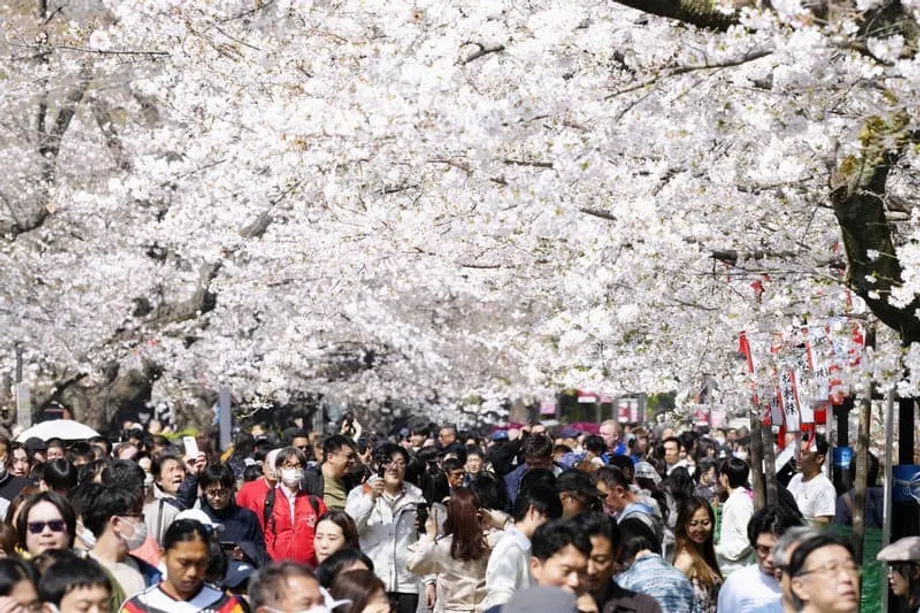
Ueno Park has approximately 1,000 cherry trees lining its central avenue, making it one of Tokyo's best known hanami destinations. Its connection with blossom viewing stretches back to the Edo period, and the park appeared in haiku by the poet Matsuo Basho.
For the 2026 season, 800 paper lanterns illuminate the main avenue from 17:00 to 23:00 through April 5. The park opens at 5:00 a.m. and closes at 11:00 p.m., allowing visitors to choose between an early visit and an evening beneath the lanterns.
The nighttime display changes the setting while keeping the flowers at the center of the visit. Ueno's long history, large concentration of trees and extended opening hours make it a prominent destination during the capital's peak weekend, when heavy crowds are expected.
Shinjuku Gyoen Extends the Viewing Season
Shinjuku Gyoen contains roughly 1,300 cherry trees representing more than 65 varieties. Its combination of early, standard and later flowering trees allows visitors to enjoy blossoms both before and after the Somei Yoshino peak recorded at Yasukuni Shrine.
The spacious grounds offer a more curated setting than many of the city's busy festival locations. Adult admission costs 500 yen. During the peak season, advance reservations are mandatory for entry between 10:00 and 16:00 on March 28 and 29 and April 4 and 5.
For anyone planning a visit as of March 29, the reservation requirement applies that day and again on the following weekend. The variety of trees gives Shinjuku Gyoen a longer viewing season, but entry arrangements still need to be checked for the intended date and time.
Chidorigafuchi Combines Moat Views and Boat Trips
Chidorigafuchi Moat, just north of the Imperial Palace, has a tunnel of cherry trees stretching 700 meters along the waterway. Branches overhang the water, giving visitors views from the paths and from rental boats beneath the blossoms.
The Chiyoda Cherry Blossom Festival runs from March 26 through April 6. Nighttime illuminations begin at 17:00 and finish at either 20:00 or 21:00, depending on the day. Visitors planning an evening trip need to check that day's closing time.
Some boat reservations are available in advance, offering a way to avoid lengthy queues. The combination of a waterside walk, illuminated branches and a view from beneath the trees makes Chidorigafuchi a different experience from the broad avenues and open grounds of Tokyo's major parks.
A Rare Walk Inside the Imperial Palace Grounds
Inui Street inside the Tokyo Imperial Palace grounds is open for a limited nine days from late March through early April. The avenue, which stretches 750 meters, is normally closed to visitors and provides a seasonal opportunity to enter this part of the palace grounds.
The Imperial Household Agency permits public access to the route only twice each year, during cherry blossom season and again in autumn for the changing foliage. Entry during the spring opening is free. Exact opening and closing dates for this nine day period were not specified.
Hundreds of visitors queued early on the first day to walk past carefully maintained cherry trees, stone walls and traditional lamp posts. The flowers form a delicate canopy along the route, while views of the modern Tokyo skyline contrast with the historic palace setting.
Security checks are in place, and authorities may temporarily pause admission if crowds become excessive. Visitors must follow the designated routes, and picnicking is prohibited to preserve the site. The opening offers a walk through normally restricted grounds, with different access rules from a public park.
Meguro and Sumida Bring Blossoms to the Rivers
The Nakameguro Cherry Blossom Festival concentrates its activities at Goryuten Playground on March 28 and 29. Organized by the local shopping street promotion association, it includes live music, brass band parades, dance performances and food vendors along the Meguro River.
More than 800 Yoshino cherry trees line the river, creating a cascading tunnel of blossoms. Pink lanterns illuminate the riverbanks from 17:00 to 20:00 for 15 days following the opening bloom, extending the viewing experience into the evening.
Along the Sumida River, the Bokutei Sakura-matsuri Festival celebrates more than 600 cherry trees originally planted by the eighth Tokugawa shogun, Yoshimune, during the Edo period. The blossom boulevard stretches one kilometer between Azumabashi Bridge and Sakurabashi Bridge, with views of Tokyo Skytree framed by pink flowers.
Local neighborhood associations operate food stalls at the Sumida celebration. Traditional geigi teahouses and yakatabune boat charters offer other ways to experience the riverside display. These settings combine the flowers with neighborhood festivities, historic associations and views across the water.
Nihonbashi and Koganei Add Food and Performances
SAKURA FES NIHONBASHI runs from mid-March through early April, bringing the season into a district of historic buildings and established businesses. Buildings including the Mitsui Main Building are illuminated in soft pink light.
The festival includes the Nihonbashi Parfes outdoor dessert event and the Sakura Yatai market. At the market, 25 longstanding restaurants serve street food prepared for the limited festival period, making food another part of the neighborhood's spring celebration.
In western Tokyo, the Koganei Cherry Blossom Festival takes place on March 28 and 29. Its setting includes more than 1,400 trees, and the program features traditional taiko drumming performances. For visitors choosing among the capital's events, Koganei combines a large blossom display with live cultural performances.
The different festival calendars matter when planning a visit. Nakameguro and Koganei hold their listed activities over the March 28 and 29 weekend, while Ueno's lantern display continues through April 5 and the Chiyoda festival through April 6. Nihonbashi's celebrations continue into early April.
Planning Around Crowds and a Short Peak
Popular destinations such as Ueno Park and Shinjuku Gyoen can attract hundreds of thousands of people daily during busy weekends. Visitors should expect significant crowds as Tokyo's full bloom coincides with weekend festivals and special seasonal access.
Chidorigafuchi and the Meguro River offer yozakura, meaning cherry blossom viewing at night. Illumination reflects off petals and water, creating a different scene from daytime viewing. These evening events can become extremely congested, especially along popular riverside routes.
Residential neighborhoods also form part of the viewing areas. Keeping noise low and disposing of rubbish properly helps limit disruption while festivals and lantern displays draw crowds. Entry requirements vary by venue, so a plan for a public park may need different arrangements from one for Shinjuku Gyoen or the Imperial Palace.
Spring weather can change quickly, and rain may shorten the display once full bloom arrives. Falling petals create the effect often called sakura snow, which becomes part of the seasonal spectacle while signaling that the peak is passing. The approximately two weeks from first flowering to withering offer a broader viewing period than the few days when most blossoms are fully open.
As of March 29, Tokyo's peak is already here, western Japan is approaching many of its expected peak dates, and northern destinations have later flowering ahead. Choosing a location therefore means considering its trees, festival schedule, admission rules and weather, rather than relying on the capital's full bloom date alone.
The Bottom Line
- Tokyo reached official full bloom on March 28, 2026, three days earlier than average and two days earlier than in 2025.
- The Japan Meteorological Agency confirmed that at least 80 percent of blossoms had opened on the Somei Yoshino sample tree at Yasukuni Shrine.
- Tokyo's first blossoms appeared on March 19. Kitanomaru Park reached 19.6 degrees Celsius shortly after 3 p.m. on March 28.
- Nagoya reached full bloom on March 27, six days early. Kyoto's peak was expected around March 31, while the March 26 forecast placed Osaka's on April 1.
- Sendai and Sapporo were expected to peak in early April and late April respectively.
- Ueno's lanterns run through April 5, and the Chiyoda Cherry Blossom Festival continues through April 6.
- Shinjuku Gyoen requires advance reservations for entry from 10:00 to 16:00 on March 28 and 29 and April 4 and 5.
- Inui Street offers free access during a limited nine day opening, with security checks, designated routes and no picnicking.
- Peak blossoms usually last only a few days, and rain can shorten the viewing period.