Bookings open on December 1 for the quieter weeks after New Year
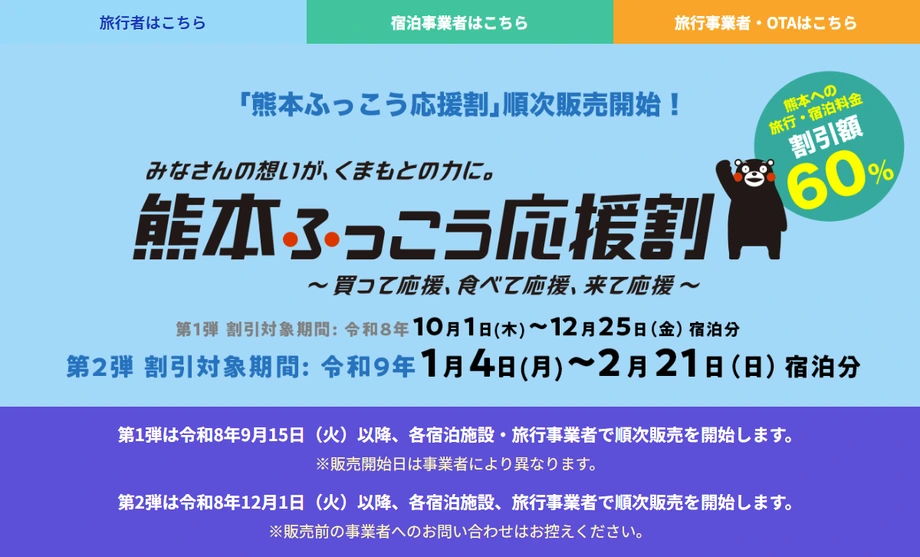
Kumamoto Prefecture will offer a second round of travel subsidies covering stays from January 4 to February 21, 2027, with a discount of 60% on eligible accommodation and package tours. Travelers can check out on February 22. Sales will begin at 10 a.m. on December 1, 2026, as individual hotels, travel agencies and booking sites complete their preparations.
Contents
- Bookings open on December 1 for the quieter weeks after New Year
- How the 60% discount and its spending caps work
- A first round that attracted 57,000 users in October
- From the July earthquake to the new booking window
- Tourism aid is running alongside housing and evacuation work
- What travelers could actually pay
- How this program differs from the 2016 recovery discounts
- Availability still depends on the prefecture and the seller
- Open businesses, overseas visitors and a wider winter campaign
- Key Points
The prefecture announced the decision on November 27 at a meeting of its recovery and reconstruction headquarters. Its official Phase 2 notice says the scheme will end as soon as its budget is exhausted, even if that happens before the final eligible stay date. Travelers should therefore treat February 21 as the last possible night, not a guarantee that discounted rooms will remain available until then.
The subsidy, known in Japanese as Kumamoto Fukko Ouenwari, is intended to bring visitors back after the July 2026 Kumamoto earthquake. Both domestic travelers and visitors arriving from overseas can use it. Reservations can be made directly with participating accommodation by telephone or through its website, through a travel company, or through an online travel agency.
Kumamoto is the only one of Kyushu's seven prefectures currently planning a separate second round. Fukuoka, Saga, Nagasaki, Oita and Miyazaki are scheduled to finish their present discounts by late December, while Kagoshima will accept eligible stays through the end of February. The new Kumamoto round specifically targets the normally quiet period after the New Year holidays.
How the 60% discount and its spending caps work
The basic calculation is simple: an eligible traveler pays 40% of the covered travel or accommodation charge, until the discount reaches a ceiling. The ceilings apply per person and vary according to the product. A higher subsidy rate does not mean that every expensive trip will receive a full 60% reduction.
- Accommodation without transportation, and a package including transportation for one night: a maximum discount of ¥20,000.
- A package including transportation for two nights or more: a maximum discount of ¥30,000.
- A tour with accommodation in at least two prefectures: a maximum discount of ¥35,000.
For accommodation booked on its own, the ¥20,000 ceiling applies regardless of the number of nights. The higher ¥30,000 allowance belongs to packages that combine transportation with at least two nights of accommodation. These rules are unchanged from Kumamoto's first round.
Reservations that already exist before Phase 2 sales begin are excluded. A traveler holding an ordinary booking for January cannot assume that its price will automatically fall. Participating businesses will be listed progressively on the scheme's special website, and the prefecture has asked people not to telephone businesses about the new discounts before those businesses start selling them.
The Kumamoto discount office can be reached on 0800-111-9449 from 9:30 a.m. to 5:30 p.m. on weekdays. Day trips, daytime use of hotel rooms, business travel and plans bundled with vouchers that can readily be converted into cash are excluded from the wider Kyushu scheme. Individual sellers can also apply narrower product and website restrictions.
A first round that attracted 57,000 users in October
Kumamoto's first round covers stays from October 1 through December 25, with checkout on December 26. It attracted about 57,000 users in October alone, according to a preliminary prefectural count, with 986 accommodation facilities taking part. Roughly 600 ryokan and hotels are expected to participate in the second round, although the final list is still being assembled.
The prefecture has allocated ¥6.8 billion to its share of the Kyushu program. It will use approximately ¥1 billion that had been held in reserve to finance Phase 2, providing capacity for at least 50,000 overnight stays. The Japan Tourism Agency puts the current budget for the seven prefecture program at about ¥15.1 billion; the initial government outline in August referred to an allocation of approximately ¥15.5 billion.
Governor Kei Kimura connected the timing of the new round to the seasonal slowdown in tourism and the continuing work of rebuilding.
We want to stimulate tourism demand after the New Year, when travel is usually quiet, and make the progress of recovery and reconstruction even stronger.
Kimura also described the cancellations experienced by ryokan and hotels as secondary damage from the earthquake. His argument is that visitor spending keeps money circulating through restaurants, transport businesses and accommodation, including businesses that were not physically damaged but lost customers after the disaster.
From the July earthquake to the new booking window
The earthquake struck at 4:27 p.m. on July 28, 2026. It had a Japan Meteorological Agency magnitude of 7.1, a depth of 16 kilometers and a moment magnitude of 6.8. Magnitude describes the earthquake's size, while seismic intensity describes shaking at a particular place. The maximum intensity of 7 was recorded in Uki City and Hikawa Town. Aso and Amakusa subsequently experienced prolonged water outages and transport disruption during the summer tourism season.
- August 10: Kumamoto's provisional tally showed about 146,000 cancelled guest nights and losses of approximately ¥2.06 billion.
- August 28: the Cabinet approved ¥147.8 billion from contingency reserves for the wider earthquake support package, and the Japan Tourism Agency published the discount framework.
- September 15: reservations began for Kumamoto and Nagasaki. Saga followed on September 24, Oita and Miyazaki later in September, and Fukuoka in October. Kagoshima prepared for a mid October start after its own discount program ended on October 13.
- October 1: eligible stays under the Kyushu program began. Saga, Nagasaki, Kumamoto and Oita announced first phase travel periods running through December 25.
- November 27: Kumamoto confirmed Phase 2, four months after the disaster and shortly before its first round was due to close.
- December 1: second round sales start at 10 a.m., followed by eligible stays from January 4 through February 21.
The cancellation figures grew as surveys were updated. By August 21, cancelled Kumamoto hotel bookings were valued at about ¥2.7 billion. The prefecture's latest estimate is approximately 190,000 cancelled guest nights and losses of about ¥2.7 billion. The August 10 breakdown showed Aso with roughly 51,000 cancelled guest nights and ¥788 million in losses, Amakusa with about 26,000 and ¥465 million, and Kumamoto City with about 24,000 and ¥257 million. Kagoshima separately recorded around ¥2.3 billion in cancelled bookings by the end of August.
Tourism aid is running alongside housing and evacuation work
The travel campaign is unfolding while hundreds of people remain displaced. As the disaster approached its four month mark on November 28, 485 households comprising 769 people were still living in evacuation shelters. Direct damage to tourism facilities and equipment was separately estimated at approximately ¥4.04 billion.
Work has started on 1,224 temporary housing units in six municipalities. Including units already finished, 928, or about 76%, were expected to be completed by the end of 2026. The recovery meeting also heard that completion of 416 constructed emergency housing units could slip until as late as the end of February 2027.
The prefecture attributed that delay partly to an increase in new applications after officials listened to residents who were still deciding what kind of housing they needed. Kimura said additional construction was likely and that the authorities would continue considering individual circumstances rather than close the door to remaining applicants.
These concurrent timelines explain the purpose of the tourism discount. It supports employment and spending in open parts of the prefecture while shelter, temporary housing and assistance for displaced residents continue elsewhere. The Japan Tourism Agency's guidance also asks visitors to check current transport information and the operating status of tourist facilities before travelling.
What travelers could actually pay
For accommodation subject to the ¥20,000 ceiling, the full percentage discount applies while the charge per person remains below approximately ¥33,333 in Kumamoto and Kagoshima. At 60%, a ¥33,333 charge would produce a discount of almost ¥20,000. In the five prefectures offering 50%, the equivalent threshold is ¥40,000 per person. Above those levels, the fixed cap reduces the effective percentage.
A review of listed October 2026 rates illustrates the arithmetic. A Kumamoto ryokan averaged ¥42,357 for two people sharing one room, or about ¥21,200 each. Applying 60% produced an estimated discount of roughly ¥12,700 and a payment of about ¥8,500 per person. A Kumamoto business hotel averaging ¥13,604 for two people worked out at approximately ¥2,700 per person after the discount.
Kagoshima ryokan had a lower average listed rate of ¥25,889 for two people. The estimated payment after the 60% subsidy was about ¥5,200 each, close to the normal price of a business hotel. These are worked examples from October listings, rounded to the nearest ¥100, rather than guaranteed prices for Kumamoto's January and February inventory.
The difference between 50% and 60% also offers a useful comparison across prefectural borders. A destination in the 50% group must have a base price 20% below a destination in the 60% group for the final payments to match. For example, a ¥10,000 stay in Kumamoto costs ¥4,000 after the full discount; a stay in a 50% prefecture would need to start at ¥8,000 to produce the same ¥4,000 payment.
How this program differs from the 2016 recovery discounts
Japan previously used accommodation subsidies after the April 2016 Kumamoto earthquake and after the 2024 Noto Peninsula earthquake. The 2016 Kyushu program ran for six months from July to December with a budget of about ¥18 billion. Kumamoto and Oita initially received a 70% subsidy that was reduced in stages to 50%, while the other five prefectures moved from 50% to 40%.
The 2026 design instead uses flat rates of 60% for Kumamoto and Kagoshima and 50% for the other five prefectures. It retains the ¥20,000 cap used for one night packages in 2016 but adds a ¥35,000 ceiling for tours spanning at least two prefectures. Its initially stated budget of approximately ¥15.5 billion was smaller than the 2016 allocation.
Earlier results help explain why discounts returned. Oita's total guest nights were down 31.6% from the previous year in April through June 2016, before its program began, but were up 1.8% in July through December. Kumamoto finished that latter period only 0.2% below the previous year. The current scheme also places greater emphasis on overseas communication, with the Japan National Tourism Organization planning social media information and joint advertising with travel companies.
Availability still depends on the prefecture and the seller
Recent booking schedules show why travelers need to check the exact sales window rather than assume that all of Kyushu operates on one calendar. On November 27, Rakuten Travel restarted discounted sales for Fukuoka at 10 a.m., Saga at noon and Nagasaki at 2 p.m. Fukuoka's applicable stays ran from December 1 through checkout on December 16, Nagasaki's from December 1 through checkout on December 26, and Saga's from November 27 through checkout on December 26.
Rakuten included accommodation and packages combining flights with hotels, except in Saga, where only accommodation was covered. Its offer excluded packages combining JR rail travel with hotels, tours spanning at least two prefectures and reservations made through its foreign language website. That website restriction is a sales channel rule; it does not remove the eligibility of overseas visitors under the government program.
H.I.S. had reopened online reservations for Kumamoto's first round at noon on November 25. It distributed coupons of up to 60% for domestic tours combining flights and accommodation, and for bus tours with accommodation, covering stays through December 25. Those sales were online only.
The staggered restarts also reflect local budgets. Discounted inventory can close when a seller or prefecture exhausts its allocation, then reopen if another sales batch becomes available. For Phase 2 in Kumamoto, the crucial controls are the December 1 opening, the list of participating businesses and the remaining prefectural budget.
Open businesses, overseas visitors and a wider winter campaign
The Japan Tourism Agency's earthquake information page carries updates from all seven prefectures. It says tourism facilities, accommodation and restaurants in parts of Kumamoto that were not affected by the earthquake are operating and can receive visitors as usual. Fukuoka reports generally normal operations, while Saga, Nagasaki, Oita, Miyazaki and Kagoshima also say their accommodation and tourist facilities are open.
When national bookings began in September, Chief Cabinet Secretary Minoru Kihara said the government hoped the campaign would counter reputational damage and "steadily advance the recovery of tourism" across Kyushu. Land, Infrastructure, Transport and Tourism Minister Yasushi Kaneko described the spread of cancellations beyond damaged communities when the framework was announced in August.
Cancellations have occurred in rapid succession both in disaster-affected areas and elsewhere, creating an extremely difficult situation. We strongly encourage people to visit Kyushu and provide their support.
Kumamoto will add another promotion from January 6 through the end of March 2027. The prefecture, six JR companies, All Nippon Airways and Japan Airlines plan to sell packages combining rail or air tickets with Kumamoto accommodation at a 5% discount. Stations and airports will also display posters promoting the prefecture.
Several practical questions remain for individual travelers. Kumamoto City intends to introduce its own accommodation discount from February, and the prefecture is still discussing whether the two subsidies can be combined. Phase 2 participants, exact inventories and seller specific conditions will appear progressively. Travelers should confirm that a reservation is newly booked under Phase 2, check the product category and cap, and review transport and attraction operations before paying.
Key Points
- Kumamoto's Phase 2 covers stays from January 4 to February 21, 2027, with checkout on February 22.
- Sales begin at 10 a.m. on December 1, 2026, as participating hotels, agencies and booking sites become ready.
- The discount is 60%, with per person caps of ¥20,000, ¥30,000 or ¥35,000 depending on the travel product.
- Existing reservations are excluded, and sales end when the approximately ¥1 billion Phase 2 budget is used up.
- About 600 accommodation providers are expected to join, with capacity for at least 50,000 overnight stays.
- The first round attracted about 57,000 users in October through 986 participating facilities.
- Kumamoto estimates roughly 190,000 cancelled guest nights and about ¥2.7 billion in accommodation losses after the July 28 earthquake.
- The other six Kyushu prefectures have no plans for a separate second round; Kagoshima's current discounts continue through February.