Three Russian Vessels Arrive at Tanjung Priok
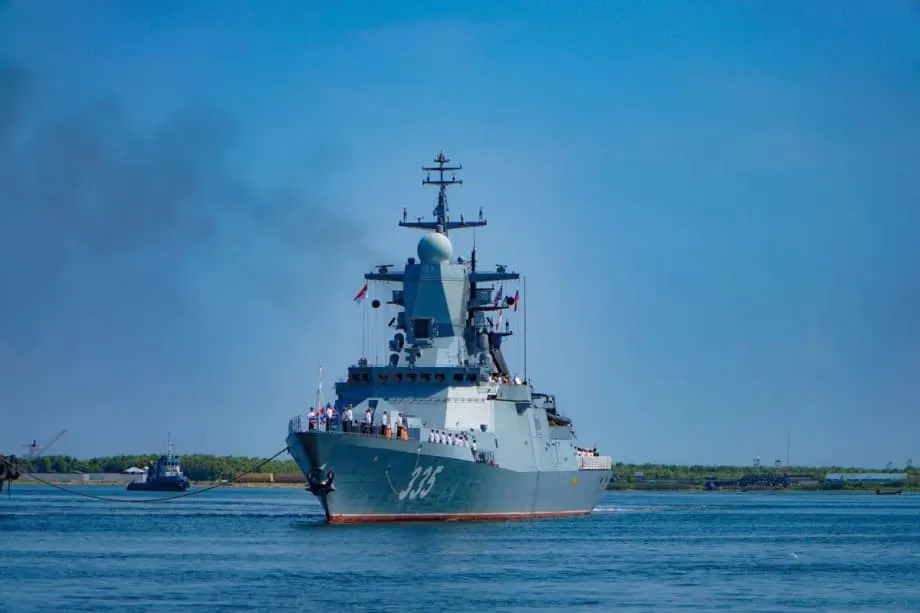
Russia's Pacific Fleet brought the submarine Petropavlovsk-Kamchatsky, the corvette Gromky and the fleet tug Andrey Stepanov to Tanjung Priok Port in North Jakarta on March 29, 2026. The visit combines joint training with public access and military diplomacy at one of Southeast Asia's most strategically important maritime hubs.
Contents
- Three Russian Vessels Arrive at Tanjung Priok
- A Deployment From Vladivostok
- Surabaya Established the Precedent
- The Dates Behind the Jakarta Visit
- Indonesia Keeps Several Partnerships Open
- Why Australia Is Watching
- The Competition Beneath the Surface
- Practical Training and Public Diplomacy
- Russia Maintains Its Pacific Presence
- Key Points
The Russian Embassy in Jakarta confirmed that the crews would take part in drills focused on maneuvering and communication, alongside ceremonies, work meetings and friendly sports competitions. An open ship program was scheduled for March 31, allowing Indonesian citizens and Navy personnel to tour the visiting vessels.
The submarine gives the deployment a different character from a visit involving surface ships alone. Diesel-electric submarines can operate quietly, gather intelligence and threaten surface vessels. Their presence matters in a region where navies are paying increasing attention to what happens beneath the sea.
Indonesia is using the engagement to maintain military relationships with several major powers while preserving its policy of non-alignment. In practical terms, that means cooperating with countries such as Russia and the United States without committing itself exclusively to either country's security arrangements.
The Jakarta arrival continues a series of Russian naval visits and exercises in Indonesia, including the first bilateral Orruda exercise near Surabaya in November 2024 and a visit in May 2025. Naval cooperation has accelerated since President Prabowo Subianto took office in October 2025.
The planned training is modest compared with Indonesia's larger exercises with Western partners. Its diplomatic significance comes from the combination of repeated contact, a visiting submarine and Jakarta's determination to keep several international relationships open at once.
A Deployment From Vladivostok
The Russian group departed Vladivostok in February 2026 on what Russian officials described as a long-range mission in the Asia-Pacific. Gromky, carrying the number 335, supplies the surface combat element. Petropavlovsk-Kamchatsky, identified as B-274 and belonging to the Kilo-class, supplies the undersea component.
Andrey Stepanov adds support capacity to the deployment. The fleet tug's presence reflects the practical demands of taking combat vessels far from their home waters, where fuel, provisions, maintenance and assistance must be planned over an extended voyage.
Russia's ability to send this combination of vessels thousands of kilometers from its home base demonstrates continuing operational reach despite resource constraints and competing strategic demands. Keeping a submarine deployed at that distance requires technical preparation as well as logistical support.
Petropavlovsk-Kamchatsky uses diesel-electric propulsion, a system involving diesel engines and electric power. The submarine's military value includes its ability to operate discreetly in coastal waters, where it can make an opposing navy's planning more difficult.
Sea denial describes the ability to make an area dangerous for another country's ships to use. A submarine can contribute to that task through the threat it poses to surface shipping, even while remaining difficult to locate. Intelligence collection provides another reason regional navies watch foreign submarine movements closely.
A foreign submarine's presence can affect surveillance routines and preparations for finding submarines, whether the vessel is undertaking operations or participating in cooperative training. For Indonesian personnel, the visit also offers an opportunity to observe Russian equipment and operating procedures and build a broader understanding of regional naval capabilities.
Surabaya Established the Precedent
Indonesia and Russia held their first bilateral naval exercise, Orruda 2024, in November 2024 in the Java Sea near Surabaya. Russian participants included the corvettes Gromky and Aldar Tsydenzhapov, the frigate Rezkiy and the tanker Pechenga. Indonesian frigates and helicopters used to detect and counter submarines also participated.
Russia sent the submarine B-588 Ufa to Surabaya for a port visit during that engagement. Its arrival established a precedent for the submarine now visiting Jakarta and placed cooperation between the two navies' undersea communities alongside their surface exercises.
Colonel Widyo Sasongko, head of the Indonesian Navy's Information Office for the 2nd Fleet Command, described the Orruda training as an expression of appreciation, solidarity and friendship between the services:
The joint training became a symbol of appreciation and solidarity from the Russian Navy to the Indonesian Navy, as well as strengthening the friendship of our two navies.
Russian officers also paid respects at the Nanggala Monument, which commemorates Indonesian sailors lost in the 2021 KRI Nanggala-402 submarine disaster. The gesture connected the exercise with a shared professional respect among sailors whose work takes place beneath the sea.
Russian Pacific Fleet ships returned to Indonesia in 2025 for a visit associated with the seventy-fifth anniversary of diplomatic relations. Aldar Tsydenzhapov and Rezkiy arrived with the tanker Pechenga. That period also included Indonesia's first hosting of the Komodo multilateral naval exercise, with Russia participating alongside the United States, Japan and China.
Repeated visits help officers and crews become familiar with one another. The pattern suggests a relationship becoming more structured, although its scale remains much smaller than Indonesia's military exercises with Western partners.
The Dates Behind the Jakarta Visit
The current deployment follows several years of naval and diplomatic contact. The sequence links ceremonial visits, exercises and discussions at senior government level, rather than a single isolated arrival.
- 2021: Indonesia lost KRI Nanggala-402 in a submarine disaster, later commemorated at the Nanggala Monument.
- November 2024: Indonesia and Russia conducted Orruda 2024 near Surabaya, while the Russian submarine Ufa made a port visit.
- February 2025: Russian Security Council Secretary Sergei Shoigu visited Indonesia and Malaysia.
- May 2025: Russian ships visited Indonesia during the year marking seventy-five years of diplomatic relations.
- August 2025: Australia and Indonesia signed a significant defense pact under Prabowo's watch as defense minister.
- October 2025: Prabowo took office as president and announced Indonesia's desire to join BRICS.
- February 2026: The current Russian naval group departed Vladivostok for its Asia-Pacific mission.
- March 29, 2026: Gromky, Petropavlovsk-Kamchatsky and Andrey Stepanov arrived at Tanjung Priok.
- March 31, 2026: An open ship program was scheduled in Jakarta.
The next public activity identified for the visit was the March 31 open ship program. The planned engagement also includes the maneuver and communication drills, ceremonies, meetings and sports events.
Indonesia Keeps Several Partnerships Open
Prabowo's foreign policy places strategic flexibility ahead of membership in a single geopolitical camp. Indonesia's decision to welcome Russian vessels sits alongside its growing cooperation with Western partners and its contacts with other regional powers.
Indonesia's position matters because of its relationship to critical sea routes, including the Malacca and Sunda straits. Maintaining several diplomatic options allows Jakarta to pursue its interests without becoming dependent on one outside power.
Prabowo announced Indonesia's desire to join BRICS in October 2025 while cultivating defense relationships across the geopolitical spectrum. His approach is often expressed through the proverb that a thousand friends is too few while one enemy is too many.
Super Garuda Shield provides a useful comparison with the Russian engagement. The annual exercise involving Indonesia, the United States and numerous allied countries brought together approximately 5,500 troops over a month in 2025 and included complex combined arms operations. Those operations bring different military services and capabilities together.
Orruda and the current Jakarta drills involve hundreds of personnel at most and concentrate on basic communication and maneuvering procedures. A defense analyst discussing the 2024 exercise compared Orruda with Garuda Shield to offering spare change after dining at an expensive restaurant.
The difference in size helps explain Jakarta's approach. Indonesia can conduct extensive training with Western partners while keeping active channels with Russia. The Russian exercises provide diplomatic contact and insight into naval capabilities and doctrine, even with a narrower training program.
Jakarta's broader objective is to preserve its freedom of action and avoid allowing any one power to dominate Southeast Asian maritime spaces. Its policy seeks to avoid alarming neighbors while increasing Indonesia's international bargaining power.
Why Australia Is Watching
Australia has followed indications of closer Russian-Indonesian defense ties with increasing interest. Reports of Russian interest in possible basing arrangements in Indonesia became a heated issue during Australia's 2025 election campaign, drawing scrutiny from both major political parties.
Indonesian officials have consistently maintained that permanent foreign bases conflict with the country's constitutional principles of non-alignment. Canberra nevertheless watches the pattern of military contact because access to facilities and repeated port visits can matter to regional security planning.
Ian Storey, an observer of Russian activity in Southeast Asia, considered Russian interest in basing in Indonesia at least somewhat plausible. He connected that interest with Moscow's international isolation and its search for specialized forms of regional cooperation.
Shoigu's February 2025 visits to Indonesia and Malaysia received high-level receptions. Those meetings suggested discussions extending beyond ceremonial diplomacy and added to Australian interest in the direction of Russia's relationships in Southeast Asia.
Australia also has substantial defense ties with Indonesia, including the August 2025 pact signed under Prabowo's watch as defense minister. An expansion of Russian military access would add an unwelcome complication for Canberra in a region already marked by competition among major powers.
Australian officials distinguish the United States' rotational presence in Australia from potential Russian access to Indonesian facilities. They point to different strategic intentions and alliance arrangements when explaining that position.
Canberra's main means of influencing Jakarta remains its bilateral relationship with Indonesia. That relationship has become more stable in recent years after disputes involving cattle exports, spying allegations and people smuggling. Continued cooperation gives Australia a channel for discussing its concerns directly with its neighbor.
The Competition Beneath the Surface
Petropavlovsk-Kamchatsky's visit takes place as undersea competition grows across the Indo-Pacific. Chinese state research vessels have conducted extensive seabed mapping in the Pacific, Indian and Arctic oceans, including surveys near Guam, Hawaii, Taiwan and the approaches to the Malacca Strait.
The surveys gather information about underwater terrain, temperature gradients and acoustic conditions. Temperature gradients are changes in water temperature across different depths or locations. Along with salinity and the shape of the seabed, they affect how sound travels through the water.
Submarines depend on the underwater environment to conceal their presence, while forces searching for them depend on understanding the same environment. Sound can travel differently as conditions change, affecting how far a submarine can be detected and where it can remain harder to find.
Former submarine commanders and specialists in detecting submarines have described that knowledge as crucial to both tasks. An assessment of the scale of China's survey work linked it to ambitions for naval operations far from home, including submarine deployments:
The scale of what they are doing is about more than just resources. If you look at the sheer extent of it, it is very clear that they intend to have an expeditionary blue-water naval capability that also is built around submarine operations.
China's transparent ocean sensor networks and seabed mapping support more effective deployment of its submarines while making American and allied undersea operations more difficult. The reference to a blue-water navy means a force capable of operating across the open ocean, rather than mainly close to its own coast.
Singapore has recently established a submarine maintenance hub with German manufacturer TKMS to service its Invincible-class submarines and allied vessels. The facility reflects expanding submarine capabilities among Southeast Asian navies.
Indonesia operates its own submarine force, although the loss of KRI Nanggala-402 in 2021 remains a major tragedy. Exchanges during Russian submarine visits may contribute to Indonesian knowledge of undersea operations. Direct technology transfer faces limits from international sanctions and policy constraints.
Practical Training and Public Diplomacy
The Jakarta drills concentrate on maneuvering and communication, two basic requirements for ships operating safely near one another. Crews need to understand movement instructions, exchange messages reliably and coordinate decisions between commanders.
Such training builds common procedures and familiarity. Those habits can be useful during later exercises or a crisis in which ships must avoid misunderstanding each other's actions. Deconfliction is the practical work of keeping movements and operations from interfering with one another.
The March 31 open ship program adds a public element to the military visit. Allowing Indonesian citizens and Navy personnel aboard the vessels gives them a chance to see the ships directly and makes the visiting force less remote.
Ceremonies, meetings between commanders and friendly sports competitions serve a different purpose from tactical drills. They help officers and crews form personal relationships that can make future communication easier.
The Russian Embassy said both countries reaffirmed their commitment to strengthening mutual interaction to preserve peace and stability in the Asia-Pacific. That framing presents the engagement as a contribution to regional stability, while the deployment also communicates Russia's continued naval reach.
For Moscow, docking a submarine at a major Southeast Asian port demonstrates interests extending into the Indo-Pacific. It supports Russia's effort to retain a visible maritime role beyond Europe and the Arctic.
Russia Maintains Its Pacific Presence
Russia's Jakarta deployment forms part of its effort to remain visible in the Asia-Pacific despite the strategic and resource pressures of the conflict in Ukraine. A small group combining combat vessels and support capacity allows the Pacific Fleet to sustain contact with regional partners far from its bases.
Other Russian naval activities include exercises with China under Joint Sea-2025 near Vladivostok, involving submarine rescue operations and training to detect and counter submarines. Russian surveillance ships and maritime patrol aircraft have also remained active near Japan, including movements through the Tsugaru Strait and the Sea of Okhotsk.
These activities reach several audiences. For Russia's domestic public, they show continuing military reach. For partners such as Indonesia, they provide another avenue of security cooperation outside arrangements centered on Western countries. For competing navies, they show Russian forces operating in important waterways and maritime chokepoints.
Regular Indonesian port visits and participation in exercises such as Komodo help Moscow maintain a place in Southeast Asian security discussions. Russia's limited deployments preserve its regional presence even as the larger balance of naval power is shaped by the United States and its allies alongside China's growing capabilities.
Jakarta's latest engagement brings those objectives together: limited practical training, continued military contact and a visible demonstration of Indonesia's willingness to work with different powers. The submarine's presence adds another factor for navies tracking activity in regional waters, while Indonesia keeps its cooperation with Russia alongside its other defense relationships.
Key Points
- Gromky, Petropavlovsk-Kamchatsky and Andrey Stepanov arrived at Jakarta's Tanjung Priok Port on March 29, 2026.
- The Russian group departed Vladivostok in February for an extended Asia-Pacific deployment.
- Joint drills focus on maneuvering and communication, with ceremonies, meetings, sports and an open ship program scheduled for March 31.
- The visit follows Orruda 2024 near Surabaya, a submarine visit by Ufa and further Russian naval contact in 2025.
- Indonesia is maintaining Russian military ties alongside larger exercises with Western partners and its policy of non-alignment.
- Australia is monitoring closer Russian-Indonesian cooperation, while Indonesian officials oppose permanent foreign bases under constitutional principles.
- Chinese seabed surveys and expanding regional submarine infrastructure form part of the wider competition beneath Indo-Pacific waters.
- Russia is using continued deployments and port visits to maintain its Pacific presence despite pressures from the conflict in Ukraine.