A brief greeting after a year of strained ties
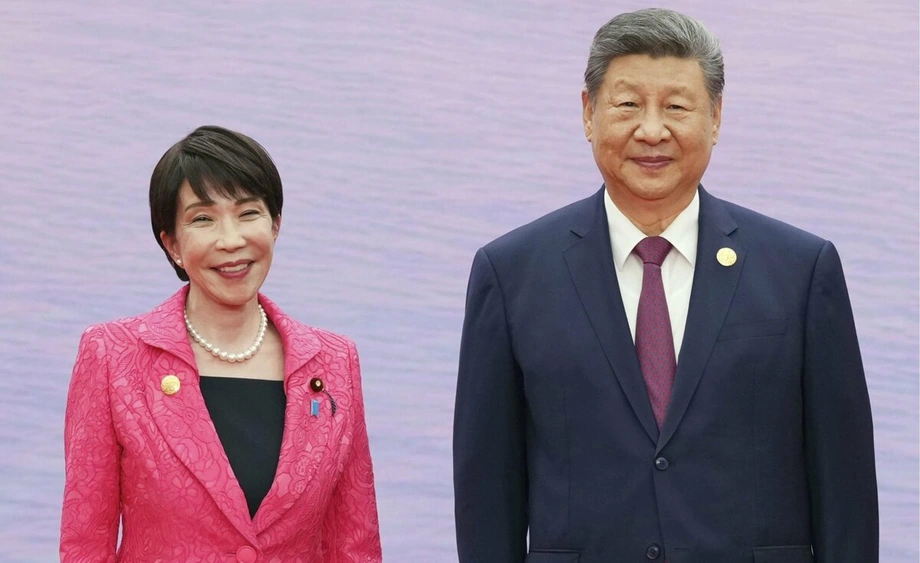
Japanese Prime Minister Sanae Takaichi shook hands with Chinese President Xi Jinping and posed for a photograph in Shenzhen on the evening of November 18, 2026, bringing the two leaders face to face after a year of tension over her remarks about a possible conflict involving Taiwan.
Contents
- A brief greeting after a year of strained ties
- Why Taiwan remains the central disagreement
- Tokyo seeks dialogue while resisting pressure
- Manila offered little contact with China's leadership
- How the dispute reached the Shenzhen summit
- Trade promises meet a difficult political relationship
- Another possible encounter carries urgent Japanese demands
- Key Points
Xi welcomed Takaichi before the dinner for leaders attending the Asia-Pacific Economic Cooperation forum summit. She exchanged brief words with him and joined Xi and his wife for a photograph. The encounter came on her first visit to China since taking office in October 2025.
Formal talks between the Japanese and Chinese leaders were considered unlikely, according to diplomatic sources. Takaichi was seeking opportunities for a short informal conversation during the summit, which runs through November 19. No formal bilateral meeting or substantive agreement was announced.
The greeting brought direct contact at a gathering where diplomatic protocol had attracted unusual attention. Earlier, China's Foreign Ministry protocol ambassador, Zhang Qiyue, received Takaichi at Shenzhen Bao'an International Airport, according to Japan's Foreign Ministry. Xi personally greeted U.S. President Donald Trump when he arrived later.
Behind those different welcomes lies a dispute with consequences for security and business. Beijing has demanded that Takaichi address her comments linking a Taiwan emergency to possible Japanese military action. China has also imposed political and economic pressure, including restrictions on exports of rare earths used in technology products. Tokyo says its established policy remains unchanged and continues to seek dialogue.
Why Taiwan remains the central disagreement
Takaichi's parliamentary remarks on November 7, 2025, connected a possible Chinese attack on Taiwan with circumstances in which Japan's Self-Defense Forces could support U.S. forces. Taiwan governs itself, while Beijing claims the island as its territory.
The dispute concerns a legal judgment as well as a political message. Takaichi said a crisis involving warships and the use of force could qualify as a situation threatening Japan's survival. Under Japan's security framework, that classification can allow collective self defense, meaning military action to help defend another country when Japan's own survival is threatened.
Tokyo subsequently explained that any such decision would depend on the actual circumstances and an assessment of the information available. Beijing has continued to seek a response from Takaichi herself.
An earlier attempt to narrow the disagreement showed how far apart the governments remained. During a September 28 meeting in Beijing, former Japanese Foreign Minister Takeshi Iwaya proposed reaffirming the intent of the 1972 Japan-China Joint Communique. Chinese Foreign Minister Wang Yi rejected that proposed approach, according to Iwaya, and wanted the prime minister to address the issue directly.
Iwaya described Wang's demand as seeking a withdrawal. Another participant, association director Tomoki Izumikawa, described it as an early correction. Both descriptions place the next political step with Takaichi, whose government maintains that Japan's Taiwan policy has not changed.
Tokyo seeks dialogue while resisting pressure
Takaichi has repeatedly said Japan still wants a constructive and stable relationship with China. The Japanese prime minister has described China in these words:
important neighboring country
Her Shenzhen visit combined that appeal for engagement with criticism of trade pressure. On November 17 in Manila, she joined the leaders of the United States, Australia and India at a gathering of the Quad, their four country partnership.
The four leaders expressed their concern using the following language:
grave concerns about economic coercion, including through arbitrary export restrictions
Economic coercion means using commercial pressure to push another government toward a political decision. For Japan, China's rare earth export restrictions have made that concern concrete. Rare earths are a group of elements used in many technology products, and controls on their export can complicate manufacturers' access to essential materials.
The confrontation has already extended beyond government meetings. Chinese tourist arrivals in Japan fell 45 percent in December 2025 from a year earlier to about 330,000, while seafood restrictions and tighter export controls added to the strain. Those developments formed part of the widening pressure on Japan following Takaichi's remarks.
Manila offered little contact with China's leadership
Takaichi flew to Shenzhen from Manila after attending meetings related to the Association of Southeast Asian Nations. Her schedule in the Philippines had offered another possible setting for contact with senior Chinese officials, but she did not meet Chinese Premier Li Qiang.
Li attended the China-ASEAN summit on Monday, November 16, and returned to Beijing that afternoon, around the time Takaichi arrived in the Philippines. He did not attend the following day's ASEAN Plus Three meeting, which brings together Southeast Asian countries with China, Japan and South Korea.
China was represented there by Agriculture and Rural Affairs Minister Zhang Zhu. Takaichi approached Zhang at his seat, shook hands and exchanged a few words with him.
The Shenzhen dinner therefore provided a more senior point of contact than Takaichi had obtained in Manila. Xi was receiving visiting leaders as summit host, giving the Japanese prime minister an opportunity to speak briefly even without a scheduled meeting.
How the dispute reached the Shenzhen summit
Takaichi and Xi last held a meeting in October 2025 on the sidelines of the APEC summit in Gyeongju, South Korea. That encounter took place about a week before the parliamentary remarks that drove relations into their current dispute.
The main dates trace a shift from an initial meeting to sustained disagreement and, now, another brief encounter:
- October 2025: Takaichi took office and met Xi at the APEC summit in Gyeongju.
- November 7, 2025: She told parliament that a Taiwan crisis could fall within circumstances permitting Japanese military action in collective self defense.
- September 28, 2026: Iwaya discussed a possible diplomatic solution with Wang in Beijing, without securing agreement on his proposed approach.
- November 17, 2026: Takaichi joined other Quad leaders in Manila in expressing concern about economic coercion and export restrictions.
- November 18, 2026: She arrived in Shenzhen, exchanged brief words with Xi and posed for a photograph before the APEC dinner.
- November 19, 2026: The APEC leaders' summit is scheduled to conclude.
APEC has provided an opening during difficult Japan-China relations before. At the 2014 summit in Beijing, Xi's visibly frosty handshake with then Japanese Prime Minister Shinzo Abe preceded formal bilateral talks. This time, the leaders exchanged a cordial greeting while prospects for a formal meeting remained poor.
Trade promises meet a difficult political relationship
Takaichi went to APEC intending to advocate free and open trade and investment. Those goals place her government's concerns about export restrictions directly alongside the summit's economic agenda.
Xi used his November 18 address to business leaders in Shenzhen to promise lower tariffs, wider market access and further opening of manufacturing and services. His market access pledges presented China as a destination for foreign companies and investment, although the speech provided no detailed tariff schedule or implementation timetable.
Japanese businesses therefore face two different messages from the same gathering: an invitation to deepen commercial ties with China and an unresolved dispute that has brought restrictions affecting trade. For companies relying on materials from China, access to supplies is a practical concern alongside the broader promises made at the summit.
APEC's role helps explain why these issues meet in Shenzhen. The forum brings together 21 member economies to discuss trade and economic cooperation. Its decisions generally depend on consensus and are not legally binding, while the presence of leaders creates opportunities for conversations outside the formal sessions.
Another possible encounter carries urgent Japanese demands
Takaichi's search for direct contact in Shenzhen also extends to Russian President Vladimir Putin. Japanese government officials expected an encounter during the summit, with Tokyo seeking a brief exchange rather than a formal meeting.
She intended to demand the immediate release of Hokkaido Shimbun reporter Yuki Imai, who was detained by Russian authorities in October on suspicion of espionage. Japan rejects the allegations. Takaichi was also expected to protest Putin's visit to Etorofu, an island controlled by Russia and claimed by Japan.
The planned Putin contact shows how much of Japan's summit diplomacy depends on short conversations around the main programme. In the Russian case, Tokyo wants to put specific demands directly to Putin. With China, Takaichi is trying to keep communication open while the two governments remain divided over her Taiwan remarks.
For Japan and China, the remaining summit schedule through November 19 offers further opportunities for an informal exchange. The central issues are still Beijing's demand for a response from Takaichi, Tokyo's insistence that its policy remains unchanged, and the economic restrictions affecting their relationship.
Key Points
- Takaichi and Xi shook hands and posed for a photograph before the APEC leaders' dinner in Shenzhen on November 18.
- The visit is Takaichi's first to China since becoming prime minister in October 2025.
- Formal talks were considered unlikely, and no substantive agreement was announced.
- Her November 2025 remarks about a Taiwan crisis remain the central source of tension.
- China's pressure has included rare earth export restrictions, while Japan continues to seek dialogue.
- The summit concludes on November 19, leaving further opportunities for brief informal contact.