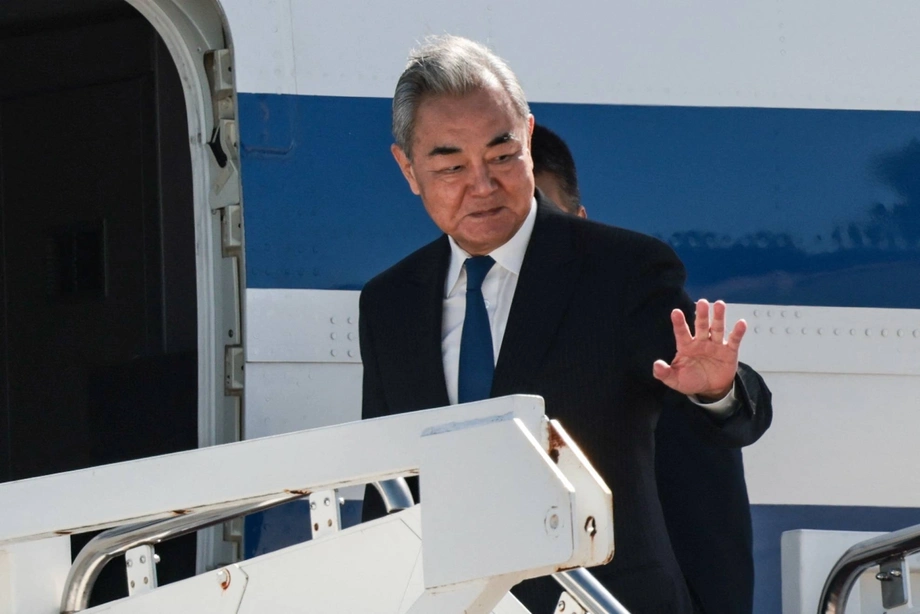
A Beijing meeting exposes the obstacle to better ties
Chinese Foreign Minister Wang Yi rejected a proposal by former Japanese Foreign Minister Takeshi Iwaya to resolve a dispute over Prime Minister Sanae Takaichi's Taiwan remarks by reaffirming a diplomatic agreement from 1972, according to Iwaya. Beijing instead wanted the Japanese leader herself to address the problem.
Contents
- A Beijing meeting exposes the obstacle to better ties
- What Takaichi said about Taiwan
- Tokyo's explanation has not satisfied Wang
- Why Iwaya turned to the 1972 agreement
- Withdrawal or correction?
- How the dispute developed
- Economic cooperation remains a separate opening
- Japan's defense policy adds another point of friction
- Why the channel through Iwaya matters
- Key Points
The proposal emerged during a September 28 meeting at the Great Hall of the People in Beijing. Iwaya, visiting as chairman of Japan's Association for the Promotion of International Trade, argued that Japan's Taiwan policy had not changed and that an explicit withdrawal by a sitting prime minister would carry a heavy political cost.
Wang, China's foreign minister and a member of the Communist Party's Politburo, repeatedly sought a withdrawal, according to details of the meeting shared within the Japanese government. He viewed Takaichi's remarks as an expression of her longstanding thinking about history rather than an accidental verbal mistake.
A second participant, association director Tomoki Izumikawa, later described Wang's request as a demand for an early correction rather than a withdrawal. That difference in wording leaves a central diplomatic question unresolved: what statement from Tokyo would satisfy Beijing?
What Takaichi said about Taiwan
Takaichi's parliamentary answer on November 7, 2025, linked a possible conflict involving Taiwan to a legal category that could allow Japan to exercise collective self defense. She said a situation involving warships and the use of force could qualify as a situation threatening Japan's survival.
Collective self defense means using force to help defend another country under specified conditions. The phrase concerning Japan's survival matters because it connects a discussion about Taiwan to the circumstances in which the Japanese government could authorize military action.
China objected strongly to that connection. Beijing's demand now concerns how the prime minister should address her words, while Tokyo maintains that its existing policy remains intact.
Tokyo's explanation has not satisfied Wang
Japan's cabinet subsequently approved a written answer stating that the government fully maintained its established position. Under that position, any decision on whether a situation threatens Japan's survival would depend on the specific circumstances and an objective, reasonable assessment of all information available to the government.
In simple terms, Tokyo says it would examine an actual crisis before deciding which legal powers applied. Iwaya carried that explanation into the Beijing meeting, arguing that Takaichi's later parliamentary statements and other remarks had made the continuity of Japanese policy clear.
Wang continued to seek a response from Takaichi herself. According to Iwaya, the two men agreed that relations needed to improve, but the Chinese government's assessment of the Takaichi administration remained harsh.
The disagreement is therefore about both substance and responsibility. Japan has offered a government explanation of how decisions would be made. Wang wants the leader who made the disputed remarks to resolve the dispute.
Why Iwaya turned to the 1972 agreement
Iwaya proposed that both governments reaffirm the intent of the 1972 Japan-China Joint Communique, one of the foundational political documents governing their relationship. He presented this as a way to achieve the practical effect of a withdrawal without requiring Takaichi to retract her answer explicitly.
The communique records Japan as fully understanding and respecting China's position that Taiwan is an inalienable part of the territory of the People's Republic of China. Returning to that wording would give the two governments an established diplomatic text around which to frame an agreement.
For Iwaya, that offered a possible exit from a dispute in which an explicit retreat would be politically difficult for the prime minister. For Wang, the proposed wording left too much unresolved.
Iwaya described Wang's rejection in an interview on October 7. Wang, speaking as China's foreign minister, objected to resolving the dispute indirectly:
An ambiguous approach is not good,
Wang also invoked a Chinese saying that the person who caused a problem should resolve it. His message placed responsibility back on Takaichi rather than on an agreement negotiated around her remarks.
Withdrawal or correction?
Izumikawa, 47, accompanied Iwaya to meetings with Wang and Chinese Vice Premier He Lifeng during the September visit. In an interview around the first anniversary of Takaichi's answer, he described Wang as seeking the earliest possible correction of what Beijing considered erroneous remarks by a leader on Taiwan.
Iwaya's account describes a demand for withdrawal; Izumikawa's describes a request for correction, which he interpreted as a less demanding formulation. Both accounts put the next substantive move on the Japanese side.
Izumikawa also cited China's Foreign Ministry as saying at a briefing that the ball was in Japan's court. He argued that dialogue was indispensable and that Japan needed to produce a response that China could accept.
No agreed wording, deadline or date for another meeting was announced in these accounts. Izumikawa's assessment suggests there may be room to discuss how Takaichi responds, while Iwaya's rejected proposal shows that reaffirming an existing agreement alone was insufficient at the September meeting.
How the dispute developed
The diplomatic effort stretched from Takaichi's parliamentary answer in November 2025 to meetings in Beijing the following September and public accounts in October and November 2026. The main steps were:
- November 7, 2025: Takaichi told parliament that a Taiwan contingency involving warships and force could qualify as a situation threatening Japan's survival.
- After the answer: Japan's cabinet approved a written response maintaining that the government would assess any such situation according to its specific circumstances.
- September 27 to 30, 2026: Iwaya visited China as chairman of the trade promotion association and held separate meetings with Wang and He.
- September 28: Iwaya and Wang discussed the Taiwan remarks at the Great Hall of the People.
- October 7: Iwaya publicly described his proposed solution and Wang's rejection.
- Around the November 7 anniversary: Izumikawa described Wang's language as a call for correction and urged further dialogue.
The sequence shows why the September discussions mattered. Nearly a year after the original answer, a former foreign minister was still trying to find language that could reopen a political relationship damaged by it.
Economic cooperation remains a separate opening
He Lifeng expressed a strong desire to promote economic cooperation during his separate meeting with Iwaya. The Japanese visitor asked China to improve its handling of exports of rare earths and other critical minerals to Japan.
Rare earths are a group of elements used in industrial products and manufacturing processes. Their importance in this dispute comes from their uses across both civilian production and defense industries, making decisions about the intended customer or use especially consequential.
He, China's vice premier, told Iwaya that Beijing intended to distinguish between military and civilian uses:
We will impose restrictions if they are for military use, but there is no problem if they are for civilian use,
He also said China was exploring better ways to manage the restrictions. For Japanese businesses, the practical issue is whether export approvals allow materials to reach factories when needed.
By October 21, Japan was seeking American help over a shortage of yttrium, a rare earth used in jet engines and semiconductor manufacturing equipment. Japanese officials and trading executives warned that shortages could emerge by the end of 2026. The economic discussions in Beijing therefore concerned supplies with direct consequences for production, alongside the dispute over political language.
Japan's defense policy adds another point of friction
Iwaya also asked Wang to stop describing Japan's efforts to strengthen its defense capabilities as a new form of militarism. The request addressed a broader source of mistrust between the governments, beyond the single parliamentary answer about Taiwan.
Japan was separately considering how to describe China in its revised National Security Strategy. By late October, Tokyo was weighing whether to retain the phrase greatest strategic challenge while avoiding the stronger label of threat.
The proposed security strategy wording remained under discussion, with consultations involving Japan's ruling parties expected to begin in the middle of November and revisions to three security policy documents due by the end of 2026.
Those decisions put diplomatic language and defense planning on overlapping calendars. Tokyo was seeking room to discuss improved relations while also reviewing how it described China's military activity and other pressures. Beijing, meanwhile, continued to object to Japan's defense buildup.
Why the channel through Iwaya matters
Iwaya traveled as the head of a trade promotion organization, rather than as Japan's serving foreign minister. His visit nevertheless secured meetings with two senior Chinese officials and allowed him to convey both political explanations and business concerns.
Some observers interpreted the warm reception as an effort by Beijing to encourage divisions within Japan. Iwaya said several factors could be involved, but argued that China appeared to recognize a need to engage someone on the Japanese side.
Iwaya, a member of the ruling Liberal Democratic Party, explained why he considered the contact useful:
It's important first to start talking and convey to China that there are also people on the Japanese side who strongly believe relations should be improved.
His meetings exposed both the opening and its limits. He Lifeng expressed interest in economic cooperation, and Wang agreed that relations should improve. Yet Wang rejected the proposed diplomatic formula, leaving Takaichi's response at the center of the political dispute.
Key Points
- Wang Yi rejected Iwaya's proposal to resolve the Taiwan remarks dispute by reaffirming the 1972 Japan-China Joint Communique.
- Japan maintains that its policy has not changed and that any security decision would depend on the circumstances of an actual crisis.
- Iwaya described a demand for withdrawal; fellow participant Izumikawa described a request for correction and interpreted it as a softer formulation.
- Vice Premier He Lifeng expressed interest in economic cooperation and said mineral export restrictions would distinguish military from civilian use.
- No settlement wording or date for another meeting was announced in the accounts of the visit.