Two fighters arrive, with 64 still to follow
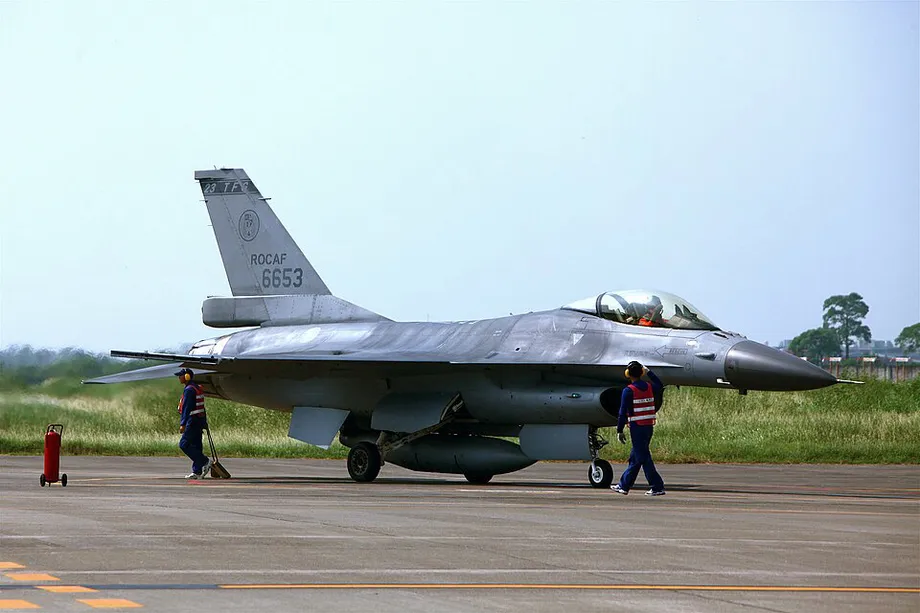
Taiwan received its first two newly built F-16C/D Block 70 fighters at Chihhang Air Base in Taitung on October 2, beginning deliveries under a purchase of 66 aircraft approved by the United States in 2019. The arrival gives the air force new aircraft for its eastern defenses, but most of the order remains in production, testing or preparation for transfer.
Contents
- Two fighters arrive, with 64 still to follow
- What happened on the delivery flight?
- How the schedule slipped
- What Taiwan has committed to buy
- Why Taiwan is strengthening its eastern coast
- What the new radar changes
- Electronic defenses, cockpit systems and range
- Two other weapons purchases face a 2028 wait
- Key Points
Defense Minister Wellington Koo said on October 12 that six aircraft had reached flight testing and acceptance procedures. Two had arrived in Taiwan, two were staying in the United States for training, and two were undergoing acceptance inspections. Acceptance is the process through which officials check that an aircraft meets the requirements before taking delivery.
The first pair represents about 3 percent of the order. Taiwan originally expected deliveries to begin in 2023 and finish by the end of 2026. Factory relocation, supply shortages and software integration work have pushed the program behind that timetable, leaving the air force waiting for aircraft intended to become a major part of its future fleet.
A Ministry of National Defense report submitted to the Legislative Yuan, Taiwan's legislature, places the fighters among three delayed purchases out of 24 active United States arms procurement programs. The other 21 remain on schedule. That gives a more precise picture of the problem: several major purchases face industrial delays while much of the broader defense procurement portfolio continues to advance.
What happened on the delivery flight?
United States pilots ferried the two fighters to Taiwan and formally handed them over on arrival, following the normal arrangement for delivery flights. The aircraft had been expected between late August and early September, making their October arrival roughly a month later than the most recent expectation.
The journey included extended stops in Hawaii and Guam. Severe weather was cited as a possible reason for those stops, although the cause was not publicly specified. This final delay came on top of the much longer wait caused by production and technical problems.
Chihhang will serve as the base for conversion training, where pilots learn the new variant and maintenance personnel become familiar with its equipment and servicing requirements. The fighters are assigned to the 7th Tactical Fighter Wing, whose F-5 Tiger II aircraft were retired in 2024.
Additional aircraft are expected in batches after preparations are complete. Taipei officials were expecting another two before the end of October, while Koo confirmed that more deliveries were expected without committing to a number.
How the schedule slipped
Lockheed Martin moved F-16 production from Fort Worth, Texas, to Greenville, South Carolina. The Greenville operation launched in 2019 and is the world's only active F-16 production facility. Taiwan's defense ministry identified relocation and restart work, together with supply chain disruption, as reasons the delivery schedule is at risk.
Moving aircraft production requires machinery, suppliers, manufacturing processes and skilled workers to operate together at a new location. A shortage of a required component can hold up an otherwise nearly complete aircraft. Software integration adds another task: the radar, cockpit displays, weapons interfaces and other systems must exchange information correctly.
The main milestones show how long Taiwan has been waiting:
- 2019: The United States approved the sale of 66 new F-16C/D Block 70 fighters.
- 2023: Deliveries were originally due to begin. Taiwan also completed upgrades to its existing F-16A/B fleet that year.
- 2024: The 7th Tactical Fighter Wing retired its F-5 Tiger II aircraft.
- March 2025: Lockheed Martin rolled out the first newly built Block 70 aircraft destined for Taiwan.
- October 2: The first two aircraft arrived at Chihhang Air Base.
- October 12: Koo outlined the status of six aircraft in testing, acceptance, training or delivery.
- End of 2026: The original deadline for completing all 66 deliveries.
Koo declined to guarantee completion by the end of 2027. Deliveries are now expected to continue at least through 2028, although no firm revised completion date has been announced. Taiwan says it will keep coordinating with Washington to accelerate the program.
What Taiwan has committed to buy
The acquisition, known as Phoenix Soaring, covers 66 newly manufactured fighters. The sale approved in 2019 was valued at $7.8 billion, while the procurement program has also been described as worth approximately $8.2 billion. Taiwan's defense ministry lists an allocation of NT$247.23 billion across 2020 to 2026.
The first two aircraft leave 64 still to reach Taiwan. Koo's breakdown also shows why aircraft in the United States have different roles: some are supporting training, while others still need to complete acceptance inspections before transfer.
Taiwan plans to use the new fighters alongside 139 older F-16A/B Block 20 aircraft upgraded to the F-16V standard. Adding all 66 new aircraft to that stated fleet would produce a total of 205 F-16s, an increase of about 47 percent over 139.
The new order has also been described as supporting eventual replacement of Taiwan's French supplied Mirage 2000 fighters, which have faced reliability concerns. Its immediate basing assignment is more specific: the aircraft arriving at Chihhang join the wing that previously operated F-5s. Those are different aspects of fleet planning, covering the receiving unit and the air force's broader replacement needs.
Why Taiwan is strengthening its eastern coast
Chihhang sits in Taitung on Taiwan's eastern side, facing the Pacific Ocean. Taiwanese authorities say the new aircraft will strengthen air defense in that area, where Chinese aircraft and ships operate during major exercises around the island.
Taiwan's air force is called on almost daily to respond to Chinese military aircraft. Those missions require available fighters, trained crews and maintenance support. A larger F-16 fleet would give the service more aircraft to allocate across operational duties, training and periods when individual jets are being serviced.
The first deliveries also begin the practical work of introducing a new variant at its home base. Pilots must complete conversion training, ground crews must learn its systems, and the unit must build experience operating and maintaining the aircraft.
The pace of later batches will shape that process. A predictable flow of aircraft helps the air force organize training and maintenance capacity, while further delays extend the period in which existing fleets carry the operational workload.
What the new radar changes
The Block 70 carries the APG-83 Scalable Agile Beam Radar, commonly called SABR. It uses an active electronically scanned array, or AESA, which steers radar beams electronically through many small elements rather than relying solely on a mechanically moving antenna.
The radar is described as able to detect, track and identify more than 20 targets simultaneously, with faster processing and greater detection range than older equipment. For a pilot, that means a more detailed picture of surrounding aircraft and potential threats.
SABR also provides synthetic aperture radar mapping. This technique uses radar signals gathered as the aircraft moves to build detailed images of the ground. It gives crews another way to examine terrain and objects when visual observation is difficult.
Electronic protection helps the radar work in an environment where opposing forces try to disrupt signals. The aircraft's mission computer and communications equipment then help turn sensor information into a picture the pilot can use, rather than a collection of separate readings.
Taiwan's upgraded F-16A/B aircraft already use the APG-83. The new purchase therefore adds airframes while extending a radar capability already introduced through the earlier modernization program.
Electronic defenses, cockpit systems and range
The Block 70 configuration described for the purchase includes the ALQ-254(V)1 Viper Shield electronic warfare suite. Its countermeasures use digital radio frequency memory technology, which can capture radar signals and generate responses designed to interfere with an opposing radar's ability to track or target the aircraft.
A new mission computer and a central cockpit display measuring 6 by 8 inches help the pilot manage information. Link 16 allows compatible military aircraft and other units to exchange tactical data, while an updated identification system helps distinguish friendly aircraft.
Night vision compatibility and a helmet mounted cueing system support operations in darkness and allow the pilot to direct certain functions by looking toward a target. An integrated GPS and inertial navigation system combines satellite positioning with onboard motion sensors.
The automatic ground collision avoidance system, known as Auto GCAS, is designed to take corrective action when an aircraft is approaching a collision with the ground. This addresses a different danger from enemy fire: an accident caused by factors such as pilot disorientation or loss of consciousness.
The new aircraft also have conformal fuel tanks fitted closely against the fuselage, increasing fuel capacity without using the mounting points needed for weapons. Reinforced landing gear supports higher takeoff weights. A General Electric F110-GE-129 engine replaces the Pratt & Whitney F100 used in Taiwan's older F-16 fleet, adding a different engine type for maintenance teams to support.
Two other weapons purchases face a 2028 wait
Taiwan's defense ministry identified MK-48 heavyweight torpedoes and AGM-154C Joint Standoff Weapons as the other two delayed procurement programs. Both are now scheduled to complete deliveries in 2028.
The MK-48 order includes 24 torpedoes for combat and four for training, costing NT$5.46 billion, or about $168 million. These are weapons launched by submarines. The ministry attributed repeated delays to supply chain disruption and the need to restart production lines.
The AGM-154C is an aircraft launched weapon designed to strike targets from a distance. Taiwan selected the latest version under the Feng Chan project associated with modernization of its F-16A/B fleet. The ministry cited resumed production, material procurement and system integration work as reasons for the delayed deliveries.
Taiwan completed the aircraft upgrades in 2023, while the associated weapons will arrive later. For air force planning, the two schedules have to be managed together: upgraded aircraft, compatible weapons, trained personnel and support equipment all contribute to the capability available for operations.
The ministry says deliveries under other programs continue, including communications equipment, Stinger missiles, Harpoon coastal defense systems, MS-110 reconnaissance pods and MQ-9B drones. Across all 24 active purchases, the three delayed programs account for 12.5 percent by program count, though the report does not give their share of the total portfolio's value.
Key Points
- Taiwan received the first two of 66 new F-16C/D Block 70 fighters at Chihhang Air Base on October 2.
- Koo said six aircraft had reached flight testing and acceptance procedures, including two remaining in the United States for training.
- The original plan called for deliveries from 2023 through 2026. No firm revised completion date has been announced.
- The fighters will join the 7th Tactical Fighter Wing and strengthen defenses along Taiwan's eastern coast.
- Adding 66 aircraft to the stated existing fleet of 139 would bring Taiwan's F-16 total to 205.
- The defense ministry identifies delays in three of 24 active United States arms procurement programs; the other 21 remain on schedule.
- MK-48 torpedo and AGM-154C weapon deliveries are scheduled to finish in 2028.