A Strategic Pivot Toward Resilience
Beijing has unveiled an ambitious energy strategy designed to insulate its economy from global supply disruptions while maintaining progress toward climate commitments. The National Energy Administration announced this week that China will prioritize energy security through large scale infrastructure projects and enhanced regional self reliance during the 15th Five Year Plan period running from 2026 to 2030. The framework represents a significant shift in how the world second largest economy balances growth, security, and environmental sustainability.
The new strategy arrives as China confronts mounting risks both at home and abroad. Rising geopolitical fragmentation has disrupted global energy trade flows, while domestic challenges including extreme weather events threaten supply stability. Meanwhile, rapid technological change continues to reshape consumption patterns, with artificial intelligence data centers and electric vehicles driving unprecedented power demand. In response, the administration has pledged to upgrade infrastructure nationwide and improve energy flows across regions, ensuring the country can withstand what officials describe as increasingly complex internal and external environments.
The strategy addresses what officials describe as a confluence of pressures. Geopolitical fragmentation has complicated maritime supply routes and international energy trade, while extreme weather events have exposed vulnerabilities in centralized power systems. At the same time, the rapid expansion of digital infrastructure and electric mobility has created demand patterns that strain legacy grid architectures designed for steady, predictable industrial loads.
Building an Energy Superpower
The 15th Five Year Plan recommendations, adopted at the Communist Party of China Central Committee Fourth Plenum in October 2025, explicitly outline Beijing ambition to become an energy superpower. This designation reflects more than increased production capacity. It signals a fundamental reorientation toward technological self reliance, supply chain security, and strategic autonomy in a world where economic competition increasingly intersects with national security concerns.
The energy superpower ambition extends beyond production volumes to encompass technological leadership in grid management, energy storage, and next generation nuclear systems. By mastering these technologies, Beijing aims to eliminate dependence on foreign equipment and expertise while positioning Chinese firms as the primary suppliers for global clean energy transitions.
According to Ren Yuzhi, head of the National Energy Administration planning department, the internal and external environment for building China new energy system is undergoing profound and complex changes. The administration aims to establish a preliminary framework for this new system by 2030, with non fossil energy consumption targeted to reach 25 percent of the total mix. This goal aligns with China commitment to peak carbon emissions before 2030 and achieve carbon neutrality by 2060, though officials stress that security considerations now carry equal weight to environmental targets.
The plan calls for steady advancement of strategic projects including the massive hydropower complex in the lower reaches of the Yarlung Zangbo River, the construction of wind and photovoltaic bases in the Three Norths regions, and integrated hydro wind solar facilities in the southwest. Coastal nuclear power bases and offshore wind farms will also expand, while the government plans solar thermal power generation projects and enhanced electric vehicle charging networks to support the ongoing electrification of transport.
Regional Self-Reliance Takes Center Stage
One of the most consequential elements of the new strategy involves reducing dependence on long distance energy transmission. The National Energy Administration has set a target for eastern coastal regions to cover more than 70 percent of their projected energy demand increases through local supply over the next five years. This marks a departure from the historical pattern where energy intensive coastal provinces relied heavily on electricity imports and ultrahigh voltage transmission lines stretching thousands of kilometers from resource rich western regions.
The shift toward regional energy independence reflects lessons learned from recent supply disruptions and the recognition that centralized systems face heightened vulnerability to extreme weather, cyber threats, and geopolitical friction. By developing distributed solar installations, regional microgrids, and localized storage systems, China aims to create a more resilient architecture that can isolate and contain disruptions before they cascade across the national grid.
To achieve the 70 percent local supply target, eastern provinces are accelerating deployment of distributed solar installations on commercial and industrial rooftops, developing offshore wind farms in coastal waters, and constructing regional battery storage facilities. These distributed energy resources can be aggregated and managed as virtual power plants, allowing them to reduce or shift demand during peak periods to help balance and stabilize the grid without relying on distant transmission.
Attaurrahman Ojindaram Saibasan, Senior Power Analyst at GlobalData, argues that decentralized systems offer distinct security advantages compared to traditional centralized models.
Decentralized systems offer greater resilience to disruptions like cyberattacks, shipping blockades, or supply shortages. By incorporating these strategies into the next Five Year Plan, China fortifies its national security framework, ensuring continuous energy supply during times of global instability.
Grid Modernization for the AI Age
State Grid Corporation of China, the world largest utility, has announced plans to invest approximately 4 trillion yuan (US$554 billion) in fixed asset development during the 15th Five Year Plan period. This represents a 40 percent increase over the previous five year cycle and reflects the urgent need to build infrastructure capable of supporting both the green transition and the explosive growth of artificial intelligence.
The investment will focus heavily on ultrahigh voltage direct current transmission channels to transport renewable energy from western generation hubs to eastern consumption centers, alongside comprehensive digital overhauls of distribution networks. China Southern Power Grid, which serves the southern industrial heartland including Guangdong Province, has allocated 180 billion yuan for 2026 alone. These upgrades aim to solve the bottleneck of green power absorption while meeting the 2030 target for non fossil energy share in terminal consumption.
The timing remains critical. According to forecasts by the International Energy Agency, global data center electricity consumption will more than double by 2030, with China domestic power demand growing at 8 to 9 percent annually as AI infrastructure matures. Unlike traditional industrial loads, data centers require constant, high volume power supplies. This creates a complex challenge for grid operators managing an energy mix increasingly dominated by intermittent wind and solar resources located far from eastern technology hubs.
Lin Boqiang, head of the China Institute for Studies in Energy Policy at Xiamen University, highlights the strategic nature of these investments. This places the grid at the intersection of energy security and digital sovereignty, he notes. Without a massive grid upgrade, neither the green transition nor the AI boom can move forward.
Balancing Climate Ambitions with Security Needs
China energy strategy must navigate the tension between decarbonization commitments and the immediate imperative of supply security. By March 2025, China combined wind and solar capacity reached 1,482 gigawatts, officially surpassing coal for the first time. Renewable energy now accounts for approximately 60 percent of total installed power capacity, with one in every three kilowatt hours consumed nationwide coming from green sources.
However, the rapid expansion of variable renewable sources has created integration challenges. Curtailment, the deliberate non dispatch of renewables to maintain grid stability, has improved markedly since mid 2010s peaks when wind curtailment reached 15 to 17 percent, but concerns persist about maintaining balance as fossil fuel backup capacity faces retirement pressures. Beijing recently relaxed the curtailment limit from 5 percent to 10 percent in some regions to accommodate the surge in renewable generation.
The plan anticipates that petroleum consumption and imports will peak before 2030, potentially as early as 2026 or 2027, driven by the rapid adoption of electric vehicles. Passenger transport fuel demand has already peaked as electric vehicles now comprise over half of new car sales. Coal consumption may have peaked in 2024 or will do so by 2026, though the power sector still accounts for 60 to 65 percent of coal use. David Fishman, Principal at The Lantau Group, expects Chinese policymakers to focus on increasing electric vehicle penetration, decreasing reliance on imported fuels, and controlling coal consumption up to the 2030 carbon peaking deadline.
By 2035, China aims to reduce economy wide net greenhouse gas emissions by 7 to 10 percent from peak levels while establishing a climate adaptive society. These targets will require binding absolute emissions controls during the 15th Five Year Plan period, shifting from the previous intensity based metrics to hard caps on total output. The national carbon market will expand to include steel, cement, and aluminum sectors this year, with regulators tightening benchmarks to bolster prices ahead of the European Union Carbon Border Adjustment Mechanism full implementation.
How China Shift Reshapes Global Markets
As China reduces its dependence on imported fossil fuels, global energy markets face significant realignment. The country currently imports crude oil from Russia (108.5 million tonnes in 2024), Saudi Arabia (78.6 million tonnes), and Iraq (63.8 million tonnes), among others. Thermal coal arrives primarily from Indonesia, Australia, Russia, and Mongolia. As domestic demand peaks and declines over the coming decade, traditional suppliers will face shrinking markets and intensified competition for remaining demand.
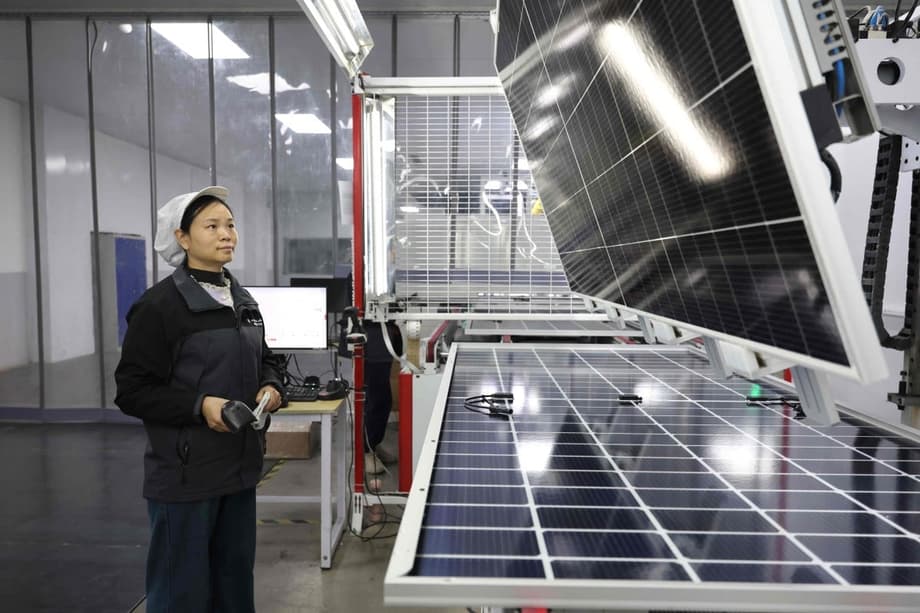
Conversely, China clean technology export sector is booming. The new three industries of solar cells, electric vehicles, and lithium batteries accounted for 10 percent of GDP in 2024, with clean energy sectors driving more than 90 percent of investment growth last year. These industries generated a record 15.4 trillion yuan (US$2.2 trillion) in business activity, comparable to the entire economies of Brazil or Canada. Chinese manufacturers now dominate global supply chains for these technologies, with solar panels providing what the International Energy Agency calls the cheapest electricity in history.
Lin Zhang, Professor at the City University of Hong Kong School of Energy and Environment, predicts that China renewable technology export market will expand markedly during the 15th Five Year Plan period, particularly to Belt and Road Initiative countries in Asia and Africa. Many of these nations are now importing Chinese solar technology and beginning to adopt electric vehicles, replicating aspects of China domestic transition. This creates a dual dynamic: declining fossil fuel imports alongside surging clean tech exports, positioning China to reshape global energy geopolitics by securing domestic supply chains while dominating manufacturing of transition technologies.
As Chim Lee, senior analyst at the Economist Intelligence Unit, observes, intense domestic competition is prompting Chinese companies to seek opportunities abroad, while tensions with markets such as the US and the EU mean that China is increasingly targeting less developed markets with its green exports and investments. Chinese renewable project financing will increase gradually as the country companies and financiers balance political pressure to increase green finance with risk management.
The Bottom Line
- China 15th Five Year Plan (2026-2030) prioritizes energy security alongside climate targets, marking a strategic shift toward self reliance and economic resilience.
- Eastern coastal regions must cover 70 percent of new energy demand growth through local supply, reducing dependence on long distance transmission from western regions.
- State Grid Corporation will invest 4 trillion yuan in grid upgrades to accommodate renewable energy integration and surging power demand from AI data centers.
- Non fossil energy consumption is targeted to reach 25 percent by 2030, with carbon emissions peaking before 2030 and declining 7 to 10 percent by 2035.
- Clean energy industries drove over 90 percent of investment growth in 2025, with solar, wind, electric vehicles, and batteries now comprising 10 percent of national GDP.
- Fossil fuel imports are expected to peak before 2030 as electrification accelerates, reshaping global energy trade flows and supplier relationships.