An Island Drowning in Plastic: The Anthropocene Arrives on Tsushima Shores
On the western coast of Tsushima Island, a border territory in Nagasaki Prefecture nestled between Japan and the Korean Peninsula, Tsuyoshi Maeda stands on Kujika Beach and points to a disturbing sight. Several centimeters beneath the surface lies not sand, but a thick white stratum of finely crushed polystyrene foam, compacted by years of exposure to ultraviolet rays, wind, and waves. The municipal government official responsible for sustainable development goals surveys this scene with a somber expression.
- An Island Drowning in Plastic: The Anthropocene Arrives on Tsushima Shores
- The Scale of an Invisible Invasion
- Tracing the Trash: International Currents of Pollution
- The Geography of Accumulation
- Technological Frontiers: Innovation Meets Reality
- The Cleanup Debate: Ecological Trade-offs
- Education and Transboundary Solutions
- Key Points
I feel we have entered the Anthropocene era.
Maeda’s reference to the proposed geological epoch marked by human impact, including plastic waste and radioactive fallout, captures the gravity of what scientists and residents confront daily on this remote archipelago.
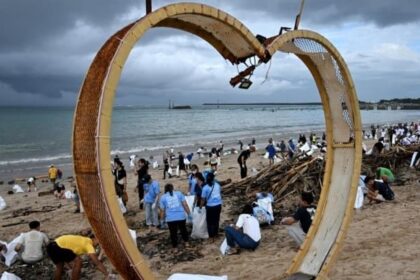
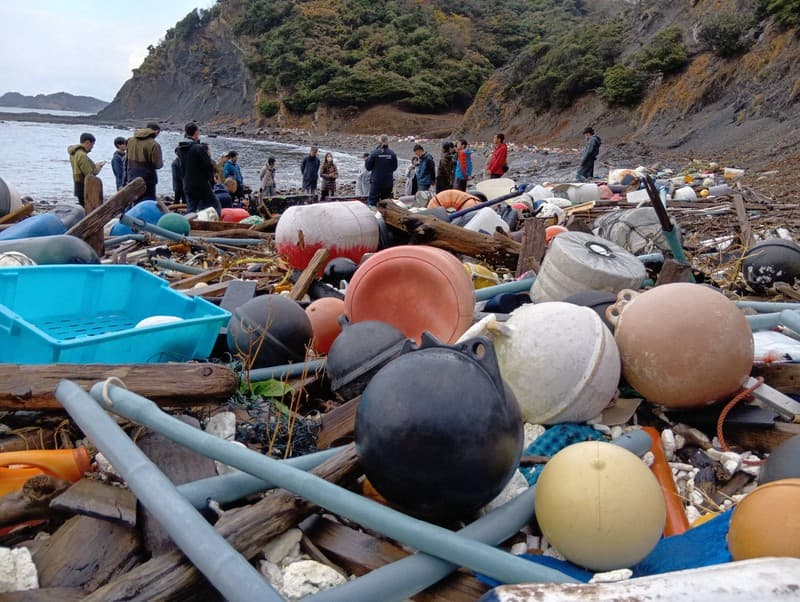
The coastline stretches from the waterline deep into the forest, carpeted with debris that defies seasonal cleaning efforts. Buoys measuring up to one meter in diameter, fragments of fishing nets, plastic tanks, bottles, and detergent containers create a landscape where synthetic materials have supplanted natural sediment. When Maeda first observed this microplastic layer around 2022, he recognized it as evidence of a transformation that future generations may view as a negative legacy left by contemporary society. The soft, white substance crunches underfoot, a tactile reminder that plastic pollution has permeated every layer of the coastal ecosystem, from the surf zone to the tree line dozens of meters inland.
The Scale of an Invisible Invasion
Tsushima receives an estimated 30,000 to 40,000 cubic meters of marine debris annually, a volume equivalent to filling approximately 100 Olympic swimming pools stretching 25 meters each. This staggering influx has transformed the island into what researchers and international organizations identify as a global hotspot for plastic pollution. According to data published by the Organization for Economic Cooperation and Development in July 2025, the combined plastic consumption of ASEAN nations plus China, Japan, and South Korea reached 152 million metric tons in 2022. Of this massive total, an estimated 8.4 million tons leaked into the environment including oceans, representing roughly one-third of global marine plastic pollution.
Scientific surveys conducted between 2017 and 2019 reveal the microscopic dimensions of this crisis. Research published in October 2024 examining microplastics distribution across Japanese beaches found that Tsushima Island exhibits distinct contamination patterns compared to other regions. While Yonaguni Island recorded the highest density at over 604,000 items per cubic meter in surface sand, Tsushima showed significant concentrations of polystyrene foam, the dominant artifact type along with plastic fragments. The studies indicate that artifacts on beaches facing the Sea of Japan, including Tsushima, experience different fates than those on Pacific coasts, with weight distributions suggesting complex current dynamics at play.
The financial and ecological toll extends beyond mere statistics. The Tsushima Municipal Government allocates approximately 300 million yen (around $2 million) annually for waste collection and landfill disposal, a significant burden for a fiscally strained community of roughly 30,000 residents. While the national government subsidizes 90% of these costs, local authorities face persistent questions from citizens about why they must bear responsibility for refuse originating overseas. Tatsuya Mihara, who heads the city government’s future environment department, expresses the frustration felt by many officials.
While we are strengthening measures with volunteer support, Tsushima alone has its limits. We want this reality to be known domestically and internationally, leading to changes in people’s behavior.
Tracing the Trash: International Currents of Pollution
The origins of Tsushima’s plastic deluge trace back across the East China Sea to industrial and urban centers in neighboring nations. When plastic bottles collected during fiscal year 2024 were sorted by country of origin, city data revealed that 37% came from China, 27% from South Korea, and only 5% from Japan. The remaining waste, while unidentifiable by label, displays characteristics suggesting foreign manufacture based on shape, molding techniques, and material composition. This transboundary flow represents the physical manifestation of inadequate waste management systems in rapidly developing economies across East Asia.
The mechanism delivering this debris operates through the powerful Tsushima Current, a branch of the Kuroshio Current system that flows northward from the East China Sea into the Sea of Japan. Oceanographic models demonstrate that floating plastics released from the Chinese coast and Korean Peninsula ride these northeast-bound waters directly toward Tsushima Strait. Numerical simulations using adjoint marginal sensitivity methods confirm that the strait serves as a natural chokepoint where currents concentrate buoyant debris. The island’s northern tip lies merely 50 kilometers from Busan, South Korea, placing it directly in the path of maritime traffic and coastal discharge from one of East Asia’s busiest ports.
Research by Japan’s Ministry of the Environment confirms these drift patterns through direct observation. Studies tracking disposable lighters and polyethylene terephthalate bottles found that more than half of collected items originated from China, the Korean Peninsula, and Taiwan. The same current systems that make Tsushima’s waters rich fishing grounds, teeming with marine life sustained by nutrient upwellings, now deliver a conveyor belt of synthetic refuse. As populations grow and economies expand throughout Asia, waste generation has surged while infrastructure for containment and recycling has failed to keep pace, creating what scientists describe as a perfect storm of marine pollution.
The Geography of Accumulation
Tsushima’s location at the entrance to the Sea of Japan explains only part of why it bears such a disproportionate share of regional pollution. The island’s physical geography compounds the problem through its extensive ria coastline, marked by submerged river valleys that create complex, irregular shorelines spanning 915 kilometers. These intricate inlets and coves generate turbulent tidal flows that trap floating debris against headlands and within secluded bays where retrieval proves difficult.
Michinao Suenaga, a 54-year-old director of Tsushima CAPPA, a general incorporated association dedicated to beach cleanups, describes the frustration of working within these constraints.
On beaches where debris accumulates, it washes ashore again no matter how many times we clean it up. It is an endless cycle.
The steep, rocky terrain prevents heavy machinery from accessing many collection sites, forcing volunteers to haul debris by hand up precipitous slopes. Annual collection efforts manage to remove only about 8,000 cubic meters, roughly 20% of the total volume arriving each year. The remainder either accumulates in inaccessible crevices or drifts back offshore where it threatens marine ecosystems and commercial fishing operations.
Scientific analysis reveals distinct characteristics in the debris reaching these shores. Polystyrene foam dominates the waste stream by number, reflecting its extensive use in aquaculture and fishing industries throughout East Asia. Unlike denser plastics that sink to the seafloor, polystyrene’s low specific gravity allows it to float indefinitely until fragmentation creates microplastics. Studies comparing Tsushima’s beaches with those in Shimane Prefecture and Okinawan islands show that the major axis dimensions of foam particles differ significantly by location, suggesting varying exposure times to weathering processes during transit through different current systems.
Technological Frontiers: Innovation Meets Reality
Faced with the limitations of manual collection, Tsushima has become a testing ground for maritime cleanup technologies. The Blue Cleanup project, developed by Saraya BlueTech, deploys a specialized catamaran equipped with conveyor systems and rotary filters capable of capturing both macroplastics and microplastics from coastal waters. This mobile platform, designed for deployment in inaccessible ria coast areas, represents an attempt to intercept debris before it beaches and becomes entangled in vegetation or fragmented by wave action.
Researchers at Nagasaki University have developed autonomous surface vehicles and underwater robots specifically designed to map and eventually collect marine litter. Led by robotics professor Ikuo Yamamoto, the team has created camera-equipped systems that can survey subsurface debris and create 3D models of accumulation zones. These technologies aim to predict where debris will concentrate based on current simulations, potentially allowing for targeted collection efforts rather than exhaustive shoreline sweeps. The researchers hope to demonstrate these systems to international audiences, positioning Tsushima as a demonstration site for automated marine debris management.
International partnerships have also focused on the island. In 2015, The Ocean Cleanup signed an agreement with Tsushima’s mayor to deploy what was planned as the world’s longest floating structure, a 2,000-meter boom intended to intercept plastic before it reached shore. While that specific project evolved, the collaboration continues through initiatives utilizing artificial intelligence to identify plastic hotspots. Automatic Debris Imaging Systems now allow real time classification of waste accumulation, while predictive modeling helps municipalities optimize limited cleanup resources. These technological interventions offer hope, yet they remain partial solutions to a problem requiring source reduction across international borders.
The Cleanup Debate: Ecological Trade-offs
While most observers view Tsushima’s plastic accumulation as an environmental disaster requiring immediate remediation, some marine biologists urge caution regarding wholesale removal efforts. Research into the neuston, organisms that inhabit the ocean’s surface layer, suggests that floating debris may have become habitat for certain species. Studies indicate that rafts of plastic can support communities of algae, bacteria, and small animals that play roles in oceanic food webs. Critics of aggressive cleanup argue that removing these materials without understanding the ecological relationships formed around them could damage ecosystems that have adapted to plastic presence over decades.
However, residents and officials on Tsushima stress the immediate hazards posed by accumulated waste. Beyond aesthetic degradation that threatens tourism, plastic debris entangles marine mammals, blocks sunlight to underwater vegetation, and introduces toxic compounds into food chains. Hazardous materials including medical waste, gas canisters, and chemical containers regularly wash ashore, posing direct physical dangers to cleanup volunteers and beachgoers. For a community dependent on fishing and eco-tourism, the economic and health costs of inaction outweigh theoretical concerns about disrupting novel ecosystems.
Education and Transboundary Solutions
Recognizing that technological fixes alone cannot stem the tide of incoming waste, local organizations have pivoted toward education and international dialogue. Tsushima CAPPA operates a trunk museum program that brings samples of marine debris to elementary schools, using suitcases filled with categorized waste to stimulate discussion about consumer habits and waste management. The organization enables exchange programs between Tsushima students and their counterparts in Busan, building cross border understanding of shared environmental challenges. These initiatives aim to convert local frustration into collective action across national boundaries.
The island serves as a physical reminder of the limitations of national boundaries in addressing environmental crises. While international agreements like the G20’s Osaka Blue Ocean Vision, which targets zero additional marine plastic pollution by 2050, provide frameworks for cooperation, implementation remains uneven. Tsushima’s plight illustrates how gaps in waste management infrastructure in one nation manifest as ecological and financial burdens in another. For officials like Mihara, the goal remains clear: convert the island’s visible suffering into a catalyst for behavioral change and policy reform across East Asia, ensuring that future generations do not inherit a legacy of synthetic sediment where beaches once stood.
Key Points
- Tsushima Island receives 30,000 to 40,000 cubic meters of plastic waste annually, with only 20% collectable due to steep terrain
- Fiscal year 2024 data attributes 37% of plastic bottles to China and 27% to South Korea, carried by the Tsushima Current
- Research identifies a thick stratum of microplastics and polystyrene foam several centimeters deep on western beaches
- Annual cleanup costs reach 300 million yen, creating significant financial strain for the island’s 30,000 residents
- New technologies including autonomous robots, specialized catamarans, and AI mapping systems are being tested to improve collection efficiency
- Local organizations emphasize international education and cross border cooperation as essential components of extended solutions