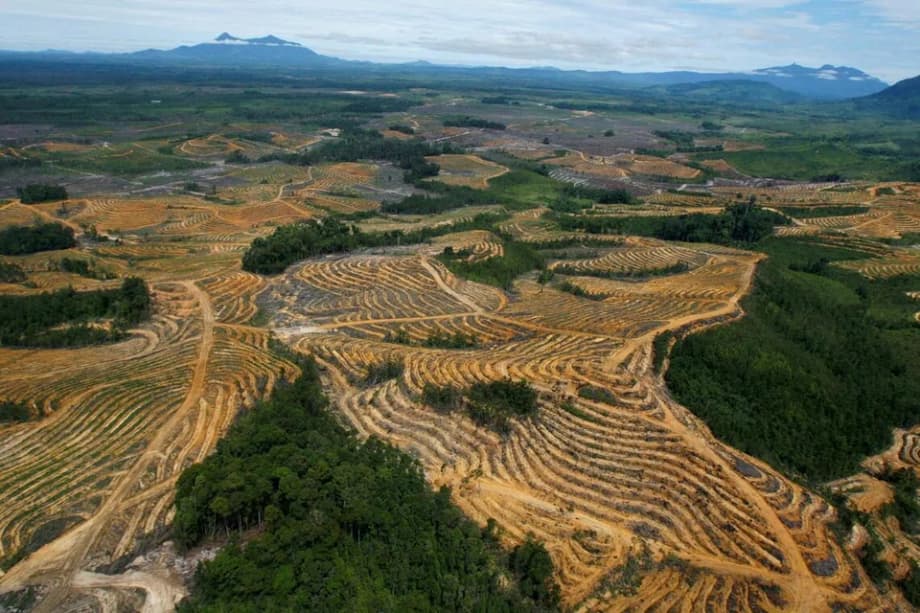
Indonesia Escalates Land Seizure Campaign with 2026 Targets
President Prabowo Subianto announced on January 7 that Indonesia plans to seize an additional four to five million hectares of palm oil plantations in 2026, expanding a controversial crackdown that has already brought vast areas under state control. Speaking at a rice harvest ceremony in West Java, Prabowo stated that his administration had already taken over 4.1 million hectares of plantations operating illegally in forest areas during 2025, with even larger seizures planned for the coming year.
- Indonesia Escalates Land Seizure Campaign with 2026 Targets
- Military-Led Task Force Transforms Palm Oil Landscape
- Global Market Disruption and Price Projections
- Environmental Restoration vs Economic Uncertainty
- Broader Pattern of Resource Nationalism
- Financial Stakes and Corporate Consequences
- At a Glance
The announcement marks a significant escalation of Indonesia’s resource governance strategy under Prabowo, who has positioned himself as a defender of national wealth against what he describes as exploitation by elites and foreign interests. The seizure campaign targets both major palm oil companies and smallholder farmers, raising concerns about food security, global supply chains, and investment stability in Southeast Asia’s largest economy.
We have controlled, have taken over four million hectares of palm oil plantations that have violated the laws. Isn’t that right, state attorney? Prabowo said at the ceremony, addressing officials from the Attorney General’s Office. In 2026, maybe we will seize four or five million more.
Indonesia is the world’s largest producer of palm oil, accounting for approximately 57 percent of global production and 60 percent of exports. The country’s total palm oil plantation area stands at 16.8 million hectares, meaning the planned seizures could bring nearly half of all plantations under direct state scrutiny or control.
Military-Led Task Force Transforms Palm Oil Landscape
The seizure campaign is led by a special Forest Area Control Task Force established in January 2025, comprising military personnel, police, and state prosecutors. Defense Minister Sjafrie Sjamsoeddin oversees the operation, reflecting the military’s expanded role in economic governance under Prabowo’s administration.
The task force operates with broad discretion to identify plantations operating within forest areas without proper permits, issuing fines and transferring land ownership to the state. Much of the seized land has been handed to Agrinas Palma Nusantara, a state-owned company that was transformed from an infrastructure services firm to the world’s largest palm oil company by area. To date, approximately 1.7 million hectares of seized plantations have been transferred to Agrinas.
The scale of the operation is unprecedented. In just nine months, the government has seized an area roughly the size of Switzerland, encompassing plantations, mine concessions, and processing facilities. The campaign gained momentum in March 2025 with the seizure of 221,000 hectares from Duta Palma Group, owned by Surya Darmadi, formerly one of Indonesia’s richest men who became the subject of a money laundering and corruption probe.
Agrinas President Director Agus Sutomo told parliament in September that much of the vast land bank isn’t yet productive, with less than half already planted with trees. The portfolio includes numerous small plots that individually lack the scale for efficient cultivation, requiring significant investment in restoration and productivity improvements.
The task force has proposed allowing farmers to remain on seized land in exchange for revenue sharing arrangements, with Agrinas typically keeping 40 to 45 percent of proceeds while farmers retain 55 to 60 percent. However, many smallholders have resisted these terms, citing loss of independence and insufficient compensation for decades of labor and investment.
We planted the trees, and we worked hard to take care of them, said Rubahan Hasibuan, a 48-year-old farmer from northern Sumatra whose family and neighbors have seen approximately 2,000 hectares of farmland seized. We turned it down to keep our independence.
AdvertisementGlobal Market Disruption and Price Projections
The seizure campaign has unnerved global palm oil markets, with analysts predicting that reduced production could drive prices higher throughout 2026. Indonesia’s palm oil exports are critical for global food supply chains, and any significant disruption would affect prices for cooking oil, processed foods, and biofuels worldwide.
Thomas Mielke, executive director of Hamburg-based forecasting firm Oil World, predicted at an industry conference in Bali that Malaysia’s benchmark palm oil contract could climb to RM5,000 (US$1,183.71) per metric tonne within six months. Dorab Mistry, director at India’s Godrej International, suggested futures could reach RM5,500 per tonne between January and March if Indonesia continues seizing plantations and advances its B50 biodiesel plan.
The price pressure compounds other challenges facing the industry, including declining yields from aging trees and slow replanting efforts. Mielke expects Indonesia’s palm oil output to fall to 49 million tonnes in 2026 from 49.4 million tonnes in 2025, with the decline continuing into 2027.
The Indonesia Palm Oil Association (Gapki) offered a more optimistic outlook, forecasting a 3 to 4 percent production increase in 2026 supported by favorable weather and newly mature plantings. However, spokesperson Fadhil Hasan acknowledged concerns over the seizures, stressing the need for balanced enforcement to keep production impacts moderate and temporary.
Fastmarkets analysts project that between 2 to 5 million tonnes of crude palm oil (CPO) production could be at risk due to increased uncertainty over land titles. The government has already seized 3.3 million hectares, of which 1.5 million hectares of oil palm planted area was transferred to Agrinas, with another 1.8 million hectares under verification.
The seizure uncertainty compounds Indonesia’s ambitious biodiesel expansion plans. The country raised its biodiesel blend target to 40 percent starting in February 2025 and is targeting a 50 percent blend (B50) by the second half of 2026. The government has since scaled back the immediate implementation to B45 for 2026, citing the need for further consideration, but the policy will continue to divert significant palm oil volumes from export markets to domestic fuel needs.
AdvertisementMielke estimated that meeting the B50 mandate would require an additional 2.2 million tonnes of palm oil for biodiesel production. Higher bio-content blending could necessitate levy increases of up to 7.5 percent due to the widening price gap between palm oil feedstock and diesel fuel, according to Julian McGill, an analyst at Glenauk Economics.
Environmental Restoration vs Economic Uncertainty
The Indonesian government frames the seizure campaign as necessary environmental restoration and governance reform. Prabowo has emphasized that the operations aim to recover state resources lost to illegal activities and improve land management in a sector where Indonesia has lost millions of hectares of forest in recent decades.
The role of deforestation in worsening floods and landslides that killed more than 1,000 people in Sumatra in late 2025 has added momentum to Jakarta’s campaign. Environmental activists have long criticized palm oil expansion for destroying carbon-rich peatlands and habitats for endangered species including orangutans, tigers, and rhinos.
Prabowo has described the campaign as the right and noble path of defending the interests of millions of Indonesians, asserting that vast areas of forest land remain under illegal control by business operators with potential state losses reaching hundreds of trillions of rupiah if left unaddressed.
However, the campaign has raised significant concerns about investment climate and policy predictability. Bhima Yudhistira Adhinegara, executive director at the Jakarta-based Center of Economic and Law Studies, characterized the approach as increasingly showing the character of a Prabowo-style command economy.
Methods like this reduce interest from investors, both in the plantation sector and in conservation, Bhima said. The uncertainty over ownership and the threat of retroactive penalties have already begun to affect investment decisions in the sector.
Industry groups warn that the seizure policy may limit investment in fertilization and cultivation, with production beginning to decline within two to three months as maintenance activities are disrupted. Gnanasekar Thiagarajan, head of trading and hedging strategies at Kaleesuwari Intercontinental, stated that it will definitely hurt supply if the seizures materialize.
The risk that production will suffer more than we dare to say now is probably bigger than vice versa, Thomas Mielke said at the Bali conference. This is a very critical and very sensitive situation.
AdvertisementBroader Pattern of Resource Nationalism
The palm oil seizures are part of a broader pattern of resource consolidation across Indonesia’s commodity sectors. The government has simultaneously cracked down on illegal mining operations, targeting tin smelters, nickel mines, and coal operations in similar fashion.
In the tin mining sector, a military-backed task force has swept across the islands of Bangka and Belitung, targeting offshore dredging vessels, illegal smelters, and uncovering heavy machinery buried underground. The operation followed convictions of executives at PT Timah, the state-owned firm that dominates the sector, for overseeing a multi-year corruption scheme to launder illegal tin into its supply chain.
Despite the corruption scandal at PT Timah, the government handed the seized tin assets to the same company for management, appointing Restu Widiyantoro, a retired army colonel, as its president director. Observers note this creates a pattern of state consolidation rather than true reform.
Many observers say this amounts to nationalization by another name, said Made Supriatma, visiting fellow at the ISEAS-Yusof Ishak Institute, whose research focuses on the role of the military in Indonesia. But the risk is that this is not acknowledged as nationalization; Prabowo frames it instead as a law-enforcement issue. All of this is driven by political factors; it has nothing to do with economic reasoning.
The crackdown has sparked mixed reactions in mining communities. While some residents welcome the environmental improvements from reduced illegal mining, others have lost their livelihoods without alternatives. There are no jobs left, said Ari, a miner from Gantung, East Belitung. Life is getting harder for us; the pit cave that I used to mine is also closed. They crack down without thinking about small people who depend on tin mining.
In the palm oil sector, overlapping land allocations are common, with some areas permitted for cultivation though still classified as forest areas. Many plantation operators argue they are farming land that was bought or handed to them years earlier under government programs to encourage internal migration.
Prabowo claims that the state has reclaimed 4 million hectares because these plots were located within forest zones, said Achmad Sukarsono at consultancy Control Risks. But how did it come to this? Such a vast amount of land couldn’t have been taken illegally by palm oil companies without approval from local governments and military officials.
AdvertisementFinancial Stakes and Corporate Consequences
The financial implications of the seizure campaign are substantial for both the Indonesian government and the companies affected. Attorney General Sanitiar Burhanuddin announced in December that the government could collect approximately $6.5 billion in fines from palm oil companies implicated in the 2025 seizures.
For 2026, Burhanuddin identified revenue potential from administrative fines amounting to IDR109.6 trillion ($6.54 billion) for palm oil and IDR32.63 trillion ($1.95 billion) for mining operations within forest areas. The task force has already collected over IDR2.34 trillion ($139.70 million) in fines from 20 palm oil companies and one nickel miner.
According to a formula laid out by the government, plantation companies will face charges of $1,497 per hectare for every year since land clearing began, aside from a five-year exemption to account for the time it takes for oil palms to become productive. This could leave companies facing penalties heftier than the value of their land.
Major international palm oil companies are already assessing their exposure. Singapore-based crop trader Wilmar International Ltd. has said it expects a few thousand hectares of its plantation area to be impacted and is in discussion with authorities. Malaysian-listed IOI Corporation Bhd., which operates palm plantations and mills in Kalimantan, will now undertake more risk assessments before investments in Indonesia, according to chief executive officer Lee Yeow Chor.
Approximately four dozen palm companies have been ordered to pay a total of around $560 million, while 22 miners were ordered to pay more than $1.7 billion as a way to return illegal gains to the state, according to figures from the Indonesian attorney general’s office.
In the nickel sector, the government is demanding a penalty of around 3 trillion rupiah ($179 million) from PT Weda Bay Nickel, whose largest shareholder is China’s Tsingshan Holding Group, for violating 148 hectares of its 45,000-hectare site. For nickel miners, the penalty rate was set at $389,000 per hectare, enough to bankrupt many small companies that still dominate output.
Industry group Gapki has heard complaints from members that harvest proceeds from seized plantations are fully directed to Agrinas’s account, with payments to partners made more than 30 days later, according to a closed-door presentation made to parliament. This payment delay creates cash flow problems for companies and farmers trying to maintain operations.
AdvertisementAt a Glance
- Indonesia plans to seize an additional 4-5 million hectares of palm oil plantations in 2026, following 4.1 million hectares seized in 2025
- A military-backed task force leads the operation, transferring land to state-owned Agrinas Palma Nusantara, now the world’s largest palm oil company by area
- Analysts predict palm oil prices could rise to RM5,000-5,500 per tonne due to production disruptions and biodiesel mandates
- The government projects potential fines of $8.5 billion from palm oil and mining companies in 2026
- Indonesia produces 57 percent of global palm oil and accounts for 60 percent of exports, making seizures significant for world markets
- The campaign is part of a broader resource nationalism strategy also targeting tin, nickel, coal, and other mineral sectors
- Smallholder farmers face loss of independence under revenue-sharing arrangements offered by the state
- Investor concerns focus on policy unpredictability and retroactive penalties that may exceed asset values
- Environmental benefits from reduced deforestation contrast with economic risks and livelihood disruptions