Breaking Down the Bonus Boost
Cathay Pacific Airways, Hong Kong’s flagship carrier, has announced that employees will receive higher profit-sharing bonuses for 2025 compared to the previous year, marking a significant turnaround in the airline’s post-pandemic recovery trajectory. Chief Executive Officer Ronald Lam Siu-por communicated the news to staff in an internal letter circulated on February 4, 2026, revealing that the company expects to distribute payouts “at a level slightly more than last year’s” under its Profit Share Scheme.
This announcement comes as welcome news for the approximately 30,000-strong workforce, particularly following the reduction in profit-sharing payments seen in 2024. Eligible staff received bonuses equivalent to 6.2 weeks of pay for 2024, representing a decrease from the 7.2 weeks distributed in 2023. However, when combined with the discretionary annual bonus of four weeks’ pay (equivalent to one month), the total compensation package for 2024 exceeded 10 weeks of eligible pay, positioning Cathay among the more generous employers in the regional aviation sector.
For 2025, the projected increase in profit-sharing payouts, coupled with the consistent discretionary bonus, will push total employee rewards beyond 10.2 weeks of pay. This comprehensive approach to compensation reflects what company leadership describes as a culture of recognizing employee contributions. “Recognising our people for work well done has always been an important part of our culture at Cathay,” Lam stated in previous communications regarding the 2024 results.
Customer Satisfaction Drives Rewards
A critical factor in the enhanced 2025 profit-sharing calculation stems from Cathay Pacific’s record-breaking performance in customer satisfaction metrics. The airline achieved a Group Customer Net Promoter Score (cNPS) of plus 34.8 in 2025, the highest level in the company’s history. This metric, which measures customer loyalty and their willingness to recommend the airline to others, directly impacts employee compensation through a multiplier mechanism in the profit-sharing formula.
The exceptional cNPS performance triggered a 7 percent multiplier on the final profit-sharing pool, effectively boosting the bonus payout beyond what financial results alone would have generated. This linkage between customer experience and employee rewards represents a strategic alignment of interests, incentivizing staff across all departments to prioritize service excellence. “Our people have helped us win customers’ hearts,” Lam noted in his communication to employees, acknowledging their role in achieving the milestone satisfaction scores.
The Net Promoter Score system operates on a scale where positive scores indicate more promoters than detractors among customers. A score of plus 34.8 suggests that for every 100 customers surveyed, approximately 35 more would actively recommend Cathay Pacific than would speak negatively about their experience. In the highly competitive aviation industry, such scores translate directly into revenue stability and growth potential, justifying the bonus multiplier structure.
Navigating Competitive Pressures
While Cathay Pacific’s bonus increases represent positive momentum, the airline operates within an increasingly competitive landscape where rival carriers have established even more lucrative compensation benchmarks. Singapore Airlines (SIA), Cathay’s primary regional competitor, distributed profit-sharing bonuses equivalent to 7.45 months’ pay for the 2024-25 financial year following a record net profit of S$2.78 billion (US$2.15 billion). Emirates, the Dubai-based global carrier, announced an even more substantial 22-week bonus payout for its 2024-25 financial year after posting a record-breaking pre-tax profit of US$6.2 billion.
These comparisons highlight the talent retention challenges facing Cathay Pacific as it rebuilds its operations. Emirates has maintained a pattern of substantial bonuses for three consecutive years, offering 20 weeks in 2024 and 24 weeks in 2023. Similarly, Singapore Airlines provided 7.94 months’ bonus in the previous year, demonstrating consistent high-level rewards even as Cathay’s payouts fluctuated during the recovery period.
Industry analysts note that Cathay Pacific’s position in the global talent market requires careful balancing of competitive compensation against sustainable financial management. The airline’s net profit of HK$9.9 billion (US$1.28 billion) in 2024, while representing a second consecutive year of profitability, pales in comparison to Emirates’ US$6.2 billion or Singapore Airlines’ record results. This financial reality constrains Cathay’s ability to match the most generous bonus levels in the industry while maintaining its ambitious HK$100 billion investment program.
Workforce Expansion and Operational Recovery
The context for Cathay Pacific’s bonus calculations involves significant workforce growth as the airline restores capacity to pre-pandemic levels. The company reached 100 percent of its pre-pandemic flight capacity in January 2025, a milestone that required substantial recruitment and training efforts. During 2024 alone, the Group recruited and trained approximately 7,000 new employees, bringing total headcount to more than 30,000 people.
This expansion directly impacts profit-sharing calculations, as the same profit pool must be distributed across a larger employee base. CEO Ronald Lam explicitly acknowledged this dynamic in his communications, noting that the expected increase in 2025 payouts occurred “despite a larger workforce following Cathay’s post-pandemic rebuilding.” The airline plans to further expand its team by up to 4,000 additional employees by the end of 2025, reaching approximately 34,000 total staff to support continued business growth.
The rebuilding process has not been without challenges. The airline faced pilot shortages, training backlogs, and occasional operational disruptions, including IT issues that affected booking systems and check-in processes. HK Express, Cathay’s low-cost subsidiary, experienced particular difficulties in 2024, with an average of five Airbus A320neo aircraft grounded due to industry-wide Pratt & Whitney engine issues. Despite these obstacles, the Group maintained profitability and continued its expansion, adding 15 new passenger destinations across Cathay Pacific and HK Express during 2024.
Strategic Vision for the Future
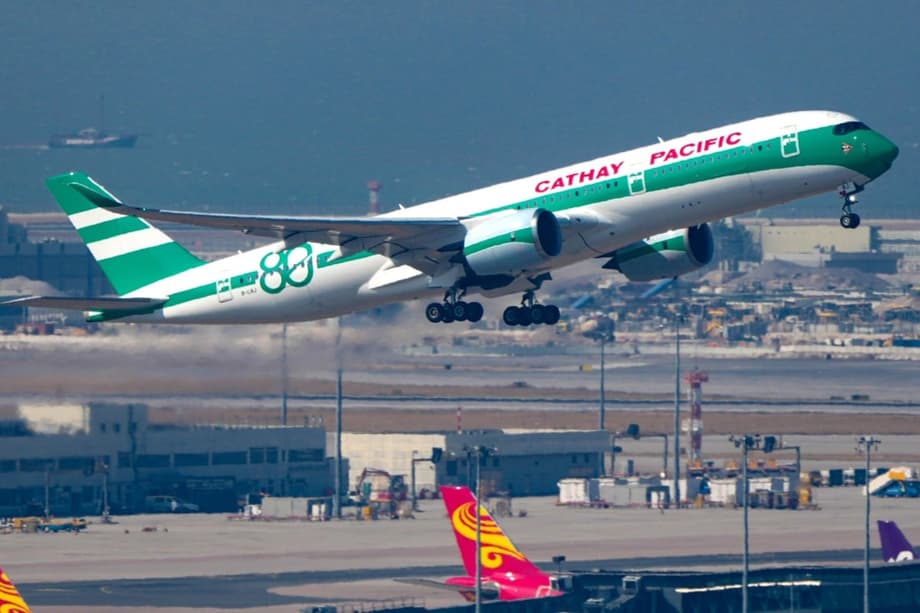
Cathay Pacific enters 2026, its 80th anniversary year, with a clearly defined strategic roadmap established at its Move Beyond Conference. The airline has committed to investing over HK$100 billion to coincide with the launch of Hong Kong International Airport’s Three-Runway System, encompassing fleet renewal, cabin upgrades, lounge renovations, and digital innovations. This investment program includes taking delivery of more than 100 new-generation aircraft and introducing world-leading cabin interiors such as the Aria Suite and new Premium Economy products.
However, management stresses that the era of rapid post-pandemic recovery growth is transitioning to a phase of normalized operations requiring disciplined cost management. “As we move into a period of more normalised growth, it will be increasingly important for us to be disciplined in how we manage our costs and continuously improve our productivity,” Lam stated. This focus on efficiency aims to build what leadership describes as a “resilient and sustainable business” anchored in safety and operational excellence.
The airline’s network expansion continues aggressively, with the Group already announcing 11 additional destinations for 2025. Combined, Cathay Pacific and HK Express will operate passenger services to more than 100 destinations worldwide during the current year. Cargo operations have also strengthened, with e-commerce demand driving strong performance in the second half of 2024, resulting in 11 percent higher tonnage and 3 percent improved yields compared to the previous year.
Financial Trajectory and Shareholder Returns
Cathay Pacific expects to announce full-year 2025 financial results in mid-March, with preliminary indications suggesting performance will exceed the 2024 consolidated results. The 2024 financial year saw the Group report an attributable profit of HK$9.9 billion, essentially flat compared to HK$9.8 billion in 2023 but representing a significant turnaround from the HK$34 billion accumulated losses during the three pandemic years.
Beyond employee compensation, the company has prioritized returning value to shareholders and fulfilling obligations to the Hong Kong SAR Government. In 2024, Cathay completed the buyback of remaining preference shares worth HK$9.8 billion and paid nearly HK$4 billion in preference share dividends and warrant buybacks. Additionally, the company announced total ordinary share dividends of 69 cents per share, representing HK$4.4 billion in distributions for 2024.
The Group’s financial health has also allowed it to repurchase approximately 68 percent of the HK$6.7 billion guaranteed convertible bonds due 2026 in early January 2025. These capital management moves demonstrate the airline’s confidence in its sustained profitability while balancing the need to reward employees, satisfy shareholders, and fund substantial capital investments for future growth.
The Bottom Line
- Cathay Pacific will increase 2025 profit-sharing bonuses above the 6.2 weeks paid in 2024, with total employee compensation exceeding 10.2 weeks including discretionary bonuses
- A record Customer Net Promoter Score of plus 34.8 triggered a 7 percent multiplier on the profit-sharing pool, directly linking customer satisfaction to employee rewards
- The airline achieved 100 percent of pre-pandemic capacity in January 2025 while expanding its workforce to over 30,000 employees, with plans to reach 34,000 by year-end
- Full-year 2025 financial results, expected in mid-March, are projected to exceed the HK$9.9 billion profit recorded in 2024
- Cathay faces ongoing competitive pressure from Singapore Airlines (7.45 months’ bonus) and Emirates (22 weeks’ bonus) in the regional talent market
- The company maintains its HK$100 billion investment commitment for fleet renewal, cabin upgrades, and network expansion while highlighting cost discipline in the transition to normalized growth
- 2026 marks Cathay Pacific’s 80th anniversary, celebrated with special liveries and strategic planning conferences setting priorities for the next five years