Higher Rewards Expected for a Larger Workforce
Cathay Pacific employees are set to receive a bigger profit sharing payout for 2025 than the 6.2 weeks of eligible pay awarded for 2024, after record customer satisfaction helped lift the amount available for staff rewards. The increase is expected even as the Hong Kong flagship carrier shares its profits across a larger workforce following its recovery from the pandemic.
Contents
- Higher Rewards Expected for a Larger Workforce
- Customer Satisfaction Adds 7 Percent to the Pool
- How the Bonus Has Changed
- Singapore Airlines and Emirates Set Higher Benchmarks
- Thousands of Recruits Change the Calculation
- HK Express and Cargo Show Different Pressures
- HK$100 Billion Investment Meets Cost Discipline
- Profits Have Returned After HK$34 Billion in Losses
- Shareholders and Government Obligations Also Receive Cash
- The Bottom Line
Chief Executive Officer Ronald Lam Siu-por outlined the expected increase in an internal letter circulated on February 4, 2026. He told staff that payments under the Profit Share Scheme would be "at a level slightly more than last year's". The exact number of weeks has not yet been announced. Full financial results for 2025 are expected in mid-March.
The announcement offers a welcome improvement for a workforce that numbered more than 30,000 after recruitment during 2024. Profit sharing payments had fallen from 7.2 weeks of pay for 2023 to 6.2 weeks for 2024, a reduction of one week.
Cathay also pays a discretionary annual bonus of four weeks of eligible pay, described as equivalent to one month. Together, the two payments amounted to 10.2 weeks for 2024. With that discretionary payment continuing, the expected increase in profit sharing would take the combined rewards above 10.2 weeks for 2025.
Lam has presented employee recognition as part of the airline's approach to rebuilding its business. In earlier communications about the 2024 results, the chief executive explained why the company was distributing some of its earnings to staff.
"Recognising our people for work well done has always been an important part of our culture at Cathay," Lam said.
Customer Satisfaction Adds 7 Percent to the Pool
Cathay's Group Customer Net Promoter Score, known as cNPS, reached plus 34.8 in 2025, the highest level in the company's history. That result triggered a 7 percent multiplier on the final profit sharing pool, increasing the amount available beyond what the financial results alone would have produced.
The score measures customer loyalty and willingness to recommend the airline. A positive result means customers who would recommend the business outnumber those who would speak negatively about their experience. At plus 34.8, the balance is approximately 35 more promoters than detractors for every 100 customers surveyed.
Cathay's formula gives that customer measure a direct role in employee rewards. The 7 percent increase applies to the profit sharing pool, the total amount set aside for distribution. The eventual payment to eligible employees also depends on the financial performance and the workforce sharing that pool.
Lam credited employees with the customer satisfaction result in his communication to staff.
"Our people have helped us win customers' hearts," he said.
The link between service and pay gives employees across departments a shared financial reason to focus on the passenger experience. For an airline competing for repeat business, customers willing to recommend its services can support revenue stability and future growth. Cathay has built that connection into the calculation of its staff rewards.
How the Bonus Has Changed
Cathay's expected increase follows a period in which its business recovered faster than its individual profit sharing payments. The airline returned to profitability, recruited thousands of workers and restored flight capacity, while the payment for 2024 fell below the previous year's level.
The main milestones show how the staff rewards fit into the wider recovery:
- 2023: Eligible employees received profit sharing equivalent to 7.2 weeks of pay, and Cathay recorded an attributable profit of HK$9.8 billion.
- 2024: Profit sharing fell to 6.2 weeks. A discretionary bonus of four weeks brought combined rewards to 10.2 weeks, while attributable profit reached HK$9.9 billion.
- January 2025: Cathay restored 100 percent of its flight capacity before the pandemic.
- During 2025: The customer satisfaction score reached a record plus 34.8, triggering a 7 percent increase in the profit sharing pool.
- February 4, 2026: Lam told employees that the payout for 2025 was expected to be slightly higher than the previous year's.
- Mid-March 2026: Cathay expects to announce its full financial results for 2025.
The combined payment for 2024 put Cathay among the more generous employers in the regional aviation sector. Some major international airlines, however, have distributed substantially larger bonuses, creating a demanding comparison as Cathay continues to recruit.
Singapore Airlines and Emirates Set Higher Benchmarks
Singapore Airlines, a primary regional competitor, paid a profit sharing bonus equivalent to 7.45 months of salary for its financial year covering 2024 and 2025. The payment followed a record net profit of S$2.78 billion, equivalent to US$2.15 billion. Its bonus for the preceding year had been 7.94 months.
Emirates announced a bonus of 22 weeks of pay for its financial year covering 2024 and 2025, after a record profit before tax of US$6.2 billion. The Dubai airline had awarded 20 weeks in 2024 and 24 weeks in 2023, maintaining substantial payments for three consecutive years.
Cathay's 2024 net profit was HK$9.9 billion, or US$1.28 billion. That was below the reported earnings figures for both rivals, although the Emirates figure measures profit before tax and the Singapore Airlines figure measures net profit.
The competing bonus levels matter to Cathay's recruitment and retention efforts. Employees considering different airlines can compare the rewards available, while Cathay must balance staff payments with the money required to run and expand its business.
The airline is also committed to an investment programme exceeding HK$100 billion. Its challenge is to offer competitive compensation while funding that programme and maintaining sustainable finances. A higher bonus helps staff share in the recovery, but the airline's spending commitments extend well beyond the annual payout.
Thousands of Recruits Change the Calculation
Cathay recruited and trained approximately 7,000 employees during 2024, taking group headcount above 30,000. That hiring supported the restoration of services and the return to full capacity in January 2025.
A larger workforce also changes how profit sharing works. A pool distributed among more eligible employees must grow enough to support a higher payment for each person. Lam acknowledged that the expected increase for 2025 came "despite a larger workforce following Cathay's post-pandemic rebuilding".
Cathay had planned to add up to another 4,000 employees by the end of 2025, taking the workforce to approximately 34,000 to support further business growth. That hiring plan formed part of the expansion beyond the initial recovery in flight capacity.
Recruitment was accompanied by operational difficulties. Cathay faced pilot shortages, training backlogs and occasional disruption, including information technology problems affecting booking systems and check-in processes. Restoring capacity therefore involved both adding employees and preparing them to operate the expanded schedule.
HK Express and Cargo Show Different Pressures
HK Express, Cathay's subsidiary offering lower fares, faced a particular constraint during 2024. An average of five Airbus A320neo aircraft were grounded because of problems affecting Pratt & Whitney engines across the industry.
Aircraft unavailable for service limited the resources the subsidiary could use during the group's expansion. Despite that problem and other operational difficulties, Cathay remained profitable and continued to broaden its network.
Cathay Pacific and HK Express added 15 passenger destinations during 2024. For 2025, the group announced another 11 destinations, with the two airlines set to operate passenger services to more than 100 destinations worldwide during that year.
Cargo provided another source of business strength. Demand from online shopping supported a strong performance in the second half of 2024. Cargo tonnage, the weight of goods carried, rose 11 percent from the previous year, while yields improved 3 percent. Yield is a measure of the revenue earned from carrying cargo.
The passenger and cargo figures show the different demands on the rebuilding business. Cathay was restoring flights and adding destinations while its cargo operation benefited from stronger demand. Staff rewards sit within that wider mix of expanding activity, operational constraints and earnings.
HK$100 Billion Investment Meets Cost Discipline
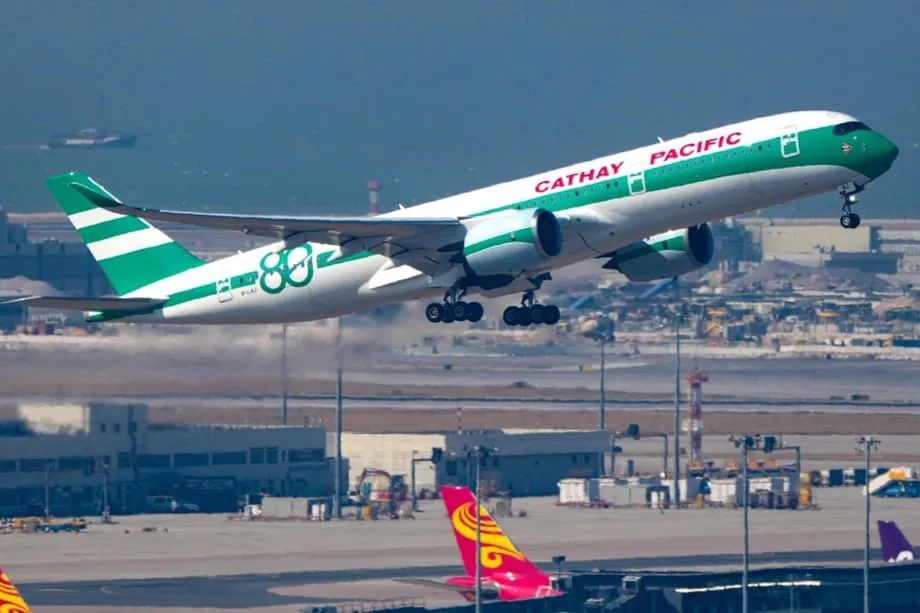
Cathay enters 2026, its 80th anniversary year, with priorities established at its Move Beyond Conference. The anniversary includes special aircraft liveries, while the conference set strategic priorities for the next five years.
The airline has committed to investing more than HK$100 billion alongside the launch of Hong Kong International Airport's Three-Runway System. The programme covers fleet renewal, cabin improvements, lounge renovations and digital innovations.
More than 100 aircraft of newer generations are included in its delivery plans. Cabin investment includes the Aria Suite and new Premium Economy products, which form part of Cathay's plans to compete through the experience offered to passengers.
Lam has also said that the period of rapid recovery is giving way to more normal growth. The chief executive linked that transition to tighter attention to spending and productivity.
"As we move into a period of more normalised growth, it will be increasingly important for us to be disciplined in how we manage our costs and continuously improve our productivity," he said.
Management describes the goal as a "resilient and sustainable business" built around safety and operational excellence. For employees, the higher expected payout comes alongside that message: the company intends to recognise their contribution while keeping control of the costs of operating a larger airline.
Profits Have Returned After HK$34 Billion in Losses
Cathay expects its consolidated financial performance for 2025 to exceed the results for 2024. The forthcoming announcement in mid-March will provide the financial detail behind the expected increase in staff profit sharing.
The group recorded attributable profit of HK$9.9 billion in 2024, compared with HK$9.8 billion in 2023. The increase was HK$100 million, leaving annual profit essentially flat even as the business continued to rebuild.
Those results represented two consecutive years of profitability after accumulated losses of HK$34 billion during the three pandemic years. The scale of those losses helps explain why the recovery involves several demands on cash at the same time: employee rewards, investment, shareholder payments and financial obligations.
The return to profit has allowed Cathay to pursue all of those priorities. Its expected increase in the 2025 staff payout therefore forms one part of a broader effort to distribute the benefits of recovery while preparing for further growth.
Shareholders and Government Obligations Also Receive Cash
Cathay completed the buyback of its remaining preference shares worth HK$9.8 billion in 2024. It also paid nearly HK$4 billion in preference share dividends and warrant buybacks as it fulfilled obligations to the Hong Kong SAR Government.
Preference shares are a form of company ownership with payment rights that differ from ordinary shares. Buying them back removes that financing from the company's capital structure. The related dividends and warrant buybacks were further parts of Cathay's financial commitments.
Ordinary shareholders also received a return from the recovery. Cathay announced total ordinary share dividends of 69 Hong Kong cents per share for 2024, amounting to HK$4.4 billion in distributions.
In early January 2025, the group repurchased approximately 68 percent of its HK$6.7 billion in guaranteed convertible bonds due in 2026. Convertible bonds are borrowing instruments that can be exchanged for shares under their terms. The repurchase addressed a substantial portion of that financing before its scheduled maturity.
These payments sit alongside the staff bonus and investment programme. Cathay's stronger finances have given it room to reward employees and shareholders, meet government obligations and reduce outstanding financing, while committing funds to aircraft, cabins and its network.
The Bottom Line
- Cathay expects its 2025 profit sharing payout to be slightly above the 6.2 weeks of eligible pay awarded for 2024.
- With the discretionary bonus of four weeks, combined employee rewards are expected to exceed 10.2 weeks of pay.
- A record customer satisfaction score of plus 34.8 triggered a 7 percent increase in the profit sharing pool.
- The group recruited and trained about 7,000 employees in 2024, taking headcount above 30,000, and planned further growth to approximately 34,000 by the end of 2025.
- Cathay restored full flight capacity in January 2025 and expects its 2025 financial performance to exceed the HK$9.9 billion attributable profit recorded for 2024.
- Singapore Airlines paid a bonus of 7.45 months and Emirates paid 22 weeks for their financial years covering 2024 and 2025.
- Cathay's investment commitment exceeds HK$100 billion, with more than 100 newer aircraft planned alongside cabin, lounge and digital improvements.
- Full financial results for 2025 are expected in mid-March 2026, during Cathay's 80th anniversary year.