A mineral supply hidden in discarded electronics
India is putting 15 billion rupees ($166 million) behind a plan to recover strategic minerals from discarded electronics, used batteries and industrial waste. Approved by Prime Minister Narendra Modi's cabinet in September 2025, the Critical Mineral Recycling Incentive Scheme aims to build 270,000 tonnes of annual recycling capacity and produce 40,000 tonnes of critical minerals a year.
Contents
- A mineral supply hidden in discarded electronics
- Why dependence on imported minerals matters
- How the subsidies are designed to work
- Why making black mass is not enough
- Companies register as the rollout gathers pace
- Connecting waste collection to mineral recovery
- The Quad adds an international dimension
- Rare earth corridors and the limits of new mining
- Keeping more manufacturing value in India
- Key Points
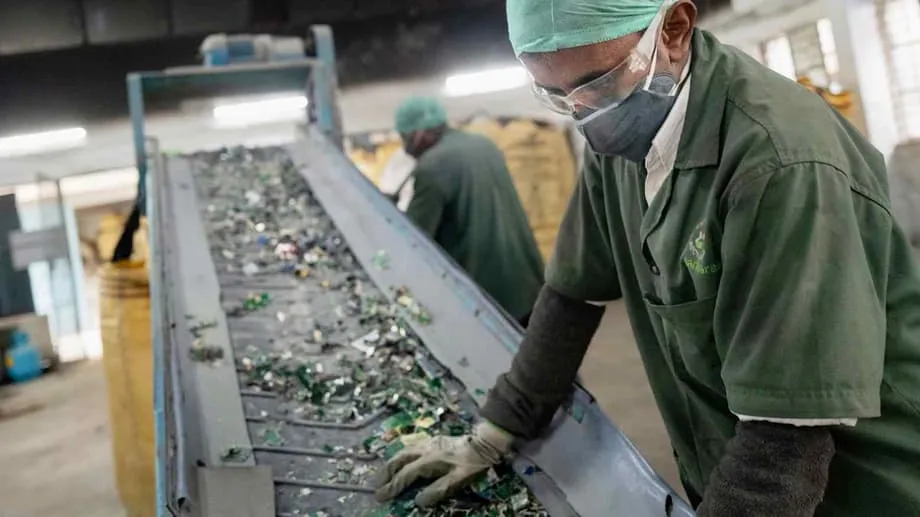
The country generates approximately 1.75 million tonnes of electronic waste annually, alongside 60,000 tonnes of spent lithium-ion batteries. Those waste streams contain lithium, cobalt, nickel and rare earth elements needed for electric vehicles, wind turbines and other technologies supporting the transition to cleaner energy. Recovering those materials is known as urban mining: drawing useful resources from products already made rather than digging fresh ore from the ground.
The program could meet 10 percent of domestic critical mineral demand and create nearly 70,000 direct and indirect jobs. It is part of the National Critical Mineral Mission, which has a total outlay of 163 billion rupees. Together, the measures represent a major shift in India's mining policy, giving recovery from waste a larger role alongside the search for underground resources.
India holds the world's third largest rare earth reserves and has recently discovered 5.9 million tonnes of lithium in Jammu and Kashmir. Yet it remains almost entirely dependent on imports for processed critical minerals. The policy therefore addresses a practical gap: possessing mineral resources and having usable materials ready for factories are different stages of the supply chain. India's recycling investment targets the processing capacity needed to connect them.
Why dependence on imported minerals matters
India imports 100 percent of its lithium, cobalt and nickel requirements, and 93 percent of its copper needs. China controls approximately 73 percent of global cobalt refining and 59 percent of lithium processing, giving it considerable influence over supplies used in electric vehicles, wind turbines and solar infrastructure.
Indonesia's nickel export bans and China's periodic restrictions on rare earth shipments have shown how quickly mineral supplies can tighten. For India, which is targeting net zero greenhouse gas emissions by 2070, access to these materials is part of both industrial planning and its climate strategy. Electric vehicle sales were projected to double to 200,000 units in 2025, adding urgency to the effort to secure supplies.
Anupam Agnihotri, director of the Jawaharlal Nehru Aluminium Research Development and Design Centre (JNARDDC), says domestic recovery capacity needs to grow now. His organisation serves as the Project Management Agency for the recycling scheme.
India must act now to build domestic recycling and recovery capacity if it wants secure supply chains,
Recycling also offers a way to limit the amount of fresh mining required. According to the International Energy Agency, recycling could reduce the need for new mining by 40 percent for copper and cobalt and 25 percent for lithium and nickel by 2050 under global climate pledges.
The recycling process is described as 2 to 10 times more energy efficient than mining virgin ore. Recovering materials already present in products can therefore support India's decarbonization goals while lowering production costs for domestic manufacturers. The government's aim is to turn a growing waste problem into a more dependable source of industrial materials.
How the subsidies are designed to work
The scheme runs for six years, from fiscal year 2025-26 through 2030-31. It combines support for building facilities with payments tied to their performance, seeking to attract established industrial recyclers as well as startups.
Capital expenditure subsidies cover 20 percent of investment in plant, machinery, equipment and associated utilities, provided participants begin production within specified timeframes. Capital expenditure means spending on the assets needed to build and operate a facility. Reduced subsidy rates apply after those deadlines, giving companies a financial reason to bring capacity into production promptly.
Operational expenditure support is tied to incremental sales over base year benchmarks. In simple terms, a participant must increase sales compared with its starting reference year to qualify for the relevant support. Recipients receive 40 percent of eligible operational subsidies in their second year of operation, with the remaining 60 percent paid in the fifth year after they achieve specified sales thresholds.
The payment schedule rewards continued output as well as construction. A company must progress from buying equipment to producing and selling recovered materials, then sustain that activity long enough to reach the later payment.
Large recyclers can receive a maximum of 500 million rupees, or 50 crore, in total incentives, including no more than 100 million rupees, or 10 crore, in operational support. Smaller players have a total ceiling of 250 million rupees, or 25 crore, including 50 million rupees, or 5 crore, for operational support.
One third of the scheme's total outlay is reserved for small enterprises and new entrants. Applied to the 15 billion rupee budget, that share amounts to 5 billion rupees. The reservation gives smaller participants a defined place in a program that also seeks investment from larger industrial businesses.
Why making black mass is not enough
The ministry has limited incentives to companies that actually extract minerals. Businesses that produce only black mass, an intermediate powder containing valuable metals, are excluded unless they complete the refining process.
Black mass comes from crushed and shredded battery material and contains lithium, cobalt and nickel. It is a stage between collecting old batteries and producing materials manufacturers can use. India's limited domestic processing capacity currently leads to exports of this material to foreign refiners, which carry out the later recovery work.
The scheme is intended to keep more of that value in India. By supporting complete mineral extraction, it seeks to build domestic expertise in recovering metals at high purity rather than concentrating activity on preparing an intermediate product for shipment abroad.
India currently has only 10 to 12 companies operating complete R4 recycling systems capable of converting battery scrap directly into usable metals. That small base helps explain why the government is supporting the final recovery stage: collecting and shredding batteries alone leaves a substantial part of the manufacturing supply chain elsewhere.
Companies register as the rollout gathers pace
Applications opened on October 2, 2025. Within weeks, more than 70 recycling companies had registered on the government portal, and more than 10 firms had been acknowledged under the eligibility framework. The early response showed interest well beyond the country's existing group of companies with complete battery recycling systems.
JNARDDC held a stakeholder consultation workshop on November 21, 2025, attended by approximately 30 prospective beneficiaries. Participants included startups, technology providers and established industrial recyclers. The agency has also established a continuous helpdesk to assist with registration, documentation and incentive disbursement.
Debmalya Sen, president of the India Energy Storage Alliance (IESA), described the cabinet decision as a commitment to resource security and recycling technology. IESA contributed to the scheme's development.
This transformative step by the Cabinet reflects a visionary commitment to building a robust circular economy, ensuring resource security, and driving innovation in recycling technologies,
A circular economy keeps materials in use by recovering them after a product reaches the end of its working life. In this scheme, the intended cycle runs from used electronics or batteries through collection and processing to minerals that can enter manufacturing again.
The policy's development spans several steps:
- February 2025: The Union Budget removed customs duties on lithium-ion battery scrap and waste from critical substances, including lead, zinc and cobalt powder.
- July 2025: The Quad launched its Critical Minerals Initiative, prioritizing electronic waste recovery and reprocessing.
- September 2025: Modi's cabinet approved the 15 billion rupee recycling incentive scheme.
- October 2, 2025: Applications opened through the government portal.
- November 21, 2025: JNARDDC held its consultation workshop for prospective beneficiaries.
- Budget 2026-27: India announced dedicated rare earth corridors in four coastal states.
- Fiscal year 2030-31: The six year recycling scheme reaches the end of its scheduled period.
Connecting waste collection to mineral recovery
Most of India's electronic waste currently passes through informal collection networks. These networks recover metals such as copper, aluminum and gold, while components containing rare earths are often discarded. The recycling scheme aims to bring dismantlers, crushers and shredders into organized supply chains that preserve critical mineral content until final extraction.
Collection is therefore as important to the program as processing equipment. A recovery facility needs a dependable supply of suitable waste, and the material must reach it with its valuable components intact. The policy seeks to connect the businesses handling discarded products with those capable of extracting their minerals.
The February 2025 removal of customs duties gives Indian recyclers access to international feedstock markets without those tariffs. Feedstock is the material a processing facility takes in, in this case battery scrap and other waste containing recoverable minerals. Imported waste can broaden access to inputs while domestic collection systems develop.
India's Extended Producer Responsibility framework also supports collection. It requires electronics and battery manufacturers to finance the collection and recycling of their products when those products reach the end of their life. The framework puts responsibility for waste management on producers rather than leaving it entirely to consumers and informal collectors.
Indian Institutes of Technology (IITs) and Council of Scientific and Industrial Research (CSIR) laboratories have developed proprietary hydrometallurgical methods for recovering and purifying metals. These methods use water based chemical extraction and are particularly suited to the complex mixtures found in spent batteries and electronic waste. They offer alternatives to pyrometallurgy, which uses heat and is more energy intensive.
Anmol Bohre, founder of Inigma Automobile, an electric two wheeler manufacturer based in Madhya Pradesh, sees domestic recycling as a way to lower costs while supporting the electric vehicle industry.
Recycling of critical minerals will reduce cost of our products. This critical step will create a circular economy, create employments, and ensure sustainability for the EV industry,
The Quad adds an international dimension
Australia, India, Japan and the United States launched the Quad Critical Minerals Initiative in July 2025. Electronic waste recovery and reprocessing are explicit priorities, placing India's domestic recycling push within a wider effort to reduce dependence on Chinese mineral processing.
The partnership treats recycling as a buffer against supply disruptions while supporting the repeated use of materials. Its members bring different resources and capabilities, along with different gaps that cooperation could help address.
Australia has vast mineral reserves but limited recycling infrastructure. Japan has developed advanced secondary recovery technologies following China's 2010 rare earth embargo, although it still depends on Chinese processing. Secondary recovery means extracting materials from used products or waste rather than newly mined ore.
The United States has advanced research institutions but lacks domestic recycling capacity. India contributes a large and growing waste stream and developing technical capabilities, while facing the task of bringing its informal electronic waste sector into organized recovery chains.
Policy recommendations include a Quad Recycling Index to track progress, common waste classifications across member countries and financing that combines public funds, green bonds and private investment. Common classifications would give participating countries a more consistent way to describe the waste they collect and process. Combining funding sources would bring several types of capital into recycling projects.
Those proposals reflect the changing purpose of recycling policy. Waste recovery is becoming part of national resource security, alongside its environmental role. For India, the international initiative sits beside a domestic program focused on increasing the amount of material recovered within its own borders.
Rare earth corridors and the limits of new mining
India's Budget 2026-27 announced dedicated rare earth corridors in Odisha, Kerala, Andhra Pradesh and Tamil Nadu. These mineral rich coastal states hold monazite sands containing an estimated 7.23 million tonnes of rare earth oxides.
Mining those sands has historically progressed slowly because of regulatory complexities, including their association with thorium and the controls applied under atomic energy rules. The corridors form another part of India's resource security plans, alongside recycling and the broader National Critical Mineral Mission.
New mining and refining operations can take more than a decade to develop. Recycling offers a route to expanding capacity sooner by recovering minerals from material already circulating in the economy. The government is therefore pursuing resources underground and resources embedded in discarded products at the same time.
Research from The Takshashila Institution suggests recycling alone could satisfy more than 35 percent of India's baseline rare earth demand within the next decade. Electric vehicle motors and wind turbines reaching the end of their life would become important sources of recoverable material.
A single electric car contains up to 1.5 kilograms of permanent rare earth magnets, while modern wind turbines use roughly 600 kilograms per megawatt of capacity. Those figures show why equipment installed for the energy transition can later become a mineral resource itself. The potential depends on collecting that equipment and recovering its materials when it is retired.
Keeping more manufacturing value in India
The economic case for recycling extends from mineral security to manufacturing costs and foreign exchange. Recovering and reusing minerals domestically can reduce money flowing abroad for materials and retain more processing activity within India.
Industry experts see lower input costs as a potential benefit for domestic electric vehicle producers. Savings in foreign exchange could also be redirected toward decarbonization efforts, helping make electric vehicles more affordable for Indian consumers.
Shubham Thakur, a sustainability expert tracking the sector, links recycling to domestic production amid global trade tensions.
Amid the ongoing tariff war globally, it is very important to promote domestic economy and production. It becomes even more critical to recycle and reuse minerals in India if we wish to accelerate our EV revolution and green transition,
The scheme's targets remain goals for the six year program, with no date given for reaching the full annual capacity of 270,000 tonnes or mineral output of 40,000 tonnes. Its intended contribution is to meet 10 percent of domestic demand and reduce import dependence by a targeted 10 percent. Production requirements and later payments tied to sales put continued operation at the centre of that effort.
India's plan joins several pieces of the same supply chain: collecting waste, preserving valuable components, extracting usable minerals and supplying manufacturers. Its central bet is that more complete recovery at home can turn discarded products into a practical source of materials that the country currently buys abroad.
Key Points
- India approved a 15 billion rupee ($166 million) Critical Mineral Recycling Incentive Scheme in September 2025, running through fiscal year 2030-31.
- The program targets 270,000 tonnes of annual recycling capacity, 40,000 tonnes of recovered critical minerals and nearly 70,000 direct and indirect jobs.
- India imports all its lithium, cobalt and nickel requirements and 93 percent of its copper needs.
- Subsidies cover 20 percent of eligible capital investment, with operational payments tied to increased sales.
- One third of the budget is reserved for small enterprises and new entrants. Producing black mass alone does not qualify for incentives.
- More than 70 companies registered within weeks of the October 2, 2025 application launch.
- The recycling push complements the Quad Critical Minerals Initiative and rare earth corridors announced for Odisha, Kerala, Andhra Pradesh and Tamil Nadu.