Five approvals connect daily travel, farm costs and business finance
India's Union Cabinet approved five decisions involving an estimated Rs 77,101 crore on November 11, 2026, including an 8.449 km extension of Noida's Aqua Line, a larger fertiliser subsidy for the winter crop season and guarantees intended to expand lending to small businesses.
Contents
- Five approvals connect daily travel, farm costs and business finance
- Where will the new Aqua Line stations be?
- Which neighbourhoods and workplaces could benefit?
- Fertiliser support rises by about 64%
- Higher stocks meet a larger seasonal requirement
- Rs 5,000 crore fund to support Mudra lending
- Stand-Up India targets another 250,000 entrepreneurs
- North and South Block will become a public museum
- The next milestones run from 2027 to 2031
- Key Points
The largest component is Rs 62,370.02 crore for phosphatic and potassic fertilisers during the 2026-27 rabi season. The government said a 50 kg bag of di-ammonium phosphate (DAP), a widely used fertiliser, would remain available at Rs 1,350 despite rising international costs.
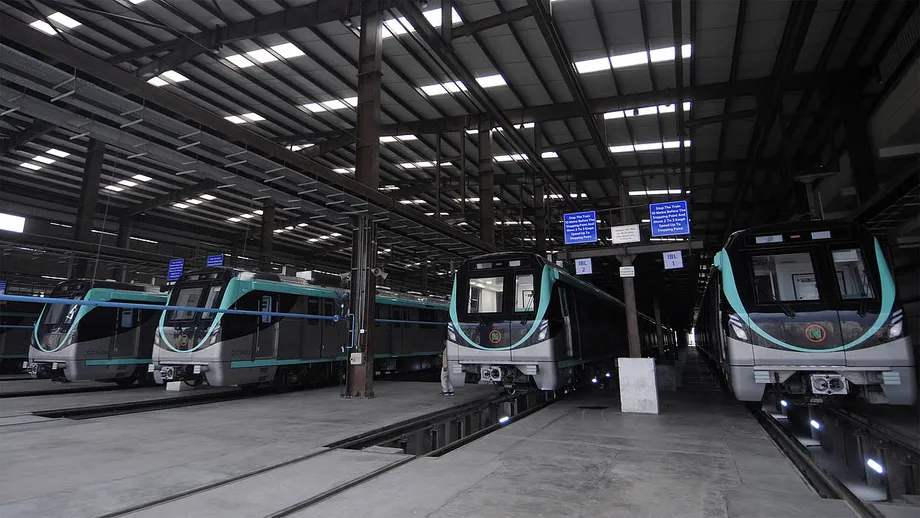
For commuters, the Rs 2,390 crore metro extension will connect Noida Sector 51 with Greater Noida Sector 4 through five elevated stations. A planned interchange at Sector 61 will connect the Aqua Line with Delhi Metro's Blue Line, improving access between Greater Noida West and the wider capital region.
The Cabinet Committee on Economic Affairs also approved Rs 3,230 crore to turn Delhi's historic North and South Block buildings into the Yuge Yugeen Bharat Museum. Its first gallery is expected to open in the latter part of 2027.
Prime Minister Narendra Modi chaired the meeting, and Information and Broadcasting Minister Ashwini Vaishnaw announced the decisions. Two further approvals provide a combined Rs 9,111 crore in credit guarantee funds for micro enterprises and for women and entrepreneurs from Scheduled Castes and Scheduled Tribes.
The package combines spending over different periods: support for one agricultural season, construction projects lasting several years and funds that protect lenders against eligible loan defaults. Fertiliser support accounts for about 81% of the stated total.
Where will the new Aqua Line stations be?
The approved corridor will run from Noida Sector 51 to Greater Noida Sector 4, serving a part of the region where residents face congestion around Parthala Chowk, Gaur Chowk and Ek Murti Circle. Construction is expected to take four years.
The five proposed elevated stations are:
- Noida Sector 61, with an interchange to the Blue Line.
- Noida Sector 70.
- Noida Sector 122.
- Noida Sector 123.
- Greater Noida Sector 4.
Sector 61 is especially important for passengers continuing towards Delhi. Travellers currently changing between the Aqua Line's Sector 51 station and the Blue Line's Sector 52 station must cover a gap of about 400 metres. The proposed interchange is intended to allow transfers between platforms within the station arrangement.
Noida and Greater Noida will have a combined active metro network of 71.878 km when the corridor opens, according to the government. The announcement gave a construction duration, but no specific opening date, start date, fares or service timetable.
Modi described the expected benefits in a November 11 post announcing the approval:
Easier access to offices, schools, hospitals and commercial hubs. Less congestion. Shorter commutes.
Which neighbourhoods and workplaces could benefit?
Gaur City 1 and 2 in Greater Noida Sector 4 and Cleo County in Noida Sector 122 are among the residential areas expected to gain better access to public transport. For residents travelling through busy road junctions, the line would offer another way to reach work, school and medical appointments.
The corridor is also intended to improve access to Gaur City Mall, H&S Mall, Blue Sapphire Mall and Golden I in Greater Noida Sector 4, along with IKEA in Noida Sector 51 and Anthurium in Sector 73. Employees at Tech Mahindra and TCL Tech offices in Sector 60 and the Oil Industry Development Board in Sector 73 are among the potential beneficiaries.
Delhi Public School in Sector 122, Kailash Hospital, Rama Hospital and Cloud9 Hospital are also identified as destinations expected to become easier to reach. Vaishnaw said the extension would serve IT companies and global capability centres, offices where multinational businesses carry out functions such as technology development and business operations.
The Sector 61 connection would improve access to Delhi's wider transport network, including onward journeys towards airports, railway stations and bus terminals. The government expects a shift from road journeys to metro travel to reduce congestion and emissions, while supporting businesses around the new stations.
Fertiliser support rises by about 64%
The Ministry of Chemicals and Fertilisers estimates that Rs 62,370.02 crore will be needed for the Nutrient Based Subsidy (NBS) scheme during the rabi season from October 1, 2026, to March 31, 2027. Rabi crops are grown during the winter season and include wheat, pulses and oilseeds.
The new requirement is Rs 24,417.73 crore above the Rs 37,952.29 crore allocated for rabi 2025-26, an increase of approximately 64.3%. Vaishnaw attributed rising fertiliser prices to the West Asia crisis and the Russia-Ukraine war, saying the government would absorb additional costs to protect farmers.
The scheme pays manufacturers and importers a subsidy linked to the nutrients in their products. It covers 28 grades of phosphatic and potassic fertilisers, including DAP and NPKS products. NPKS refers to nitrogen, phosphorus, potassium and sulphur, nutrients that help crops grow.
The approved subsidy rates are Rs 94.21 per kg for nitrogen, Rs 66.11 for phosphorus, Rs 2.38 for potash and Rs 10.42 for sulphur. These are rates used to calculate government support. Farmers buy the resulting fertiliser products at retail prices.
The government has retained special support, above the NBS subsidy, to keep DAP at Rs 1,350 for a 50 kg bag. Domestic manufacturers of fertilisers based on sulphur will also receive support equal to 20% of actual procurement cost, subject to stated floor prices of $800 per tonne for sulphur and $266.67 per tonne for sulphuric acid.
Higher stocks meet a larger seasonal requirement
India held 23.52 million tonnes of fertiliser on November 10, compared with 17.35 million tonnes a year earlier, according to government figures. The increase of 6.17 million tonnes amounts to roughly 35.6%.
Urea stocks rose to 10.31 million tonnes from 7.21 million tonnes. DAP stocks increased to 2.86 million tonnes from 2.48 million tonnes, while NPK stocks reached 6.08 million tonnes against 4.24 million tonnes a year earlier.
Vaishnaw put the rabi season's fertiliser requirement at 35 million tonnes. The stock figure describes supplies held on a particular date; production and imports during the season will also contribute to meeting demand.
The larger subsidy requirement creates a budget challenge. The financial year 2026-27 NBS allocation was Rs 54,000 crore, of which Rs 33,664 crore had been spent by the end of September. That left Rs 20,336 crore, about Rs 42,034 crore below the newly approved seasonal estimate, potentially requiring additional budget support.
S. Sankarasubramanian, chairman of the Fertiliser Association of India, welcomed the revised rates and support measures:
It will help ensure adequate availability of P&K fertilizers at affordable prices, promote balanced plant nutrition and provide an important impetus to domestic production.
Rs 5,000 crore fund to support Mudra lending
The Credit Guarantee Fund for Micro Units will continue until March 31, 2031, with a Rs 5,000 crore corpus. The government expects it to support Rs 12.6 lakh crore in lending under the Pradhan Mantri Mudra Yojana over five years.
A credit guarantee gives lenders protection against eligible losses when a borrower fails to repay. Through the National Credit Guarantee Trustee Company, the fund supports lending to small businesses that may lack assets to pledge as collateral. Borrowers remain responsible for repaying their loans.
The guarantees cover eligible Mudra loans of up to Rs 20 lakh, specified overdrafts of up to Rs 10,000 under Pradhan Mantri Jan Dhan Yojana accounts and eligible loans to self-help groups. For self-help groups, the specified portfolio range is Rs 10 lakh to Rs 20 lakh.
The annual guarantee fee for eligible Mudra loans falls from 1% to 0.75%, a reduction of one quarter. Self-help group fees remain at 0.25% in the first year and 0.50% in later years. Guarantee coverage will reflect amounts disbursed for working capital and outstanding balances for term loans, linking protection to lenders' actual exposure.
By September 2026, lending institutions had sanctioned more than 60.36 crore Mudra loans worth Rs 43.34 lakh crore since the programme began, according to the government. Those figures count loan sanctions, and individual borrowers can receive loans at different times.
Stand-Up India targets another 250,000 entrepreneurs
The Cabinet approved a Rs 4,111 crore credit guarantee corpus under Stand-Up India, continuing support until March 31, 2031. The target is to provide financial assistance to an additional 2.5 lakh, or 250,000, entrepreneurs among women and members of Scheduled Castes and Scheduled Tribes.
Stand-Up India has facilitated loans to more than 2.75 lakh entrepreneurs since its launch in April 2016. The new target would add assistance on a scale close to the number reached during the programme's first decade.
Eligible borrowers can seek loans above Rs 10 lakh and up to Rs 1 crore to establish new enterprises in manufacturing, services, trading and activities allied to agriculture. Such businesses are described as greenfield enterprises because they are being set up for the first time.
Loans can cover up to 85% of project cost and may combine a term loan with working capital. A term loan generally finances spending such as machinery or premises, while working capital pays for everyday needs such as supplies and wages.
The scheme provides guarantee coverage for 85% of the loan amount, with a standard guarantee fee of 0.50%. Its guarantee fund and the Mudra guarantee fund together total Rs 9,111 crore, supporting lending through banks and other eligible institutions.
North and South Block will become a public museum
The Ministry of Culture will develop the Yuge Yugeen Bharat Museum by adapting North and South Block for public use while preserving their architectural character and heritage significance. The Rs 3,230 crore project has a proposed built-up area of approximately 178,509 square metres.
The government describes its ambition as creating the world's largest museum display area. A smaller museum area figure of 100,000 square metres has also been cited, without a clear explanation of which spaces that measurement includes.
The project will combine thematic galleries, exhibition spaces, collection storage, conservation facilities and visitor amenities. Landscaping, building management systems and immersive technologies are also included. Adaptive reuse means giving existing buildings a new purpose while keeping their important historic features.
About 1.8 million objects have been identified for possible display from the National Museum, other Culture Ministry museums, 52 Archaeological Survey of India site museums, state museums and private collections. Collection and content analysis is under way to decide how objects will be selected and presented.
The galleries will cover tangible heritage, such as artefacts and buildings, and intangible heritage, such as languages, traditions and knowledge. Proposed themes include architecture and cityscapes, mathematics and astronomy, languages and scripts, faith and spirituality, and India's connections through trade and ideas.
The museum is designed to handle approximately one crore, or 10 million, visitors annually, with a daily capacity cited at about 30,000. Expected work opportunities include conservation, research, exhibition design, crafts, technology and tourism. Planned revenue sources include tickets, guided tours, food services, events and retail.
The next milestones run from 2027 to 2031
The museum will open in stages rather than all at once. Its first gallery, themed Adornment, is expected to welcome visitors in North Block in the latter part of 2027.
Vaishnaw also described an expected completion period of three years, while the detailed implementation schedule spans five financial years, from 2026-27 to 2030-31. The phased schedule provides the longer framework for adding galleries and facilities.
The key dates show how the approvals connect earlier planning with the next delivery targets:
- May 18, 2023: Modi announced the establishment of the Yuge Yugeen Bharat Museum.
- July 27, 2026: The Public Investment Board appraised the museum proposal; the Culture Ministry accepted its recommendations.
- October 1, 2026: The approved rabi fertiliser subsidy period began.
- November 11, 2026: The Cabinet announced the five approvals.
- March 31, 2027: The fertiliser subsidy period ends.
- Latter part of 2027: The museum's first gallery is expected to open.
- March 31, 2031: The extended credit guarantee programmes reach their approved end date.
Farmers are the intended beneficiaries of the most immediate measure, through fertiliser prices during the current season. Entrepreneurs will seek loans over the extended programme period, while commuters and museum visitors will gain access as construction and phased openings proceed.
Key Points
- The five approvals involve an estimated Rs 77,101 crore across fertiliser support, transport, culture and credit guarantees.
- The Rs 2,390 crore Aqua Line extension will add five elevated stations over 8.449 km, with a Blue Line interchange at Sector 61.
- Rabi fertiliser support rises about 64% to Rs 62,370.02 crore; DAP remains priced at Rs 1,350 per 50 kg bag.
- A Rs 5,000 crore Mudra guarantee fund is expected to support Rs 12.6 lakh crore in loans over five years.
- Stand-Up India's Rs 4,111 crore guarantee corpus targets assistance for another 250,000 entrepreneurs.
- The Rs 3,230 crore Yuge Yugeen Bharat Museum is planned in North and South Block, with its first gallery expected in late 2027.