Rs 2,000 payments reach farmers as Gujarat hosts national launch
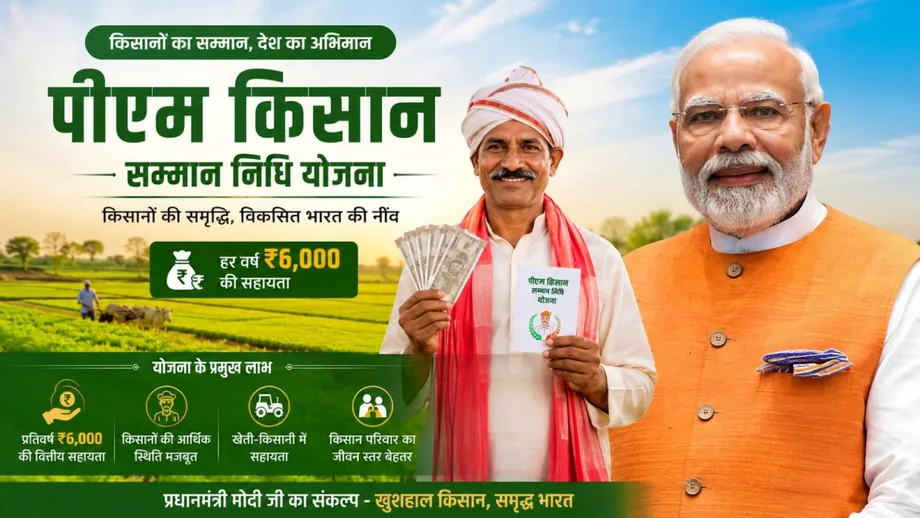
Prime Minister Narendra Modi released more than Rs 18,690 crore to over 9.34 crore eligible farmer families on October 30, 2026, from Banaskantha in Gujarat, bringing the government's stated cumulative payments under PM-KISAN to more than Rs 4.64 lakh crore across 24 instalments.
Contents
- Rs 2,000 payments reach farmers as Gujarat hosts national launch
- What the payment means for a farming family
- How the latest release fits the programme's timeline
- Where the state payments went
- Bihar connects income support with flood relief
- Madhya Pradesh adds its own annual assistance
- How money travels from registration to a bank account
- What farmers can do when a payment is missing
- Identity checks, complaints and language support
- Storage and horticulture target the journey after harvest
- Other farm programmes accompany the cash transfer
- Key Points
The transfer gives each eligible family Rs 2,000, one of three payments making up its annual Rs 6,000 entitlement under the Pradhan Mantri Kisan Samman Nidhi scheme. Direct Benefit Transfer, or DBT, sends the assistance into beneficiaries' bank accounts rather than distributing it through an intermediary.
Uttar Pradesh received Rs 4,482.19 crore for more than 2.24 crore farmers, according to its state government. Bihar received Rs 1,465.84 crore for 73.29 lakh beneficiaries, while Rajasthan received more than Rs 1,335 crore for over 66.59 lakh farmers. Together, those three states accounted for about 39% of the national payment, using the announced amounts.
The Banaskantha programme also paired immediate household assistance with investment in farming facilities. Plans announced for the event included dedicating 521 units developed under the Agriculture Infrastructure Fund and inaugurating 12 horticulture clusters covering about 1.46 lakh hectares.
The package addresses different stages of a farmer's work: money for current expenses, facilities to store and process harvested crops, and organised production and marketing for crops expected to earn more. Its practical value will depend on both successful bank transfers and farmers' access to the new facilities.
What the payment means for a farming family
PM-KISAN provides income support to eligible families holding cultivable land. The Rs 6,000 annual benefit belongs to the eligible family, with payment made to one member. Farmers can use it for seeds, fertiliser, irrigation, equipment expenses or household needs.
A Rs 2,000 instalment is one third of the annual entitlement. Across a full year, Rs 6,000 works out to Rs 500 a month, although families receive the money in three instalments rather than monthly payments. That helps explain the scheme's role as a contribution towards expenses alongside other sources of farm and household income.
The Ministry of Agriculture and Farmers Welfare put cumulative disbursement after the latest transfer above Rs 4.64 lakh crore. Before the release, the government had described payments through the first 23 instalments as exceeding Rs 4.47 lakh crore.
How the latest release fits the programme's timeline
PM-KISAN began on February 24, 2019. The October release follows the 23rd instalment in June and a Cabinet decision in July to continue the programme through the financial year ending in March 2031.
- February 24, 2019: PM-KISAN launched.
- 2020: The mobile application launched, extending registration and payment services to mobile users.
- 2023: Face authentication became available in the application; Kisan-eMitra launched in September.
- June 20, 2026: The 23rd instalment released from Tarakeswar in Hooghly, West Bengal, with about Rs 18,880 crore for more than 9.44 crore farmers.
- July 2026: The Union Cabinet approved continuation from 2026-27 to 2030-31, with an outlay of Rs 3.15 lakh crore.
- October 30, 2026: The 24th instalment released from Banaskantha, with more than Rs 18,690 crore for over 9.34 crore farmers.
The latest headline figures are about Rs 190 crore and 10 lakh beneficiaries below those announced for June. Beneficiary records undergo verification and updating before payments. The annual entitlement remains Rs 6,000 per eligible family.
The Union Budget for 2026-27 allocated Rs 60,000 crore to PM-KISAN. The latest payment is equivalent to about 31% of that allocation. The Rs 3.15 lakh crore approved for five financial years provides the broader funding framework for continued assistance.
Where the state payments went
Uttar Pradesh's Rs 4,482.19 crore payment represented about 24% of the national total. The state government said its farmers had received Rs 1,07,943.95 crore since the scheme began.
Chief Minister Yogi Adityanath thanked Modi in a post on X and connected the payment to his government's stated efforts to raise farm income and lower cultivation costs. He described the transfer as assistance arriving before Diwali.
Rajasthan Chief Minister Bhajan Lal Sharma joined the programme by video conference from his official residence. He said the state's farmers had received more than Rs 29,099 crore through the first 23 instalments, before the latest transfer exceeding Rs 1,335 crore.
Uttarakhand received Rs 161.96 crore for more than 8.08 lakh farmers. At the Survey Auditorium in Dehradun, Chief Minister Pushkar Singh Dhami said participation had grown from about four lakh beneficiaries when the first instalment was released in 2019 to more than eight lakh, roughly doubling the state's reach.
Bihar connects income support with flood relief
Bihar held its state PM-KISAN Utsav Diwas programme at Gyan Bhawan in Patna, attended by Chief Minister Samrat Choudhary. The state's 73.29 lakh beneficiaries received Rs 1,465.84 crore, following more than Rs 33,000 crore distributed through the first 23 instalments.
Choudhary said flood affected farmers had also been given assistance of Rs 7,000 each and that Rs 270 crore had been provided through agricultural input subsidies. He directed officials to assess crop damage from unseasonal rain during the preceding two days and identify farmers for compensation.
Bihar's announced measures also included managing silt in tal and diara areas, low lying agricultural land and riverine tracts where sediment can disrupt cultivation. Choudhary said arrangements to remove silt were being introduced and that district authorities had been instructed to address problems caused by sand and sediment.
Agriculture Minister Vijay Kumar Sinha discussed using Farmer IDs to connect cultivators with seeds, fertiliser and subsidies, and extending government support to sharecroppers. At Piprakothi in Motihari, former Union agriculture minister and MP Radha Mohan Singh attended a local screening and said more than four lakh farmers in the district were receiving the instalment.
Madhya Pradesh adds its own annual assistance
Madhya Pradesh Chief Minister Mohan Yadav said farmers eligible for both PM-KISAN and the state's Mukhyamantri Kisan Kalyan Yojana receive Rs 12,000 annually: Rs 6,000 from each programme. He addressed farmers and traders at the agricultural produce market in Ujjain.
Yadav said PM-KISAN benefits about 80 lakh farmers in Madhya Pradesh, including two lakh in Ujjain district. Union Agriculture and Farmers Welfare Minister Shivraj Singh Chouhan was scheduled to attend the release programme in Raisen.
Yadav also announced that a branch of the elevated route being built between Agar Naka and Hari Phatak would reach the Ujjain market. For farmers transporting crops, the proposed connection is intended to ease congestion and give tractors and other vehicles more direct access.
Jharkhand's release figures require clarification: about 19 lakh beneficiaries were described as receiving Rs 300 crore, while 19 lakh payments of Rs 2,000 would total about Rs 380 crore; officials had not explained the gap. Union Minister of State for Agriculture Ram Nath Thakur joined the programme from the ICAR National Institute of Secondary Agriculture campus in Ranchi.
How money travels from registration to a bank account
Farmers can register through the PM-KISAN portal, its mobile application or a Common Service Centre. They submit personal information, landholding details and bank account information. State governments and Union Territories identify eligible households and verify those records.
Aadhaar and bank details are then checked, while land records must be recorded and verified in the scheme's database. Aadhaar is the identity number used to authenticate beneficiaries. Electronic Know Your Customer verification, usually called e-KYC, confirms the recipient's identity.
The Public Financial Management System checks bank account information after state approval. Validated records lead to payment requests and fund transfer orders. The Department of Agriculture and Farmers Welfare sanctions the funds, and sponsor banks and the National Payments Corporation of India process the transfers into beneficiaries' accounts.
Each stage has a practical purpose: establishing eligibility, confirming identity, checking the destination account and authorising public spending. A farmer's payment status can therefore depend on more than completing the initial application.
What farmers can do when a payment is missing
Incomplete e-KYC, an Aadhaar link missing from the receiving bank account, pending land verification, an incorrect account number or IFSC banking code, and an account not enabled for DBT can delay a transfer.
Farmers can check their records through the portal's Know Your Status option. The process uses a registration number, the displayed captcha security code and verification through a one time password. The screen shows payment information and the status of required checks.
- Check whether e-KYC, land verification and Aadhaar bank linking are complete.
- Review the payment entry for the latest instalment and any pending requirements.
- Use Beneficiary List to select the state, district, subdistrict, block and village, then request the list.
- For corrections or assistance, contact the local agriculture office, a Common Service Centre, the portal helpdesk or helpline 155261.
Farmers can also find officials through the portal's searchable contact directory and register grievances through the Centralized Public Grievance Redressal and Monitoring System, or CPGRAMS. Once money has reached the account, it can be withdrawn at a bank or ATM, or spent through UPI. No separate PM-KISAN withdrawal application is required.
Identity checks, complaints and language support
Authorities had recovered Rs 416.75 crore from ineligible beneficiaries by December 2025, according to government figures. Recovery proceedings cover people receiving benefits despite falling within excluded categories, including income tax payers, government employees, public sector personnel and holders of constitutional posts.
The PM-KISAN portal recorded 24,605 grievances during 2024-25. Monitoring takes place at national, state and district levels, with the Cabinet Secretary chairing the national review mechanism. Public beneficiary lists at village level give households a way to check inclusion and seek corrections.
Farmers can complete e-KYC using a one time password, biometric verification or face authentication. The face option, added to the application in 2023, allows identity verification without a fingerprint scan or password sent to a phone.
Kisan-eMitra, introduced in September 2023 with technical support from the EkStep Foundation and BHASHINI, answers questions about eligibility, registration and payments through voice and text. It operates around the clock in 11 languages: Hindi, English, Tamil, Bengali, Odia, Malayalam, Gujarati, Punjabi, Telugu, Marathi and Kannada.
Storage and horticulture target the journey after harvest
The 521 Agriculture Infrastructure Fund units announced for dedication form part of a wider programme supporting warehouses, cold storage, cold chains and primary processing facilities. The government put investment under the fund at about Rs 1.75 lakh crore across more than 2.28 lakh projects.
Storage and processing address costs that arise after a crop has been grown. Cold storage can keep perishable produce usable for longer, while processing can prepare crops for buyers and different markets. The government's stated goals include reducing losses after harvest and improving farmers' access to better prices.
The 12 horticulture clusters are expected to benefit more than 1.3 lakh farmers across about 1.46 lakh hectares. Two clusters in northern Gujarat will focus on potatoes. A cluster brings production, processing and marketing activities together around a crop and location.
Uttarakhand Agriculture Minister Ganesh Joshi described a related diversification effort involving lavender and dandelion in mountain areas. Dhami also said the state's supplementary budget provided Rs 1,100 crore for paddy and wheat procurement, combining support for established crops with efforts to develop additional income sources.
Other farm programmes accompany the cash transfer
Modi used the Banaskantha event to describe a broader agricultural programme. He said the agriculture budget had grown more than fivefold since 2013-14 and that farmers had received or saved about Rs 50 lakh crore through government initiatives over 12 years.
His figures included Rs 24 lakh crore transferred to wheat and paddy farmers through minimum support price procurement and around Rs 2 lakh crore paid in crop insurance compensation. He also cited about Rs 16 lakh crore spent to maintain affordable food supplies, 12 lakh solar pumps under PM-KUSUM, savings exceeding 80 crore litres of diesel, more than 26 crore Soil Health Cards and about 150 crore livestock vaccine doses.
Modi also described efforts to develop seeds suited to changing conditions:
Farmers have also been provided access to 3,000 new seed varieties developed to withstand changing climatic conditions.
The wider policy package includes crop insurance, Kisan Credit Cards for agricultural borrowing, irrigation support under Per Drop More Crop, missions to increase domestic edible oil and pulse production, and natural farming clusters. In Ranchi, agriculture department joint secretary Franklin L Khobung said about 25,000 hectares and 11,000 farmers in Jharkhand were covered by the traditional agriculture development scheme.
The Gujarat programme also included development projects worth more than Rs 14,000 crore, a research centre described as the country's first for the indigenous Kankrej cattle breed, and two train services, including the Ahmedabad Sabarmati to Varanasi Express.
Key Points
- Modi released more than Rs 18,690 crore to over 9.34 crore farmer families on October 30, 2026.
- PM-KISAN pays eligible families Rs 6,000 annually in three instalments of Rs 2,000.
- The government put cumulative transfers across 24 instalments above Rs 4.64 lakh crore.
- The Cabinet approved continuation through 2030-31 with an outlay of Rs 3.15 lakh crore.
- The accompanying agricultural package included 521 infrastructure units and 12 horticulture clusters.
- Farmers awaiting payment can check their status, identity verification, land records and banking details through the scheme's services.