Higher profit meets tougher market expectations
HSBC reported third quarter profit before tax of $9.632 billion on October 27, 2026, up 32% from a year earlier, and announced plans to buy back up to $1 billion of shares. Investors nevertheless sold the stock as revenue missed expectations, the bank left its interest income forecast unchanged and a key capital measure slipped below its medium term target range.
Contents
- Higher profit meets tougher market expectations
- What drove the 32% profit increase?
- Why the interest income outlook mattered
- A buyback with less capital headroom
- New capital rules could provide room in 2027
- Asian wealth inflows strengthen another source of income
- Lower credit losses, but costs still need managing
- Asset sales reshape the group
- Why shareholders remained cautious
- Key Points
The London headquartered bank declared a third interim dividend of $0.10 a share. Its planned repurchase, which follows a completed $1 billion buyback announced with the interim results, is expected to finish before HSBC publishes its results for the full year of 2026.
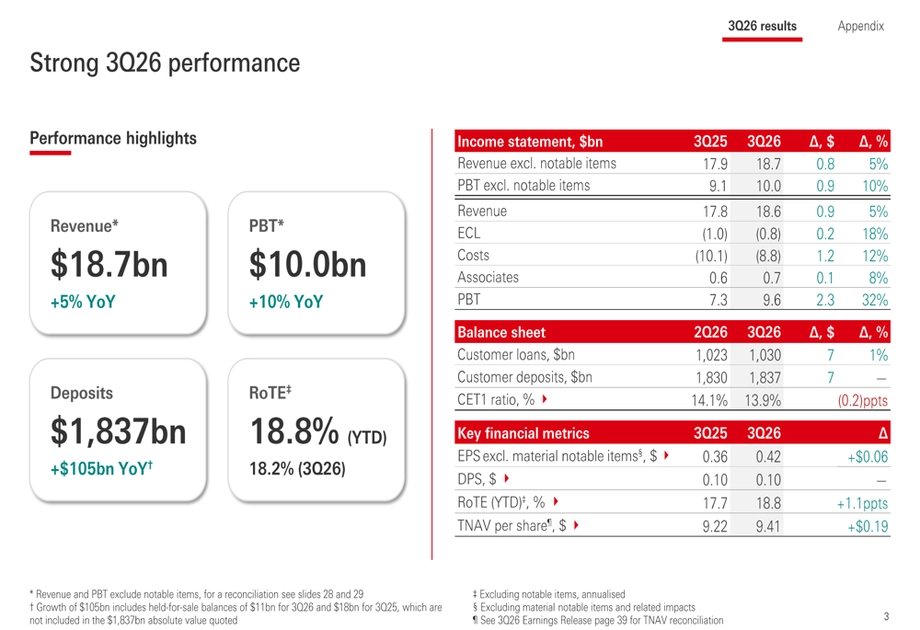
Revenue rose 5% to $18.62 billion, against an analyst consensus of $18.93 billion compiled by the bank. Profit before tax was slightly below the $9.69 billion consensus. The revenue shortfall was about $310 million, or roughly 1.6%, while the profit gap was about $58 million, or 0.6%.
HSBC's earnings meeting announcement, released through the London Stock Exchange on October 27 under RNS Number 6044A, named Group Chief Financial Officer Pam Kaur as the speaker for its investor and analyst briefing. The notice put group assets at $3.445 trillion on September 30, with operations in 56 countries and territories.
The official HSBC Holdings plc Earnings Release 3Q26 includes the financial tables headed "Reported and constant currency results". In those tables, reported "Profit before tax" was $9,632 million for the quarter and $29,154 million for the first nine months, while reported "Revenue" was $18,620 million and $56,362 million respectively.
The central issue for shareholders was the gap between improving annual results and expectations for the next stage of growth. Earnings benefited from the absence of a large legal charge, while the bank faced tighter interest margins and had less capital headroom than at the end of June.
What drove the 32% profit increase?
HSBC's profit comparison benefited heavily from a $1.4 billion legal provision booked in the third quarter of 2025 that did not recur this year. A provision is money set aside for an expected cost. When a large charge disappears from the comparison, annual profit can rise sharply even if the underlying business grows more slowly.
Operating expenses fell 12% to $8.8 billion, largely because that legal provision was absent. Excluding notable items, expenses increased as inflation and spending on technology pushed costs higher.
HSBC's measure of profit before tax excluding notable items and using constant exchange rates rose by about $900 million to $10 billion. Constant currency comparisons hold exchange rates steady so that changes in the value of currencies do not obscure changes in business performance.
The quarterly comparison was softer. Reported profit before tax fell 5.1% from the second quarter, while profit attributable to ordinary shareholders reached $7.09 billion, up 45.5% from a year earlier but down about 7.8% from the preceding quarter. Annual growth and a quarterly slowdown therefore appeared in the same results.
Why the interest income outlook mattered
HSBC kept its forecast for banking net interest income in 2026 at no less than $46 billion. Investors had expected management to raise that forecast for a third time, making the unchanged guidance a source of disappointment.
Banking net interest income rose 5% to $11.66 billion in the quarter. The group's separately reported net interest income measure was $9.3 billion, up 6%. Both describe earnings connected to interest, but they use different reporting definitions and should be followed consistently when comparing periods.
Net interest income is broadly the difference between interest earned on loans and other assets and interest paid on deposits and other funding. Deposit growth helped HSBC, as did reinvesting its structural hedge at higher yields. That hedge uses financial contracts to make interest earnings more stable over time.
The net interest margin, which measures interest earnings relative to interest earning assets, was 1.57%. It was unchanged from a year earlier but down five basis points from the second quarter. A basis point is one hundredth of a percentage point, so the quarterly decline was 0.05 percentage points.
Hong Kong's competition for deposits added pressure. Customers moving money from current accounts into fixed term deposits can earn more interest, but those deposits cost the bank more. HSBC was attracting funds while also paying more to retain some of them.
A buyback with less capital headroom
HSBC's common equity tier 1 capital ratio, known as CET1, fell to 13.9% at the end of September from 14.1% at the end of June. The ratio measures a bank's highest quality capital against assets adjusted for risk. A riskier loan requires more capital support than a safer asset.
The bank attributed the decline to higher risk weighted assets, lower fair values for debt instruments and the buyback announced at its interim results. Its medium term CET1 target remained 14% to 14.5%, leaving September's ratio 0.1 percentage points below the bottom of that range.
Kaur said a $1 billion repurchase was feasible with CET1 at around 14%, taking account of expected capital generation and the bank's priorities for using capital. A buyback returns money by purchasing shares, reducing the number outstanding. A dividend pays shareholders directly.
The proposed amount exceeded the $500 million expected by some brokerages. It was nevertheless below the $2 billion to $3 billion repurchases announced each quarter during 2024 and the first half of 2025. The new programme is between one third and one half of those earlier amounts, explaining why it could beat some immediate forecasts yet still disappoint investors accustomed to larger returns.
New capital rules could provide room in 2027
HSBC estimated that the final Basel 3.1 standards could lift its CET1 ratio by 40 to 50 basis points from January 1, 2027, based on its latest modelling. Basel standards set international principles for how banks calculate and hold capital against financial risks.
Kaur described the estimated effect during the October 27, 2026, earnings call, a recorded analyst and investor presentation scheduled for 07:45am GMT:
Today, we are giving you our estimated Basel 3.1 impact of 40 to 50 basis points, which will apply from 1st January 2027.
A gain of that size is equivalent to 0.4 to 0.5 percentage points, compared with the 0.2 percentage point decline in HSBC's ratio during the third quarter. The estimate remained under assessment, and the actual ratio in January will also reflect changes in the business, profits and capital distributions before then.
HSBC maintained its dividend payout target of 50% on its target basis. Management must balance those payments and buybacks with capital needed for lending, investment and protection against losses.
Asian wealth inflows strengthen another source of income
HSBC attracted $38 billion of net new money into its Asian wealth business during the third quarter, taking inflows for the first nine months above $95 billion. Net new money measures funds clients bring in after withdrawals, rather than gains caused by rising investment prices.
Kaur gave the figures during the earnings call:
Wealth net new money at $38 billion in Asia this quarter brings our year-to-date flow to more than $95 billion.
The bank also recorded higher fee income in its corporate and institutional banking and wealth businesses. Fees from investment products and financial services provide another source of revenue alongside interest income, making the Asian inflows relevant at a time when deposit competition is squeezing margins.
Kaur said all four businesses grew deposits and each delivered an annualised return on tangible equity above 17%, excluding notable items. Return on tangible equity compares profit with shareholder capital after removing intangible assets such as goodwill. It gives investors a way to judge how much profit the bank generates from that capital.
HSBC's annualised return on average tangible equity for the quarter was 17.7%, compared with 12.3% a year earlier. Its return for the first nine months was 18.8%. The group retained its target of at least 17% for 2026 through 2028, excluding notable items.
Lower credit losses, but costs still need managing
HSBC booked $830 million of expected credit losses in the quarter, down 17% from a year earlier. These charges estimate money the bank may lose when borrowers cannot repay their debts.
The decline included $100 million less in provisions for stage 3 Hong Kong commercial property exposures, alongside lower provisions in the United Kingdom and Mexico. Stage 3 refers to loans already showing evidence of credit impairment. The reduced charges helped earnings while leaving the bank with property related risks to manage.
HSBC maintained its 2026 expected credit loss guidance at about 45 basis points of average gross loans. It also kept its target for operating expense growth at approximately 1% on its target basis.
Kaur linked cost control to savings from simplifying the organisation. Technology spending and inflation continued to increase underlying expenses, while stronger business performance could bring additional performance related pay and modestly higher cost growth. Potential cuts to the UK wealth management workforce linked to greater use of artificial intelligence were also under consideration, with no confirmed number of roles or timetable.
Asset sales reshape the group
HSBC completed the sale of its Uruguay business and announced plans to sell its Singapore life insurance business, its Australian home and personal loan portfolio and its Egyptian retail banking business. It also began a strategic review of retail banking and local small and medium sized business banking in Turkey.
The transactions span several different activities rather than a single geographic withdrawal. They change where HSBC deploys capital and management attention while the group continues investing in growth areas, including Asian wealth management.
Group Chief Executive Georges Elhedery said the bank would strengthen its business by simplifying the organisation, investing for growth and delivering shareholder returns. HSBC also retained its ambition for revenue to grow annually through 2028, with 5% growth in 2028 compared with 2027, excluding notable items and using constant exchange rates.
The sequence of results, market trading and upcoming capital changes is:
- September 30, 2026: HSBC ended the quarter with a 13.9% CET1 ratio and assets of $3.445 trillion.
- October 27, 2026: The bank released its third quarter results, declared a $0.10 dividend and announced a buyback of up to $1 billion.
- November 2, 2026: Hong Kong shares traded at HK$132.40, down 2.43% during the session.
- January 1, 2027: The date from which HSBC expects the estimated Basel 3.1 capital benefit to apply.
- Before the full year 2026 results: HSBC expects to complete the new repurchase programme. No specific results publication date was given.
Why shareholders remained cautious
HSBC's London shares fell 6.5% in early European trading after the results. Hong Kong shares were down 2.95% at an earlier trading snapshot, with the decline deepening during the results session. Selling pressure continued into November 2.
The reaction reflected several pressures arriving together: revenue below consensus, unchanged banking interest income guidance, a narrower quarterly interest margin and a capital ratio below the bank's target range. Goldman Sachs subsequently lowered its earnings forecasts and cut its Hong Kong share price target from HK$192 to HK$188, citing a more cautious interest income outlook.
HSBC therefore entered the final quarter with strong annual profit growth and substantial Asian wealth inflows, but with investors seeking faster revenue growth and greater capacity for capital returns. The next tests are whether it delivers at least $46 billion of banking net interest income, keeps cost growth near its target and rebuilds capital while completing the buyback.
Key Points
- Third quarter profit before tax rose 32% to $9.632 billion but fell 5.1% from the preceding quarter.
- Revenue reached $18.62 billion, below the $18.93 billion analyst consensus.
- HSBC declared a $0.10 dividend and plans to repurchase up to $1 billion of shares.
- The CET1 capital ratio fell to 13.9%, below the medium term target range of 14% to 14.5%.
- Basel 3.1 changes could add 40 to 50 basis points to the capital ratio from January 2027.
- Asian wealth net new money reached $38 billion for the quarter and more than $95 billion for the first nine months.
- HSBC retained its 2026 banking net interest income forecast of at least $46 billion and its profitability targets for 2026 through 2028.