Cracked screens bring a costly launch problem into focus
Apple has instructed stores and authorized service providers to inspect iPhone Duo devices with cracked inner displays and repair or replace them under standard procedures, after buyers in several countries reported failures within hours or days of purchase. The phone launched on October 23, 2026, starting at $1,999 in the United States.
Contents
- Cracked screens bring a costly launch problem into focus
- What Apple has promised affected owners
- The warning signs owners describe
- How the complaints and response developed
- Why the hinge is under examination
- A supplier denial and disputed factory claims
- Free replacements can still take days
- Why classification matters for a $999 repair
- Demand puts pressure on replacement stock
- What owners can do now
- Key Points
Apple acknowledged the problem on October 26 and said only a small number of devices were affected. Complaints have since included two customers in South Korea who received free replacements after service delays. One, Incheon manufacturing worker Lee Jeong-ho, received his phone on October 29 and reported that its screen failed on November 1.
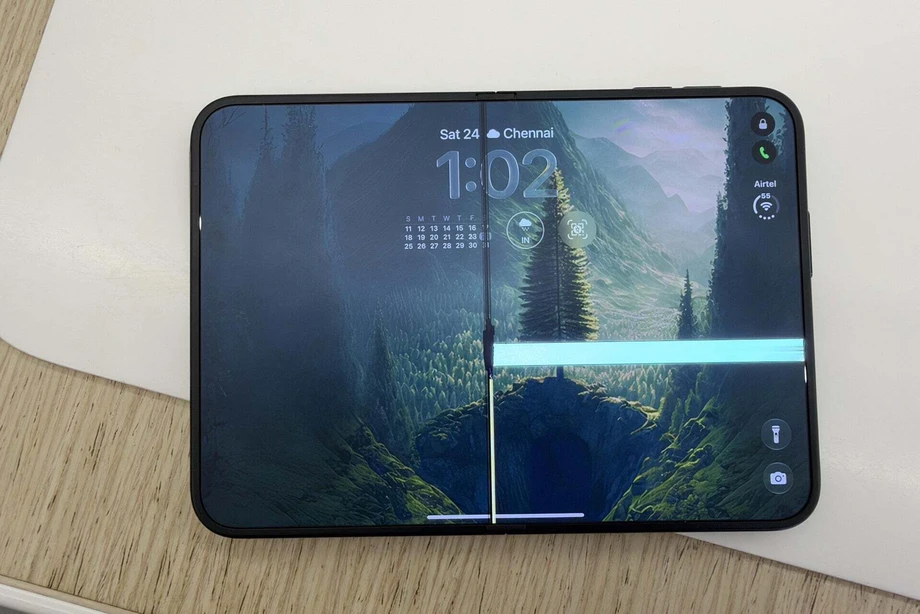
Owners describe a recurring sequence: the hinge suddenly becomes harder to move, a crack or crunch is heard, and bright lines or visible damage appear near the central fold. Several say they could feel a bump beneath the display. Repair specialist iFixit has proposed a possible failure involving a support component inside the hinge.
Apple has not identified the technical cause, disclosed a failure rate or named affected production batches. The company says most devices are unaffected and that failures in susceptible units appear quickly. There is no recall or separate public repair program, and Apple has given no date for publishing its investigation findings.
What Apple has promised affected owners
Apple directed customers with display problems to AppleCare, its support service. An AppleCare+ protection plan is not required for replacement of a device affected by the defect.
Apple described its response in a statement:
If users experience issues with their iPhone Duo display, they should contact AppleCare for a replacement.
The company also said early customer feedback had been positive. Its account places the problem among failures appearing soon after use begins, rather than a fault it expects most owners to develop gradually.
Apple employees initially said stores and customer support staff had received no formal instructions. A subsequent internal memo told technicians at Apple Stores and Apple Authorized Service Providers to inspect affected phones and repair or replace them using normal service procedures.
For customers, the practical process still involves an assessment and access to a replacement or repair. Experiences range from immediate exchanges to repeated visits, approval delays and waits for stock.
The warning signs owners describe
Tom Battle, an Apple customer in San Diego, said the first warning was a change in how the phone opened. He described resistance followed by damage visible on the inner screen:
I went to unfold it and it felt stuck/harder/slower to open than usual. And when I opened it it had the lines on the screen.
Battle said he could feel a bump or loose piece beneath the display. Jainam Shah described a hinge that had felt normal until one opening suddenly required more effort. Shah said the phone had not been dropped, hit or subjected to unusual pressure.
Shah described what happened next:
I continued opening it, heard an audible crack and immediately noticed the bright vertical and horizontal lines across the inner display.
Apple Store employees replaced Shah's phone immediately and asked whether engineers could contact him. Venture capitalist Jonathan King reported another consequence: his inner display became unusable and registered touches when he was not touching it, although the smaller outer screen continued working.
More than six early customer complaints were independently checked against photographs or support records, with later reporting describing conversations with about a dozen owners. In Melbourne, moderators of a Reddit community reviewed additional photographs and Apple repair paperwork before marking a buyer's account as verified. That customer said the display broke within six hours of purchase.
How the complaints and response developed
The reported failures span the launch period and the following days. Several occurred during ordinary tasks, including restoring a backup, setting up apps, ordering food and opening the phone to watch a video.
- October 23: The iPhone Duo went on sale. A Melbourne buyer reported a cracked inner display within about six hours and received an immediate store replacement.
- October 26: Apple acknowledged an issue affecting a small number of inner displays and directed owners to AppleCare.
- October 27: A South Korean customer identified as Yoon reported a failure in Cheonan. Accounts also emerged alleging changes to factory inspection standards and materials.
- October 29: Yoon received a replacement. Lee Jeong-ho received his original phone in Incheon.
- November 1: Lee reported that his inner screen failed while he unfolded the phone to watch a video.
- November 2 and 3: Lee visited an authorized service center, waited for Apple's approval and collected his replacement the following day.
The response has advanced since the first screen crack complaints, when customers described different assessment procedures and Apple had not yet publicly addressed the specific failures. The later service memo gives technicians a common instruction, while individual cases show that approval and inventory can still slow an exchange.
Why the hinge is under examination
iFixit used CT scans, teardown footage and Apple patent filings to build a three dimensional model of the hinge. CT scanning reveals internal structures without requiring every part to be removed first.
The model points to a central support bar that may fail to lower far enough when the phone closes. A folding display curves inside the closed device. If a rigid support remains in its path, pressure can collect on a small part of the screen instead of spreading across a wider area.
iFixit's proposed mechanism fits the location of damage and customer descriptions of a bump beneath the display. A teardown by video creator CuriousHagi also found a hinge element thinner than neighboring components and heavy crush marks on a nearby part.
Jung Yong-cheol, a principal researcher at the Korea Institute of Industrial Technology who studies the reliability of folding displays, said concentrated pressure could damage a panel immediately or make it deteriorate through repeated folding. He described two possible patterns:
If it's a design problem, you'd expect failures to appear more broadly. But if they're concentrated in a particular production batch, the cause could be a faulty component or an assembly problem. Even then, those defects should have been caught during inspection.
Jung said investigators would need to examine multiple failed phones and compare their internal structures. That work would help distinguish a component problem from an assembly problem, such as parts being positioned incorrectly.
Testing has also produced different outcomes. One teardown recreated cracking through misuse, while other endurance testing showed hinges surviving thousands of folds. Separately, iFixit found that fine particles could reach the hinge and cause crunching despite the phone's IP68 resistance rating. Investigators therefore have several possible mechanisms to examine alongside the damaged customer devices.
A supplier denial and disputed factory claims
FineMtech, a Korean supplier of hinge components, has rejected claims that defects in its parts caused the reported failures. In a statement published on its website, the company said the customer problems were not caused by quality defects in the components it supplied.
FineMtech said assigning responsibility to a particular component required technical checks across the complete product and manufacturing process. It also said it would consider legal action over unsupported claims targeting its components.
An unnamed Foxconn employee involved in production separately alleged that Apple temporarily relaxed some component acceptance standards to increase launch supply. The employee also claimed that a batch of materials had been replaced after the failures emerged, while production schedules and stocking plans remained unchanged.
Those allegations have not been publicly confirmed by Apple. Samsung supplied the display panel and Foxconn handles final assembly, placing several companies within the manufacturing chain. Apple's engineering investigation and comparisons among failed devices will be central to identifying where the fault occurred.
Free replacements can still take days
Lee's experience in Incheon shows how an exchange can stall even when a replacement is physically available. He visited an authorized TUVA service center on November 2, where staff initially expected to replace his phone that day. Apple approval took about five hours, requiring him to return the next day.
Lee, a manufacturing worker aged 30, described the wait:
The replacement was right there in front of me. Even the staff thought I could get it that day.
Yoon's household encountered a different delay in Cheonan. Her husband, Jeong, said staff told them they had received no official instructions, despite Apple's acknowledgment of the issue. The phone was replaced on October 29, two days after the failure. The couple paid to replace their case and screen protector.
A customer using the name Centrino31A in Richmond, Virginia, said one store recognized a defect but had no Genius Bar appointments. A second store checked the device and found no accidental damage, according to the customer, but had no replacement inventory.
Other exchanges were faster. Justin Lokos received a replacement at Apple's Fifth Avenue store in New York after an Early Field Failure Analysis, a process for collecting information about faults appearing soon after a product launches. Vishnu Rajkumar obtained a replacement from an authorized reseller in Chennai and reported no problems during its first 24 hours. In Allen, Texas, Surya Mangi was ultimately offered a replacement by express delivery after initially facing the prospect of sending his phone away.
Why classification matters for a $999 repair
An inner display repair outside warranty coverage is listed at $999 in the United States. Compared with the $1,999 starting price, that is almost half the cost of the entire phone. A customer's route through service therefore depends heavily on whether Apple handles the failure as a product defect or as damage requiring a paid repair.
The listed inner screen service charge with AppleCare+ is $99. Cover layer repairs are listed separately at $49 without the plan and $19 with it. Those charges sit alongside Apple's promise to replace devices affected by the acknowledged defect without requiring AppleCare+.
The Melbourne buyer initially received an express replacement offer that required a payment card hold for the phone's full value, with no promised delivery date. Such a hold temporarily reserves money or available credit while the exchange is processed. The buyer instead obtained a replacement directly from a store.
iFixit awarded the Duo a provisional repairability score of five out of 10, its highest score for a folding smartphone. It praised access to some components and battery adhesive that releases when a small electrical current is applied, while describing the inner screen and hinge as difficult and expensive to repair.
Demand puts pressure on replacement stock
Apple's service problem is unfolding alongside strong demand and tight supply. Earlier higher production targets included a reported increase from 9.7 million to 14 million phones over the first 12 months, roughly 44%, while some buyers faced delivery estimates extending into January 2027.
South Korea reportedly received about 30,000 devices for the initial launch. Without a count of failed phones in that allocation, a local failure percentage cannot be calculated. The more immediate issue for customers is whether service centers have the right configuration ready for an exchange.
The Duo's 7.6 inch inner display is also the feature many buyers paid to use. Lokos said he opened his phone because ordering through Grubhub on the outer screen was awkward. Rajkumar was checking Outlook on the larger display when he felt unusual tightness. Their experiences connect the hardware complaints with the uneven app experience that accompanied launch.
Apple developed the device over more than a decade and promoted its durability, hinge engineering and display technology. For affected buyers, restoring confidence now involves concrete steps: a working replacement, consistent instructions at service centers and an explanation of the failure.
What owners can do now
Customers seeing cracks, bright lines, white patches or touch problems should contact AppleCare and describe when the symptoms began. In the United States and Canada, Apple support can be reached at 1-800-APL-CARE. Photographs and a record of any sudden resistance or noise can help document the sequence for technicians.
Owners who feel unusual resistance should stop rather than force the hinge and arrange an inspection. Booking a service appointment and checking replacement availability may reduce unnecessary travel. Customers offered a shipment should ask about delivery timing and any payment card hold before agreeing.
Apple engineers have been seeking affected devices for analysis, and store staff have asked some owners to take part in follow-up discussions. The central task is to connect the damaged screens with the condition of the hinge and other internal components, then determine which devices require action.
Key Points
- Apple says a small number of iPhone Duo inner displays are affected and directs owners to AppleCare for replacement.
- Customers describe sudden hinge resistance, cracking sounds and display damage within hours or days of purchase.
- iFixit has proposed a hinge support mechanism as a possible cause; Apple has not announced its diagnosis.
- FineMtech denies that defects in its supplied components caused the failures.
- Some customers received immediate free exchanges, while others faced approval delays, stock shortages or additional visits.
- Apple has issued service instructions but has announced no recall or separate public repair program.
- An inner screen repair outside warranty coverage costs $999 in the United States, almost half the phone's starting price.