Orders rise as buyers face a January wait
Apple's first foldable iPhone is drawing bigger production requests and delivery estimates stretching into January 2027, putting its suppliers under pressure to turn launch demand into finished phones. Supply chain accounts put the increase in orders at about 30%, while a more detailed estimate places the production target for the first 12 months at 14 million units, up from 9.7 million, an increase of roughly 44%.
Contents
- Orders rise as buyers face a January wait
- Why the production numbers vary so widely
- The hinge is only one production bottleneck
- What buyers get for nearly $2,000
- Scarcity creates a resale premium
- Apps and everyday use shape the next test
- Suppliers prepare for a wider foldable market
- US component investment runs alongside Asian assembly
- Large forecasts meet a shrinking phone market
- Key Points
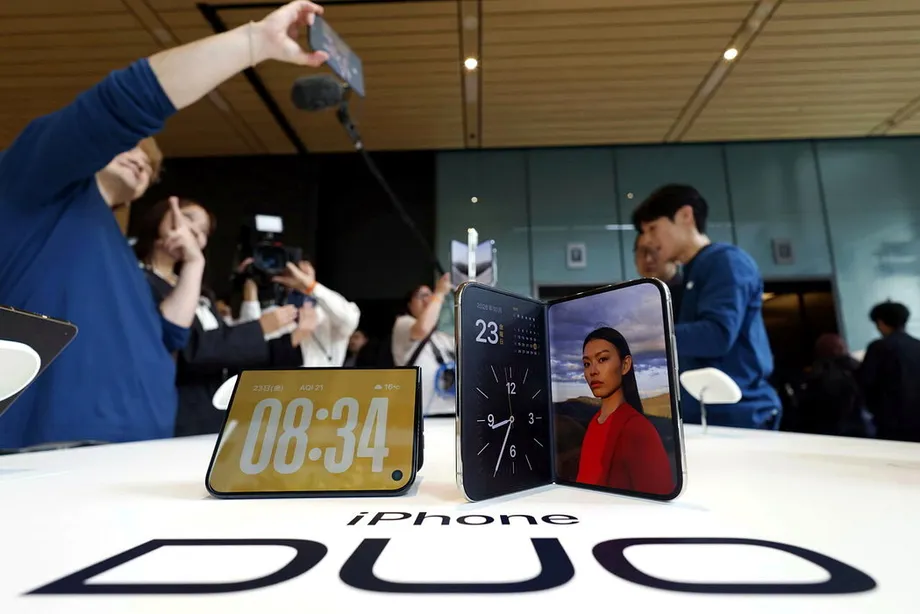
The iPhone Duo went on sale on October 23, 2026, starting at $1,999 in the United States and NT$74,900 in Taiwan. Initial Taiwan allocations reportedly sold out across configurations, with the next shipment expected on January 22. Elsewhere, online delivery estimates reached late January across both colors and storage options ranging from 256GB to 2TB.
Apple has not publicly confirmed either reported order increase or explained whether they cover the same suppliers and production periods. Its October 15 announcement sets out the product and purchasing arrangements, including the October 16 preorder opening, rather than sales totals or revised factory targets.
Hinges, flexible displays and final assembly are all slowing production. The commercial opportunity therefore reaches beyond selling an expensive new phone: Apple and its partners must manufacture a complicated design consistently enough to shorten queues, while persuading customers that its larger screen is worth the price.
Apple described the response to preorders in a statement:
nothing short of extraordinary
The company capped preorders at two phones per customer. Launch day purchases in mainland China, France, Hong Kong, India and Japan were restricted to customers who had ordered online, while several other markets had limited stock for shoppers arriving without reservations.
Why the production numbers vary so widely
The 14 million figure covers the first 12 months of production, extending well into 2027. Estimates of 6 million, 8 million or 10 million generally concern the shorter period ending in December 2026. Keeping those calendars separate helps explain part of the apparent gap.
Supply chain expectations have changed several times as factories encountered manufacturing problems and then received stronger demand signals:
- July 2026: Apple was reportedly seeking about 10 million foldable iPhones for the calendar year.
- September 2026: Analyst Jeff Pu estimated production of about 6 million during 2026 because of hinge constraints.
- October 16: Preorders opened at 5 a.m. Pacific time, and delivery estimates quickly moved into January.
- October 23: Retail sales began amid reports that the target for the first 12 months had risen from 9.7 million to 14 million.
- January 22, 2027: The next shipment date cited for Taiwan, with some other buyers facing estimates later that month.
Counterpoint Research also expects roughly 6 million shipments in 2026. More optimistic industry estimates put this year's volume at 8 million to 10 million, compared with an earlier expectation of 6 million. Some customers have already seen their delivery dates move forward as Apple reallocates or increases supply.
A precision manufacturing company representative in southern China described approximately 3.5 million units in confirmed purchase orders and materials sufficient for about 7.2 million phones. The representative said orders could reach 6 million to 6.5 million if demand continued.
Those figures describe different stages of preparation. A confirmed purchase order commits a supplier to a quantity; a rolling forecast is updated as demand changes. Materials on hand indicate what factories could build once the other parts and assembly capacity are ready. The same representative projected 8 million to 10 million shipments in the first quarter of 2027 and planned capacity of 30 million from the fourth quarter of 2026 through the third quarter of 2027.
The hinge is only one production bottleneck
Foxconn, also known as Hon Hai, is identified as the Duo's exclusive assembler, with TSMC manufacturing its main processor. A joint venture between Foxconn and Shin Zu Shing supplies key hinge components, while US company Amphenol is identified as a second supplier. Samsung Display is reported to be the exclusive supplier of the folding display.
Counterpoint Research deputy director Liz Lee attributes reduced production expectations to instability in folding OLED panel production, adjustments to the hinge design and a longer period needed to stabilize final assembly. OLED is a display technology in which individual pixels produce light. Making that display bend repeatedly adds demands on its materials and construction.
The hinge module reportedly contains more than 100 components. Its cover is described as recycled titanium made using 3D printing. Suppliers expect the cost of the first generation hinge module could fall to about $80 by September 2027, giving Apple a possible route to lower manufacturing costs as production matures.
Factories must also improve yield, the share of products that pass quality checks. If a line assembles 100 phones and only 80 pass, its yield is 80%. Better yield produces more saleable phones from the same production effort, which makes it central to reducing the backlog.
Customers have already raised durability concerns. Following early screen crack complaints, owners in Australia, China and other markets described damage near the central fold, sometimes within hours of receiving their phones. Apple replaced a Melbourne customer's device, while a Shanghai customer said her handset required assessment. The number affected, the failure rate and the cause remain unknown.
What buyers get for nearly $2,000
Apple lists a 7.58 inch inner display and a 5.36 inch outer display, measured diagonally as rectangles. The company says the inner screen has 50% more area than the iPhone 18 Pro Max display. Rounded corners reduce the actual viewable area.
The Duo uses an A20 Pro processor, two batteries and iOS 27 software that changes its layout as the device folds, turns or switches screens. Split View allows two apps to appear together. A user could keep a document beside a reference page instead of repeatedly switching between them.
Apple lists a 48 megapixel main camera with an integrated optical quality 2x telephoto option, a 48 megapixel ultrawide camera, a Center Stage front camera and another camera beneath the inner display. Reviews criticizing the lack of a telephoto lens refer to the absence of a dedicated telephoto camera; Apple's 2x option is integrated into the main camera system.
The price rises sharply with storage. The US range runs from $1,999 for 256GB to $3,199 for 2TB. Starting prices elsewhere include 15,999 yuan in mainland China, ¥364,800 in Japan and 3.29 million won in South Korea.
Scarcity creates a resale premium
Taiwan resale asking prices reportedly reached NT$100,000, about NT$25,100 above the NT$74,900 starting price, or a premium of approximately 33.5%. In Beijing, reseller Alex Wang offered customers an extra 3,000 yuan for phones they had just collected.
Wang attributed his offer to scarce stock outside the Sanlitun Apple Store:
The main reason is the tight supply.
Mary Tong, an Apple customer who arrived at the Beijing store at 6 a.m., described a line of about 100 people. In Hong Kong, a buyer who paid HK$17,499 for a 256GB model planned to resell it for a profit of around HK$4,000. These markups put an additional cost on getting a device immediately rather than waiting for delivery.
Apple's payment programs spread the expense in participating markets. Its US announcement lists trade in credits of $175 to $885 for eligible iPhone 13 models or newer, and qualifying carrier offers of up to $1,200. Its Klarna lease starts at $57.99 a month for 24 months, excluding taxes and any trade in credit. At the end, customers can return the phone, upgrade if eligible or buy it with a separate payment.
Regional software availability also affects the purchase. Apple says Siri AI begins in English as a beta with iOS 27 and is initially unavailable in the European Union on iOS. Its announcement says Siri AI and the other new Apple Intelligence features will not be available in China. A mainland beta involving translation, photo cleanup and writing tools has separately been described as planned for October, following reported approval of Alibaba models on October 14, leaving buyers facing different rollout schedules.
Apps and everyday use shape the next test
Developers are still adapting apps to the Duo's display. Following its uneven app launch, familiar services including Gmail, Google Maps, Uber and Kindle were identified as awaiting fuller layouts, while Microsoft Word and Outlook still lacked interfaces designed for the larger screen.
Apple has highlighted more than 50 apps and games that are ready or coming soon. Customers may encounter anything from an expanded interface with useful extra columns to a small window surrounded by unused space. The benefit depends on the apps a person actually uses.
Technology commentator John Gruber described his experience after a week with the device:
It's been a lot of fun trying the Duo out for a week, but it feels like I've gotten to use an extraordinarily polished prototype - not a finished product that I'd want to buy and carry.
Other reviewers praised the design and unobtrusive hinge while describing compromises in quick tasks when the phone is folded. For people who want a larger workspace without carrying a separate tablet, the format offers a concrete attraction. Buyers primarily sending messages or checking social media face a harder price comparison with conventional phones.
Suppliers prepare for a wider foldable market
South Korean materials company ICH plans to more than double its original fourth quarter supply of polyethylene foam, taking expected monthly supply value to about 2 billion won. The company says the material absorbs impact inside the Duo and supports durability around the folding section.
ICH also supplies cushioning polyurethane foam and gaskets that block electromagnetic interference for Samsung's Galaxy Z8 phones. Its position across both manufacturers gives it exposure to expansion in the category rather than dependence on a single launch.
Display chip suppliers anticipate greater demand for touch and display driver integration, known as TDDI. This combines electronics that sense touch with those that control the display. Industry accounts describe the technology as a technical requirement for foldables, while cost continues to limit its use in conventional flagship phones.
Japan illustrates how small the category remains in some markets. MM Total Research puts foldable shipments there at about 330,000 out of 31.33 million smartphones in 2025, approximately 1.1%. Samsung held 67.7% of that foldable segment. Apple's entry gives materials and component suppliers a chance to sell into a larger customer base.
US component investment runs alongside Asian assembly
Apple's wider American Manufacturing Program links the Duo launch to investment in materials and components, while its final assembly supply chain remains centered on Foxconn. The program sits within a stated commitment to invest $600 billion in the United States over four years.
The reported arrangements include $100 million over three years for Pennsylvania titanium producer Perryman, supplying Grade 5 titanium containing at least 80% recycled material. Corning's Harrodsburg plant in Kentucky is expected to supply all cover glass for iPhones and Apple Watches sold globally by the end of 2026, including the Duo's outer screen cover.
TSMC's Arizona operations are expected to produce more than 100 million chips for Apple during 2026 across products including iPhones, iPads and Apple Watches. Amkor's advanced packaging and testing project in Peoria, Arizona, is expected to create more than 3,500 jobs, with Apple among its initial customers. Packaging connects and protects chips so they can function inside finished devices.
Other partners serve the broader product range. Qnity Electronics supplies optical films for the iPhone 18 Pro's variable aperture camera. Broadcom's Colorado expansion is tied to a $1.5 billion capital investment plan and agreements involving more than 15 billion radio frequency components. Coherent supplies laser components from Texas for facial sensing systems.
Apple's Houston operations also include AI server assembly and a planned start to Mac mini production during 2026. A manufacturing training center opened there in August. Those projects extend the company's manufacturing footprint across several product lines while the immediate Duo backlog depends on folding displays, hinges and assembly output.
Large forecasts meet a shrinking phone market
IDC forecasts Apple will capture 31% of global foldable shipments and 44% of foldable sales value in 2026, then lead both measures in 2027. The higher share of revenue reflects the Duo's premium pricing. Other industry projections put Apple at as many as 33 million foldable shipments in 2027 and roughly 40% of the market.
Forecasts for the category put shipment growth at 25.7% in 2026 and 59.1% in 2027, compared with 7.4% in 2025. Existing rivals include Samsung, Huawei and Xiaomi. In China, Huawei's Mate XT2 starts at about $3,000, while Xiaomi has introduced the 18 Fold.
The wider smartphone market is much weaker. IDC's preliminary figures show global shipments falling 22% from a year earlier in the third quarter of 2026. Apple's shipments fell 4%, while its market share rose from 18.2% to 22.4%, a gain of 4.2 percentage points.
IDC research director Nabila Popal says storage chip costs have risen about 350% from a year earlier. Higher component bills create pressure on manufacturers and buyers, even as suppliers hope Duo demand will cushion softer iPhone 18 Pro sales. Evercore ISI analyst Amit Daryanani maintains an outperform rating on Apple with a $380 price target, while identifying the pace of production increases as a key factor.
Apple is expected to hold a product event on October 28 and release its fiscal fourth quarter results on November 2. Investors will be looking for firmer information about demand, delivery progress and manufacturing costs. For customers, the most immediate measure of success is simpler: a reliable phone arriving sooner at its advertised price.
Key Points
- Apple reportedly raised its first 12 months production target from 9.7 million Duo phones to 14 million; another supply chain estimate cites an order increase of about 30%.
- Delivery estimates extend into January 2027, with purchases limited in several markets.
- Folding displays, hinge production and assembly yield are restricting output.
- IDC expects Apple to take 31% of foldable shipments and 44% of sales value in 2026.
- Suppliers are expanding materials and component capacity, while buyers face high prices, unfinished app layouts and early durability complaints.
- Apple's expected October 28 event and November 2 earnings release are the next scheduled business milestones.