Half a million devices, with internet access included
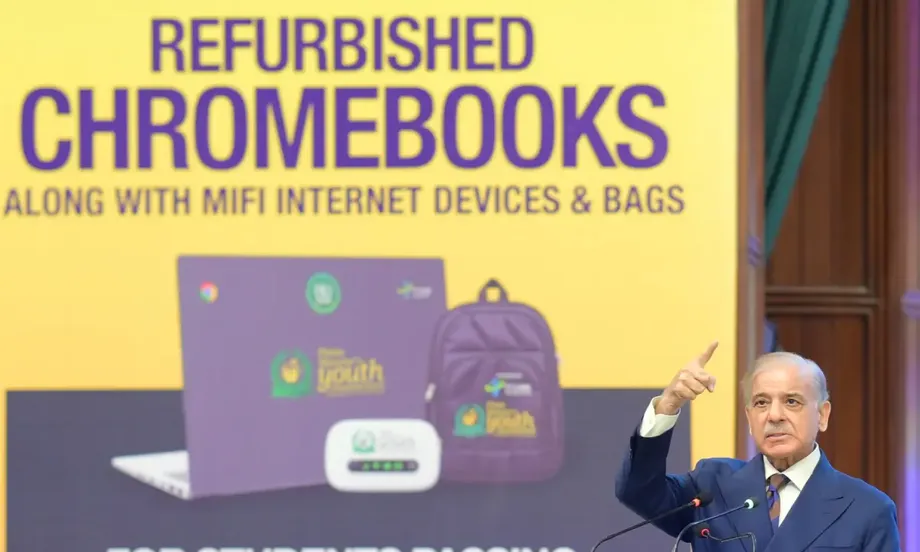
Pakistan plans to distribute 500,000 refurbished Chromebooks to students over two years under a programme launched by Prime Minister Shehbaz Sharif at Islamabad's Convention Centre on October 25, 2026. The package includes MiFi internet devices and bags, with 100,000 computers earmarked for students at registered religious seminaries.
Contents
- Half a million devices, with internet access included
- Who qualifies, and how merit will be assessed
- How the 500,000 Chromebooks are divided
- Seminary students receive a defined share
- What students receive with the computer
- Checking records and preparing an application
- Devices will be tracked from dispatch to receipt
- A faster distribution target than previous programmes
- Digital access alongside a wider education gap
- Key Points
The Prime Minister's Youth Chromebook Scheme combines academic selection with regional quotas. Punjab has the largest allocation at 181,090 devices, followed by Islamabad with 100,000. Within every province and region, schools are allocated 80% of the devices and seminaries, also known as madaris, receive 20%.
Sharif handed Chromebooks and internet devices to some students at the launch. He said the wider distribution would reward academic ability and hard work, without discrimination based on economic background or educational institution.
The prime minister presented the computers as tools for both education and future employment:
"These Chromebooks will help you gain further education, and in the future, these devices will help you secure employment," the premier said.
The programme is being run by the Ministry of Federal Education and Professional Training with the Prime Minister's Youth Programme. The partner foundation, identified at the ceremony as Tokyo Technology Care Foundation, has committed to supplying the devices under a letter of understanding.
For families, the practical promise extends beyond receiving a computer. Internet access could allow students to use electronic libraries, continue lessons from home and share access to learning resources with relatives. Sharif estimated that the programme would reach 2.5 million people when family members are included, equivalent to five people for every Chromebook distributed.
Who qualifies, and how merit will be assessed
Education ministry officials described the main selection group as students in Grade 9 with strong results in SSC-I examinations, the first part of the Secondary School Certificate. Students must have scored at least 50%, with results checked through the Inter Boards Coordination Commission (IBCC).
A score of 50% is the minimum threshold. Students will be ranked within their province or region, examination board and academic stream until the relevant allocation is filled. A student meeting the minimum therefore still needs to rank high enough to receive a device.
The eligibility descriptions contain differences that matter to families. Ministry officials included public schools, private schools supported by provincial education foundations and registered madaris. Published application guidance excludes private school students, while describing Grade 9 students as eligible in the four provinces and both Grade 9 and Grade 10 students as eligible in Islamabad, Azad Jammu and Kashmir and Gilgit-Baltistan. Families at foundation supported private schools will need confirmation of their institution's status.
Examination boards and the IBCC are to check marks and prepare merit lists. Provincial education departments and education foundations will verify enrolment and school affiliation. Seminary students will undergo separate checks involving the Directorate General of Religious Education.
How the 500,000 Chromebooks are divided
The regional allocations total exactly 500,000 devices. The distribution plan assigns:
- Punjab: 181,090 Chromebooks.
- Sindh: 85,925.
- Khyber Pakhtunkhwa: 51,170.
- Balochistan: 31,815.
- Islamabad: 100,000.
- Azad Jammu and Kashmir: 25,000.
- Gilgit-Baltistan: 25,000.
Punjab's allocation represents about 36.2% of the total, while Islamabad's represents 20%. The two together account for 281,090 devices, or about 56.2% of the programme.
The 80% school allocation produces a national total of 400,000 devices, leaving 100,000 for madaris. Within the school allocation, 70% is reserved for science students and 30% for arts students. Applied across the programme, those proportions amount to 280,000 Chromebooks for science students and 120,000 for arts students.
Seminary students receive a defined share
Defence Minister Khawaja Asif said one in five Chromebooks would go to a student at a registered seminary. The detailed allocation plan applies that proportion within each province and region, making seminary participation a defined part of the distribution.
Deputy Prime Minister Ishaq Dar welcomed the inclusion of madrasa students in a statement on X:
Including madrasa students marks a historic national consensus that every child deserves the tools of the modern world.
Sharif said previous laptop programmes had also reached prominent religious seminaries. At the launch, students from schools and madaris received devices, bringing both groups into the same national initiative.
The ceremony also recognised individual students, including Syed Shams Raza, who lives in an orphanage, and seminary student Alma Mahak Sabir. Both spoke after the distribution and expressed gratitude for the recognition of their academic effort.
What students receive with the computer
The devices are refurbished Chromebooks, as stated on banners at the launch and in the programme description. Refurbished computers have been used before and prepared for further use, rather than supplied as newly manufactured machines.
A Chromebook runs Google's ChromeOS operating system. It is designed around browser applications and online services, with cloud storage allowing files to be kept on internet servers and accessed from different devices. This makes the accompanying connection especially relevant for students using electronic libraries and online lessons.
A MiFi device is a portable mobile internet hotspot. It connects to a mobile network and shares that connection through Wi-Fi, allowing a Chromebook or another compatible device to go online. The package also includes a bag for the computer and books.
The government has not specified the Chromebook models, battery standards, remaining software support, mobile data allowance, duration of funded connectivity, application deadline or individual delivery dates. These details will determine how long students can use the devices reliably and what continuing costs families may face.
Sharif said access from home would help students continue learning beyond the classroom. His estimate of 2.5 million beneficiaries includes relatives sharing the benefits of connectivity, while the physical distribution target remains 500,000 computers.
Checking records and preparing an application
Published application guidance directs students to the portal at pmychromebooks.ibcc.edu.pk to search for their academic records. Students are instructed to select their examination board and enter their B Form or national identity card number, roll or registration number, and date of birth.
The search function, labelled Find My Record, is intended to show the student's name, school and other details for checking. Final selection depends on verification, merit ranking and the available quota after the record is found.
The guidance lists four types of documents for applicants:
- A recent passport size colour photograph in JPG or PNG format.
- A marks sheet for matriculation Part I or Part II.
- An attested copy of the student's B Form or national identity card.
- An attested copy of a parent's or guardian's national identity card.
Each file must be no larger than 300 kilobytes. Students should check their examination details and school information carefully, since those records feed into the selection and verification process.
Devices will be tracked from dispatch to receipt
The distribution plan links each Chromebook's serial number to an individual recipient. Before dispatch, the device record is to be checked against the student's merit position, enrolment, institutional affiliation and delivery information.
Couriers will deliver the computers directly to verified students. A central monitoring system is intended to record dispatches, successful deliveries, failed attempts and confirmation that recipients have received their devices.
An apex committee will oversee the programme, while the federal education ministry coordinates implementation with provincial governments. Provinces will appoint focal persons to help manage work locally.
Complaint committees at examination board and provincial or regional levels are to handle disputes about merit rankings, inclusion or exclusion from lists, enrolment checks, examination data and missing deliveries. A contracted firm is to provide repair and maintenance after the first year following delivery.
For a family waiting for a computer, those arrangements create several points of accountability: the academic record used for selection, the serial number assigned to the student and the courier record showing whether the package arrived.
A faster distribution target than previous programmes
Sharif said previous Pakistan Muslim League-Nawaz governments distributed 600,000 laptops over a decade, including in Gilgit-Baltistan and Azad Jammu and Kashmir. The new target of 500,000 Chromebooks over two years requires a much faster annual pace.
The earlier total averages 60,000 laptops a year. The new commitment averages 250,000 Chromebooks a year, about 4.2 times that rate. Prime Minister's Youth Programme Chairman Rana Mashhood Ahmad Khan subsequently described the plan as an annual distribution of 250,000 Chromebooks to schools nationwide.
The announcements and related manufacturing milestones developed over several dates:
- November 2025: Pakistan's first Google Chromebook assembly line opened in Haripur through a partnership involving the government, Google and Tech Valley, with expected production of 500,000 devices by 2026.
- August 2026: Sharif said on International Youth Day that 250,000 students with strong academic results would receive Chromebooks that year.
- October 25, 2026: The prime minister launched the scheme in Islamabad and committed to distributing 500,000 devices within two years.
- The following day: Mashhood described the annual target as 250,000 Chromebooks.
The Haripur assembly target and the student distribution target both involve 500,000 devices, but they concern different activities. The factory partnership concerns production capacity; the student scheme specifies refurbished computers supplied through the foundation partnership.
Digital access alongside a wider education gap
Pakistan's 2023 census counted about 25.4 million children aged five to 16 outside school. The Chromebook scheme focuses on students already studying and achieving qualifying examination results, while the country also faces the larger task of bringing children into classrooms.
Poverty, distance from government schools, transport costs and private school fees restrict access to education. Security concerns and cultural restrictions create further barriers for girls in some areas. A computer and connection can expand learning opportunities for a selected student, while school access requires spending on teachers, buildings and attendance.
Sharif connected the Chromebook launch to the expansion of Daanish Schools, which provide free education. He referred to a recently inaugurated campus in Islamabad and 27 campuses under construction nationwide. Mashhood separately described plans for 30 schools across the country, including five in Sindh.
Education Minister Khalid Maqbool Siddiqui cited Pakistan's 150 million young people as he argued for education that responds to changing needs. Foundation chairman Rashid Minhas said the partnership aims to help students become digital creators, extending their role from using online content to making it.
Mashhood also announced plans for a national youth employment policy, a unified artificial intelligence policy and e-sports arenas. Those proposals place the Chromebook programme within a broader effort to connect education with skills and work. For the selected students, the immediate priorities are more concrete: an accurate merit list, a working computer, usable internet access and delivery to the right address.
Key Points
- Pakistan plans to distribute 500,000 refurbished Chromebooks over two years, with MiFi internet devices and bags.
- Schools receive 400,000 devices and registered seminaries receive 100,000 under the allocation plan.
- Selection is based on verified academic results, regional quotas and academic streams, with a stated minimum score of 50%.
- Eligibility descriptions differ on foundation supported private schools and the grades covered in some regions.
- Devices are to be linked to recipients by serial number and delivered by courier with central tracking.
- The target averages 250,000 devices annually, compared with 60,000 laptops a year under the previous decade's total cited by Sharif.