Visa deadlines put Bhutanese students under pressure
Australia's student visa changes, effective from 2 October 2026, could require thousands of Bhutanese students to leave the country before applying to finish their studies. An estimated 20,000 to 30,000 Bhutanese could be affected over the coming years, according to migration industry estimates. The Department of Home Affairs has not published an official count of affected Bhutanese students.
Contents
- Visa deadlines put Bhutanese students under pressure
- Who must apply from outside Australia?
- Which students can still apply in Australia?
- Why changing institutions matters
- Waiting abroad can disrupt a course
- Partners and children face separate restrictions
- A sponsored work visa is a different route
- Bhutanese application numbers were already falling
- Dates students and families need to track
- Key Points
The first wave of departures is expected in February and March 2027, when many current visas are due to expire. Students who changed education providers, or whose courses now finish after their visas expire, face particular pressure to check whether they qualify to submit another application while still in Australia.
The Department of Home Affairs' student visa factsheet says most current Student visa holders seeking another Student visa must apply from outside Australia unless an exemption applies. Affected applicants must also be outside Australia when the new visa is granted.
Existing visas remain valid under their current conditions and expiry dates. For students already studying, the immediate issue is whether their present permission to stay lasts long enough to complete their course, and where they can apply if it does not.
The changes also restrict applications by other temporary visa holders and sharply limit when partners and children can join a Student visa application. Families may therefore have to make decisions about education, employment and travel together, rather than treating a student's next visa as an individual matter.
Who must apply from outside Australia?
The restrictions cover the Student visa, known as subclass 500, and applications for the Student Guardian visa, subclass 590. A subclass is simply the identifying number for a particular type of Australian visa.
Most temporary visa holders can no longer apply for either visa while in Australia. Student visa dependants who want to become the main applicant on their own Student visa are included. Current Student Guardian visa holders, however, can continue applying for another Student Guardian visa from within Australia.
Immigration law firm Fragomen's visa rules update identifies additional affected categories: Temporary Work visas under subclass 400, Training visas under subclass 407, Temporary Activity visas under subclass 408, Skills in Demand visas under subclass 482, Working Holiday visas under subclass 417 and Work and Holiday visas under subclass 462.
For an affected applicant, the two required locations are straightforward: outside Australia when submitting the application, and outside Australia when it is approved. Approval depends on meeting the visa requirements, so departure carries a risk that the student will be unable to return to complete the course.
Which students can still apply in Australia?
Home Affairs lists several exemptions for current Student visa holders. These cover particular study circumstances, government sponsorship and cases where an education provider can no longer deliver a course.
- Students needing up to 12 additional months after their original course end date, while continuing with the same education provider.
- Students sponsored by the Department of Foreign Affairs and Trade or Defence.
- Applicants undertaking a PhD or primary or secondary school studies.
- Students who have completed their main course and are progressing to an eligible qualification at a higher level.
- Students making specified transitions between school studies, courses without an Australian Qualifications Framework level and courses with such a level.
- Students unable to continue because their education provider has defaulted.
The Australian Qualifications Framework, or AQF, places recognised qualifications at different levels. The progression exemption requires a completed course and an eligible next step. For someone who completed a higher education course, the next course must also be a higher education course delivered by a higher education provider.
The extra time exemption also has limits. A student taking a package of courses must need the additional time for the main course. A student needing more than 12 additional months, or continuing with a different provider, would need another exemption to apply from within Australia.
Why changing institutions matters
Bhutanese students have cited tuition costs as a reason for transferring after arriving in Australia. Some initially select expensive or well known institutions because they believe those choices will strengthen their visa applications, then move to cheaper providers to reduce the cost of studying.
Others change courses to improve employment prospects or pursue qualifications they believe could help them qualify for skilled migration or permanent residence. Those decisions can change a course's finishing date and the student's eligibility for a later visa application within Australia.
Updated Home Affairs guidance places students who changed providers after their current visa was granted outside the course completion exemption if they need another visa to finish. Students whose extended completion dates require more than 12 additional months also fall outside that exemption.
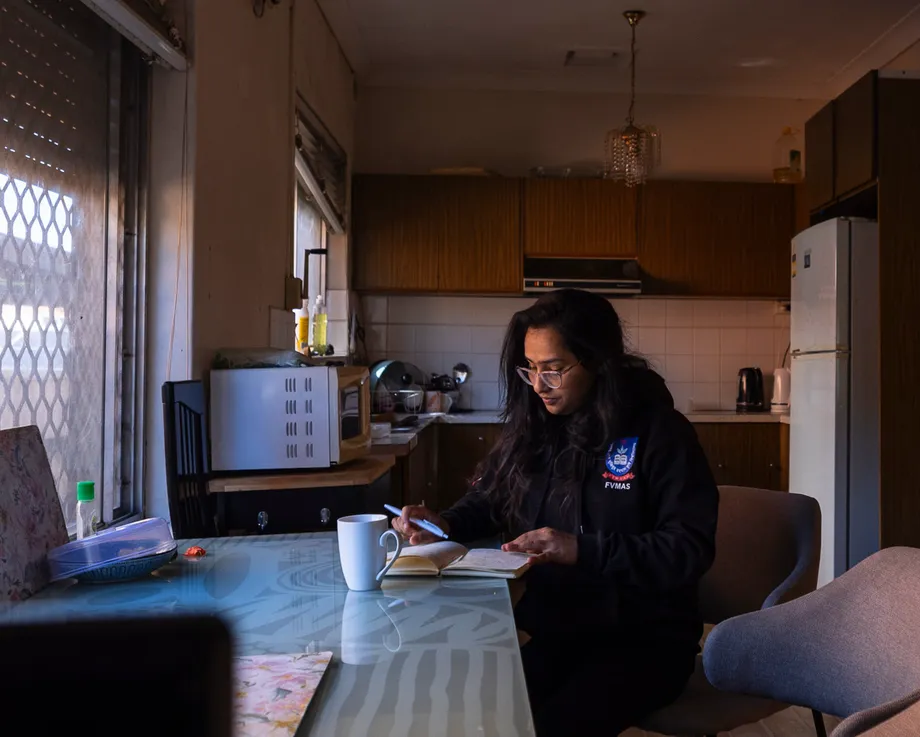
Fatima Bonna, a 27-year-old student from Bangladesh studying in Adelaide, changed degrees and institutions after her first semester. Her visa expires in September, four months before her master's course in early childhood education at the Ikon Institute is due to finish. She described her reaction to the changes:
If I had any idea of it, I wouldn't have changed.
A registered migration consultancy has warned that students need to understand the immigration consequences before transferring. A migration lawyer also said education consultancies should have given clearer advice where changing courses could affect future visa options.
Waiting abroad can disrupt a course
Home Affairs processing estimates cited for higher education Student visa applications put 50% of decisions within 16 days and 90% within four months. Those figures describe processing across applications; an individual student's waiting time will depend on their case.
A student leaving Australia near the start of a teaching term could therefore face a gap between departure and permission to return. Travel costs, accommodation arrangements and missed classes become practical concerns alongside the application itself. Health examinations and possible biometric collection, such as fingerprints and a photograph, may also be required.
Gurpreet Dhawan, a migration agent based in Melbourne, described the uncertainty for students who must apply abroad:
It's a huge risk. We will send them offshore to lodge the visa but how long will they have to sit there?
For affected Bhutanese students, returning home may be the most practical way to submit an application outside Australia. The formal requirement concerns being outside Australia, however, rather than applying specifically from Bhutan.
Partners and children face separate restrictions
New Student visa applicants generally cannot include a partner or dependent children unless an exemption applies. The rule also covers applications for a further Student visa, making the next application important for families already living in Australia.
Exemptions for including family members at the time of application cover PhD students, students sponsored by Foreign Affairs and Trade or Defence, recipients of foreign government scholarships, and eligible students from Pacific countries or ASEAN member countries. Bhutan is outside the Pacific and ASEAN categories, although a Bhutanese applicant may qualify under another exemption.
Students who already have family members included in their current visa and apply within Australia may be able to include those relatives in the next application. The main applicant and every included family member must be in the same location when the application is submitted.
Home Affairs states that current Student visa holders can no longer add family members after the visa has been granted, with no exemptions to that rule. A PhD student's ability to include family in an initial application therefore differs from their ability to add a relative later.
Wina Satria, an Indonesian PhD candidate at the University of Sydney, travelled to Australia with her young son and planned for her husband to join them later. She described what the new restriction means for her family:
It's hard if we can't have our family with us.
Julian Hill, assistant minister for international education, said the government was "not in the business of separating families already onshore in Australia". He outlined a possible response for some families:
Sympathetic consideration would be given to visitor visas where required to keep families together while a student completes their stay in Australia.
Hill's statement leaves families dependent on the outcome of a separate visa application. Parents must also consider children approaching 18, because dependent children under Student visa rules generally must be unmarried and younger than 18. A child seeking their own Student visa is covered by the new application location rules unless an exemption applies.
A sponsored work visa is a different route
Some education consultancies are exploring whether affected students could qualify for the Skills in Demand visa, subclass 482. That visa allows eligible skilled workers to work for an approved sponsoring employer.
A migration lawyer cautioned that the route requires an employer willing and able to sponsor the applicant, as well as satisfaction of the relevant visa requirements. A job offer alone does not secure a sponsored visa. Students considering this option need to establish both their own eligibility and the employer's capacity to sponsor them.
The rules also matter if a worker later wants to return to study. Subclass 482 is among the visa categories covered by the expanded restriction on Student visa applications within Australia.
Daniel Martin, who arrived from Colombia in 2024 and completed a master's in education in July, illustrates the uncertainty facing graduates making longer plans. He holds a temporary graduate visa, is seeking teaching and educational adviser jobs, and hopes to undertake a PhD. Political proposals affecting graduate visas have led him to reconsider those plans.
The Australian government says its reforms are intended to welcome genuine students and strengthen the integrity of the Student visa program. They form part of an effort to reduce annual net overseas migration from almost 300,000 to 225,000 by mid-2028, a reduction of about one quarter.
Bhutanese application numbers were already falling
Home Affairs figures cited for Bhutanese applicants show 8,891 Student visa applications lodged in the 2024–25 financial year, compared with 13,301 in 2023–24. That is 4,410 fewer applications, a decline of about 33%.
Visa grants fell from 9,787 to 6,186 over the same financial years, a decrease of 3,601, or about 37%. The figures describe applications lodged and visas granted during each year. Decisions can concern applications submitted in a different period, so calculating an approval rate requires a dataset that follows the same applications through to their outcomes.
The annual figures show that Bhutanese demand and visa grants were already falling before the October 2026 changes. The estimate of 20,000 to 30,000 people potentially needing to return concerns several coming years and a wider group already in Australia.
For individual students, the decisive facts are more specific than the national totals: their visa expiry date, their original and revised course completion dates, whether they changed providers, whether they completed a qualification, and whether their next application includes family members.
Dates students and families need to track
Home Affairs says applications lodged before 2 October 2026 continue to be assessed under the rules that applied when they were submitted. The application date therefore determines which rules govern those cases.
A further Student visa Transfer stream is planned for 2027. Its details are still being developed, and no precise launch date or full eligibility rules have been announced.
- 2023–24: Bhutanese students lodged 13,301 applications, and 9,787 Student visas were granted.
- 2024–25: Applications fell to 8,891, while grants fell to 6,186.
- 2 October 2026: New application location and family inclusion rules took effect.
- February and March 2027: The first wave of affected Bhutanese students is expected as many current visas expire.
- 2027: The government plans to introduce a Student visa Transfer stream.
- Mid-2028: The government aims to bring annual net overseas migration to 225,000.
Migration professionals say affected students should establish whether they qualify to apply within Australia before their current visas expire. Reviewing course records, provider changes, family circumstances and application requirements early gives students a clearer basis for arranging study and travel.
Key Points
- Most current Student visa holders seeking another Student visa must apply from outside Australia unless an exemption applies.
- Existing visas remain valid under their conditions and expiry dates.
- Eligible exemptions include specified course completion needs, academic progression, doctoral studies and provider default.
- Partners and children face tighter inclusion rules, and relatives cannot be added after a Student visa is granted.
- An industry estimate puts the number of potentially affected Bhutanese at 20,000 to 30,000 over coming years.
- Students required to apply abroad must also be outside Australia when the new visa is granted, and approval is not guaranteed.