A shared electricity market for southern China
China's first regional electricity market has entered formal operation across Guangdong, Guangxi, Yunnan, Guizhou and Hainan, bringing more than 290,000 registered participants into a common trading system where spot prices update every 15 minutes.
Contents
- A shared electricity market for southern China
- What changes when prices update every 15 minutes?
- Why provincial boundaries mattered
- Renewable electricity gets a wider customer base
- Who can participate?
- How the market reached formal operation
- Common rules need common oversight
- What an earlier design review identified
- How southern trading connects to a national market
- Key Points
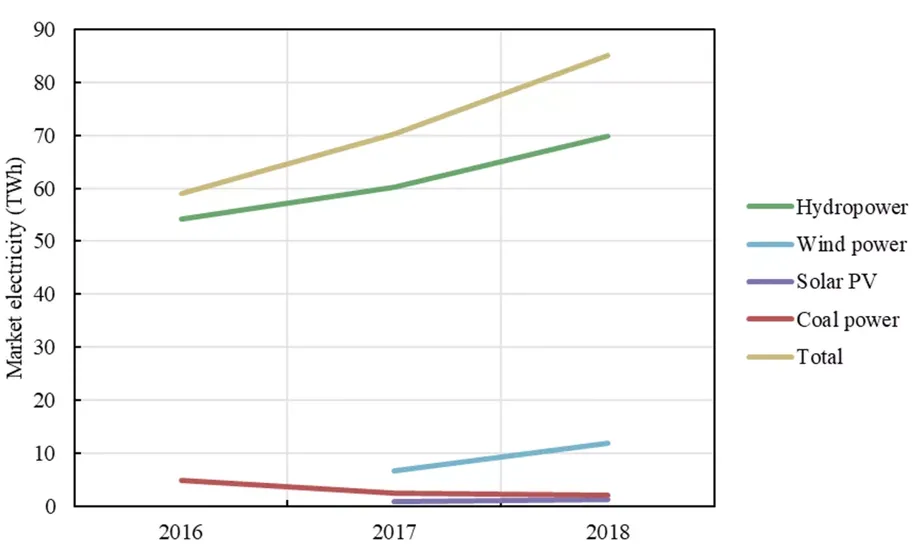
The Southern Regional Electricity Market allows electricity generators and business users across the five provinces and autonomous regions to trade under unified rules. Hydropower, coal generation, wind and solar compete in the same market, with prices responding to electricity supply and demand.
The scale is already substantial. During trial operation, electricity traded in the first nine months of 2025 was equivalent to about 70% of the five areas' total electricity consumption. That figure describes the volume of market trading, while the wider purpose is to make electricity easier to buy, sell and move across provincial boundaries.
For businesses, the change broadens access to electricity suppliers beyond their own province. For generators, it expands the pool of potential customers. Household electricity prices remain set by the state and are unaffected by fluctuations in the spot market.
The formal opening follows the start of continuous settlement trials on June 28, 2025, in Guangzhou. Those trials tested the trading system through an extended period in which transactions were measured and settled, an essential step before regular operation.
What changes when prices update every 15 minutes?
A spot electricity market matches power available for delivery with demand close to the time it is needed. Updating prices every 15 minutes lets the market respond to changes such as factories increasing production, solar output falling toward evening or stronger winds raising generation.
Electricity is different from many other goods because generation and consumption must remain closely balanced across the grid. Market prices provide a signal about when power is plentiful and when supplies are tighter. Grid operators still have to keep the system running within its physical limits.
A factory can now make purchasing decisions within a regional framework instead of relying on a market shaped mainly by its provincial boundary. A generator can compete for demand across a larger area. The price a business ultimately pays will depend on its purchasing arrangements and market conditions.
Lower purchasing costs are a possible benefit of wider competition, rather than a fixed result for every company. Prices can rise when supply is tight and fall when more generation is available. The immediate change is a broader choice of trading partners under common rules.
Why provincial boundaries mattered
Guangdong, Guangxi, Yunnan, Guizhou and Hainan previously operated with differing provincial electricity market rules. Those differences restricted trading and the allocation of power across borders, even when electricity available in one place could meet demand in another.
The consequences could be practical and costly. Renewable generators could struggle to send surplus electricity elsewhere, while businesses in another province faced higher purchasing costs or inadequate supply. A larger market gives buyers and sellers more ways to connect.
Southwestern hydropower can serve demand in the Guangdong-Hong Kong-Macao Greater Bay Area. Wind and solar generators also gain access to a wider area in which their output can be consumed, making provincial demand less of a constraint on their sales.
Transmission capacity still matters. Electricity needs space on power lines to reach buyers, and the regional market's preparations included work on managing congestion between provinces. Common trading rules and the ability to deliver electricity must operate together.
Renewable electricity gets a wider customer base
The region's renewable electricity utilization rate has remained above 95%, higher than the national average, according to figures accompanying the formal opening. In simple terms, the measure concerns how much available renewable generation is used rather than curtailed, or held back.
The national comparison was given without an exact national percentage. The regional figure is also a different measure from the 70% trading figure: one concerns the use of renewable generation, while the other compares market trading volume with total electricity consumption.
Wind and sunshine vary by place and time. A wider trading area gives generators more opportunities to find buyers when local demand is insufficient. Hydropower adds another source of electricity whose availability changes with river conditions and the seasons.
Coal generation also participates in the regional market. Bringing these sources into one trading framework means that electricity from different technologies competes to meet demand, while the system must account for changing weather, water availability and consumption.
Who can participate?
The more than 290,000 registered participants include power generators, electricity retailers, electricity users, new forms of energy storage and virtual power plants. The total therefore covers several types of market participant, rather than generators alone.
Electricity retailers buy power and arrange supplies for customers. Storage facilities can absorb electricity at one time and release it later. Their commercial opportunities depend partly on differences in electricity prices between those periods.
A virtual power plant coordinates several smaller resources through a shared control system. These can include distributed generators, batteries or electricity demand that can be adjusted. By coordinating them, an operator can offer the market a service that individual small resources might struggle to provide alone.
Virtual power plants and new storage businesses are expected to participate further as the market develops. No detailed timetable for that expansion was given with the opening update. Their inclusion broadens the market beyond the traditional relationship between large power stations and electricity buyers.
How the market reached formal operation
The National Energy Administration's July 4 announcement describes three years of trial operation and 12 rounds of stress tests covering a broad range of operating conditions before continuous settlement trials began.
Settlement trials grew from two days to a full month and covered conditions from the dry season to the flood season, as well as periods when electricity supplies were ample or relatively tight. Settlement is the process of calculating what each participant owes or receives after its transactions and actual electricity use are measured.
The development also spans a longer period of rulemaking and national reform. Key steps include:
- 2015: The Communist Party of China Central Committee and the State Council issued a new round of electricity reform measures.
- 2022 to July 2023: Regulators and market institutions released documents proposing the southern regional market design.
- December 15, 2023: The Regulatory Assistance Project published a review of that proposed design.
- June 28, 2025: Continuous settlement trial operation began in Guangzhou across the five participating areas.
- July 1, 2025: The National Development and Reform Commission approved a mechanism for regular electricity trading across grid operating areas.
- October 24, 2025: An update accompanying formal operation put registered market participation above 290,000.
The testing examined the full transaction process: market design, execution of trades, metering, settlement and risk controls. A market needs each stage to function reliably so that accepted trades can become delivered electricity and accurate bills.
Common rules need common oversight
The southern energy regulator developed a framework described as "1+N+5X" to connect national requirements, a unified regional framework and detailed operating rules. The practical aim is to give participants across the five areas a common basis for trading.
The National Energy Administration also describes the creation of regional rules for managing key market parameters. Such parameters are settings used to run a market. The new arrangements define which belong at regional or provincial level and set procedures for changing them.
China's first regional electricity market management committee brings together generators, retailers, electricity users and storage participants. A separate coordination structure links government, the grid, market participants and operating institutions.
Officials and market institutions also worked jointly on 12 subjects, including large hydropower participation, opening priority generation arrangements to market trading and managing congestion between provinces. Each concerns how trading decisions fit with the operation of a large electricity system.
What an earlier design review identified
The Regulatory Assistance Project's regional market review, dated December 15, 2023, examined proposed rules released from 2022 through July 2023. Its authors were Fredrich (Fritz) Kahrl and Jingying "Jing" Chen.
The documents reviewed came from the National Energy Administration's southern regulatory office, the China Southern Grid Dispatch Center and the Guangzhou Power Exchange. The review described the rules as an important first step toward a comprehensive regional electricity market.
Kahrl and Chen identified areas needing clarification and potential design problems, and proposed improvements. Their review addressed the proposed rules at that stage of development; subsequent trials extended the testing of how the market would work in practice.
The government's later account places particular attention on parameter management, congestion, settlement and risk controls. Together, these details show why the opening involved more than putting buyers and sellers on a common platform. Participants also needed procedures for operating the market and resolving competing demands on the grid.
How southern trading connects to a national market
The five participating areas are within China Southern Grid's operating territory. Integrating their electricity markets is one part of a broader national effort that also involves trading between the operating areas of China Southern Grid and State Grid.
An August 12, 2025 national market assessment describes the National Development and Reform Commission's July 1 approval of the Plan for Normalised Power Trading Mechanism Across Power Grid Operating Areas.
That plan allows electricity users to participate in transactions across grid operating areas through medium and long term contracts, spot trading and green electricity trading. Longer contracts arrange purchases further in advance, spot trades respond to nearer delivery conditions, and green electricity trading concerns power from renewable sources.
The commission set the end of 2025 as the target for State Grid and China Southern Grid to further unify market rules and trading products so that transactions between their operating areas could take place regularly. The southern opening supplies experience in coordinating several provincial markets within that wider effort.
For electricity users and generators, the concrete change is access to a larger market with common rules and prices that respond frequently to supply and demand. The next stage is to make that access work consistently across participants, technologies and grid boundaries, while maintaining reliable supply.
Key Points
- China's first regional electricity market has entered formal operation across Guangdong, Guangxi, Yunnan, Guizhou and Hainan.
- More than 290,000 participants are registered, including generators, retailers, electricity users, storage and virtual power plants.
- Spot electricity prices update every 15 minutes. Household tariffs remain set by the state.
- Trading during the first nine months of 2025 equaled about 70% of the five areas' total electricity consumption.
- The region's renewable electricity utilization rate remains above 95%.
- Continuous settlement trials began on June 28, 2025, following three years of trials and 12 rounds of stress tests.
- A national plan set an end of 2025 target for further alignment of trading rules and products between State Grid and China Southern Grid.