A different way to measure China's technology drive
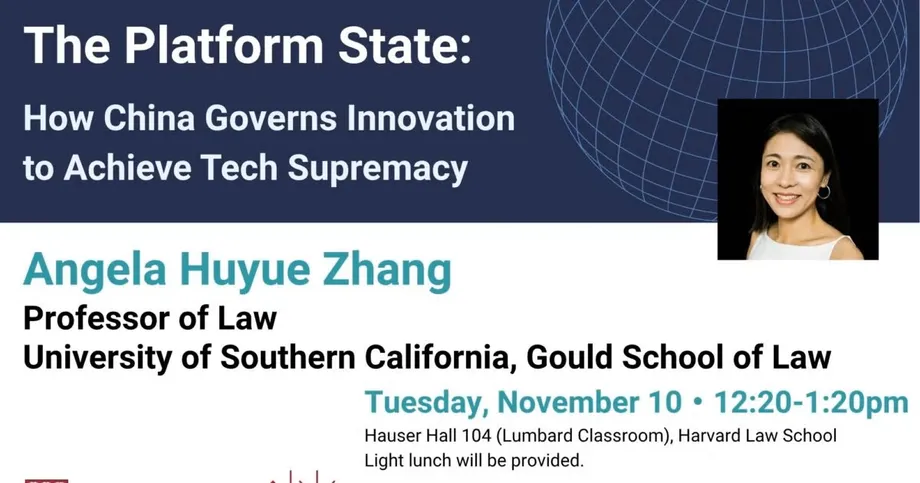
China's growing strength in electric vehicles, renewable energy and artificial intelligence sits alongside a business puzzle: companies can expand production and technical capabilities while earning very little money. Angela Huyue Zhang, a law professor at the University of Southern California, and S. Alex Yang, professor of management science and operations at London Business School, propose an explanation. Beijing governs innovation less like the manager of a single company and more like the owner of a vast platform.
Contents
- A different way to measure China's technology drive
- What makes a state resemble a platform?
- Why industrial strength can coexist with weak profits
- Central direction meets a fragmented system
- The difficult journey from a laboratory to a factory
- Why factories remain at the center
- Law, AI and the distribution of benefits
- How the argument developed
- What the framework changes for readers
- Key Points
Their joint project, The Platform State, puts the network of businesses, researchers and institutions at the center of the story. Individual companies compete, sometimes fiercely, while the state shapes the conditions under which they operate. National gains can include stronger supply chains, cheaper technology and greater manufacturing capacity, even when individual businesses struggle to earn profits.
Zhang and Yang are scheduled to discuss the framework at the University of Hong Kong on June 18, 2026, from 11 a.m. to noon. The university's CCL event announcement describes a state that controls access to the innovation ecosystem, sets rules for participants and protects its position through control over exit.
The argument arrives as technology takes a central place in China's economic planning. In commentary published on March 27, 2026, Zhang and Yang interpreted the recently concluded Two Sessions, the annual meetings of China's national legislature and political advisory body, as a signal that technology would be the primary engine of the country's economic future.
For businesses, workers and foreign competitors, the central issue is how those national ambitions translate into decisions about investment, competition and the distribution of gains.
What makes a state resemble a platform?
A commercial platform brings different participants together and sets the conditions for their interaction. An online marketplace, for example, can decide who sells, what rules sellers follow and how transactions work. Zhang and Yang apply a similar organizational idea to China's innovation economy.
Their framework has three main principles: coordinate the ecosystem rather than concentrate only on selecting individual winners; place control at important connections between participants while using ownership selectively; and expand first, capturing value later.
Companies retain room to make products, pursue customers and compete. Their freedom operates within a system whose access points and rules remain subject to state authority. Control can therefore extend beyond the businesses the government directly owns.
The researchers describe China's distinctive combination as strong state capacity, a large domestic market and substantial discretion over how the benefits of innovation are distributed and used. A large market gives businesses room to grow, while administrative power gives the government ways to steer the wider network.
The project shifts the basic question from whether a particular company succeeds to whether the ecosystem builds capabilities that serve national goals. That changes how losses, low prices and intense competition fit into the picture.
Why industrial strength can coexist with weak profits
Electric vehicles and renewable energy feature prominently in the Hong Kong event abstract because they capture the tension between expanding industrial strength and difficult business economics. China has become a major force in those sectors, while firms struggle to earn profits.
A company's financial return and a country's industrial return measure different things. A business needs revenue that covers its costs and rewards investment. A government may also value a broader supplier network, a skilled workforce, greater production capacity and reduced dependence on foreign technology.
In Zhang and Yang's framework, intense competition can help build those capabilities while keeping company margins narrow. The gains spread across customers, suppliers and the wider industrial system rather than accumulating entirely inside the company that develops or sells a product.
The principle of expanding before capturing value helps explain the willingness to prioritize scale. It also places pressure on the firms doing the expanding: production and technical progress can advance faster than earnings. The framework makes that tension central to understanding China's innovation model.
Central direction meets a fragmented system
The Mercator Institute for China Studies, or MERICS, provides a useful institutional comparison. Its whole-of-nation innovation report, published on March 5, 2024, examines China's effort to organize research and industry around strategic technological needs.
President Xi Jinping established the Central Science and Technology Commission in March 2023 to oversee this approach, with the Ministry of Science and Technology reformed into a supporting agency. The initiative draws on earlier national mobilization efforts but operates in an economy with a large private sector.
MERICS describes a system spread across partially overlapping initiatives and platforms. Its assessment finds an unclear public picture of technology priorities and responsibility for bringing national efforts together. At the time of publication, the Science and Technology Mid- to Long-Term Plan covering 2021 to 2035 had not been published.
The platform framework helps explain how central authority can coexist with that fragmentation. The state can steer the conditions of competition while leaving many organizations to pursue different projects. MERICS also identifies a practical limit: coordinating numerous businesses, universities, laboratories and government bodies is difficult, even with strong political direction.
China's private entrepreneurs remain central to the account. MERICS points to digital platforms, solar panels, electric vehicles and telecommunications as areas in which entrepreneurship has played an important role alongside state policy.
The difficult journey from a laboratory to a factory
Universities and research institutes can produce discoveries without giving manufacturers something they can use economically. MERICS identifies this separation between academic work and industrial needs as the "two-layers" problem.
A useful way to understand the gap is to imagine three stages: discovering an idea, turning it into a workable product and producing it reliably in large quantities. China has strong research output and considerable ability to expand production. Connecting a domestic invention to an industrial process remains a major challenge.
MERICS says Chinese firms often avoid risky basic research, particularly in strategically important sectors, because they regard it as a responsibility for the state. Researchers, meanwhile, may work toward goals that do not closely match the immediate needs of factories and customers.
Beijing has introduced several mechanisms to connect the two sides. Government and industry can publish technological challenges for research institutions to solve. Local authorities organize innovation associations linking companies with universities and laboratories. New research institutes with a stronger market orientation seek to move discoveries into commercial use, while patent ownership reforms aim to encourage researchers to become entrepreneurs.
The National People's Congress identified the continuing gap when reviewing the Science and Technology Progress Law in October 2023. The issue shows why governing an innovation ecosystem involves more than financing promising companies: the links between institutions must work well enough to carry an invention into production.
Why factories remain at the center
China's industrial strategy extends beyond the newest technologies. MERICS describes a policy priority of maintaining a complete, advanced and secure manufacturing base, including traditional sectors such as steel, coal and shipbuilding.
Zheng Shanjie, director of the National Development and Reform Commission, explained the importance of traditional manufacturing in a passage reproduced in the MERICS report:
Traditional industries make up most of China's manufacturing prowess.
Zheng's argument was that established industries should be upgraded rather than simply pushed aside. That approach connects advanced research to an existing network of factories, suppliers and industrial workers.
MERICS cites calculations by Cui Fan, a professor at the University of International Business and Economics, putting manufacturing's share of gross domestic product at 26.3% in 2020 after years of decline. The report records increases of 1.1% in 2021 and 0.3% in 2022, alongside a rise in debt.
The economic value of that industrial base reaches beyond any single invention. MERICS argues that replacing China's capacity in products such as solar panels, active pharmaceutical ingredients and telecommunications equipment would present other countries with a major economic challenge. China can gain strategic weight through the volume, cost and speed of production.
Maintaining that position carries tradeoffs. MERICS says the focus on industrial production can push other goals down the list, including stronger household consumption, lower carbon emissions and reduced reliance on export markets.
Law, AI and the distribution of benefits
Zhang and Yang place law at the center of the platform state. Rules provide room for experimentation and expansion while preserving the government's ability to maintain order across the innovation ecosystem.
The Hong Kong event abstract points to several tensions the researchers intend to examine. China restricts its domestic internet while promoting the international spread of AI models with openly available components. It has introduced some of the earliest AI regulations, while enforcement has been sparse. Its AI companies trail leading frontier laboratories, while their valuations are a small fraction of those of American counterparts.
The abstract supplies no company valuations or comparable enforcement counts. Those examples therefore remain qualitative parts of the researchers' argument about how the system works.
Open-source AI can allow other developers to inspect, adapt or build on a model, depending on its license and which components are released. Spreading a model widely can serve a different purpose from charging each user for access. In the platform framework, diffusion can expand the surrounding network of developers and applications.
Workers are part of the same distribution question. The event abstract highlights government attention to people displaced by automation alongside resistance to a welfare state. If innovation raises industrial capacity while businesses earn little and some workers lose jobs, the way benefits reach households becomes a central policy choice.
How the argument developed
The institutional changes and research span several years. The sequence helps separate China's policy developments from the later effort to explain them:
- March 2023: Xi establishes the Central Science and Technology Commission to oversee the new approach to national innovation.
- September 5 and 6, 2023: The analysis later published by MERICS is presented at a conference in Berlin on China's innovation and industrial ecosystems.
- October 2023: A National People's Congress review of the Science and Technology Progress Law identifies continuing gaps between knowledge institutions and industry.
- March 5, 2024: MERICS publishes its examination of national innovation coordination and industrial policy.
- March 27, 2026: Zhang and Yang publish commentary connecting the platform state argument to the economic priorities signaled by the Two Sessions.
- June 18, 2026: The University of Hong Kong schedules Zhang and Yang's discussion of the framework.
The June event is scheduled as an English language session requiring advance registration, in Room 824 of Cheng Yu Tung Tower. Sida Liu, professor and associate dean of HKU's Faculty of Law, is listed as moderator.
What the framework changes for readers
Zhang and Yang's project brings together two perspectives that often sit apart: legal control over economic activity and the organization of production across connected businesses. Their platform state research is their fifth joint project; two of their previous collaborations have appeared in Management Science.
For a business assessing China, the framework directs attention toward the wider network: who can participate, which connections the state controls, how competition is organized and where the benefits of expansion accumulate. Company earnings remain vital to investors, while industrial capacity has a separate value for policymakers.
For foreign governments, MERICS identifies a related tension. China's pursuit of technological independence and a complete industrial base can make international cooperation more difficult, while its manufacturing scale keeps it deeply connected to global trade. Export performance also gives Beijing an external measure of whether domestic firms can compete.
The combined picture is of an innovation system with considerable capacity to expand production, persistent difficulty connecting some research to industry, and continuing choices about who receives the gains. The platform state argument explains why those outcomes can exist together rather than assuming that technological progress must quickly produce large profits for every leading firm.
Key Points
- Angela Huyue Zhang and S. Alex Yang describe China as a platform state that governs a network of competing, connected firms.
- Their framework prioritizes ecosystem coordination, control at important connections and expansion before capturing value.
- MERICS identifies fragmented innovation initiatives and a persistent gap between academic research and industrial production.
- China's manufacturing strategy values production capacity and supply chains alongside individual company profits.
- The University of Hong Kong has scheduled the researchers' discussion for June 18, 2026.