A recovery with millions of learning needs behind it
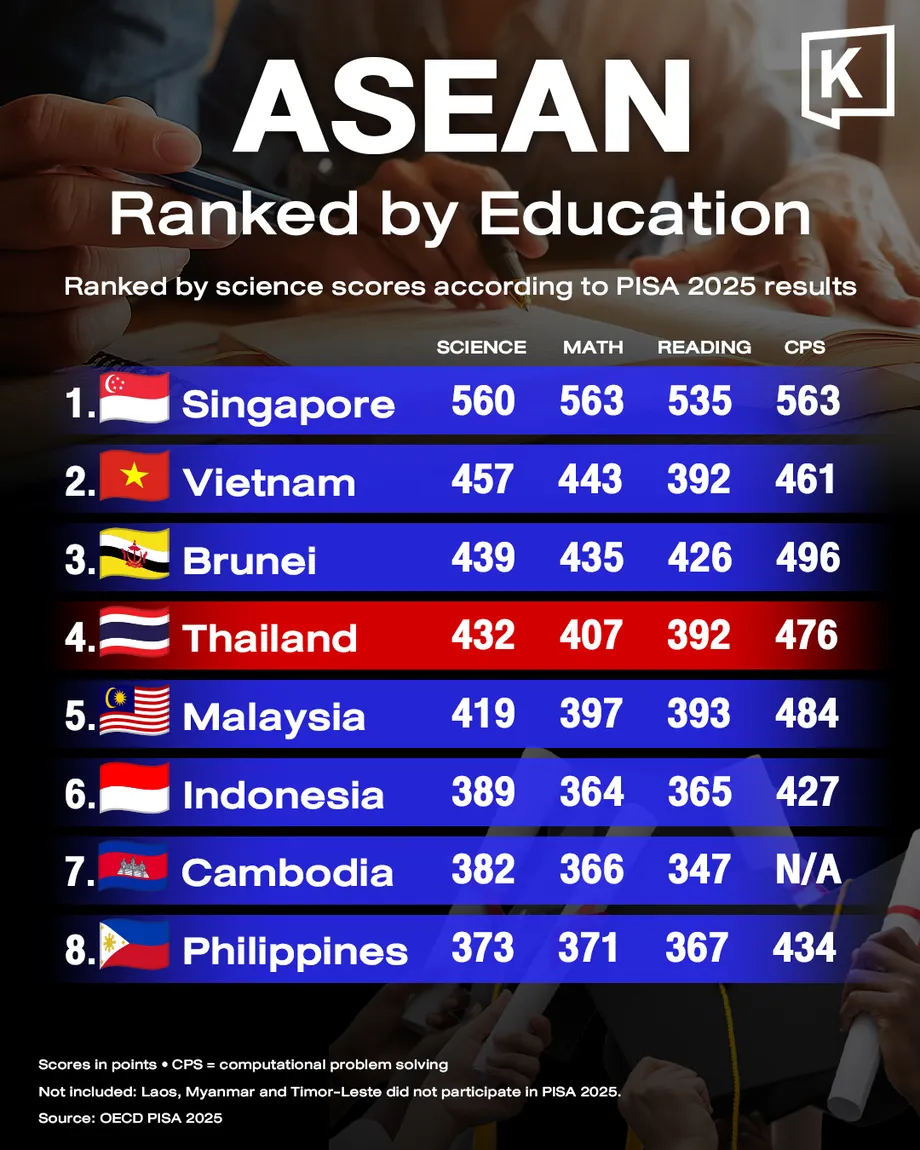
Thailand scored 432 points in science, 407 in mathematics and 392 in reading in PISA 2025, improving in all three subjects from 2022. Yet about 59% of participating Thai students remained below the basic proficiency threshold in mathematics and reading, while 36.9% fell below it in all three subjects.
Contents
- A recovery with millions of learning needs behind it
- What the assessment measured
- Basic skills remain the largest challenge
- Why the longer trend matters
- Poorer students gained faster, but inequality persisted
- Disadvantaged students show what support could unlock
- AI is already part of schoolwork
- Persistence meets shortages in the classroom
- Environmental ambition needs stronger science foundations
- Key Points
The results reveal both a recovery and a difficult task for education policy. Science rose by 23 points, while mathematics and reading each gained 13 points. Among students from disadvantaged households, 17% reached the top quarter of science results within Thailand, exceeding the OECD average of 12%.
The OECD's Thailand country note nevertheless records an incomplete recovery: science and reading results remained below their 2015 levels, and science remained below its 2018 level. Thailand also scored below OECD averages in every core subject and in the new assessment of computational problem solving.
An analysis presented by Thailand's Equitable Education Fund and the OECD puts inequality at the centre of the policy response. Poorer students made larger recent gains than wealthier students, but the difference between their results changed little over the decade from 2015 to 2025.
For families, the practical issue is whether improving national averages will translate into stronger reading, mathematics and science skills in every classroom. The findings show substantial student determination, widespread use of artificial intelligence and strong environmental interests. They also reveal shortages of learning materials and limited confidence that effort can change intelligence or social position.
What the assessment measured
PISA, the OECD's Programme for International Student Assessment, examines how students aged 15 apply learning to practical problems. Rather than testing only whether students remember a lesson, it asks them to interpret information, use evidence and work through unfamiliar situations.
More than 760,000 students participated across 91 countries and economies, representing about 33 million students. In Thailand, 8,547 students at 273 schools took part. They represented approximately 542,700 students, an estimated 69% of the country's population aged 15. The results therefore describe a large student population, while leaving a substantial share of that age group outside the represented population.
Science was the main subject in the 2025 assessment. Thailand placed 53rd among the 91 participants in science. The Equitable Education Fund analysis described an improvement of 11 places, while the reported positions of 58th in 2022 and 53rd in 2025 amount to five places. The OECD does not publish a single combined ranking for all PISA subjects.
The sequence of results helps explain why the latest gains require a longer view:
- 2015: The comparison year for assessing changes in basic proficiency and the science gap between advantaged and disadvantaged students.
- 2018: Thailand's science performance was still above its 2025 level.
- 2022: Scores provided the starting point for the latest increases of 23 points in science and 13 points each in mathematics and reading.
- 2025: All three core subjects improved, although science and reading remained below their 2015 levels.
- 2029: The next assessment identified in the analysis will focus on reading, including media and AI literacy.
Basic skills remain the largest challenge
Only 41% of Thai students reached at least Level 2 in mathematics, compared with 65% across OECD countries. Reading showed the same Thai share, 41%, against an OECD average of 69%. The gaps were therefore 24 percentage points in mathematics and 28 in reading.
Level 2 is PISA's baseline proficiency threshold. In science, students at this level can recognise explanations for familiar events and use data to assess a simple conclusion. Reaching it gives students a foundation for handling more demanding learning and everyday decisions.
Science was stronger: 59% reached the baseline, compared with 74% across OECD countries. However, only 1% reached the highest science levels, against 7% across the OECD. In mathematics, 1% were top performers, compared with 8%. Almost no Thai students reached the highest reading levels, against 6% across the OECD.
Only 0.1% achieved high proficiency across all three subjects, compared with an OECD average of 2.6%. Thailand consequently faces two connected tasks: helping many more students acquire basic skills and giving those ready for advanced work opportunities to progress.
Why the longer trend matters
Thailand's latest improvement followed substantial earlier losses. Compared with 2015, the share performing below Level 2 increased by six percentage points in mathematics and nine points in reading. Science moved in the opposite direction, with the share below the baseline falling by six points.
The difference matters for planning. Science has reduced the proportion of students below the basic threshold over the decade, even though its average score remains below 2015. Reading and mathematics now have larger shares struggling with basic tasks than they did then.
Thailand's science score of 432 also places its performance in a useful regional context. Vietnam scored 13 points higher and Brunei seven points higher, while Malaysia scored 13 points lower. Those differences put the corresponding scores at 445, 439 and 419.
Singapore remained far ahead of the other participating ASEAN countries and ranked second globally, behind B-S-J-Z (China). Three ASEAN members did not participate, so the regional comparison covers only part of Southeast Asia.
Poorer students gained faster, but inequality persisted
Disadvantaged students improved their science scores by 29.36 points between 2022 and 2025, compared with an increase of 18.53 points among the most advantaged. That narrowed the gap by about 11 points during the latest assessment period.
The decade tells a slower story. Between 2015 and 2025, the gap narrowed by only about two points, a change that was not statistically significant. In plain language, the measured difference was too small to confidently identify a lasting change beyond the uncertainty involved in estimating results from a sample.
The OECD recorded a science gap of 55 points between students in the most advantaged quarter and those in the most disadvantaged quarter. That was smaller than the OECD average gap of 85 points. Socioeconomic status accounted for 7% of variation in Thai science performance, compared with 12% across OECD countries.
The Equitable Education Fund analysis interprets the recent narrowing primarily as recovery from the disruption associated with COVID-19. The OECD also found no statistically significant change between 2022 and 2025 in the gap between the highest and lowest scoring 10% in any of the three core subjects. Household advantage and position in the score distribution measure different things, but both comparisons help show where improvement is reaching students.
Disadvantaged students show what support could unlock
Some 17% of disadvantaged Thai students reached the top quarter of science results within their own country, up from 15% in 2022 and above the OECD average of 12%. PISA describes these students as academically resilient because they achieve strong results despite difficult economic circumstances.
The comparison is based on performance within each country. For Thailand, it identifies students whose science achievement stands out nationally even though their households have fewer resources. Their share increased by two percentage points from 2022 and exceeded the OECD average by five points.
More than 85% of students from poor households wanted to reach a higher level of education and employment than their parents. Among academically resilient students, that share exceeded 90%, according to the Equitable Education Fund analysis.
Only 38% of Thai students, however, believed they could change their social status. Ambition and confidence in opportunity are different: a student can want a better job while doubting that the route to it is open. Helping disadvantaged students complete education and enter better employment could turn their demonstrated ability into greater household security and help reduce poverty across generations.
AI is already part of schoolwork
Thai students scored 476 in computational problem solving, compared with an OECD average of 500, and placed 40th among 91 countries and economies. The assessment examined how students use digital tools to model problems, run experiments, analyse data and build or debug digital products. Debugging means finding and correcting mistakes.
AI use was widespread. The Equitable Education Fund analysis put the share using AI for assigned work at 95.5%. The OECD country note found that only about 4% never or almost never used AI chatbots for the schoolwork tasks examined.
Frequency varied by activity. Some 51% used chatbots to help them learn at least weekly, compared with 46% across the OECD. In Thailand, 41% used them for preliminary research, 42% for summarising texts and 41% for drafting assignments. The corresponding OECD figures were 31%, 30% and 29%.
Thai students also reported 2.2 hours a day using digital devices at school for learning, compared with 1.7 hours across the OECD, alongside 1.5 hours for leisure, compared with 1.1 hours. Schools therefore face a practical teaching task: connecting frequent technology use with reading, reasoning and checking information. The 2029 emphasis on reading, media and AI literacy makes those skills an immediate curriculum concern.
Persistence meets shortages in the classroom
Eighty one percent of Thai students said they made extra effort when work became difficult, compared with 60% across OECD countries. Thai students also scored above the OECD average in seeking help and setting goals. Nine in ten said their science teacher took an interest in every student's learning.
Only 36%, however, believed intelligence could develop through work, effort and feedback, compared with 69% across the OECD. This belief is often called a growth mindset. The contrast suggests that many students report working hard while remaining uncertain that their abilities can improve.
Nearly four in ten students attended schools where principals said inadequate learning materials hindered teaching. Thailand also scored below the OECD average for students' sense of belonging at school. Encouragement from teachers therefore sits alongside gaps in resources and in how connected students feel to their schools.
The policy priorities identified in the Equitable Education Fund analysis address both conditions: allocate budgets according to need, continue developing teachers, strengthen support from families and communities, and provide safe learning environments. For students, those priorities mean access to suitable materials, help when they struggle and classrooms where asking questions feels possible. No detailed funding timetable was given.
Environmental ambition needs stronger science foundations
Environmental science offers a particularly clear example of the gap between interest and knowledge. In Thailand, 56% reached baseline proficiency in this area, compared with 74% across OECD countries, a difference of 18 percentage points.
Students nevertheless expressed strong confidence in environmental action. Some 84% believed they could positively affect the environment, 90% believed collective action could address environmental problems, and 81% said they knew how to work with others to help. The corresponding OECD averages were 81%, 82% and 68%.
Future employment was part of that interest: 84% wanted to contribute to environmental protection through their jobs, compared with 62% across the OECD. Students also reported everyday engagement. Some 77% discussed environmental impacts with friends and family, against 56% across the OECD, while 80% considered product sustainability when buying, compared with 54%.
Those interests give teachers concrete subjects for developing scientific reasoning. Evaluating an environmental claim, interpreting measurements or comparing products requires the same ability to understand evidence that PISA tests. Linking such interests to stronger reading and science instruction would connect student motivation with the basic skills many still need.
Key Points
- Thailand's scores rose to 432 in science, 407 in mathematics and 392 in reading, but remained below OECD averages.
- About 59% were below baseline proficiency in mathematics and reading; 36.9% were below it in all three core subjects.
- Poorer students improved faster after 2022, while the science gap between advantaged and disadvantaged students changed little over the decade.
- Seventeen percent of disadvantaged students reached Thailand's top quarter in science, above the OECD average of 12%.
- AI use was widespread, while computational problem solving averaged 476 points against the OECD's 500.
- Resource shortages, weak confidence in changing social position and gaps in basic skills remain priorities alongside teacher support and student determination.
- PISA 2029 will put reading, media literacy and AI literacy in focus.