Five Days of Police Custody as Fraud Inquiry Widens
An Islamabad court has granted police five days of custody of the main suspect in an alleged Rs9.3 million education and visa fraud linked to the death of Laiba Ijaz, a physics gold medallist whose family sold land and pawned jewellery to finance her plans to study in the United States.
Contents
- Five Days of Police Custody as Fraud Inquiry Widens
- A Science Career Backed by a Family's Savings
- How Claims of Official Status Built Trust
- The Different Accounts of the Money
- Documents That Allegedly Failed Verification
- Repeated Delays and an October 12 Demand
- Arrests, Digital Evidence and Separate Cases
- What Ministers and the Senate Are Demanding
- A Wider Fraud Problem, Without a Proven Link
- Key Points
Judicial Magistrate Zunaira Zafar approved the remand after police requested 10 days, according to an account of the October 12, 2026 hearing. The Federal Investigation Agency (FIA) has registered a separate case over allegedly fabricated scholarship letters, university admission offers and payment receipts. A Senate committee has also called a meeting for October 15 to demand answers from police, federal investigators and education authorities.
Ijaz, from Sargodha in Punjab, was found dead near the weekly market in Islamabad's G-10 sector. Most accounts place her death on October 9. Police are investigating a suspected suicide, but the formal autopsy findings were still awaited in reports describing the initial investigation. The circumstances of her death and the alleged fraud remain matters for investigators and the courts.
The main suspect is identified as Muhammad Nauman, with spellings including Noman and Nouman appearing in accounts of the proceedings. FIA Director General Usman Anwar confirmed his arrest on October 11. Later reports describe the arrests of two women as well, although accounts differ over their identities and whether one name was an alias.
The case concerns more than a promised university place. Investigators are examining allegations of impersonation, repeated demands for money, false financial records and digital communications that persuaded the family to trust arrangements they later found could not be verified.
A Science Career Backed by a Family's Savings
Ijaz studied physics at the International Islamic University Islamabad and earned a gold medal. Her family said she wanted to pursue further education in the United States and become a scientist. Relatives also said she had received a scholarship opportunity in Saudi Arabia but chose to continue pursuing her American study plans.
Accounts differ on her age and completed qualification. Several describe her as 20 and a recent BS graduate, while others give her age as 24. Her father's account describes a master's degree in physics. These details have not been reconciled publicly, although the reports consistently identify her university and academic distinction.
Her father, Mohammad Aijaz, supported the household by selling milk and yoghurt in Islamabad. Relatives said he had done that work since 1994 and had made his daughters' education a priority despite his own limited schooling. Ijaz was described as the youngest of seven children. Her eldest sister had studied in China on a scholarship and later worked as a translator in Lahore.
To pay for the proposed overseas education arrangements, her father sold a plot intended for a family home. Her mother pledged jewellery to raise further funds. One family account identifies Rs2.1 million paid in cash after the land sale. The family's losses therefore involved assets accumulated for housing and financial security, rather than money set aside solely for an application.
How Claims of Official Status Built Trust
The FIA's initial account said the suspect was not a registered visa agent and gained the family's confidence by misrepresenting his identity and employment. Investigators described claims that he worked as an accountant at the Supreme Court of Pakistan or as an officer of a government institution. Ijaz's father said the man introduced himself as a Supreme Court registrar.
These are accounts of what the suspect allegedly claimed, not evidence that he held any of those positions. The family also alleged that he took money to obtain a Supreme Court job for Ijaz's brother, extending the relationship beyond overseas education.
The father said the dealings continued for approximately seven months. Accounts of the initial contact differ: some describe a search for an education consultant, while others say Ijaz met Nauman during a job interview in Islamabad's Blue Area. A later investigative account alleges he contacted her through a friend in February and impersonated that friend's brother, who lived in the United States.
FIA Director General Usman Anwar described the case as an impersonation scam. The alleged deception involved a supposed American contact who could obtain scholarship and sponsorship documents. Her maternal uncle, lawyer Amjad Ur Rehman, said the family was told a woman named Aiza could help arrange those papers.
The Different Accounts of the Money
The FIA's registered case puts the alleged fraud at Rs9.3 million, also expressed as 93 lakh Pakistani rupees. A lakh means 100,000. Its preliminary breakdown says Rs2.9 million passed through Ijaz's bank account and the balance was paid in cash.
On that breakdown, the cash component would be Rs6.4 million. Bank transfers would represent about 31% of the total and cash about 69%. That distinction matters to the evidence: bank records can establish transfers, while cash payments may require witnesses, receipts and other supporting records.
Earlier figures differ. An initial FIA statement described Rs7.2 million for admission to Harvard and Rs550,000 for employment for her brother, a combined Rs7.75 million. FIA Director Shehzad Nadeem Bukhari separately cited Rs7.2 million for admission and Rs500,000 for the job. Another family account put the loss at approximately Rs8.7 million.
Her father described demands of Rs2.2 million for admission and Rs3 million for preparing a bank statement, followed by a further Rs2.2 million demand sent to his daughter. The public accounts do not establish how all these amounts fit together, whether the employment payment is included in the Rs9.3 million total, or whether the final demand was paid. They should not be added together as if they were separate confirmed losses.
The father's statement also identifies a Rs2.1 million cash payment in G-10 and Rs2.9 million transferred by his daughter. The FIA complaint describes further cash payments at a shop in Gulistan Plaza, G-10 Markaz. Investigators have obtained bank records to examine the payment trail.
Documents That Allegedly Failed Verification
The FIA said fabricated scholarship award letters, university admission offers and fee receipts were used to deceive Ijaz and her family. One account describes a document claiming that a $7,500 fee for a master's programme in physics had been paid. Her father separately alleged that the suspect produced a false receipt showing a $20,000 transfer into an account for bank statement requirements.
The $7,500 and $20,000 figures are claims allegedly made in documents. They are not verified tuition charges, university payments or funds received by Ijaz. Her father also questioned bank account information and travel tickets supplied during the process.
Amjad Ur Rehman said relatives contacted Harvard directly and made inquiries through contacts at the US Embassy in Islamabad. Neither institution could verify the documents, he said. Other accounts say the papers failed verification when Ijaz attended a visa interview. No direct public statement from Harvard or the embassy is included in these accounts, so the verification findings remain attributed to relatives and investigators.
The allegations do not establish that Ijaz had genuine admission to Harvard or an authentic scholarship. They concern the use of the university's name to support promises of admission, financial support and a US visa.
Repeated Delays and an October 12 Demand
Ijaz's brother-in-law, Zaid bin Afzal, said Nauman repeatedly postponed her purported visa interviews. On three or four occasions, he allegedly contacted her the night before an appointment to say it had been cancelled. Afzal said the suspect eventually claimed another interview would take place on October 12 and demanded a further Rs2.2 million beforehand.
Her father described a message demanding the same amount and offering replacement documents. He said the family faced five to six days of severe distress after the suspect stopped answering calls. Relatives linked that distress to their discovery of the alleged deception, but the medical and legal findings surrounding her death were still pending.
The reported sequence includes several dates that require careful separation:
- February: A later investigative account places the suspect's initial contact with Ijaz in this month.
- October 9: Most accounts say Ijaz was found dead near the G-10 weekly market.
- October 10: Reports describe the registration of criminal cases and a visit by Interior Minister Mohsin Naqvi and Minister of State for Interior Talal Chaudhry.
- October 11: FIA Director General Usman Anwar confirmed the main suspect's arrest.
- October 12, 2026: A court report records the hearing that resulted in five days of police remand. October 12 was also the date allegedly given for another visa interview.
- October 15: The Senate Standing Committee on Human Rights called a meeting to examine the case.
Some timing details conflict. Bukhari's account says Ijaz discovered the false registration certificate two days before a planned October 12 announcement to her family, which would place that discovery on October 10, after the widely reported death date. An October 11 report also describes her being found dead a day earlier. Those discrepancies remain unresolved.
Arrests, Digital Evidence and Separate Cases
Nauman was reportedly arrested during a raid in Islamabad's H-13 sector, where investigators said he had been staying in a rented room. Later accounts identify the arrested women as Fatima Sarwar and Aiza. Another account of the FIA case names Fatima Sarwar alias Aiza, making it unclear whether that reference concerns one woman or two distinct people.
Police have sent a phone recovered from the suspect for forensic examination and obtained bank records. Investigative accounts describe fake email addresses, assumed identities and recovered chats. One alleges that artificial intelligence was used to prepare false student visa documents. That allegation has not been supported by a published forensic finding.
A later report says Nauman confessed during interrogation. A reported police confession is not a court finding of guilt. Investigators also reportedly found phone material suggesting other fraud schemes and the blackmail of women. Those separate allegations remain under investigation.
Islamabad police registered a case at Ramna Police Station under Sections 322 and 34 of the Pakistan Penal Code following the father's complaint. Section 322 concerns punishment for causing death without an intention to kill through an unlawful act. Section 34 addresses acts carried out by several people with a common intention. The sections recorded in a complaint do not establish guilt.
The FIA registered its separate case following a complaint from Amjad Ur Rehman. Reports describe allegations of cheating, dishonestly inducing the delivery of property and abetment, alongside provisions of the Emigration Ordinance. The five days of physical remand allow police custody for further investigation; they are not a sentence or a verdict.
What Ministers and the Senate Are Demanding
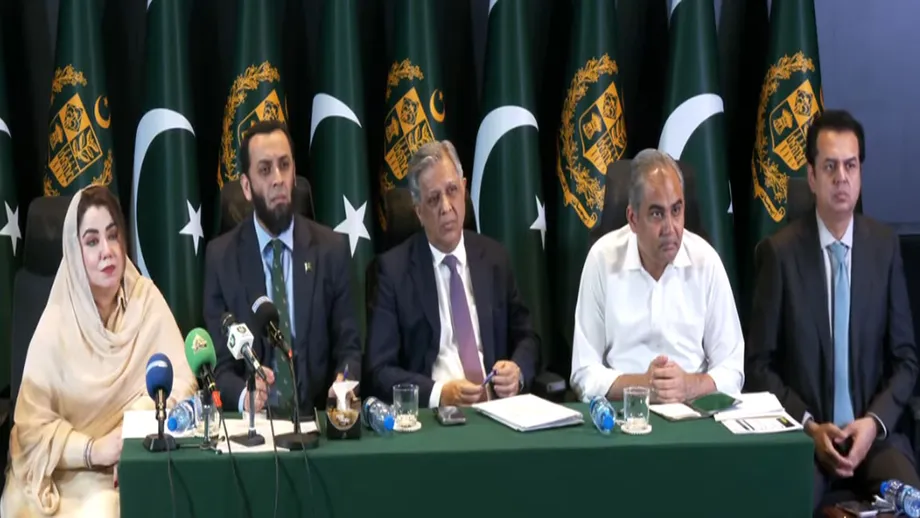
Prime Minister Shehbaz Sharif directed Islamabad's inspector general of police and chief commissioner to take the suspect into custody, according to statements from the Prime Minister's Office. Talal Chaudhry also directed the FIA to act. Interior Minister Mohsin Naqvi said recovering the family's money was a priority alongside identifying those responsible.
Speaking during his visit to the bereaved family, Naqvi described the investigation as a measure of the authorities' response to fraud:
This is a test case for us.
He also made a personal commitment to follow the proceedings:
I can say that I will personally pursue their case.
The Senate Standing Committee on Human Rights, chaired by Senator Samina Mumtaz Zehri, called an October 15 meeting and directed the Islamabad police chief, FIA director general and Higher Education Commission chairman to attend with reports. The committee sought details of the cases, arrests and investigative progress.
It also asked about steps to cancel the licence of the consultant who issued the alleged false certificate. That request needs to be considered alongside the FIA's earlier statement that the suspect was not a registered visa agent. The accounts do not establish what licence, if any, he held.
Police secured documents and forensic samples, while the formal autopsy report remained pending in the initial accounts. When asked whether investigators were considering murder, Naqvi declined to comment and said police should be allowed to establish the facts. No completed money recovery or final judicial finding is reported.
A Wider Fraud Problem, Without a Proven Link
The case has drawn attention to other alleged document fraud, but those investigations should not be treated as part of the same operation without evidence. In a separate inquiry, the FIA reportedly arrested 22 people, including six Ministry of Foreign Affairs officials, after raids on education consultancy and courier offices in Islamabad.
That investigation concerned allegedly counterfeit apostille stickers, forged stamps and payments for expedited services. An apostille is a certificate used to authenticate a public document for recognition abroad; it does not itself prove admission to a university or eligibility for a visa. No established connection between those arrests and Ijaz's case is reported.
Separate allegations put unofficial collections for processing about 800,000 documents over one year at Rs12 billion. These figures are not a verified audit total and do not measure the loss in Ijaz's case.
Naqvi also described staffing shortages at the National Cyber Crime Investigation Agency, saying it had 61 personnel across Punjab while receiving approximately 3,000 complaints daily. Those figures concern a separate agency, not the FIA team handling this fraud case. They nevertheless provide concrete context for his promise that complainants should receive responses and updates, rather than merely have complaints registered.
For Ijaz's family, the immediate issues are specific: establishing who received the money, determining whether other people were involved, testing the documents and digital evidence, and recovering what can be recovered. Her father urged students and parents to verify agents, admission procedures and paperwork directly with the institutions concerned. That appeal does not shift responsibility for the alleged deception away from those accused of carrying it out.
Key Points
- Laiba Ijaz, a physics gold medallist from the International Islamic University Islamabad, was found dead near Islamabad's G-10 weekly market.
- The FIA case alleges Rs9.3 million in fraud, including Rs2.9 million transferred through her account and the balance paid in cash.
- The family sold land and pawned jewellery to fund promised US education arrangements.
- The main suspect was arrested and placed in police custody for five days. Later reports describe two further arrests.
- Investigators are examining allegedly false admission letters, scholarship documents, payment receipts and digital communications.
- Reports differ on Ijaz's age, qualification, some payment figures, dates and the identities of alleged accomplices.
- The Senate human rights committee called an October 15 meeting. Final medical findings, court determinations and money recovery were not established in the reported proceedings.