A growing audience for an AI system built around plugins
DeepSeek Harness reached 1.54 million daily active users on November 4, 2026, with those users consuming about 92 trillion tokens a day, according to figures released by its development team on the evening of November 5. The count covers people accessing the open source agent runtime through DeepSeek's official application programming interface, or API.
Contents
- A growing audience for an AI system built around plugins
- How quickly has usage grown?
- What does Harness actually do?
- Why the plugin marketplace matters
- Compatibility and security are immediate priorities
- The larger ambition: agents that keep working across sessions
- Who is building it, and why open source?
- What changes for users and developers?
- Key Points
The announcement puts a number on the rapid growth of a product whose first version launched on August 13. Harness helps an artificial intelligence model operate as an agent: software that can use tools, manage tasks and carry work through several steps, rather than simply produce an answer in a chat window.
DeepSeek is now preparing an official plugin marketplace and a support program for plugin creators. Around 35,000 plugins from outside developers have appeared since launch, and about 60% of active users have created or installed at least one, the team said.
The next phase will focus on making that expanding collection easier to use and maintain. DeepSeek plans to improve the stability and compatibility of its plugin API, strengthen security mechanisms and give authors a central place to publish their work. The team gave no launch date for either the marketplace or the creator support program.
How quickly has usage grown?
DeepSeek's September 30 figure was 271,000 daily active users, measured as an average over seven days. The figure reached 429,000 on October 7, before climbing to 1.54 million for November 4.
The November count is about 5.7 times the September figure, a numerical increase of roughly 1.27 million. The comparison uses different measurement periods: September's number smooths activity across a week, while November's measures a single day. A matching weekly average would give a more consistent picture of sustained usage.
DeepSeek also limits the count to users of its official API, the connection through which software sends requests to the company's models. People using Harness through other model connections fall outside that stated scope.
The 92 trillion tokens processed daily describe the volume of model activity. Tokens are small pieces of text or other encoded content that models receive and generate. A token may be a word, part of a word or a punctuation mark. An agent carrying out a complicated task can make repeated model requests, with each request adding to that total.
For readers following the product's development, the main dates show how closely the growth announcement follows its initial releases:
- March 2026: DeepSeek formed its Agent Harness team.
- August 13: Harness v0.1 launched.
- September 29: The desktop version launched.
- September 30: Daily active users averaged 271,000 over seven days.
- October 7: The reported daily active user figure reached 429,000.
- October 31: The team published its Super-agent design article.
- November 4: Daily active users reached 1.54 million within the official API count.
- November 5: The team disclosed the usage figures and its plugin ecosystem plans.
What does Harness actually do?
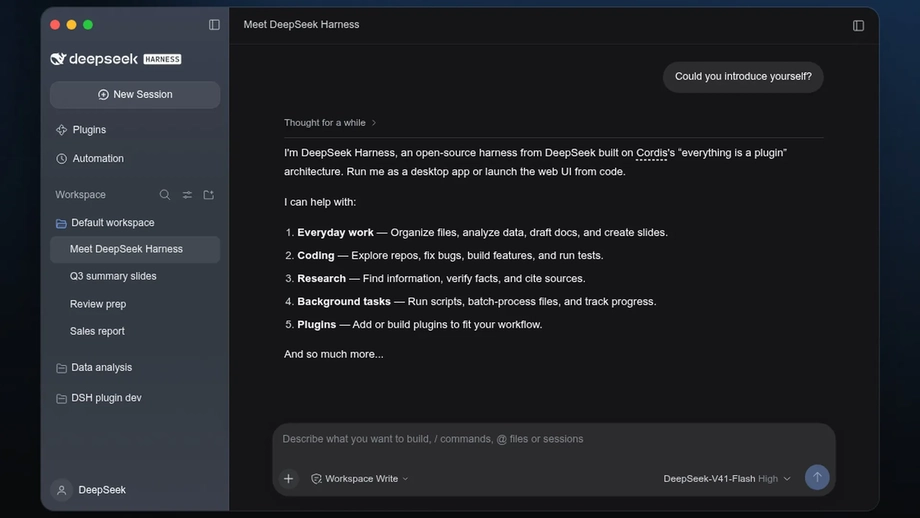
A large language model supplies the reasoning and generated text or code behind an AI application. A harness supplies the surrounding software that organizes tools, sessions, storage and execution. It is the operating framework that helps turn a model's responses into a sequence of actions.
For example, an agent working on a software task may need to inspect files, call a tool, retain the result and decide what to do next. Harness manages the connections and working state around those steps. Its design matters because useful agent behavior depends on more than the quality of an individual model response.
DeepSeek organizes this framework around plugins. Models, tools, skills, sessions, sandboxes, storage, execution loops, scheduling and the user interface can all be assembled from components that developers can replace or combine. A sandbox is a restricted environment intended to contain what running software can access.
That approach gives developers control over several layers of an application. A plugin can provide a tool or change how work is managed; another can supply storage or alter the interface. DeepSeek's product is therefore both an application people use and a framework on which others can build.
Why the plugin marketplace matters
About 35,000 plugins is a substantial catalog for a product less than three months old. The team's estimate that around 60% of active users have made or installed a plugin also suggests that extensions are part of everyday use for a large share of its audience.
Developers have so far relied on community indexes and repositories to distribute and discover plugins. An official marketplace would create a central distribution point, bringing publication and discovery into a more organized channel.
DeepSeek says the marketplace should make it easier for authors to publish and for users to find the components they need. That addresses a practical problem in an expanding software ecosystem: a useful extension has limited reach when potential users cannot easily locate it.
The planned creator support program would offer token incentives, technical exchanges and featured placement. Tokens are also the unit used to measure model processing, so incentives tied to tokens could help creators with the model usage involved in developing or operating their work. DeepSeek said the program's details would be shaped by community needs and feedback.
Startups and companies have also been invited to bring products, services and specialist capabilities into Harness as plugins and explore partnerships. That opens another route for the catalog to grow, alongside extensions produced by individual developers.
Compatibility and security are immediate priorities
DeepSeek's promise to stabilize the plugin API addresses a concern familiar to software developers. An API defines how one component communicates with another. When that interface changes, a plugin may need an update before it works with a newer release.
Harness has already shown how ambitious extension support can meet practical limits. Its October 3 release, v0.2.1-alpha.1, introduced an experimental bridge for extensions written for Anthropic's Claude Code. The earlier compatibility experiment had three runnable examples, Token Weather, Blast Radius and Replay Theater, while four other mods lacked required events, interfaces or display capabilities.
The bridge also ran those mods without a sandbox. That detail makes the team's new commitment to stronger plugin security especially relevant: extensions can affect an agent's tools, working information and behavior, so the permissions and execution environment around them matter to users.
DeepSeek's stated priorities connect two needs that grow with the catalog. Authors need interfaces that remain dependable across releases, and users need security mechanisms suited to software assembled from many independently developed parts.
The larger ambition: agents that keep working across sessions
DeepSeek's October 31 technical article, titled Super-agent Design Exploration: Toward More Autonomous Agent Systems, sets out the broader direction behind Harness. The team wants agents to retain context across sessions and advance several complicated tasks at once without those tasks interfering with each other.
The problem begins with the way many current agents are organized around a manually started conversation. When work expands into several tasks or involves a team, the person using the agent must spend more attention managing sessions and keeping information aligned.
DeepSeek calls its proposed continuous agent and supporting architecture a Super-agent. The design combines two architectural layers, operation driven by events, asynchronous interaction across multiple channels, separation of computation from storage and an external watchdog.
In plain language, an event can trigger work when something happens, rather than requiring a person to start every step. Asynchronous interaction allows different activities to proceed without all of them waiting for the same exchange to finish. Separating computation from storage keeps the processing of work distinct from the information it needs to retain.
The external watchdog provides a monitoring element outside the agent's immediate execution flow. Together, these design choices aim to move more session management and context coordination into the software, leaving people to make decisions and judge completed work.
Who is building it, and why open source?
DeepSeek formed its Agent Harness team in March 2026. Its lead, Cui Tianyi, joined the company that month after nine years at the quantitative trading firm Jane Street. Cui studied computer science at Zhejiang University and holds six gold medals from ACM Asia Regional programming contests.
The team's short history places the August launch and November usage figures within an unusually compressed development period. Less than eight months separate the team's formation from the disclosure of 1.54 million daily active users.
DeepSeek research engineer Gao Xi addressed the company's reasons for releasing technology openly during the artificial intelligence dialogue at the 2026 World Internet Conference Wuzhen Summit on November 3. Asked why DeepSeek chose open source, Gao gave a brief answer, translated from Chinese:
to bring AGI sooner
AGI means artificial general intelligence, a term used for the goal of systems able to handle a broad range of intellectual tasks. Gao said that when researchers discover cheaper training methods or better model structures, publishing them allows more people to discuss and verify the ideas quickly.
Harness applies that open approach at the application framework level. Outside developers can contribute components, experiment with different arrangements and build services around a shared runtime. The announced marketplace and author program would give that participation a more formal structure.
What changes for users and developers?
Users now face a much larger selection of extensions than at launch. The planned marketplace could simplify finding them, while the promised API and security work addresses whether those extensions remain usable and operate within appropriate limits.
Plugin authors have a different set of immediate concerns: keeping their work compatible, reaching users and covering development activity. DeepSeek's proposed technical exchanges, token incentives and featured placement are aimed at those needs, although the terms are still being shaped.
The November announcement brings those product decisions into focus. DeepSeek has reported rapid growth in both usage and plugin supply. Its next stated work centers on the infrastructure needed to support that activity: dependable interfaces, stronger security and an official distribution channel.
Key Points
- DeepSeek Harness recorded 1.54 million daily active users on November 4, 2026, counting users of DeepSeek's official API.
- The team reported about 92 trillion tokens of daily processing and around 35,000 plugins from outside developers.
- The September 30 user figure was a seven day average of 271,000; the November figure covered one day.
- About 60% of active users had created or installed at least one plugin.
- DeepSeek plans an official plugin marketplace, stronger security mechanisms and a creator support program, with no launch dates announced.
- The team's Super-agent design aims to support continuing work across sessions and several tasks at once.