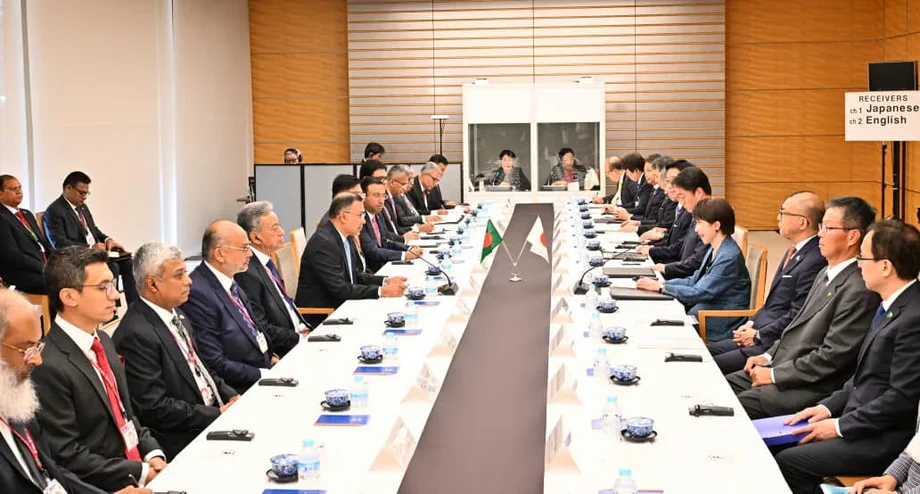
Tokyo talks put investment and employment at the centre
Bangladesh Prime Minister Tarique Rahman invited Japanese investors, businesses and financial institutions to invest in Bangladesh after talks with Japanese Prime Minister Sanae Takaichi in Tokyo on October 27, 2026. Energy, information and communication technology, railways, infrastructure and deep seaports were among the areas where the leaders pledged closer cooperation.
Contents
- Tokyo talks put investment and employment at the centre
- From a formal welcome to agreements
- Turning the trade agreement into business
- Energy, railways and ports form a connected agenda
- Marubeni discussions identify industrial possibilities
- JICA talks focus on projects and skills
- Employment cooperation has a recruitment date
- Proposed cooperation extends beyond large projects
- Political ties support the economic push
- Key Points
Speaking at a joint news conference at the Kantei, the Japanese prime minister's office, Rahman said agreements and memorandums of understanding had been exchanged during his four day visit. He said a joint statement would set out the summit's outcomes and shared priorities. The number, full terms and financial value of the instruments exchanged were not announced in his remarks.
The meeting brought together three connected ambitions for Bangladesh: putting its Economic Partnership Agreement with Japan into practice, securing investment in production and infrastructure, and creating employment supported by better skills and technology.
Rahman, Bangladesh's prime minister since February 17, presented the investment invitation as a way to turn diplomatic ties into economic activity. Addressing Japanese investors, businesspeople and financial institutions, he said:
I sincerely invite Japanese investors, businesspeople and financial institutions to explore the investment opportunities in Bangladesh and be part of our next phase of growth.
His appeal followed meetings with Marubeni Corporation Chairman Masumi Kakinoki and Japan International Cooperation Agency President Akihiko Tanaka. Those discussions identified specific possibilities, including modernising a fertiliser company, exploring another fertiliser factory, accelerating existing development projects and establishing a skills partnership.
From a formal welcome to agreements
Takaichi welcomed Rahman at the Kantei before the summit began at 11:45am local time. A Japanese military contingent presented a guard of honour as the two national anthems played. Rahman inspected the guard, and the leaders introduced their delegations before he signed the visitors' book.
Bangladeshi and Japanese flags lined the approach road to the prime minister's office. The talks covered bilateral relations, trade and investment, cooperation in key sectors, and regional and international issues.
Deputy Press Secretary Shahadat Hossain Shadhin said an official luncheon followed the summit and joint press announcement. Rahman's wife, Dr Zubaida Rahman, also attended. The programme had scheduled the luncheon from 12:30pm to 1:10pm, with welcome remarks and reciprocal toasts by the leaders.
The visit connects several stages of economic diplomacy:
- February 2026: Bangladesh and Japan signed their Economic Partnership Agreement.
- October 17: The countries signed an employment and skills development memorandum, with copies scheduled for exchange during the Tokyo visit.
- October 26: Rahman arrived in Tokyo and met Japanese parliamentary, business and development cooperation leaders.
- October 27: Rahman and Takaichi held their summit, followed by a joint news conference and luncheon.
- October 26 to 29: The visit programme includes a keynote address at the Bangladesh-Japan Economic Forum and meetings with Japanese business leaders.
Turning the trade agreement into business
Foreign Secretary Asad Alam Siam identified effective implementation of the Bangladesh-Japan Economic Partnership Agreement, signed in February, as a central objective of the visit. Bangladesh wants wider access for its products in Japan and stronger connections between businesses in the two countries.
An economic partnership agreement provides a framework for closer commercial relations. For a Bangladeshi producer, the practical goal is to sell more goods in Japan. For a Japanese company considering Bangladesh, the investment discussions concern opportunities to establish or expand operations there.
Bangladesh had set out its investment and loan priorities before the visit, seeking fresh Japanese private investment, lower interest rates on Japanese loans and faster progress on infrastructure projects. The summit's focus on trade, financing and project delivery follows that agenda.
Rahman's planned address to the Bangladesh-Japan Economic Forum gives him another opportunity to bring those priorities to companies. The forum is part of a visit that combines negotiations between governments with direct engagement with businesses expected to make investment decisions.
Energy, railways and ports form a connected agenda
Rahman said the leaders reaffirmed cooperation in energy, information and communication technology, railways, infrastructure, deep seaports and foreign direct investment. Foreign direct investment means money committed by an overseas investor to a business in another country, such as establishing a factory or acquiring a lasting stake in a company.
Bangladesh's investment agenda links production with the services needed to support it. Factories need electricity, while railways and ports provide routes for moving materials and finished products. The summit placed those needs alongside efforts to attract businesses and technology.
Renewable energy, agriculture, science and technology, digital transformation and workforce development also featured in preparations for the talks. Digital transformation means using digital systems to change how businesses or public services operate, rather than simply replacing paper documents with electronic copies.
Rahman described the intended benefits in terms of productive investment, technology transfer and skilled employment. Technology transfer involves sharing equipment, production methods or technical knowledge so that local businesses and workers can use them.
Marubeni discussions identify industrial possibilities
Marubeni Corporation Chairman Masumi Kakinoki met Rahman on the first day of the visit. Their discussions covered trade and investment, implementation of the Economic Partnership Agreement, and potential Japanese investment in information and communication technology, energy and advanced manufacturing.
Karnaphuli Fertilizer Company Limited was a specific focus. Rahman and Kakinoki discussed modernising the company and explored the possibility of establishing a second fertiliser factory in Bangladesh.
The fertiliser discussions give a concrete industrial focus to the wider investment appeal. Fertiliser supplies nutrients used to grow crops, connecting the proposed factory work with agriculture as well as manufacturing. Modernising an existing company and exploring another factory would involve different investment decisions, both of which were on the meeting's agenda.
Advanced manufacturing was another area identified for possible investment. The term refers to production that relies on sophisticated machinery, technology and technical skills. It fits Rahman's stated interest in bringing investment together with knowledge and employment.
JICA talks focus on projects and skills
Japan International Cooperation Agency President Akihiko Tanaka discussed continued Japanese support for infrastructure and economic development with Rahman. Faster implementation of ongoing projects was a priority, alongside proposals for a Bangladesh-Japan Skills Partnership and a Technological Village and Innovation City.
The meeting addressed both existing work and new ideas. Bangladesh sought quicker delivery of projects already under way while presenting proposals intended to support technical capabilities and innovation.
Agricultural modernisation, processing agricultural products, light engineering and energy security also featured in the discussion. Processing agricultural products means turning crops or other farm output into goods that can be stored, transported or sold in another form. Light engineering includes making or repairing machinery, tools and components.
For Bangladesh, those subjects connect infrastructure spending with the productive work it is intended to support. Farms, processing businesses and engineering workshops depend on transport, power and workers able to operate and maintain equipment.
Employment cooperation has a recruitment date
Skills development featured in both the summit preparations and Rahman's meeting with Tanaka. It also follows an employment and skills agreement signed on October 17, under which recruitment of Bangladeshi workers is due to begin on April 1, 2027.
Bangladesh's Ministry of Expatriates' Welfare and Overseas Employment said that memorandum would initially run for five years and automatically extend for another five. Copies were scheduled to be formally exchanged during Rahman's October 26 to 29 visit.
Japan's stated plan covers recruitment of 426,200 foreign workers from 17 countries, including Bangladesh, between April 1, 2027, and March 2029. Bangladesh's share, recruitment charges and detailed application requirements had not been announced. Bangladesh's embassy says more than 55,000 Bangladeshis already work in Japan, including in construction, caregiving, shipbuilding, airport ground handling, garments and agriculture.
Expatriates' Welfare and Overseas Employment Minister Ariful Haque Chowdhury has said workers covered by the agreement would receive legal protection equivalent to that enjoyed by Japanese workers, including safeguards against dismissal because of pregnancy or childbirth. The recruitment timetable gives prospective workers a concrete date alongside the summit's broader commitment to skills and employment.
Proposed cooperation extends beyond large projects
Siam said before the summit that memorandums under discussion covered agriculture, fisheries, human resource and skills development, domestic aviation, trade, environmental conservation and modernisation of local government.
The list extends the visit's agenda beyond factories and major transport infrastructure. Agriculture and fisheries concern production, while aviation, environmental conservation and local government involve services and public administration.
Rahman's announcement that several instruments had been exchanged marked a step beyond the negotiations described before his arrival. He said the joint statement would explain the outcomes and priorities agreed by the two governments.
Finance and Planning Minister Amir Khosru Mahmud Chowdhury and Bangladesh Bank Governor Md Mostaqur Rahman accompanied the prime minister. The delegation also included Finance and Planning Adviser Rashed Al Mahmud Titumir, State Minister for Foreign Affairs Humaiun Kobir, State Minister for Power, Energy and Mineral Resources Aninda Islam Amit, and technology adviser Rehan Asif Asad.
Investment authority Chairman Ashik Chowdhury, Foreign Secretary Asad Alam Siam and officials responsible for economic relations and overseas employment were also present. Political representatives travelling with Rahman included Hefazat-e-Islam and Nezame Islam Party leader Azizul Haque Islamabadi and Am Janatar Dal General Secretary Md Tarek Rahman.
Political ties support the economic push
Former Japanese prime minister Taro Aso led a parliamentary delegation that met Rahman on October 26. Rahman recalled their meeting in Japan in 2006 and acknowledged Aso's contribution to relations between the countries. State Minister Humaiun Kobir said Rahman invited Aso to visit Bangladesh again.
At the joint news conference, Rahman recalled Japan's early recognition of Bangladesh after independence in 1971 and its role as a development partner for more than five decades. Bangladesh's prime minister described the relationship in personal as well as diplomatic terms:
Japan holds a special place in the hearts of the people of Bangladesh.
Rahman arrived at Narita International Airport on October 26 on a Biman Bangladesh Airlines flight and was received by Japanese State Minister for Foreign Affairs Yasutaka Nakasone. Tokyo was his third state visit abroad since taking office on February 17, following visits to Malaysia and China. He also travelled to New York in September for the 81st session of the United Nations General Assembly.
The Tokyo meetings brought political contacts, development cooperation and private business into the same programme. Bangladesh's stated aims remain concrete: more investment, better access to Japan's market, faster project delivery and employment supported by stronger skills.
Key Points
- Rahman and Takaichi held summit talks in Tokyo on October 27, focusing on trade, investment and cooperation.
- Rahman said agreements and memorandums had been exchanged, with details to follow in a joint statement.
- Energy, technology, railways, infrastructure and deep seaports were named as cooperation priorities.
- Marubeni discussions covered fertiliser production and possible investment in technology, energy and manufacturing.
- JICA talks addressed faster project implementation, skills development and proposed technology and innovation facilities.
- Recruitment under the October 17 employment and skills agreement is scheduled to begin on April 1, 2027.